What Is a Bakery Tray Cleaning Brush?
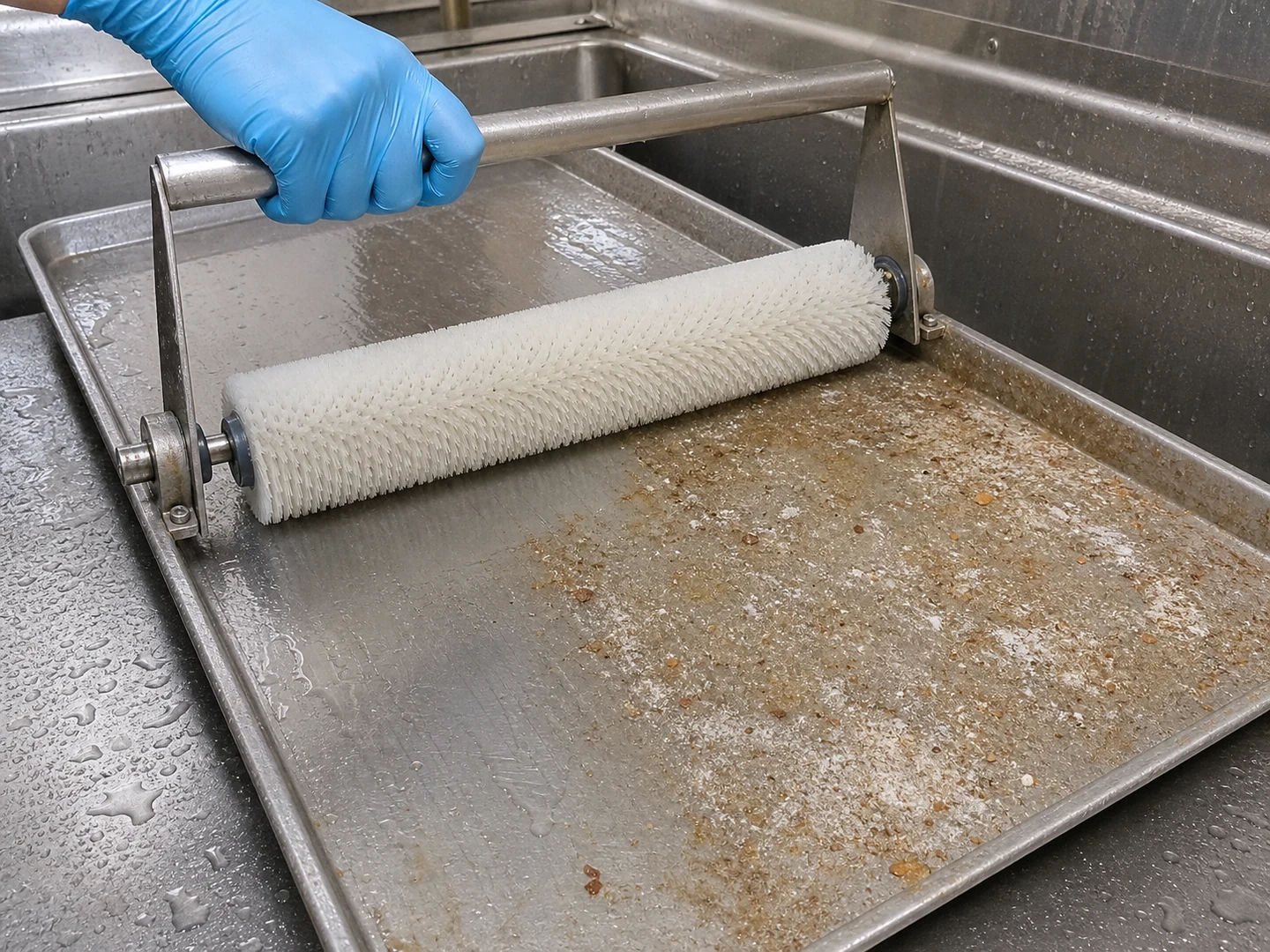
A bakery tray cleaning brush is a bristled tool, typically with a handle or mounting interface, used to scrub flat or contoured surfaces in food processing environments. The bristles (filaments) are engineered to dislodge adhered residues without damaging tray coatings or roughening metal surfaces. In wet food zones, the brush must resist water absorption, chemical attack, and bacterial growth while maintaining its stiffness and filament retention through repeated use.
Common Types and Material Options
For food-manufacturing equipment and wet food zones, eCFR — 21 CFR Part 117 Human Food CGMP and Preventive Controls is the production-side CGMP and preventive-controls reference.
When the article mentions sanitizing food-contact articles, eCFR — 21 CFR 178.1010 Sanitizing Solutions provides the regulatory context for sanitizing solutions.
For food-service sanitation language, the FDA — Food Code is the reference point for food safety terminology rather than a brush manufacturer’s preference.
For the material or regulatory boundary in this section, the supporting reference is eCFR — 21 CFR 177.1500 Nylon Resins.
For the material or regulatory boundary in this section, the supporting reference is eCFR — 21 CFR 177.1520 Olefin Polymers.
For the material or regulatory boundary in this section, the supporting reference is eCFR — 21 CFR 177.1630 Polyethylene Phthalate Polymers.
Bakery tray cleaning brushes vary by filament material, stiffness, mounting style, and size. The most common filament options include:
- Polypropylene (PP): Medium stiffness, good chemical resistance, widely used for general cleaning of plastic and aluminum trays. Resists most acids, alkalis, and solvents.
- Polyester (PET): Higher stiffness and temperature resistance than polypropylene, suitable for warm washdowns up to about 120°C continuous. Excellent in wet environments due to low moisture absorption.
- Nylon: Available in multiple grades (e.g., 6, 6.6, 6.12), nylon bristles are tough, resilient, and perform well with chemical cleaners. They can absorb moisture, so stabilized or heat-set nylon is preferred for constant wet use.
- Stainless Steel Wire: For extreme residues like caramelized sugar or carbon on stainless steel trays. Not recommended for coated or soft metal surfaces. Must be carefully selected to avoid rust in wet zones—typically type 304 or 316 wire.
- Combinations: Abrasive-impregnated nylon or mixed filament brushes offer a balance of scrubbing power and surface protection.
Bakery Tray Cleaning Brush Options Comparison Table
| Feature | Polypropylene | Polyester | Nylon (Stabilized) | Stainless Steel Wire |
|---|---|---|---|---|
| Typical Stiffness | Medium | Medium-High | Medium to High | Very High |
| Wet Zone Compatibility | Excellent (low moisture absorption) | Excellent | Good if heat-stabilized | Good (use type 316 in high-humidity) |
| Common Chemical Resistance | Resists most chemicals | Resists many chemicals; avoid strong bases | Resists fuels, weak acids/alkalis; affected by strong acids | Resists most chemicals; avoid chlorides |
| Temperature Range | Up to 90°C continuous | Up to 120°C continuous | Up to 100°C (stabilized) | Up to 260°C+ |
| Surface Suitability | Plastic, aluminum, coated trays | Stainless steel, some plastics | Stainless steel, aluminum (caution with coatings) | Bare stainless steel only |
| Typical Mounting | Handle, block, strip | Handle, block, strip | Handle, twisted-in-wire, strip | Twisted-in-wire, disc, block |
| Food Contact Consideration | FDA-compliant filaments available | FDA-compliant filaments available | FDA-compliant filaments available | 316 grade acceptable; avoid contamination from wire fragments |
How to Choose a Bakery Tray Cleaning Brush for Wet Food Zones
Selecting the right brush requires evaluating several practical factors:
- Residue Type: Soft, sticky dough requires different bristle stiffness than hard, caramelized sugar. For baked-on carbon, a wire brush may be needed; for light flour dust, a soft polypropylene brush suffices.
- Surface Sensitivity: Aluminum trays with non-stick coatings demand gentle, non-metallic filaments to preserve the coating. Stainless steel trays can handle more aggressive cleaning.
- Equipment Interface: Determine whether the brush will be used manually or mounted on a machine. Machine-mounted brushes need precise dimensions, arbor holes, or shank sizes to fit the cleaning station.
- Wet and Chemical Exposure: In zones with continuous washdowns and foaming cleaners, choose filaments with zero water absorption and proven chemical resistance (e.g., polyester or polypropylene). Avoid nylon unless stabilized, as it can swell and soften.
- Hygiene Expectations: Brushes in direct food contact areas must use FDA-listed materials and be easily sanitized. Consider brush design with minimal crevices where bacteria can hide.
- Maintenance Frequency: Brushes that will run continuously on automated lines must withstand prolonged wet cycles. A more durable filament (e.g., polyester) may justify higher upfront cost by reducing changeover frequency.
- Custom Size Requirements: Odd tray shapes or tight spaces may demand a custom brush length, width, or filament pattern. Suppliers can provide CAD drawings for review before production.
Operating Conditions That Affect Brush Performance
Even the best brush choice can fail if operating conditions are not considered:
- Temperature: Washdown water at 80°C will dramatically soften nylon if not properly stabilized. Check the brush’s rated temperature against your CIP (Clean-in-Place) or manual wash water temperature.
- Chemical Concentration: High pH cleaners (caustic soda) can degrade polyester over time. Verify compatibility with the sanitation chemical SDS (Safety Data Sheet).
- Pressure and Speed: Machine-mounted brushes spinning at high RPMs generate heat and centrifugal stress, which can cause filament loss. The brush core must be securely bonded to handle centrifugal forces.
- Drying and Storage: Brushes left soaking in sanitizer solution between shifts can harbor biofilm. They should be cleaned, rinsed, and hung to dry.
Common Mistakes When Selecting a Bakery Tray Cleaning Brush
- Choosing by Stiffness Alone: A stiffer brush does not always clean better; it may scratch coatings or embed debris into the tray surface.
- Ignoring Chemical Compatibility: Using a nylon brush with a strong alkaline cleaner can cause rapid softening and filament breakage.
- Overlooking Filament Retention: low-cost brushes may shed bristles, introducing a physical hazard into the food stream. Always verify retention strength with the supplier.
- One-Size-Fits-All Approach: Different tray zones (flat bottom vs. corners) may require different brush shapes or stiffness levels to clean effectively.
- Forgetting to Test: Prototype testing in the actual cleaning environment with real residues is the only way to confirm performance. Relying on catalog specs alone can lead to poor results.
When a Bakery Tray Cleaning Brush Is Not Enough
A bakery tray cleaning brush is a valuable tool, but there are scenarios where it may be insufficient or unsafe:
- Extreme Carbonized Deposits: Heavy, rock-hard carbon may require a metal scraper, high-pressure water jet, or even thermal cleaning (pyrolytic oven) before brush use.
- Sensitive Coatings: PTFE or ceramic-coated trays can be damaged by any brush, even soft plastic. In such cases, non-contact methods like ultrasonic cleaning or low-pressure foam/solution soaking may be needed.
- Dry Environments: In a dry food processing area, a static dissipative brush may be required to prevent dust attraction and ignition risks—a typical bakery tray brush might not be appropriate.
- Brush Shedding Risk: If product purity is critical (e.g., allergen-free lines), any brush that can shed filaments is a potential contamination source. Consider a single-piece scraper or a validated filament-retention design.
- Complex Geometry: Intricate tray designs with deep grooves may need a brush profile that a standard brush cannot provide. Request a custom brush drawing from the supplier for review, or explore alternative cleaning methods like high-pressure spray nozzles.
When in doubt, arrange a sample test with the supplier. A reputable brush manufacturer will provide test samples and engineering drawings to confirm fit and durability before you commit to a large order.
Final Takeaway
A bakery tray cleaning brush is the right choice for wet food zones when you match the filament material and stiffness to the specific residue and surface, verify chemical and temperature resistance for your washdown conditions, and ensure the brush design meets hygiene and filament-retention standards. A well-chosen brush reduces cleaning time, extends tray life, and supports food safety. If your environment pushes the boundaries of standard brush capabilities—extreme chemicals, high heat, or delicate coatings—invest in sample testing or consult with a brush engineering specialist to avoid costly mistakes. Remember that the best cleaning solution is the one that works reliably under your real-world conditions, not just on a specification sheet.
Frequently Asked Questions
What filament material is safest for direct food contact in wet zones?
Polypropylene and polyester filaments can be manufactured with FDA-compliant resins and are generally preferred for direct food contact because they absorb minimal moisture. Stabilized nylon is also acceptable if it meets FDA standards and is kept dry between uses.
Can I use a stainless steel wire brush on non-stick baking trays?
No. Wire brushes will scratch and quickly destroy PTFE, silicone, or ceramic non-stick coatings. Always use a synthetic filament brush suitable for coated surfaces, or switch to a non-contact cleaning method.
How can I tell if a brush is losing filaments too quickly?
Regularly inspect the brush for broken or missing bristles and check cleaned trays for stray filaments. If filament loss increases noticeably after a few cycles, the material may be incompatible with your chemical or temperature regime, or the brush is undersized for the mechanical load.
What is the difference between a twisted-in-wire and a molded brush for tray cleaning?
A twisted-in-wire brush holds filaments between twisted metal wires, offering good flexibility and high filament density but may trap debris. A molded brush has filaments set in a plastic block, which is easier to clean and less likely to trap food particles, making it preferable for stringent hygiene zones.
How should I clean and store a bakery tray cleaning brush after use?
Rinse the brush with warm water to remove visible soil, apply a compatible sanitizer if required, rinse thoroughly, and hang it with bristles facing down to drain and air-dry. Avoid leaving brushes submerged in sanitizer overnight unless the manufacturer explicitly permits it.
Do I need a custom-sized brush for my tray configuration?
If standard brush lengths or shapes cannot reach corners or cover the full tray width in one pass, a custom brush may improve cleaning efficiency and reduce manual labor. Request a supplier drawing to review before production.
What temperature range can a polyester brush handle continuously?
High-performance polyester brush filaments typically withstand continuous exposure up to 120°C (248°F). Always confirm the specific filament grade with the manufacturer, especially if your washdown water exceeds 90°C.
When should I consider an alternative to a brush, like a scraper or spray system?
If residues are extremely hard, if tray geometries create recesses that a brush cannot reach, or if the risk of bristle contamination is unacceptable, a non-contact or scraper-based system may be safer and more effective. Evaluate the total cost, cleaning consistency, and food safety risk before deciding.