
Brush Type
Custom Disc Brushes
Disc Brush
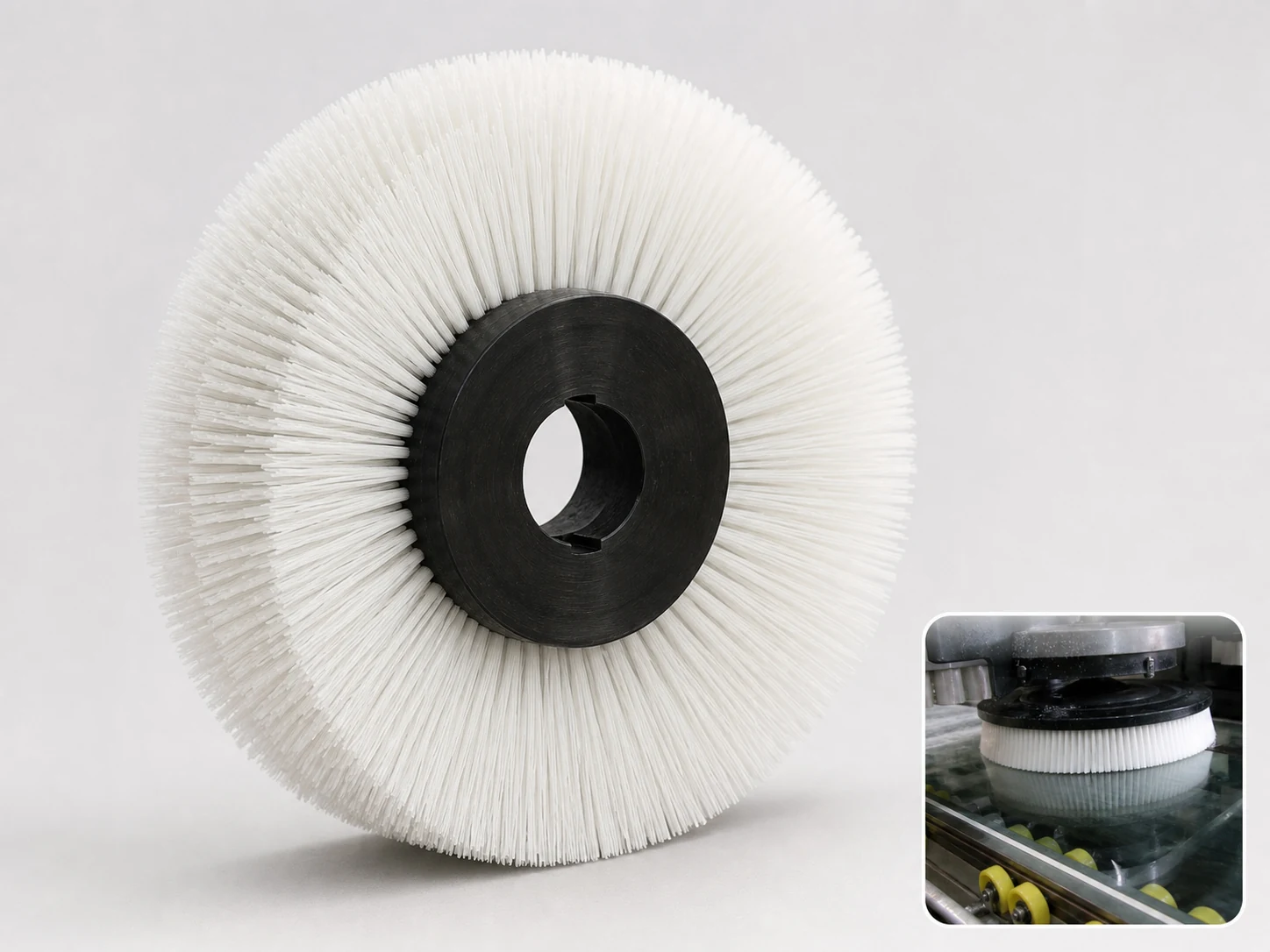
Choose a disc brush when a circular face must scrub, wipe, polish, sweep, or condition a broad surface from a hub or machine plate.
At a glance
- How it is driven
- Machine-driven
- How it mounts
- Snap-Fit
When should you choose this brush type?
Choose a disc brush when the main working area is the circular face and you need broad rotating contact on a floor, panel, conveyor edge, or automated surface. A cylindrical floor brush is the better option when debris pickup or line contact across a width matters more than a flat rotating footprint.
What are Disc Brushes?
Disc brushes arrange tufts, strips, pads, or blades on a circular backing so the main contact occurs across the face. They are used below floor machines, beside conveyors, on edge-cleaning units, and in automated surface processes where a broad rotating footprint is required.
Outside diameter, active annulus, hub or coupling, trim, density, fill pattern, and installed compression determine coverage and contact pressure. The center may be solid, open, recessed, or shaped around the drive, and the filament zones can be uniform or arranged to move liquid and residue.
What dimensions can I customize?
| Head diameter | 200 mm |
|---|---|
| Head or working length | 25 mm |
| Mounting interface | Snap-Fit |
Where is this brush type commonly used?
Start with the job the brush needs to do, then confirm dimensions, contact direction, material, and mounting.
What configurations are available?
Full-face tufted disc
A broad uniform brush field for scrubbing, washing, sweeping, and general surface contact.
Annular or ring disc
An open center clears a hub, spray path, sensor, or product feature while the outer ring performs the work.
Zoned or patterned disc
Different tuft groups, angles, or stiffness zones control liquid flow, edge action, and contact distribution.
Side or edge disc
A flared or offset disc reaches walls, edges, and side surfaces beyond the main machine path.
Replaceable segment disc
Individual sectors, strips, or modules can be serviced without replacing the complete backing.
What material is right for this brush type?
PBT
Wet scrubbing and repeated washdown where good recovery is required.
Nylon PA
General floor and industrial contact with broad stiffness and wear options.
Polypropylene PP
Economical wet service, coarse debris, and suitable chemical exposure.
Abrasive nylon
Stripping, deburring, and controlled surface conditioning.
Rubber, foam, or soft wiping media
Squeegee, liquid control, and low-marking contact where filament alone is not appropriate.
Filament materials to compare
What do I need to know before ordering?
Provide the machine or hub drawing, outside diameter, center opening, active annulus, trim and installed compression, rotation direction, surface material, liquid and residue, customer-supplied operating speed, edge-clearance requirement, and quantity.
Questions this page is asked
How is the actual coverage of a disc brush determined?
Use the outside working diameter together with the hub, inner unfilled zone and the filament's controlled deflection to map the active annulus. For multiple discs, trial their installed centers and rotation so overlap closes untreated bands without causing a raised contact ridge or collision.
Why should disc-brush rotation be qualified with the actual liquid or residue?
Rotation, skirt geometry and machine travel determine whether debris and liquid move toward collection or are thrown into bearings, fixtures and already-clean areas. Conduct a contained trial with representative residue and retain the direction only when evacuation, guarding and finish results meet the process criteria.
What should be monitored when setting disc-brush contact on a machine?
Increase contact within the machine and brush limits while monitoring drive current or torque, vibration, temperature and the representative surface result. After the trial, inspect the base, hub and every replaceable segment for movement, uneven compression or missing fill before approving the setting.
Guides that go deeper on this
Abrasive Filament Brush Dressing: Extending Brush Life
Read this guideGuideCarpet Machine Brush vs Floor Scrubber Brush: Which Fits?
Read this guideGuideElectrode Powder Removal Brushes: Types and Selection
Read this guideGuideFloor Scrubber Brush Selection: Disc Brush vs Roller Brush
Read this guideGuideHow to Measure and Document Brush Dimensions for Custom Orders
Read this guideGuideHow to Measure and Select the Correct Brush Dimensions
Read this guideGuideHow to Request and Evaluate Custom Brush Supplier References
Read this guideGuidePCB Cleaning and Deburring: Which Disc Brushes Avoid Damage?
Read this guideGuideWhen to Customize Combined Sanding Disc Brush
Read this guideGuideWhen to Customize Diamond Disc Brush
Read this guideGuideWhich Disc Brushes Belong on Glass Processing Lines?
Read this guideNo catalogue item for this yet
Every brush here is made to order, and this one has no catalogue entry so far. Send the working surface, the residue, the access opening and the quantity, and it is quoted through the same specification route as the rest of the range.
Custom Manufacturing RFQ
Discuss This Brush Type
Share the working surface, residue, dimensions, material direction, interface, quantity and drawing or sample photo.
Custom Brush RFQ
Request a Custom Cleaning Brush Quote
Upload a drawing, product photo, or sample photo and provide the core dimensions and cleaning conditions.
“We need a brush to remove wet residue from a stainless steel conveyor, about 800mm wide. The current brush wears quickly. We can send photos.”
“We sell drinkware and need a cleaning brush to include with the product. Quantity around 5,000 pieces.”