
Application
Pharmaceutical Reactor Residue Cleaning
For Pharmaceutical Reactor Residue Cleaning, the brush must reach the working area, disturb or collect powder/crystalline deposits/adhered pharmaceutical residue, and release it without creating unacceptable surface damage or process interference. The right structure is set by how the brush reaches the area, how it moves, and how the cleaning is performed.
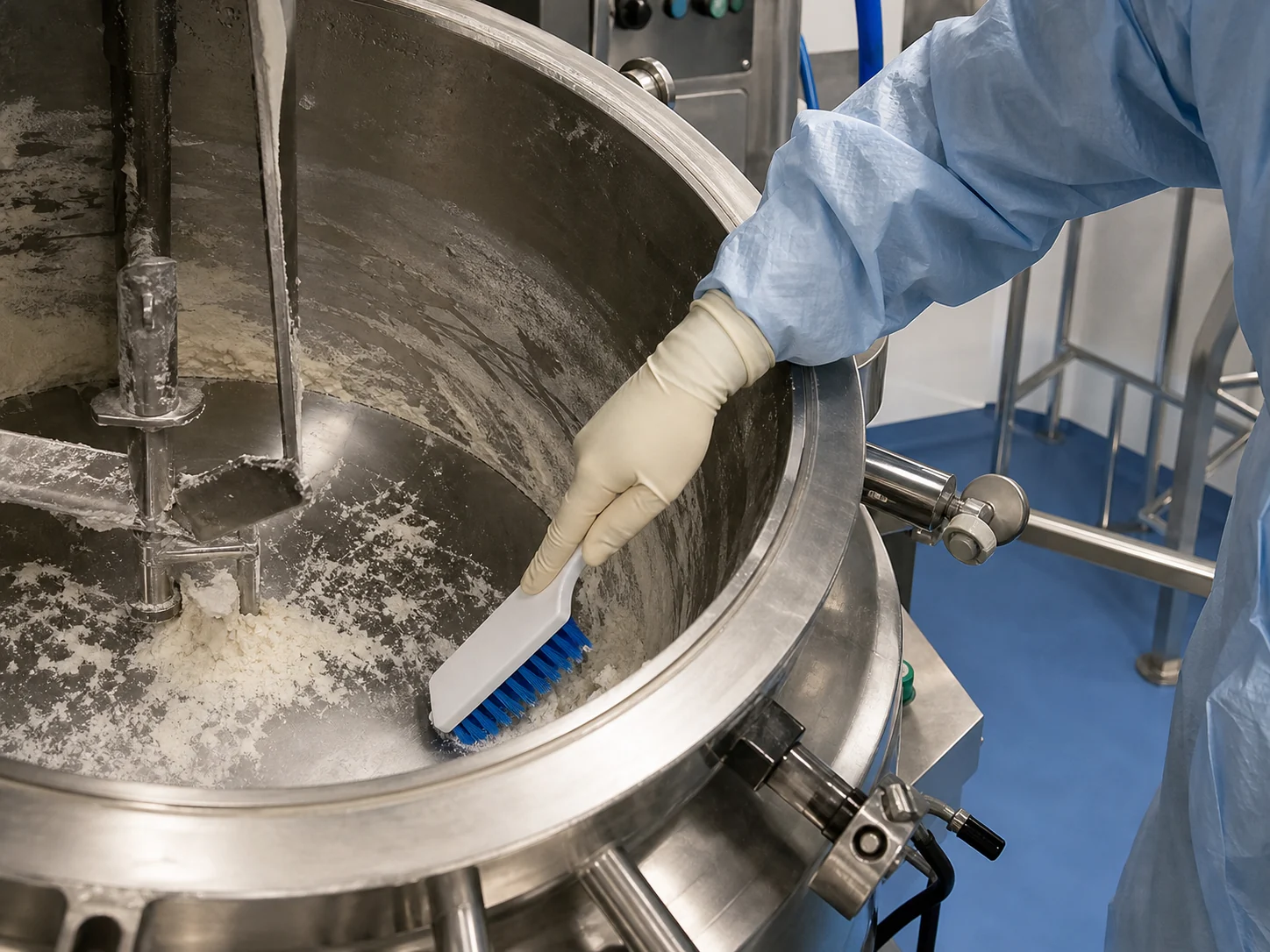
At a glance
- Cleaning target
- Powder/Crystalline Deposits/Adhered Pharmaceutical Residue
- Working environment
- Cleanroom / Wet Indoor Area
- Cleaning method
- Wet Brushing / Soaking / Steam Cleaning
- Requirements to check
- GMP; Material Traceability; USP Class VI / ISO 10993 Material Evaluation Where Required
In a validated reactor the brush has to be justified as well as effective: material traceability, shedding behaviour and the exact CIP shadow it addresses all become part of the record.
What makes Pharmaceutical Reactor Residue Cleaning different from other medical and laboratory cleaning?
The task is to remove Powder/Crystalline Deposits/Adhered Pharmaceutical Residue while controlling surface damage, residue carryover, brush shedding and chemical or temperature degradation.
The work happens in cleanroom and wet indoor area against powder, crystalline deposits and adhered pharmaceutical residue.
The part people get wrong: this is not one job. The same equipment carries several targets, each with a different opening and a different residue, and one brush rarely covers them all.
What are the most common cleaning targets in Pharmaceutical Reactor Residue Cleaning?
There are 5 distinct targets here, and the brush that suits one will usually not reach another.
| Part or area | Residue type | Cleaning requirement |
|---|---|---|
| Reactor Wall | Powder, Crystalline Deposits, Adhered Pharmaceutical Residue | The head must pass the neck or opening, then expand against the internal wall and reach the base curve. |
| Agitator and Baffle | The head must reach the working face and apply even contact without marking the surface. | |
| Nozzle and Port | The head must be narrower than the opening and stiff enough to lift residue without splaying at the mouth. | |
| Drain and Outlet | ||
| Validated CIP Shadow-Area | The head must reach the working face and apply even contact without marking the surface. |
The dimensional envelope those targets impose on the brush:
| Parameter | Typical range |
|---|---|
| Contaminant | Powder/Crystalline Deposits/Adhered Pharmaceutical Residue |
| Required hardness | Soft–Medium |
| Maximum temperature | 140°C |
| Chemical exposure | WFI/Purified Water; Acid / Alkali Cleaning pH 2–12; Ethanol/Isopropyl Alcohol |
| Cleaning method | Wet Brushing/Soaking/Steam Cleaning |
| Environment | Cleanroom/Wet Indoor Area |
Which brush types work for each cleaning target?
Select hand, tube, strip, roller, disc or machine-mounted geometry from access and motion.
| Cleaning target | Recommended brush type | Why it fits |
|---|---|---|
| Reactor Wall | Bottle & Container Brushes | The wall is a mirror-polished surface where crystalline residue lodges along the weld lines, so the brush must have filament fine enough not to change the finish. |
| Agitator and Baffle | Handheld Detail Brushes | Agitator blades and baffles are shadowed from the spray device, so a brush is what puts contact on their back faces during the manual step. |
| Nozzle and Port | Tube & Pipe Bore Brushes | Every port is a short dead-leg off the vessel, so a small bore brush enters it and cleans the length that flow never reaches. |
| Drain and Outlet | The outlet is a short dead-leg below the vessel with a seat behind it, so a small bore brush enters the port and cleans the seat that draining alone leaves coated. | |
| Validated CIP Shadow-Area | Handheld Detail Brushes | A shadow area is documented as unreachable by spray, so it is brushed manually and that brushing is the step the validation rests on. |
Every one is a bore brush on a rod, entering through a nozzle or the manway; nothing is mounted on the vessel itself.
In practical brush terms: reach first, then residue. A brush that fits but is too soft can be stiffened; a brush that does not fit is simply the wrong tool.
What filament materials work best for Pharmaceutical Reactor Residue Cleaning?
PTFE filament where the cleaning cycle swings from pH 2 to pH 12 and the material has to carry its own documentation; nylon for the softer wall passes between batches.
| If the condition is… | Filament to start with | Why |
|---|---|---|
| pH swinging from 2 to 12 in one cycle | PTFE Filament | chemically inert across the whole range |
| Material traceability the batch record has to show | PTFE Filament | available with USP Class VI or ISO 10993 evaluation |
| Soft wall passes between batches | Nylon PA | lifts powder without marking the vessel finish |
The constraints this application puts on the filament:
| Constraint | Value for this application |
|---|---|
| Filament hardness | Soft–Medium |
| Maximum service temperature | 140°C |
| Chemical exposure | WFI/Purified Water; Acid / Alkali Cleaning pH 2–12; Ethanol/Isopropyl Alcohol |
| Cleaning method | Wet Brushing, Soaking, Steam Cleaning |
How do I choose the right brush for my pharmaceutical reactor residue equipment?
Start with soft-to-medium fill, a 140°C ceiling and WFI or purified water, then size to the ports, nozzles and agitator clearance the CIP cycle misses.
The order that avoids rework:
- Identify the target part and measure the access opening or clearance
- Describe the residue: what it is, how thick it sits, and how strongly it holds
- Choose the construction that can physically reach that target
- Set the filament from surface risk, working temperature and cleaning chemistry
- Fix filament diameter, free trim length and density for the contact pressure you need
- Run one cycle and check the result before committing to a production quantity
Before you commit to a quantity, send the port and nozzle bores, the agitator clearance, and the material documentation your validation requires.
When is a pharmaceutical reactor residue brush the wrong tool?
A validated CIP cycle is the qualified method, and any manual intervention has to be justified inside that validation. Where the residue needs a solvent or a boil-out the brush is not the control, and confined-space entry brings its own limits.
What common mistakes should I avoid in Pharmaceutical Reactor Residue Cleaning?
- Proposing a brush without the material traceability and shedding data the validation will demand
- Changing the filament while leaving excessive engagement, poor alignment or no discharge path unchanged
- Copying a worn brush without first recording its motion, direction, mounting and original working diameter
When a brush is running but not cleaning, start here rather than adding pressure:
| Symptom | What to change |
|---|---|
| Residue remains | Increase discharge or relative motion before adding pressure |
| Surface marks | Reduce engagement and use finer/softer fill |
| Rapid wear | Check alignment, temperature and chemical attack |
| Redeposition | Add wash, vacuum or collection path |
Questions this page is asked
When can a brush be added to a validated pharmaceutical reactor cleaning process?
Use it only where the approved procedure identifies a manual-access step, the brush can reach the defined residue without damaging the reactor, and its material is compatible with the actual cleaner, temperature and contact time. Treat the addition or substitution of a brush as a controlled process change and complete the site's required assessment or revalidation before routine use.
How should a reactor-cleaning brush be controlled between product campaigns?
Identify whether the tool is dedicated or permitted for shared use, then clean, rinse, dry, protect and store it under the site's written tool-control procedure. Retire it for loose filaments, damaged cores, trapped residue, staining that cannot be evaluated, chemical attack or any loss of cleanability, and record the disposition where the quality system requires traceability.
What evidence is needed after manually brushing a hard-to-reach reactor area?
Complete the approved rinse and inspection sequence and sample the specified worst-case locations by the validated visual, swab, rinse or analytical method. Release the equipment only when the documented acceptance limits are met and the brush is accounted for with no missing filament or component.
Guides that go deeper on this
No catalogue item for this yet
Every brush here is made to order, and this one has no catalogue entry so far. Send the working surface, the residue, the access opening and the quantity, and it is quoted through the same specification route as the rest of the range.
Custom Manufacturing RFQ
Discuss This Application
Share the working surface, residue, dimensions, material direction, interface, quantity and drawing or sample photo.
Custom Brush RFQ
Request a Custom Cleaning Brush Quote
Upload a drawing, product photo, or sample photo and provide the core dimensions and cleaning conditions.
“We need a brush to remove wet residue from a stainless steel conveyor, about 800mm wide. The current brush wears quickly. We can send photos.”
“We sell drinkware and need a cleaning brush to include with the product. Quantity around 5,000 pieces.”