
Custom Cleaning Brush
Chimney Cleaning Brush
Custom chimney cleaning brush for round and square flues, vents, and ducts. PP, nylon, or wire fill with M8–M12/NPT rod connections and 1–10 m reach.
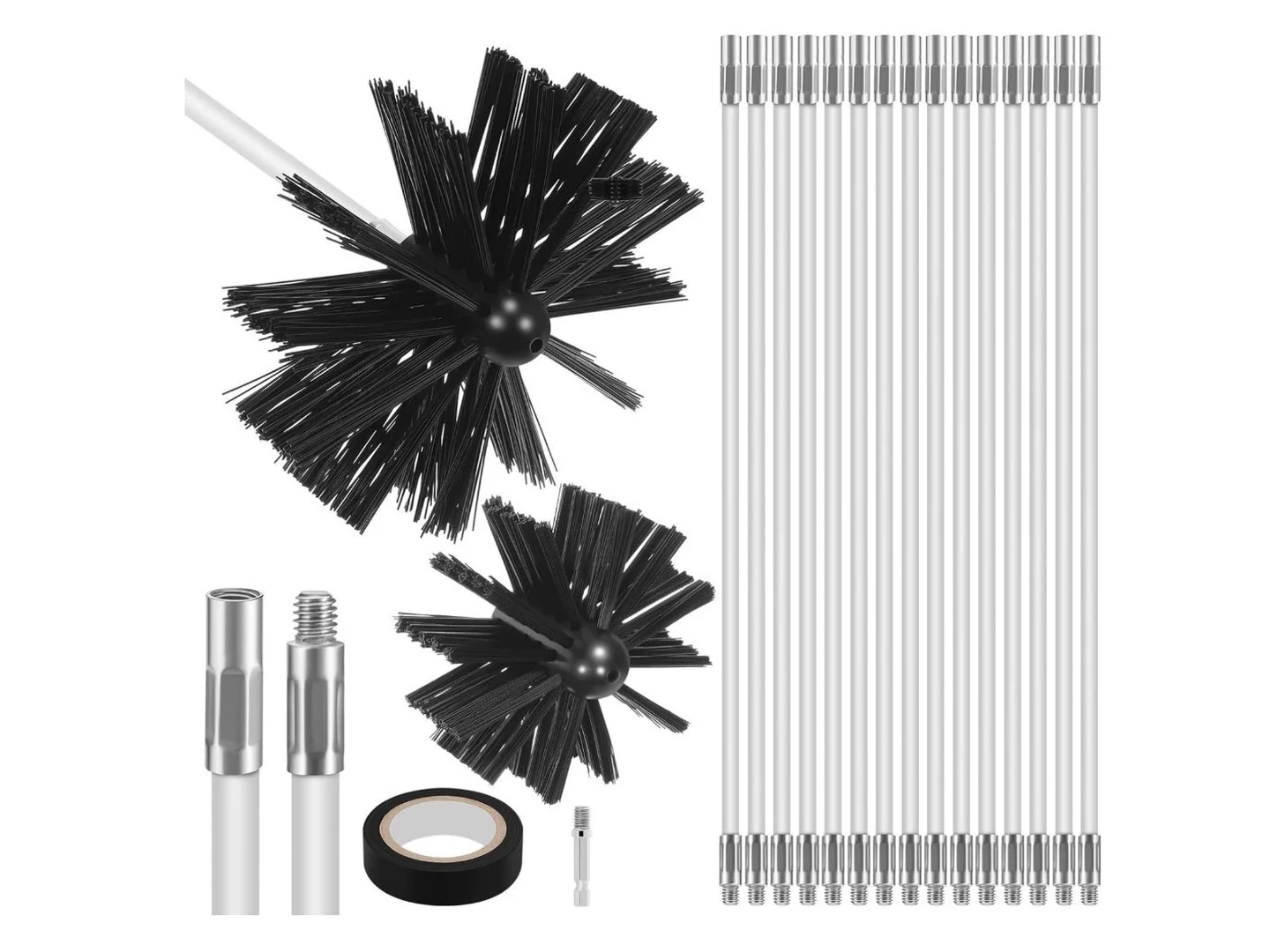
Medium brush
100 pcs
Minimum order
Worked with two hands or on a pole: chimney, gutter and pond-filter brushes, discs, cups and tank brushes.
Production lead time, once the specification is confirmed
- Up to 100 pcsWithin 7 days
- 101–5,000 pcsWithin 14 days
- 5,001–50,000 pcsWithin 21 days
- Over 50,000 pcsConfirmed with your quotation
Peak season can extend these times; the shipping date is confirmed in writing with your quotation. Sampling and shipping are quoted separately.
A rod-driven cleaning head for vertical flues, round and square chimneys, dryer vents, and long duct runs that loosens soot, creosote, lint, dust, and light scale without damaging lined or unlined surfaces. Available with polypropylene or nylon fill for lined flues, stainless steel wire fill for unlined flues, and standard threaded ends that connect to manual rods, flexible rod sets, or rotary drill systems.
What can this brush do for you?
Holds the Right Contact Pressure Along the Flue Wall
Soot and creosote stay attached when the brush just touches the surface, but a head that is too large binds and stalls. Polypropylene and nylon heads are built with a nominal 5–20% oversize over the measured flue diameter, so the filaments flex against the liner and scrub instead of polishing. Wire fill uses near-size contact with lower interference, because steel does not yield the way polymer does and can score a liner. The result is effective wiping or scraping with less jamming and less liner damage.
Passes Through Elbows and Long Runs as a Connected Rod Set
A single brush head only cleans what it can reach. With M8, M10, M12, 1/4 NPT, or 3/8 NPT connections, the head builds into a chimney cleaning brush and rods assembly that follows vertical stacks, offset elbows, and horizontal vent runs up to 10 m. Flexible couplings let the brush work around bends instead of stopping at the first offset.
Choose the Fill Material for the Flue Surface, Not Just the Residue
Polypropylene and nylon PA filaments remove dry and tarry deposits from stainless steel, ceramic, or coated liners without scratching the surface. Stainless steel wire fill handles hardened creosote and scale in unlined masonry flues, where the wall can accept a more aggressive contact. A single chimney cleaning brush family covers both jobs by changing the fill, not the whole system.
Head Shapes That Match the Passage Cross-Section
Round heads wipe the full circumference of circular flues. Square and star heads reach corners in rectangular duct or chimney passages, and star forms leave channels so loosened debris falls or is drawn downward rather than packing ahead of the brush. Wheel heads suit larger industrial ducts where a broad face covers more surface per pass.
Works Manual or Rotary from the Same Rod Connection
The threaded end accepts a manual handle, extension rods, a drill adapter, or a rotary chimney brush cleaning system. Low-speed drill use speeds repeated passes on long or heavily soiled runs, while manual push-pull operation gives an operator more direct feel in delicate lined flues.
What is a Chimney Cleaning Brush?
A Chimney Cleaning Brush is the working end of a flue-cleaning set. It is not a standalone tool: the brush head mounts to a rod or drill adapter, enters the flue from the top, roof access, or a cleanout door, and is pushed, pulled, or rotated along the passage to loosen attached soot, creosote, lint, and dust. The loosened material is then vacuumed or collected downstream. The brush does not extract debris; it releases it from the wall so extraction can do its job.
Most heads are built around a twisted-wire stem or a threaded hub. Polymer filaments radiate from the hub in one or more rows, trimmed to the flue contact diameter. Wire fills use formed steel filaments that retain their set and scrape rather than wipe. The head length, filament density, and oversize determine how much pressure stays on the wall through bends and how easily the head reverses direction in the flue.
The tool’s real variables are the measured flue inside diameter, liner material, bend geometry, and access points. A brush that is right for a 150 mm stainless liner in a straight vertical run will not automatically be safe in a 200 mm unlined masonry chimney with two offsets and glazed creosote. Sizing and fill selection are part of the tool choice, not an afterthought.
Technical Specifications
The table below shows the standard build range for the brush head and rod interface. Exact dimensions are set to the flue ID, deposit type, and access configuration.
| Parameter | Value / Options |
|---|---|
| Flue diameter range | 100–600 mm, sized to the measured inside diameter |
| Brush head length | 80–300 mm, longer heads for heavy build-up, shorter for tight bends |
| Rod reach | 1–10 m assembled; extension rods added to match total run |
| Connection | M8, M10, M12, 1/4 NPT, 3/8 NPT |
| Fill material | PP, Nylon PA, Stainless steel wire 304/316 |
| Filament diameter | 0.30–1.20 mm; thinner for wiping, thicker for scraping |
| Head form | Round, square, star, wheel |
| Contact setting | Near-size for wiping; 5–20% oversize for polymer scrubbing; lower interference for wire |
| Working depth | 10–150 mm, selected for deposit thickness and power source |
| Operating environment | Dry soot, creosote, lint, dust, light scale; confirm temperature and chemical exposure for each fill |
| Brush type | Custom Tube & Pipe Bore Brushes |
| How it is driven | Hand-driven on rods or a flexible shaft |
| Cleaning target | wood stove and fireplace flue, stainless steel and ceramic liner, and unlined masonry chimney cleaning |
| Surface or part | flues, passages, vents, dryer vents, bends, ceramic, hubs, and walls |
| Residue or debris | dust, lint, soot, scale, and light scale |
| Mounting / connection | M8, M10, M12, 1/4 NPT, 3/8 NPT |
For powered operation, run polymer fills at low to moderate drill speed. Wire fill is generally used at manual speed or with controlled rotary feed, because overspeeding a wire brush against a liner can cut grooves.
Where does this brush work best?
- Wood stove and fireplace flues: round or square lined chimneys where annual sweeping removes creosote before it hardens.
- Stainless steel and ceramic liners: PP or nylon fill with modest oversize cleans without scratching the polished surface.
- Unlined masonry chimneys: stainless steel wire fill handles scale and hardened deposits the polymer fills cannot cut.
- Dryer vents and duct runs: lint and dust collect in long horizontal and vertical passages; segmented rods and flexible couplings reach the full length.
- Boiler flues and industrial exhaust ducts: larger diameters and wheel or star heads cover more surface per pass; verify deposit chemistry before choosing polymer fill.
How do I choose the right one?
Start with the measured inside diameter of the flue or duct, not the nominal trade size. A 150 mm chimney can measure 138 mm inside a liner or 160 mm in an unlined masonry passage. The brush outside diameter is set from that measured ID.
- Match the diameter and interference to the fill. For PP or nylon, order the head 5–20% larger than the measured ID. For wire, stay near size or only slightly oversize. Oversize wire will fight the operator and may damage the liner.
- Select fill by liner, not just deposit. Polypropylene is low-cost and works for dry lint, dust, and light soot. Nylon PA resists wear and returns to shape better on long runs. Use stainless steel wire only in unlined flues or industrial steel ducts where scratching is acceptable and deposits are hard.
- Choose the head form to the cross-section. Round for round flues, square or star for rectangular ducts and corners, wheel for wide industrial passages. Star heads also give debris a path past the brush so it does not pack into a plug.
- Set filament diameter and head length to the deposit. Thin filaments 0.30–0.60 mm wipe soft soot and dust. Thicker filaments 0.80–1.20 mm scrape tarry residue. A longer head adds contact time per stroke; a shorter head turns and reverses more easily through elbows.
- Decide manual or rotary before ordering rods. Manual rods give the operator direct feel in a lined flue. A drill adapter and rotary chimney brush cleaning system reduce labor on long or heavily soiled runs, but keep polymer fills at low-to-medium drill speed and keep wire fills out of high-speed rotary use unless the liner and brush are engineered for it.
If the flue contains thick glazed or tar-impregnated creosote, brushing alone may only polish the surface. A chemical creosote treatment or professional removal may be required before mechanical sweeping. If the passage has sharp offsets tighter than the flexible rod coupling can follow, or if the duct is too fragile for any bristle contact, choose a vacuum-only or camera-inspected cleaning method instead. A chimney cleaning brush loosens attached deposits; it does not remove standing water, sludge, or wet chemical residues.
Can I customize this brush?
Chimney cleaning brushes are built to the flue, not sold as fixed shelf diameters. We need the measured inside diameter, liner material, deposit type, bend count and radius, access points, rod length, and power source. A drawing or site photo of the cleanout and termination helps set the correct head and rod configuration.
- Head geometry: outside diameter, head length, round, square, star, or wheel form, filament row count, hub size, and custom profiles for oval or transitional flues.
- Fill material and filament: PP, Nylon PA, stainless 304/316 wire, filament diameter from 0.30 to 1.20 mm, trim length, density, and color.
- Connection interface: M8, M10, M12, 1/4 NPT, 3/8 NPT, male or female, plus custom threads or quick-release couplings.
- Rods and accessories: extension rods, flexible rod sections for elbows, drill adapters, guide discs, handles, and storage or transport cases as a chimney cleaning brush kit.
- Marking and packaging: custom color, pad print or laser marking, bulk packing, individual cartons, retail-ready sleeves, or kit packaging.
For projects that require material declarations, dimensional inspection, third-party testing, or project-specific documentation, we can coordinate those requirements during customization.
Which filament survives the cleaning and still lasts on a chimney cleaning brush?
How do I check whether the brush is sized correctly before first use?
Compare the brush outside diameter with the measured flue ID. For polymer fill, you should see 5–20% oversize. Test through the cleanout: the head should move with steady but controllable resistance. If it stalls immediately or bows the rods, it is too large. If it slides with no wall contact feel, it is too small.
Can the same head clean a round flue and the square section below it?
Usually not. A round head leaves the corners of a square or rectangular section untouched. Use a square or star head for that portion, or specify a kit with two heads when the chimney changes cross-section.
What does the brush do about the debris it removes?
The brush only loosens attached soot, creosote, or lint. The loosened material must be collected with a proper soot vacuum or removed from the bottom cleanout. Use a vacuum designed for fine combustion particles; a standard household vacuum will not contain the dust safely.
Can I run this brush with a high-speed drill?
No. Polymer fills should run only at low to medium drill speed. Wire fill should be used manually or at controlled low speed. High speed can melt or mat polymer filaments, groove a liner with wire, and make the rod assembly difficult to control.
When should I replace the brush head?
Replace the head when the filaments stay bent over, are shortened by more than about 25%, the hub is cracked, the connection threads are worn, or the head no longer maintains the required oversize. Inspect before each heating season or before a large run of duct work.
Is a wire chimney cleaning brush safe on a stainless steel liner?
No. Use PP or nylon fill for stainless steel or ceramic liners. Wire fill is for unlined masonry flues or industrial steel ducts where the surface can accept scraping. Even there, keep wire near size to avoid excessive liner wear.
Guides that go deeper on this
Custom Manufacturing RFQ
Describe Your Application
For an accurate quotation, please provide the main dimensions, material preference, working surface, residue, quantity, and a drawing or photo.
Drawing or photo optional — it speeds things up, it does not gate the enquiry.
Custom Brush RFQ
Send Your Brush Project
Upload a drawing, product photo, or sample photo and provide the core dimensions and cleaning conditions.
“We need a brush to remove wet residue from a stainless steel conveyor, about 800mm wide. The current brush wears quickly. We can send photos.”
“We sell drinkware and need a cleaning brush to include with the product. Quantity around 5,000 pieces.”