
Application
CPAP Hose Cleaning
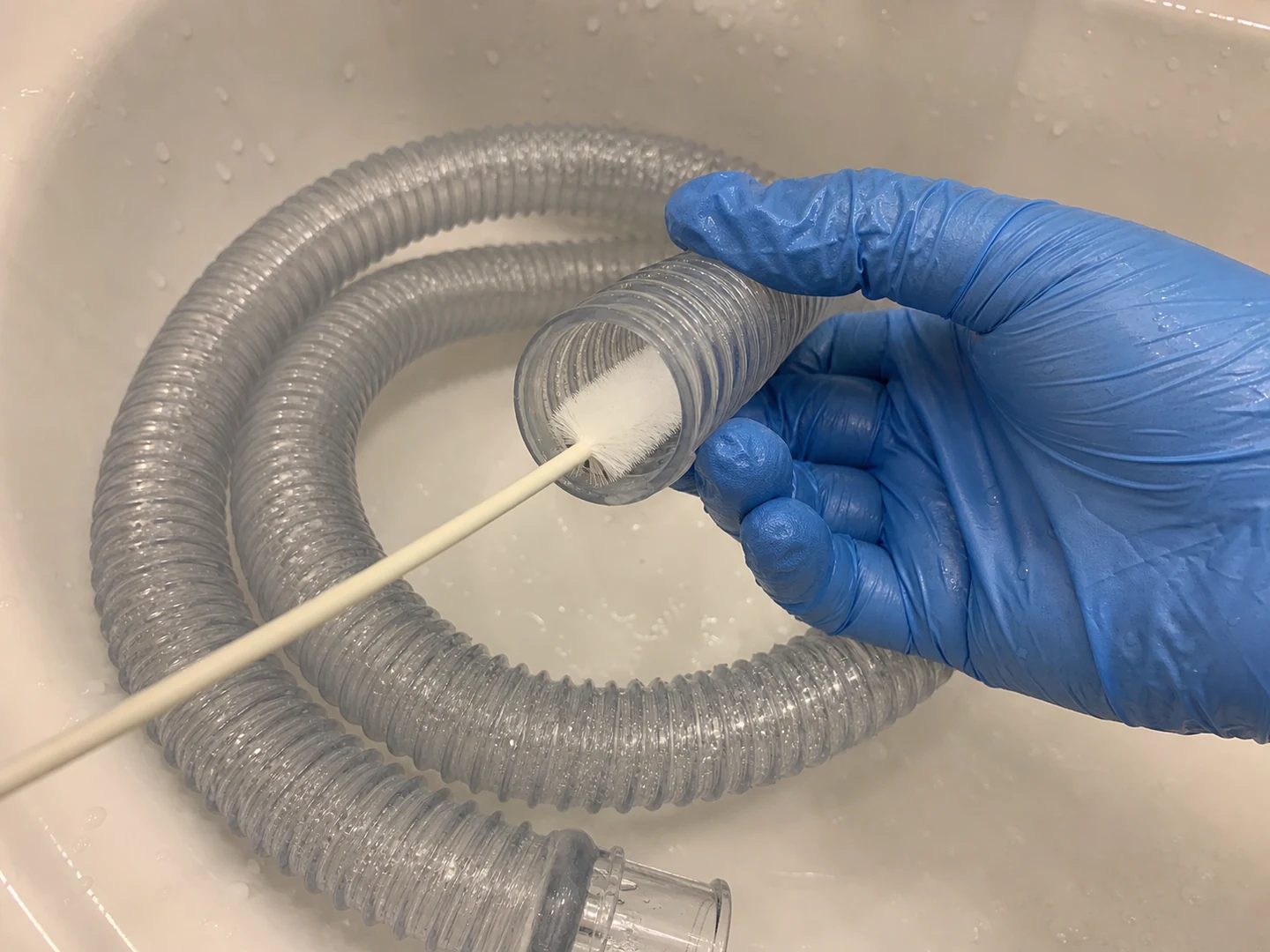
For CPAP Hose Cleaning, the brush must reach the working area, disturb or collect skin oil / condensation residue / dust / microbial film, and release it without creating unacceptable surface damage or process interference. The right structure is set by how the brush reaches the area, how it moves, and how the cleaning is performed.
At a glance
- Cleaning target
- Skin oil / condensation residue / dust / microbial film
- Working environment
- Indoor Healthcare / Home-Care Environment
- Cleaning method
- Wet Brushing / Soaking
- Requirements to check
- Device-manufacturer cleaning instructions; ISO 18562 respiratory-gas-pathway considerations where applicable
A CPAP hose is cleaned daily by the patient, so the brush is defined by hose ID, a rounded tip that cannot cut the corrugation, and whatever the hose maker’s own instructions permit.
What makes CPAP Hose Cleaning different from other medical and laboratory cleaning?
The main difficulty is removing oil, carbon, scale, biofilm, process residue, and particles from bores, channels, tubes, hoses, ports, and internal passages without damaging the surface, loading the brush, or carrying contamination back into the process.
The work happens in indoor healthcare and home-care environment against skin oil, condensation residue, dust and microbial film.
The part people get wrong: the hose manufacturer’s instructions come before any brush decision. Several makers specify soaking only, and a heated-wire hose is ruled out unless the maker says otherwise.
What are the most common cleaning targets in CPAP Hose Cleaning?
One target, and its length is what makes it difficult: the hose interior has to be reached end to end, through a corrugated wall, in a single pass.
| Part or area | Residue type | Cleaning requirement |
|---|---|---|
| CPAP Hose Interior | Skin oil, condensation residue, dust, microbial film | The brush must pass the full length of the passage and hold contact with the wall without folding over at the far end. |
What the equipment leaves you to work inside:
| Parameter | Typical range |
|---|---|
| Hose inner diameter | 15 mm for ResMed ClimateLineAir; 19 mm for ResMed standard tubing |
| Hose length | 6.5 ft (≈1.98 m) ClimateLineAir; 2.0 m standard tubing |
| Brush diameter | Match the actual hose ID, approximately 15–19 mm for those ResMed hoses |
| Brush reach | At least the full hose length, using a flexible stem/rod |
Which brush types work for each cleaning target?
Long flexible tube brush sized to the hose ID with rounded tip.
| Cleaning target | Recommended brush type | Why it fits |
|---|---|---|
| CPAP Hose Interior | Tube & Pipe Bore Brushes | A bore brush on a flexible shaft follows the corrugated hose and scrubs the internal wall along its whole run. |
How the brush is usually carried on the machine:
- Driven brush — use when oil, carbon, scale, biofilm, process residue, and particles needs repeatable scrubbing or controlled relative movement
- Passive or free-running brush — use for loose contamination and lower process complexity on bores, channels, tubes, hoses, ports, and internal passages
- Localized hand, strip, or tube brush — use where only an edge, gap, port, or maintenance point needs contact
In practical brush terms: match the construction to the access before anything else. A geometry that cannot reach the target will not be rescued by a better filament.
What filament materials work best for CPAP Hose Cleaning?
Soft nylon/PBT or other documented non-abrasive filament with protected stem; exact requirements follow the hose manufacturer.
| If the condition is… | Filament to start with | Why |
|---|---|---|
| Sensitive or coated surface | Polypropylene PP | acid, alkali, water, and detergent resistance |
| Wet, washdown, or detergent service | PBT | stable wet stiffness and low moisture uptake |
| Bonded residue or aggressive cleaning | PA6 Nylon | economical firm scrubbing |
What the duty rules out before you start comparing grades:
| Constraint | Value for this application |
|---|---|
| Filament hardness | Soft |
| Maximum service temperature | 60°C |
| Chemical exposure | Mild neutral detergent, typically pH 6–8; no aggressive solvent |
| Cleaning method | Wet Brushing, Soaking |
How do I choose the right brush for my cpap hose equipment?
Hose ID sets the head, hose length sets the stem, and the hose maker’s instructions decide whether a brush belongs inside it at all.
The order that avoids rework:
- Identify the target part and measure the access opening or clearance
- Describe the residue: what it is, how thick it sits, and how strongly it holds
- Choose the construction that can physically reach that target
- Set the filament from surface risk, working temperature and cleaning chemistry
- Fix filament diameter, free trim length and density for the contact pressure you need
- Run one cycle and check the result before committing to a production quantity
Before you commit to a quantity, send the hose internal diameter and length, and say whether it is a heated-wire hose.
When is a CPAP hose brush the wrong tool?
Warm soapy water and a full soak clean most hoses with no brush at all, which is what most manufacturers actually specify. A hose with cracks, tears or persistent discolouration is replaced, and nothing goes inside a heated-wire hose unless the maker says so.
What common mistakes should I avoid in CPAP Hose Cleaning?
- Ordering by hose length instead of internal diameter, and not saying whether the hose is heated-wire
- Changing brush material while leaving excessive engagement, poor alignment, or no discharge path unchanged
- Copying a worn brush without recording motion, direction, mounting, and the original working diameter
If the brush is already in service and the result is wrong, work from the symptom:
| Symptom | What to change |
|---|---|
| Residue remains | Increase relative motion or discharge, then change filament diameter or density; do not add pressure before checking loading by oil, carbon, scale, biofilm, process residue, and particles. |
| Surface marks or scratches | Reduce engagement, use finer or softer fill, and remove trapped abrasive particles from contact with bores, channels, tubes, hoses, ports, and internal passages. |
| Rapid wear or uneven cleaning | Check alignment, runout, support, motion, temperature, chemical attack, and whether the brush covers the complete working path. |
| Brush loads or redeposits residue | Open the fill pattern or add wash, vacuum, air, scraping, or a collection path so removed oil, carbon, scale, biofilm, process residue, and particles leaves the contact zone. |
No catalogue item for this yet
Every brush here is made to order, and this one has no catalogue entry so far. Send the working surface, the residue, the access opening and the quantity, and it is quoted through the same specification route as the rest of the range.
Custom Manufacturing RFQ
Discuss This Application
Share the working surface, residue, dimensions, material direction, interface, quantity and drawing or sample photo.
Custom Brush RFQ
Request a Custom Cleaning Brush Quote
Upload a drawing, product photo, or sample photo and provide the core dimensions and cleaning conditions.
“We need a brush to remove wet residue from a stainless steel conveyor, about 800mm wide. The current brush wears quickly. We can send photos.”
“We sell drinkware and need a cleaning brush to include with the product. Quantity around 5,000 pieces.”