
Application
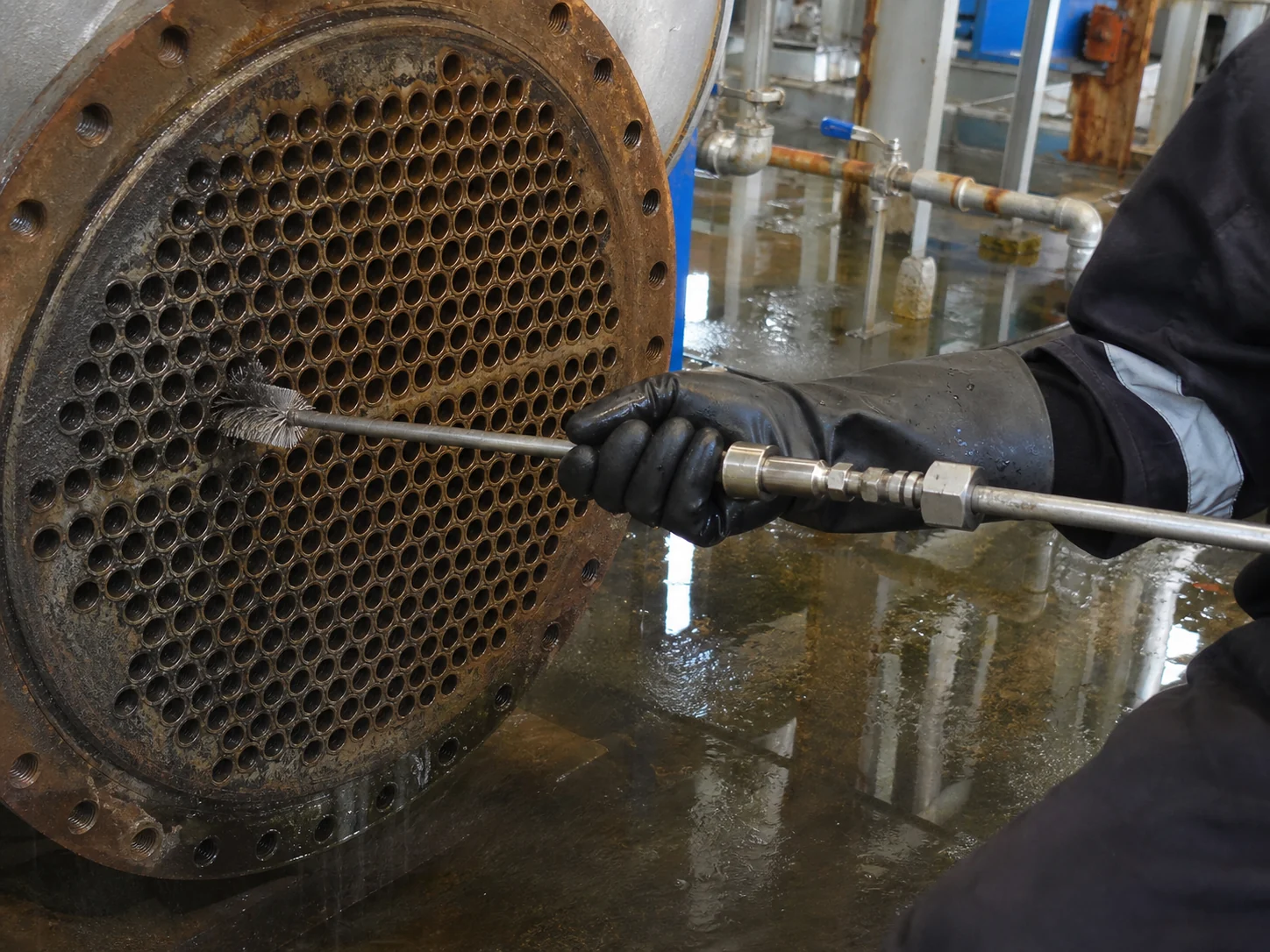
Heat Exchanger Tube Cleaning
For Heat Exchanger Tube Cleaning, the brush must reach the working area, disturb or collect mineral scale/oil and grease/biofilm/deposits, and release it without creating unacceptable surface damage or process interference. The brush structure must match the access path, contact movement, and cleaning process.
At a glance
- Cleaning target
- Mineral Scale/Oil and Grease/Biofilm/Deposits
- Working environment
- Wet Indoor Area
- Cleaning method
- Wet Brushing / Soaking
- Requirements to check
- Pipe-Material Compatibility; Brush-Diameter and Pipe-ID Fit; Equipment SOP
Exchanger tubes are cleaned to restore heat transfer, so the brush is sized to the tube ID and to whether the bundle is straight or U-bent, then matched to scale, oil or biofilm.
What makes Heat Exchanger Tube Cleaning different from other industrial and manufacturing cleaning?
The task is to remove Mineral Scale/Oil and Grease/Biofilm/Deposits while controlling surface damage, residue carryover, brush shedding and chemical or temperature degradation.
The work happens in wet indoor area against mineral scale, oil and grease, biofilm and deposits.
The part people get wrong: the residue tells you the filament, but the access opening tells you the construction. Get them in that order and the shortlist is short.
What are the most common cleaning targets in Heat Exchanger Tube Cleaning?
5 targets, each with its own opening, residue and contact requirement.
| Part or area | Residue type | Cleaning requirement |
|---|---|---|
| Straight-Tube Heat Exchanger | Mineral Scale, Oil and Grease, Biofilm, Deposits | The brush must pass the full length of the passage and hold contact with the wall without folding over at the far end. |
| U-Bend Tube | ||
| Condenser Tube | ||
| Boiler Tube | Hard waterside scale, soot and ash on the fireside, oxide deposits | |
| Sanitary Process Heat-Exchanger | Mineral Scale, Oil and Grease, Biofilm, Deposits | The head must reach the working face and apply even contact without marking the surface. |
The dimensional envelope those targets impose on the brush:
| Parameter | Typical range |
|---|---|
| Contaminant | Mineral Scale/Oil and Grease/Biofilm/Deposits |
| Required hardness | Medium–Hard |
| Maximum temperature | 150°C |
| Chemical exposure | Acid Descaling pH 1–4; Alkaline Degreasing pH 9–13; Solvent |
| Cleaning method | Wet Brushing/Soaking |
| Environment | Wet Indoor Area |
Which brush types work for each cleaning target?
Select hand, tube, strip, roller, disc or machine-mounted geometry from access and motion.
| Cleaning target | Recommended brush type | Why it fits |
|---|---|---|
| Straight-Tube Heat Exchanger | Tube & Pipe Bore Brushes | A straight tube can be brushed right through, so the head is sized as a close fit and driven from one tubesheet to the other in a single pass. |
| U-Bend Tube | A U-bend cannot be rodded straight through, so the brush has to be flexible enough to follow the return bend and still hold contact around it. | |
| Condenser Tube | Condenser tubes are thin-walled and often brass or titanium, so the brush is chosen to clear the scale without cutting into the tube wall. | |
| Boiler Tube | Boiler tubes carry hard deposits, so a stiff bore brush is worked back and forth rather than run through once at speed. | |
| Sanitary Process Heat-Exchanger | A sanitary exchanger has to be clean to a swab and not just to flow, so a bore brush is passed through each tube during the validated strip-down. |
All five run on a rod, a flexible shaft or a drive motor down the tube bore; the shell side is not brushed at all.
In practical brush terms: reach first, then residue. A brush that fits but is too soft can be stiffened; a brush that does not fit is simply the wrong tool.
What filament materials work best for Heat Exchanger Tube Cleaning?
Tube material decides it: 304 stainless or brass wire in steel tubes, abrasive nylon in copper and titanium where wire would score the bore, and PA612 for the soft passes that follow a descaling soak.
| If the condition is… | Filament to start with | Why |
|---|---|---|
| Steel tubes | Stainless Steel 304 Wire | cuts scale without contaminating the bore |
| Copper or titanium tubes | SiC Abrasive Nylon | removes deposits without the scoring wire leaves in soft metal |
| Soft passes after a descaling soak | PA612 Nylon | low water uptake, so the head keeps its diameter wet |
The constraints this application puts on the filament:
| Constraint | Value for this application |
|---|---|
| Filament hardness | Medium–Hard |
| Maximum service temperature | 150°C |
| Chemical exposure | Acid Descaling pH 1–4; Alkaline Degreasing pH 9–13; Solvent |
| Cleaning method | Wet Brushing, Soaking |
How do I choose the right brush for my heat exchanger tube equipment?
Start with medium-to-hard fill, a 150°C ceiling and acid descaling at pH 1–4, then size to tube ID and to whether the bundle is straight or U-bent.
Work through it in this order:
- Identify the target part and measure the access opening or clearance
- Describe the residue: what it is, how thick it sits, and how strongly it holds
- Choose the construction that can physically reach that target
- Set the filament from surface risk, working temperature and cleaning chemistry
- Fix filament diameter, free trim length and density for the contact pressure you need
- Run one cycle and check the result before committing to a production quantity
Before you commit to a quantity, send the tube ID and length, whether the bundle is straight or U-bent, and the deposit type.
When is a heat exchanger tube brush the wrong tool?
Hard mineral scale comes out by chemical cleaning or hydro-jetting, with the brush following to sweep what those loosened. On enhanced, finned or thin-wall tubing, stiff or wire fill damages the very surface the exchanger depends on.
What common mistakes should I avoid in Heat Exchanger Tube Cleaning?
- Giving tube OD instead of ID, and not saying whether the bundle is straight or U-bent
- Changing the filament while leaving excessive engagement, poor alignment or no discharge path unchanged
- Copying a worn brush without first recording its motion, direction, mounting and original working diameter
When a brush is running but not cleaning, start here rather than adding pressure:
| Symptom | What to change |
|---|---|
| Residue remains | Increase discharge or relative motion before adding pressure |
| Surface marks | Reduce engagement and use finer/softer fill |
| Rapid wear | Check alignment, temperature and chemical attack |
| Redeposition | Add wash, vacuum or collection path |
Questions this page is asked
What determines the endpoint for mechanical tube brushing?
Use the exchanger procedure's defined observations, such as unrestricted passage, removed deposit, rinse clarity, visual or borescope condition and restored performance data. Stop for abnormal resistance, scoring, metal fragments, leakage or suspected wall loss and route the tube for engineering inspection rather than adding force.
When may a tube brush be combined with chemical descaling?
Combine them only under an engineered cleaning procedure that identifies the tube alloy, deposit, inhibitor, concentration, temperature, exposure time, ventilation, rinse, neutralization and waste controls. Verify compatibility with the brush fill, stem, seals and cleaning equipment, because a filament that tolerates a short wipe may fail during heated circulation.
Guides that go deeper on this
No catalogue item for this yet
Every brush here is made to order, and this one has no catalogue entry so far. Send the working surface, the residue, the access opening and the quantity, and it is quoted through the same specification route as the rest of the range.
Custom Manufacturing RFQ
Discuss This Application
Share the working surface, residue, dimensions, material direction, interface, quantity and drawing or sample photo.
Custom Brush RFQ
Request a Custom Cleaning Brush Quote
Upload a drawing, product photo, or sample photo and provide the core dimensions and cleaning conditions.
“We need a brush to remove wet residue from a stainless steel conveyor, about 800mm wide. The current brush wears quickly. We can send photos.”
“We sell drinkware and need a cleaning brush to include with the product. Quantity around 5,000 pieces.”