
Custom Cleaning Brush
12mm SS304 Tube Brush
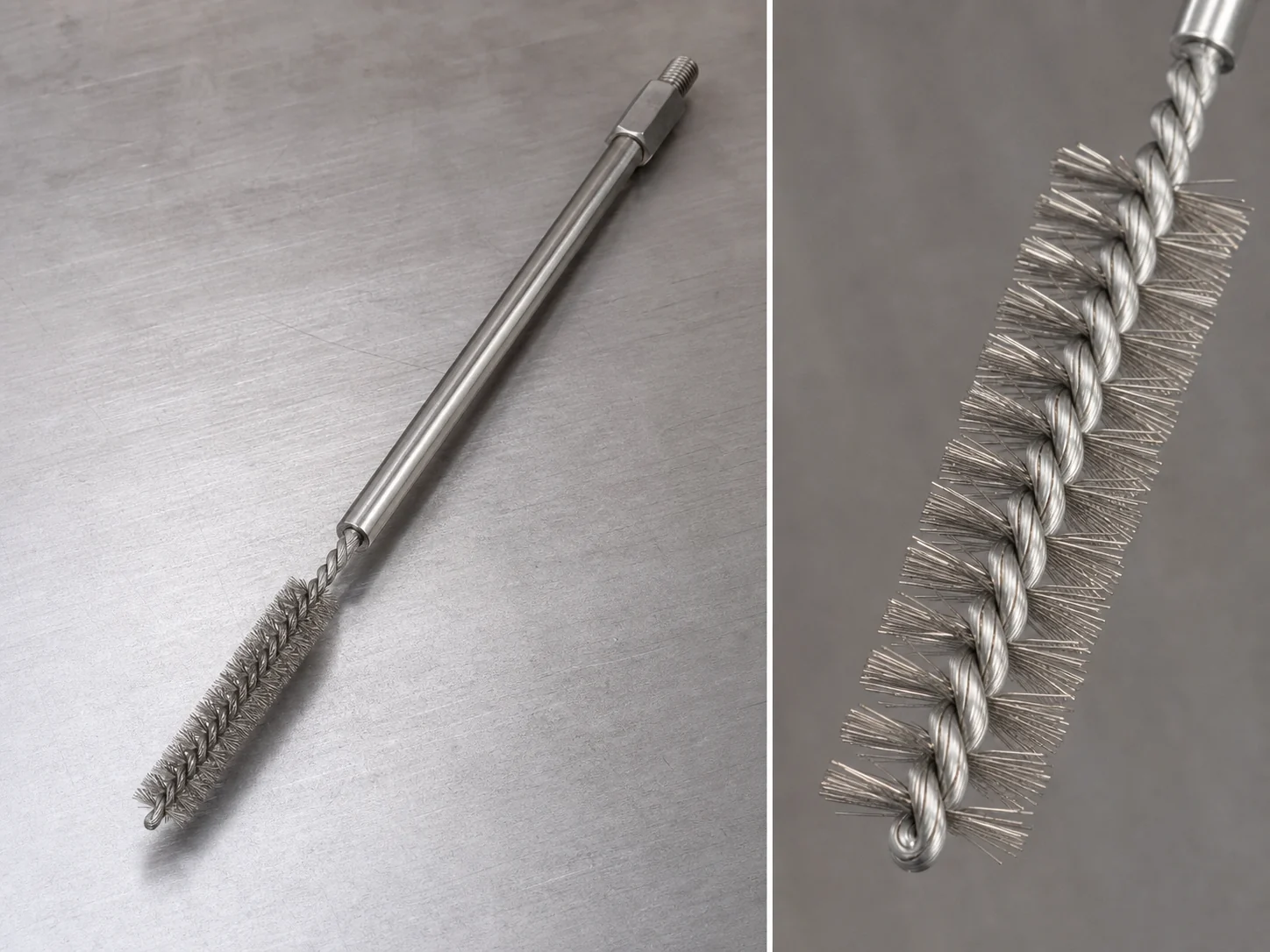
12mm SS304 tube brush for cleaning heat exchanger tubes, hydraulic ports, and threaded bores. Twisted SS304 wire core, removable threaded handle.
Small brush
500 pcs
Minimum order
Held in one hand: tube, bottle, detail and swab brushes — including long-handled ones with a small head.
Production lead time, once the specification is confirmed
- Up to 500 pcsWithin 7 days
- 501–50,000 pcsWithin 14 days
- Over 50,000 pcsWithin 21 days
Peak season can extend these times; the shipping date is confirmed in writing with your quotation. Sampling and shipping are quoted separately.
A 12 mm twisted-wire tube brush with an SS304 stainless steel filament head and twisted SS304 core, built for heat exchanger tube internal cleaning and other cylindrical bores, ports, and thread roots where scale, rust, carbon, chips, and process residues must be mechanically removed. The threaded removable connection keeps the handle reusable while replacement heads handle the wear.
What can this brush do for you?
Full bore contact without oversizing the tool
The 12 mm nominal head is dimensioned for internal passages where undersized brushes leave strips of untouched wall and oversized brushes wedge at the first restriction. SS304 filaments spiral around the twisted core, so a push-pull stroke with light rotation contacts the full circumference over the entire head length instead of only the bottom of the tube.
Scrapes oil, scale, rust, and carbon out of the bore
The stainless steel wire ends fracture dried coolant, light rust, carbon, chips, and process powder rather than smearing them into the surface. SS304 remains stiff enough to break these deposits but flexible enough not to shatter on first contact with a cross hole. As you stroke and rotate, loosened material falls out of the filament rows instead of packing the brush solid.
Threaded removable connection separates wear from the handle
The wire head threads onto the stem or handle, so worn filaments or a damaged stem do not force you to throw away the complete tool. On a multi-tube cleaning job, the operator can swap a fresh 12 mm head in seconds and keep the same handle and extension setup.
Follows shallow bends, tapers, and offset cross holes
At this diameter, the twisted SS304 core still flexes enough to pass through shallow tube bends, threads, tapers, and slightly misaligned ports without taking a permanent kink. The operator can feel the head meet a weld bead, scale ridge, or blind end and adjust stroke pressure before damaging the wire.
Washes down without introducing rust contamination
SS304 wire and the twisted core tolerate water-based degreasers, hot water, and common industrial cleaners far better than carbon steel wire brushes. The tool can be rinsed after use, dried, and returned to service without a rust bloom that would contaminate the next tube or bore.
What is a 12mm SS304 Tube Brush?
A 12mm SS304 Tube Brush is a small-diameter wire tube brush with an approximately 12 mm round cleaning head. Stainless steel 304 filaments are mechanically twisted into a double-wire SS304 core, locking the filament ends outward along the entire head length. The brush is inserted into heat exchanger tubes, coolant galleries, hydraulic ports, fitting bores, and other circular internal cavities, then stroked and rotated to dislodge attached deposits.
During use the stem leads into the bore, and the head follows. Cleaning pressure comes from bristle interference against the bore wall, not from heavy manual force. The twisted wire construction creates a continuous spiral contact line, which removes deposit from both the leading edge and the sidewall in one motion. A threaded removable connection joins the head to the operating stem or an extension.
This is not a polishing or finishing brush. SS304 wire leaves fine scratch marks on polished, plated, or soft metal surfaces, and a broken filament can remain in the bore if the process does not include flushing. It is also not a replacement for chemical descaling, pickling, or honing when the deposit is mineral-bonded, pitted into the base metal, or hard enough to exceed the mechanical limit of the wire.
Technical Specifications
The table lists the standard 12mm SS304 wire tube brush configuration. Parameters marked as configurable can be adjusted at order to the actual tube or bore.
| Parameter | Value |
|---|---|
| Nominal brush diameter | 12 mm |
| Head length | 80 mm |
| Overall length | Approximately 260 mm (80 mm head + 180 mm stem/handle) |
| Bristle material | Stainless steel 304 (SS304) wire |
| Core / stem material | Twisted SS304 stainless steel wire |
| Stem / grip diameter | 8 mm |
| Head profile | Round (cylindrical), spiral twisted-in-wire filament distribution |
| Connection | Threaded removable head-to-handle coupling; thread size confirmed at order |
| Filament wire gauge | Configurable, typically 0.15–0.35 mm depending on deposit hardness and curve geometry |
| Fill density | Medium to high; selected by residue type and required wall pressure |
| Working motion | Push-pull with light rotation; hand operation or low-speed powered rotation with proper chucking |
| Operating environment | Oils, coolants, water-based cleaners, hot water, mild alkaline solutions; avoid prolonged exposure to concentrated chlorides or strong reducing acids |
| Brush type | Custom Tube & Pipe Bore Brushes |
| How it is driven | Hand-guided |
| Cleaning target | heat exchanger tube internal, hydraulic manifold and valve body, and fitting and threaded socket cleaning |
| Surface or part | bores, tubes, thread, ports, holes, cross holes, passages, and walls |
| Residue or debris | scale, rust, chips, coolant, carbon, oil, powder, and process deposits |
| Mounting / connection | Threaded removable head-to-handle coupling; thread size confirmed at order |
If the tube is blind or has an internal stop, head length should be shortened so the operator can reach the full cleaning zone without bottoming the stem against the end.
Where does this brush work best?
- Heat exchanger tube internal cleaning — straight and shallow-curve tubes in condensers, evaporative coolers, oil coolers, and boiler circuits with IDs around 12 mm that collect scale, sludge, corrosion film, and process deposits.
- Hydraulic manifolds and valve bodies — intersecting cross holes, spool bores, sensor ports, and short galleries loaded with dried oil, chips, grinding dust, and assembly debris.
- Fittings and threaded sockets — internal threads, seat areas, and pre-assembly bores where old sealant, rust, and dirt must be cleared before a leak-tight connection.
- Mold and die coolant channels — gun-drilled water lines, ejector pin bores, and small connector passages with baked coolant film and mineral scale.
- Pump and filter housings — suction/discharge ports, drain holes, and transfer bores with varnish, powder, and light corrosion.
For bore IDs well outside the 11.5–14 mm range, a different nominal diameter is required; see the selection guidance below.
How do I choose the right one?
Start with the smallest cross-section the brush must pass through, including any fitting, step, bend, or thread root. A tube brush only cleans where the bristles carry interference against the wall. Too little interference means the brush slides through without removing adhered film; too much means wire ends fold back, snap, or wedge the head.
| Check | Use this 12mm SS304 configuration when |
|---|---|
| Internal bore diameter | 11.5–14 mm; use the lower end of the range for hard deposits and strong wall pressure, the upper end for easier insertion or softer residue |
| Access path | Straight or shallow curve; blind holes need a depth mark and possibly a shorter head |
| Deposit type | Chips, oil, coolant, light-to-moderate scale, rust, carbon, powder, and process deposits; heavy welded or baked-on deposit may require heavier wire or powered cleaning |
| Bore surface | Uncoated steel, stainless, cast iron, or brass; avoid polished, plated, or soft bores unless scratching and embedded wire particles are acceptable |
| Cleaning environment | Oils, coolants, water-based cleaners, mild alkalis; avoid concentrated chlorides and strong reducing acids that promote pitting |
Filament weight and fill density: Finer wire follows threads, steps, and cross holes with less breakage and is easier to push through curved passages. Heavier wire removes hard scale, rust, and carbon faster but produces more insertion resistance and sheds wire fragments as it fatigues. Specify the deposit thickness and number of obstructions when defining wire gauge.
Reach and connection: Overall length must cover the full tube depth plus the grip allowance outside the bore. The threaded removable connection can take a matching extension for longer heat exchanger tubes, but every joint adds a catch point and reduces feel. For tubes substantially longer than a standard hand stroke setup, or for fully blocked tubes, a flexible shaft tube cleaner or powered rotary tube cleaning system is usually the better method.
When this brush is the wrong tool: Use a brass, nylon, or non-woven brush when the bore is titanium, plated, precision-honed, or must remain free of embedded steel particles. Use SS316, duplex, or a coated wire when the system carries seawater, high chloride scale, or hot reducing acids. Select a smaller or larger nominal diameter instead of forcing this 12 mm head into bores outside the 11.5–14 mm fit range.
Can I customize this brush?
The 12mm SS304 wire tube brush can be adjusted to the actual tube or bore without changing the basic twisted-in-wire construction. To define the custom configuration, send the minimum and maximum bore ID, full insertion depth, bend geometry, deposit type, cleaning chemical, hand or powered rotation, and the required thread or handle interface. A scrap tube section, drawing, or photo of the old worn brush reduces back-and-forth during sampling.
- Head length — 40–120 mm options so the wire contact zone matches the tube depth or restricted cavity
- Wire gauge and fill density — finer filaments for threads and curves, heavier filaments for scale, rust, and carbon removal
- Stem / handle length — standard 180 mm, extendable from 150 mm to 500 mm or segmented with matching threaded joints
- Threaded connection — thread size, pitch, and gender matched to your existing handle, extension rod, or powered driver
- Core construction — twisted SS304 standard; double-wire or reinforced core available for long reach or higher torque applications
- Handle / grip form — plain wire stem, loop end, knurled grip, hex shank for a drill chuck, or color-coded identification
- Marking — batch code, size marking, color band, or pad print on the handle where applicable
- Packaging — bulk, individual polybag, oil-treated anti-corrosion wrap, labeled boxes, or project-specific carton marking
SS304 is the default wire material described on this page. For chloride-heavy cleaning environments, ask about SS316 or coated wire alternatives for the project. If you need material certificates, inspection reports, dimensional records, or third-party testing to support incoming inspection or customer qualification, that documentation can be arranged with the batch.
When is a 12mm SS304 tube brush worn out rather than just dirty?
How do I confirm the 12 mm head will pass through every section of my tube?
Measure the smallest internal diameter along the entire path, including fittings, bends, steps, and thread roots. A caliper or pin gauge is enough if access allows; for long tubes, use a bore gauge or a test piece. The head should pass the narrowest restriction without forcing. If it binds at a bend or step, shorten the head or move to a finer wire gauge rather than pushing harder.
What should I inspect before starting a cleaning shift?
Check the brush for broken or missing filaments, permanent bends in the stem, loose threads, and corrosion stains. Pull on the head to confirm the threaded connection is fully seated. If the brush will be rotated by a power tool, run it at low speed unloaded first; any wobble, flying wire, or vibration means the tool should be replaced before use. Always wear eye protection because SS304 wire fragments are sharp and can be ejected from a bore.
Why should I avoid reversing rotation when the brush is inside the bore?
Reversing a powered driver with the brush fully engaged can unwind or kink the twisted core and snap wire ends. Stop rotation before changing direction, or keep the original rotation while pulling the brush out. For hand use, rotate in one direction during the stroke and do not twist back against a lodged deposit.
How do I know when the 12mm brush is worn out?
Compare the bristle circle against a 12 mm ring gauge or a new brush. Replace the head when filament length has shortened noticeably, when more than a few wires are missing or broken, or when the stem has taken a permanent bend. A worn brush leaves deposit in the bottom of the tube and increases the chance of shedding wire fragments into the system.
Will brushing alone return a heat exchanger tube to clean condition?
Brushing removes attached deposits from the accessible bore surface, but it does not remove deep corrosion pits, hard mineral scale that exceeds wire pressure, or blockages in already sealed tubes. After brushing, flush in the flow direction and inspect with a borescope or clean cloth. If pitting or hard scale remains, combine the brush with chemical cleaning, high-pressure water, or mechanical honing before returning the unit to service.
Guides that go deeper on this
Custom Manufacturing RFQ
Describe Your Application
Send the key measurements, cleaning requirement, residue, material direction, mounting method, quantity, and drawing or photo.
Drawing or photo optional — it speeds things up, it does not gate the enquiry.
Custom Brush RFQ
Send Your Brush Project
Upload a drawing, product photo, or sample photo and provide the core dimensions and cleaning conditions.
“We need a brush to remove wet residue from a stainless steel conveyor, about 800mm wide. The current brush wears quickly. We can send photos.”
“We sell drinkware and need a cleaning brush to include with the product. Quantity around 5,000 pieces.”