
Application
Beverage Equipment Cleaning
For Beverage Equipment Cleaning, the brush must reach the working area, disturb or collect syrup/adhered residue/biofilm, and release it without creating unacceptable surface damage or process interference. Access space, brush movement, and cleaning method are the main factors in selecting the structure.
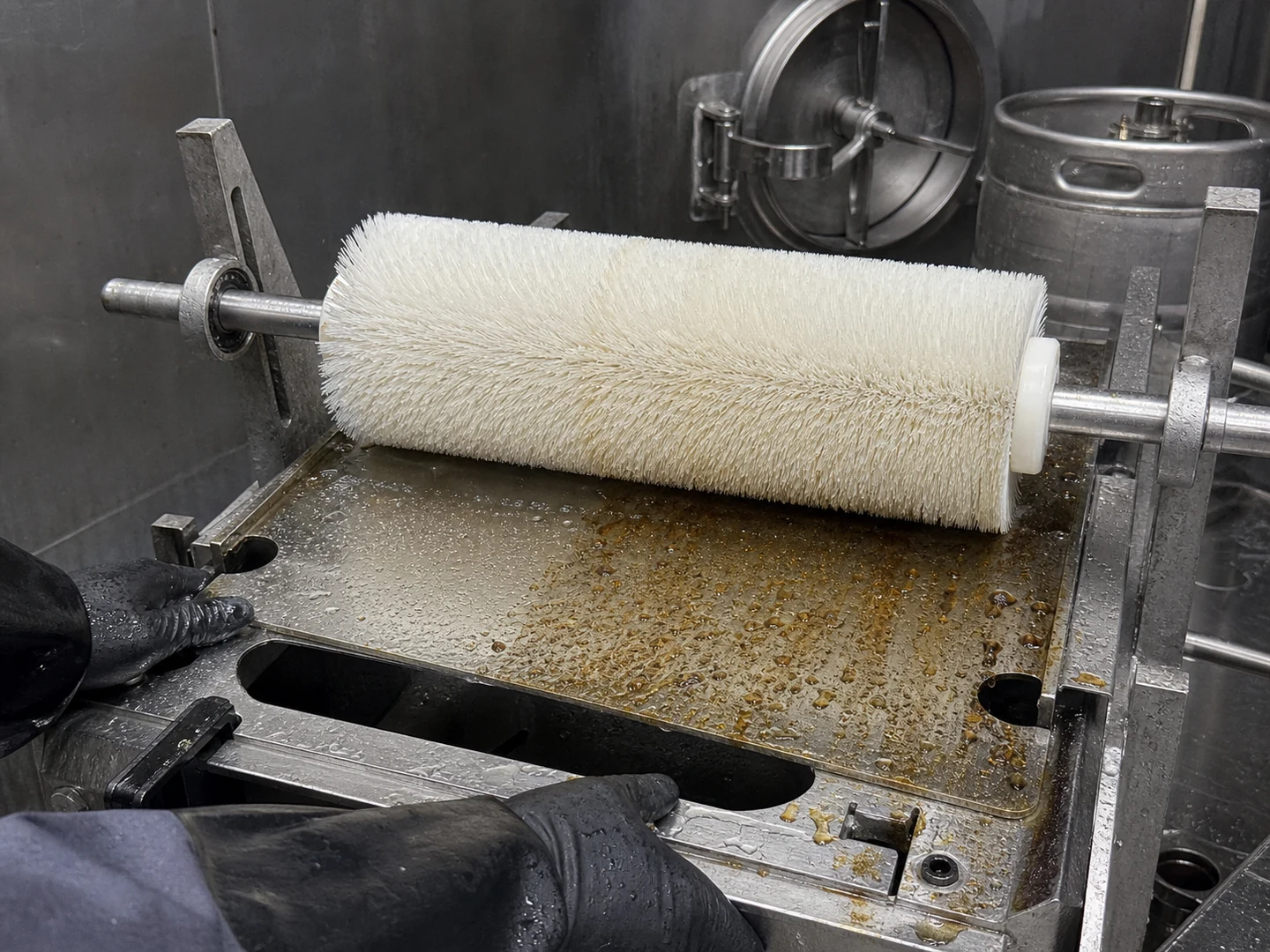
At a glance
- Cleaning target
- Syrup/Adhered Residue/Biofilm
- Working environment
- Wet Indoor Area
- Cleaning method
- Wet Brushing / Soaking / Steam Cleaning
- Requirements to check
- FDA 21 CFR; EU 10/2011; HACCP
Beverage lines cycle between acid and alkali, so the filament and core have to survive that chemistry as reliably as they have to reach the valve, keg or transfer line.
What makes Beverage Equipment Cleaning different from other food and beverage cleaning?
The main difficulty is removing crumbs, flour, fat, protein, syrup, dough, and product film from food equipment, belts, trays, tanks, containers, and process parts without damaging the surface, loading the brush, or carrying contamination back into the process.
The work happens in wet indoor area against syrup, adhered residue and biofilm.
The part people get wrong: this is not one job. The same equipment carries several targets, each with a different opening and a different residue, and one brush rarely covers them all.
What are the most common cleaning targets in Beverage Equipment Cleaning?
There are 5 distinct targets here, and the brush that suits one will usually not reach another.
| Part or area | Residue type | Cleaning requirement |
|---|---|---|
| Beverage Tank and Vat | Syrup, Adhered Residue, Biofilm | The head must pass the neck or opening, then expand against the internal wall and reach the base curve. |
| Filling-Nozzle and Valve | The head must be narrower than the opening and stiff enough to lift residue without splaying at the mouth. | |
| Keg and Cask | The head must pass the neck or opening, then expand against the internal wall and reach the base curve. | |
| Transfer-Line | The brush must pass the full length of the passage and hold contact with the wall without folding over at the far end. | |
| Carbonated-Beverage Equipment | The head must reach the working face and apply even contact without marking the surface. |
What the equipment leaves you to work inside:
| Parameter | Typical range |
|---|---|
| Filament diameter | 0.10–0.50 mm; 0.25–0.80 mm |
| Overall length | 200–450 mm; 200–600 mm |
| Trim length | 20–60 mm; 15–100 mm |
| Working width / head size | 20–2,000 mm |
| Wash temperature | 20–85°C |
Which brush types work for each cleaning target?
Tank brush, valve/nozzle tube brush, keg brush or machine-mounted roller.
| Cleaning target | Recommended brush type | Why it fits |
|---|---|---|
| Beverage Tank and Vat | Bottle & Container Brushes | A container brush sized to the opening spans the vat diameter, so the wall and the base radius are cleaned in one pass. |
| Filling-Nozzle and Valve | Handheld Detail Brushes | A filling nozzle is a small bore ending at an internal seat, so a fine head enters it and works syrup out instead of pushing it toward the product side. |
| Keg and Cask | Bottle & Container Brushes | A keg is entered through a small neck and opens into a full-diameter body, so the head has to pass the neck and then reach the shoulder from inside. |
| Transfer-Line | Tube & Pipe Bore Brushes | A transfer line is long and closed, so only a bore brush travels its length and holds contact on the wall where biofilm starts. |
| Carbonated-Beverage Equipment | Handheld Detail Brushes | Carbonated lines carry syrup that dries hard around fittings and clamps, so a hand-guided head is used to work each fitting rather than flush the whole run. |
How the brush is usually carried on the machine:
- Driven brush — use when crumbs, flour, fat, protein, syrup, dough, and product film needs repeatable scrubbing or controlled relative movement
- Passive or free-running brush — use for loose contamination and lower process complexity on food equipment, belts, trays, tanks, containers, and process parts
- Localized hand, strip, or tube brush — use where only an edge, gap, port, or maintenance point needs contact
In practical brush terms: match the construction to the access before anything else. A geometry that cannot reach the target will not be rescued by a better filament.
What filament materials work best for Beverage Equipment Cleaning?
PBT, PP, PA612 or specialist polymer chosen based on acid/alkali cycle; stainless components where appropriate and documented.
| If the condition is… | Filament to start with | Why |
|---|---|---|
| Sensitive or coated surface | Nylon PA | balanced flex life and abrasion resistance |
| Wet, washdown, or detergent service | PBT | stable wet stiffness and low moisture uptake |
| Bonded residue or aggressive cleaning | Polypropylene PP | acid, alkali, water, and detergent resistance |
What the duty rules out before you start comparing grades:
| Constraint | Value for this application |
|---|---|
| Filament hardness | Soft–Medium |
| Maximum service temperature | 100°C |
| Chemical exposure | Neutral to Alkaline pH 6–12; Peracetic Acid |
| Cleaning method | Wet Brushing, Soaking, Steam Cleaning |
How do I choose the right brush for my beverage equipment equipment?
Start from the cleaning cycle’s acid and caustic concentrations, because those eliminate materials. Tank, valve and keg geometry then picks the shape.
The order that avoids rework:
- Identify the target part and measure the access opening or clearance
- Describe the residue: what it is, how thick it sits, and how strongly it holds
- Choose the construction that can physically reach that target
- Set the filament from surface risk, working temperature and cleaning chemistry
- Fix filament diameter, free trim length and density for the contact pressure you need
- Run one cycle and check the result before committing to a production quantity
Before you commit to a quantity, send the tank, valve and keg dimensions, plus the acid and caustic concentrations and temperatures per cycle.
When is a beverage equipment brush the wrong tool?
Acid and caustic cycles do the work inside a tank or transfer line, and a keg washer beats hand cleaning outright. Brushing is for valves, gasket grooves and manway shadows where flow velocity drops and chemistry alone stops being enough.
What common mistakes should I avoid in Beverage Equipment Cleaning?
- Omitting the acid and caustic concentrations the brush will see on every cycle
- Changing brush material while leaving excessive engagement, poor alignment, or no discharge path unchanged
- Copying a worn brush without recording motion, direction, mounting, and the original working diameter
If the brush is already in service and the result is wrong, work from the symptom:
| Symptom | What to change |
|---|---|
| Residue remains | Increase relative motion or discharge, then change filament diameter or density; do not add pressure before checking loading by crumbs, flour, fat, protein, syrup, dough, and product film. |
| Surface marks or scratches | Reduce engagement, use finer or softer fill, and remove trapped abrasive particles from contact with food equipment, belts, trays, tanks, containers, and process parts. |
| Rapid wear or uneven cleaning | Check alignment, runout, support, motion, temperature, chemical attack, and whether the brush covers the complete working path. |
| Brush loads or redeposits residue | Open the fill pattern or add wash, vacuum, air, scraping, or a collection path so removed crumbs, flour, fat, protein, syrup, dough, and product film leaves the contact zone. |
Questions this page is asked
How should manual brushing be separated from a beverage system's CIP route?
Use the equipment and sanitation documents to map surfaces validated for closed-loop CIP, parts requiring disassembly and inspection, and accessible details approved for manual brushing. Do not insert a brush into a validated closed path or leave an uncleanable manual tool in the circuit unless the procedure explicitly includes it.
Which beverage-equipment details deserve a separate post-clean inspection?
Inspect disassembled valve seats, gaskets, threads, sample ports, filler details and other product hold-up spaces identified by the equipment procedure. Check for syrup film, protein, yeast, scale, gasket damage and brush fragments before reassembly, because bulk tank cleanliness does not demonstrate those interfaces are clean.
What should release beverage equipment after a brush-assisted cleaning cycle?
Complete the specified rinse volume or time and verify the site's defined chemical or residue endpoint at the locations identified by the sanitation procedure. Account for brush parts, inspect reassembled seals and record the result before product enters the equipment, rather than relying on water clarity alone.
Guides that go deeper on this
We have not written a guide specific to this one yet. The material that covers selection, filament, dimensions, maintenance and sourcing is collected in the technical resources library.
No catalogue item for this yet
Every brush here is made to order, and this one has no catalogue entry so far. Send the working surface, the residue, the access opening and the quantity, and it is quoted through the same specification route as the rest of the range.
Custom Manufacturing RFQ
Discuss This Application
Share the working surface, residue, dimensions, material direction, interface, quantity and drawing or sample photo.
Custom Brush RFQ
Request a Custom Cleaning Brush Quote
Upload a drawing, product photo, or sample photo and provide the core dimensions and cleaning conditions.
“We need a brush to remove wet residue from a stainless steel conveyor, about 800mm wide. The current brush wears quickly. We can send photos.”
“We sell drinkware and need a cleaning brush to include with the product. Quantity around 5,000 pieces.”