
Application
Drain and Sewer Pipe Sludge Cleaning
For Drain and Sewer Pipe Sludge Cleaning, the brush must reach the working area, disturb or collect sludge/hair/grease/biofilm, and release it without creating unacceptable surface damage or process interference. Choose the brush structure from the available access, contact direction, and cleaning process.
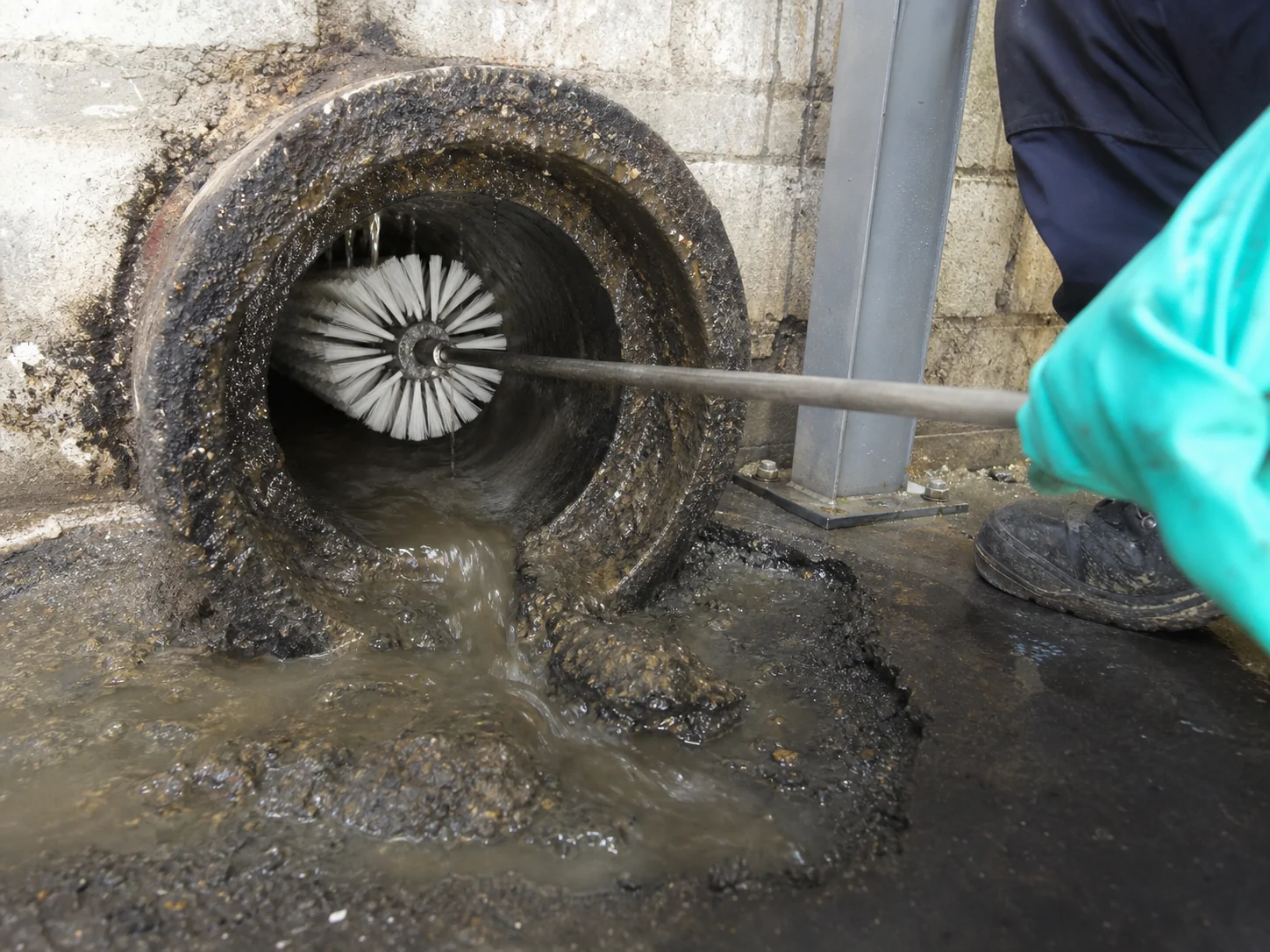
At a glance
- Cleaning target
- Sludge/Hair/Grease/Biofilm
- Working environment
- Underwater / Wet Indoor Area
- Cleaning method
- Wet Brushing / Soaking
- Requirements to check
- Wastewater-Work Hygiene and Confined-Space SOP
Drain work runs from a sink trap to a municipal main, so the brush is defined by bore, run length and drive method — and a grease line is treated as a different job from sludge.
What makes Drain and Sewer Pipe Sludge Cleaning different from other facility, floor and outdoor cleaning?
The task is to remove Sludge/Hair/Grease/Biofilm while controlling surface damage, residue carryover, brush shedding and chemical or temperature degradation.
The work happens in underwater and wet indoor area against sludge, hair, grease and biofilm.
The part people get wrong: the surface, the residue and the access opening decide the brush together. Fix on any one of them alone and the geometry comes out wrong.
What are the most common cleaning targets in Drain and Sewer Pipe Sludge Cleaning?
The work breaks into 5 targets. They look similar from outside the machine and behave nothing alike at the brush.
| Part or area | Residue type | Cleaning requirement |
|---|---|---|
| Sink and Kitchen Drain | Sludge, Hair, Grease, Biofilm | The brush must pass the full length of the passage and hold contact with the wall without folding over at the far end. |
| Floor-Drain | ||
| Grease-Line | ||
| Building Sewer Pipe | ||
| Municipal Sewer Main |
What the equipment leaves you to work inside:
| Parameter | Typical range |
|---|---|
| Contaminant | Sludge/Hair/Grease/Biofilm |
| Required hardness | Medium–Hard |
| Maximum temperature | 80°C |
| Chemical exposure | Acidic pH 2–5; Alkaline pH 9–13; Chlorinated Cleaner |
| Cleaning method | Wet Brushing/Soaking |
| Environment | Underwater/Wet Indoor Area |
Which brush types work for each cleaning target?
Select hand, tube, strip, roller, disc or machine-mounted geometry from access and motion.
| Cleaning target | Recommended brush type | Why it fits |
|---|---|---|
| Sink and Kitchen Drain | Tube & Pipe Bore Brushes | A sink drain is a short trap that packs with hair and fat, so a slim bore brush fed through the outlet pulls the plug back out of the trap. |
| Floor-Drain | A floor drain has a basket over a wider trap body, so a larger bore-brush head reaches the trap wall the basket keeps out of sight. | |
| Grease-Line | A grease line coats evenly with fat, so a close-fitting bore brush shears that layer off the wall instead of melting a channel through the middle of it. | |
| Building Sewer Pipe | A building drain is long and turns, so the brush travels on rods and has to stay in contact through each bend rather than skate past it. | |
| Municipal Sewer Main | A main is large enough to brush from a winch line, so the head is sized to the pipe and drawn through, working the whole circumference in one pass. |
All five run on a hand rod or a powered drain machine, pushed in from an access point rather than mounted anywhere.
In practical brush terms: match the construction to the access before anything else. A geometry that cannot reach the target will not be rescued by a better filament.
What filament materials work best for Drain and Sewer Pipe Sludge Cleaning?
PA66 gives the stiffness needed to push a sludge plug along the bore, and it recovers after being folded through a bend — which is what a brush on a rod actually has to survive.
| If the condition is… | Filament to start with | Why |
|---|---|---|
| Pushing a sludge plug along the bore | PA66 Nylon | stiff enough to move the plug rather than pass through it |
| Folding through a bend on a rod | PA66 Nylon | recovers its form after the bend, so contact resumes |
What the duty rules out before you start comparing grades:
| Constraint | Value for this application |
|---|---|
| Filament hardness | Medium–Hard |
| Maximum service temperature | 80°C |
| Chemical exposure | Acidic pH 2–5; Alkaline pH 9–13; Chlorinated Cleaner |
| Cleaning method | Wet Brushing, Soaking |
How do I choose the right brush for my drain and sewer pipe sludge equipment?
Start with medium-to-hard fill, an 80°C ceiling and an acidic cleaner at pH 2–5, then size to bore, run length and the drive you actually have.
The sequence that gets a usable sample first time:
- Identify the target part and measure the access opening or clearance
- Describe the residue: what it is, how thick it sits, and how strongly it holds
- Choose the construction that can physically reach that target
- Set the filament from surface risk, working temperature and cleaning chemistry
- Fix filament diameter, free trim length and density for the contact pressure you need
- Run one cycle and check the result before committing to a production quantity
Before you commit to a quantity, send the pipe bore, the run length, the number of bends, and how the brush will be driven.
When is a drain and sewer pipe sludge brush the wrong tool?
Jetting and an auger clear a blockage; a brush is a maintenance tool for a line that already flows. Grease lines are pumped and treated rather than brushed, and a collapsed or root-broken pipe needs repair before any tool goes in.
What common mistakes should I avoid in Drain and Sewer Pipe Sludge Cleaning?
- Giving pipe length without bore, bend count and how the brush will be driven
- Changing the filament while leaving excessive engagement, poor alignment or no discharge path unchanged
- Copying a worn brush without first recording its motion, direction, mounting and original working diameter
If the brush is already in service and the result is wrong, work from the symptom:
| Symptom | What to change |
|---|---|
| Residue remains | Increase discharge or relative motion before adding pressure |
| Surface marks | Reduce engagement and use finer/softer fill |
| Rapid wear | Check alignment, temperature and chemical attack |
| Redeposition | Add wash, vacuum or collection path |
Questions this page is asked
What prevents a long drain brush from becoming lodged in the pipe?
Confirm the pipe material, internal diameter, bends, transitions, known damage and access length, then select a brush, shaft and coupling rated for that geometry. Establish a retrieval limit and stop at abnormal resistance rather than forcing the brush past a collapsed pipe, root intrusion, offset joint or unknown obstruction.
When does sewer-pipe brushing require atmospheric or confined-space controls?
Apply the site's hazard assessment anywhere hydrogen sulfide, oxygen deficiency, methane, sewage aerosols or an entry space may affect the worker, even if the tool is operated from an opening. Do not enter a manhole, vault or pipe without the required permit, isolation, testing, ventilation, attendant and rescue provisions.
How is a drain or sewer brush handled after contaminated use?
Wear the procedure-defined protection, contain drips and solids, and clean and disinfect the recoverable tool at the designated wastewater-controlled location using a compatible method. Inspect the shaft, couplings and fill, then dry and store it away from clean tools or dispose of it under the facility's contaminated-equipment rules.
Guides that go deeper on this
No catalogue item for this yet
Every brush here is made to order, and this one has no catalogue entry so far. Send the working surface, the residue, the access opening and the quantity, and it is quoted through the same specification route as the rest of the range.
Custom Manufacturing RFQ
Discuss This Application
Share the working surface, residue, dimensions, material direction, interface, quantity and drawing or sample photo.
Custom Brush RFQ
Request a Custom Cleaning Brush Quote
Upload a drawing, product photo, or sample photo and provide the core dimensions and cleaning conditions.
“We need a brush to remove wet residue from a stainless steel conveyor, about 800mm wide. The current brush wears quickly. We can send photos.”
“We sell drinkware and need a cleaning brush to include with the product. Quantity around 5,000 pieces.”