
Application
Tire Swabbing, Lubrication and Dressing
Tire Swabbing, Lubrication and Dressing is a process-use page rather than a general cleaning category. Select the brush from the required contact function, working surface, motion, and interface, then verify how Tire Dressing Compound/Wax/Oil Film/Road Film and Dry Indoor Area / Outdoor affect the construction.
At a glance
- Cleaning target
- Tire Dressing Compound/Wax/Oil Film/Road Film
- Working environment
- Dry Indoor Area / Outdoor
- Cleaning method
- Wet Brushing / Application
- Requirements to check
- Automotive Detailing Process Requirements; Low Shedding; Resistance to Care Products
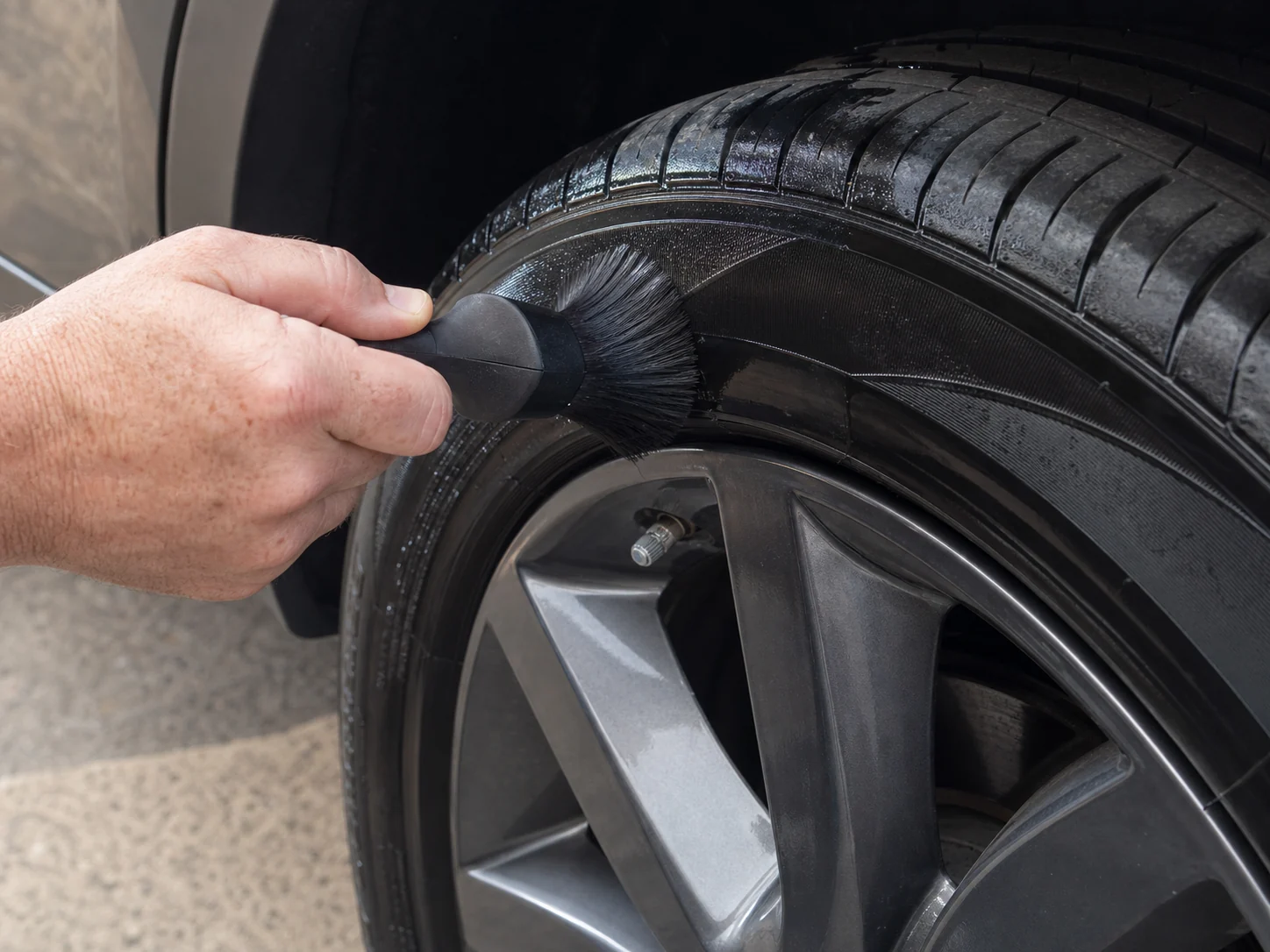
Here the brush applies rather than removes: a mounting swab has to carry lubricant evenly onto the bead, and a dressing applicator has to lay film on the sidewall without flinging it onto paint.
What makes Tire Swabbing, Lubrication and Dressing different from other automotive and transportation cleaning?
The task is to remove Tire Dressing Compound/Wax/Oil Film/Road Film while controlling surface damage, residue carryover, brush shedding and chemical or temperature degradation.
The work happens in dry indoor area and outdoor against tire dressing compound, wax, oil film and road film.
The part people get wrong: this is not one job. The same equipment carries several targets, each with a different opening and a different residue, and one brush rarely covers them all.
What are the most common cleaning targets in Tire Swabbing, Lubrication and Dressing?
There are 4 distinct targets here, and the brush that suits one will usually not reach another.
| Part or area | Residue type | Cleaning requirement |
|---|---|---|
| Tire-Mounting Lubricant Application | Mounting lubricant applied rather than removed | The head must reach the working face and apply even contact without marking the surface. |
| Tire Sidewall Dressing | Tire Dressing Compound, Wax, Oil Film, Road Film | |
| Tire Cleaning Before Dressing | ||
| Whitewall and Raised-Letter Treatment |
What the equipment leaves you to work inside:
| Parameter | Typical range |
|---|---|
| Contaminant | Tire Dressing Compound/Wax/Oil Film/Road Film |
| Required hardness | Soft–Medium |
| Maximum temperature | 60°C |
| Chemical exposure | Water-Based or Silicone-Oil Tire Dressing; Hydrocarbon-Based Care Product |
| Cleaning method | Wet Brushing/Application |
| Environment | Dry Indoor Area/Outdoor |
Which brush types work for each cleaning target?
Select hand, tube, strip, roller, disc or machine-mounted geometry from access and motion.
| Cleaning target | Recommended brush type | Why it fits |
|---|---|---|
| Tire-Mounting Lubricant Application | Handheld Detail Brushes | Mounting paste has to go onto the bead all round in seconds, so a curved head follows the bead seat and lays the same film on every part of it. |
| Tire Sidewall Dressing | Dressing shows every missed patch, so the head has to follow the sidewall curve and lay an even film from the bead line out to the tread shoulder. | |
| Tire Cleaning Before Dressing | Dressing applied over road film fails early, so the same curved head is used first to break that film across the whole sidewall. | |
| Whitewall and Raised-Letter Treatment | Raised letters have to be picked out without dressing the black around them, so a hand-guided head lets the operator work letter by letter. |
All hand-applied. These are applicators rather than scrubbers, and each one stays dedicated to a single product so the dressings do not mix.
In practical brush terms: match the construction to the access before anything else. A geometry that cannot reach the target will not be rescued by a better filament.
What filament materials work best for Tire Swabbing, Lubrication and Dressing?
Cotton yarn, because the job is carrying and laying down dressing evenly rather than scrubbing — a synthetic fill holds far less product and leaves streaks down the sidewall.
| If the condition is… | Filament to start with | Why |
|---|---|---|
| Laying dressing down evenly | Cotton Yarn | carries far more product than a synthetic fill and leaves no streak |
| Silicone-oil and hydrocarbon dressings | Cotton Yarn | unaffected by the care products it sits in |
What the duty rules out before you start comparing grades:
| Constraint | Value for this application |
|---|---|
| Filament hardness | Soft–Medium |
| Maximum service temperature | 60°C |
| Chemical exposure | Water-Based or Silicone-Oil Tire Dressing; Hydrocarbon-Based Care Product |
| Cleaning method | Wet Brushing, Application |
How do I choose the right brush for my tire swabbing, lubrication and dressing equipment?
Start with soft-to-medium fill, a 60°C ceiling and a water-based or silicone-oil dressing, then size the applicator to the bead or sidewall it coats.
The order that avoids rework:
- Identify the target part and measure the access opening or clearance
- Describe the residue: what it is, how thick it sits, and how strongly it holds
- Choose the construction that can physically reach that target
- Set the filament from surface risk, working temperature and cleaning chemistry
- Fix filament diameter, free trim length and density for the contact pressure you need
- Run one cycle and check the result before committing to a production quantity
Before you commit to a quantity, send the tire sizes, the lubricant or dressing you apply, and the film thickness you are aiming for.
When is a tire swabbing, lubrication and dressing brush the wrong tool?
Spray and foam applicators lay a more even film than a swab across large batches, and gel dressings are applied by pad. A brush is the wrong applicator wherever overspray onto paint, brake surfaces or the tread face cannot be tolerated.
What common mistakes should I avoid in Tire Swabbing, Lubrication and Dressing?
- Ordering a cleaning brush when the requirement is an applicator that lays an even film
- Changing the filament while leaving excessive engagement, poor alignment or no discharge path unchanged
- Copying a worn brush without first recording its motion, direction, mounting and original working diameter
If the brush is already in service and the result is wrong, work from the symptom:
| Symptom | What to change |
|---|---|
| Residue remains | Increase discharge or relative motion before adding pressure |
| Surface marks | Reduce engagement and use finer/softer fill |
| Rapid wear | Check alignment, temperature and chemical attack |
| Redeposition | Add wash, vacuum or collection path |
Guides that go deeper on this
No catalogue item for this yet
Every brush here is made to order, and this one has no catalogue entry so far. Send the working surface, the residue, the access opening and the quantity, and it is quoted through the same specification route as the rest of the range.
Custom Manufacturing RFQ
Discuss This Application
Share the working surface, residue, dimensions, material direction, interface, quantity and drawing or sample photo.
Custom Brush RFQ
Request a Custom Cleaning Brush Quote
Upload a drawing, product photo, or sample photo and provide the core dimensions and cleaning conditions.
“We need a brush to remove wet residue from a stainless steel conveyor, about 800mm wide. The current brush wears quickly. We can send photos.”
“We sell drinkware and need a cleaning brush to include with the product. Quantity around 5,000 pieces.”