
Custom Cleaning Brush
Baking Tray Cleaning Brush
Custom baking tray cleaning brushes for bakeries and food processing. PBT or PP filaments, 50–300 mm heads, M6–M10 threaded mounts for hand or washer use.
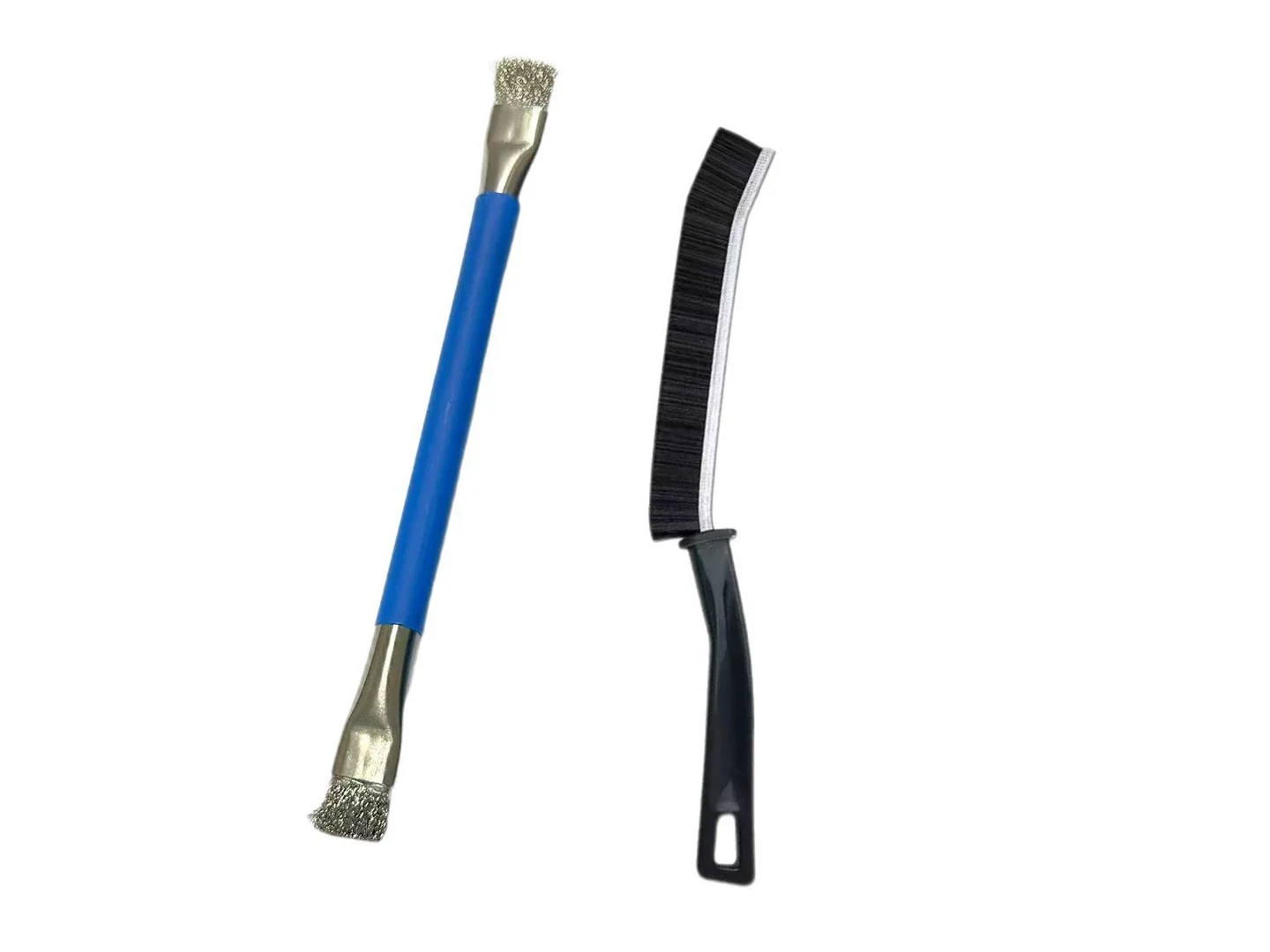
Medium brush
100 pcs
Minimum order
Worked with two hands or on a pole: chimney, gutter and pond-filter brushes, discs, cups and tank brushes.
Production lead time, once the specification is confirmed
- Up to 100 pcsWithin 7 days
- 101–5,000 pcsWithin 14 days
- 5,001–50,000 pcsWithin 21 days
- Over 50,000 pcsConfirmed with your quotation
Peak season can extend these times; the shipping date is confirmed in writing with your quotation. Sampling and shipping are quoted separately.
A custom-built baking tray cleaning brush for bakeries, commercial kitchens, and food processing lines. It clears baked-on dough, starch, sugar, oils, and washdown soil from tray surfaces, edges, and perforations, and is available as a hand brush or threaded machine-mount configuration with PBT or polypropylene fill.
What can this brush do for you?
Wide heads clear full tray bases and side flanges
Head widths from 50 mm to 300 mm cover the main floor of sheet pans, bun pans, and bakery trays in fewer passes. Wide coverage reduces the number of individual scrub strokes between wash cycles and keeps tray handling moving on a production line.
Stiff PBT filament for dried dough, sugar, and starch
PBT retains its stiffness in hot, wet washdown conditions and resists bending under operator pressure. A 0.25–0.80 mm PBT fill with a short-to-medium trim cuts through dried flour film, caramelized sugar, and hardened dough without the wire-brush scratching that can damage aluminum or stainless trays.
Polypropylene fill for oils, detergents, and soft contact
PP filaments resist oil, alkaline detergents, and continuous moisture while applying a gentler contact. For plastic trays, non-stick coated sheets, or greasy wash lines, PP gives chemical resistance with less risk of surface marking than PBT.
Threaded interface works as a hand tool or a machine part
M6, M8, M10, or project-specified thread grade for food-area use let the same brush head screw onto a hand handle, an extension pole, or a tray-washer holder. Maintenance teams can standardize one brush pattern for manual stations and automated lines, and replace only the worn head instead of the entire assembly.
Temperature and moisture tolerance for washdown environments
The selected PBT and PP grades operate continuously at 0–120°C and have very low water absorption. They will not soften at hot wash temperatures or swell and lose shape after repeated flooding, soaking, and drying cycles.
What is a Baking Tray Cleaning Brush?
A Baking Tray Cleaning Brush is a flat or contoured brush head with dense PBT or PP filaments, sized to scrub baking trays, sheet pans, bun pans, and similar food-contact tray surfaces. It is used where tray residue is too heavy for spray rinsing alone but still soft enough to remove safely with plastic filament rather than wire or abrasive pads.
In hand use, the operator works the brush across the tray base, side rails, and corner radii with push-pull strokes. In machine use, the same head pattern mounts into a tray-washer brush holder or rotary arm, where it applies continuous contact as trays pass through the wash zone. The block or backing material is matched to the mounting and wash chemistry: polypropylene, stainless steel, or aluminum are common, depending on whether the brush is hand-operated, pole-mounted, or bolted into equipment.
The brush is designed for organic baking and food residues such as flour, starch, sugar glazes, egg wash, oils, dough, and washdown soil. It is not a replacement for a caustic soak, carbon removal, or abrasive scouring. Plastic filament is the right trade-off when you need effective mechanical cleaning without gouging the tray surface or leaving metal contamination behind.
Technical Specifications
The ranges below reflect common bakery and food-processing tray configurations. We size each build to the tray geometry, mounting point, and residue type; custom values outside these ranges are available.
| Parameter | Value / Options |
|---|---|
| Head width | 50–300 mm, set to cover the tray base or lane width |
| Trim length | 20–60 mm, shorter for a firmer scrub, longer for recessed or contoured trays |
| Overall length | 200–600 mm, matched to hand reach or machine mount distance |
| Filament diameter | 0.25–0.80 mm; finer for film and perforations, heavier for caked residue |
| Fill material | PBT for stiffness and abrasion resistance; PP for chemical resistance and softer contact |
| Threaded handle | M6, M8, M10, or project-specified thread grade for food-area use, for hand handles, poles, and machine holders |
| Operating temperature | 0–120°C continuous with selected PBT/PP grades |
| Backing / block | Polypropylene, stainless steel, or aluminum, selected for mount and washdown exposure |
| Mounting style | Hand scrubbing, pole mount, fixed holder, or rotary machine mount |
| Brush type | Custom Handheld Detail Brushes |
| How it is driven | Hand-guided |
| Cleaning target | commercial bakery tray washer, sheet pan, and perforated and wire-mesh baking tray cleaning |
| Surface or part | trays, aluminum, plastic, pans, sheets, metal, holes, and edges |
| Residue or debris | oil, dough, sugar, starch, washdown soil, scale, flour, and food residue |
| Mounting / connection | Hand scrubbing, pole mount, fixed holder, or rotary machine mount |
Where does this brush work best?
- Commercial bakery tray washers where aluminum or stainless baking trays run continuously after depanning and need residue removed before stacking.
- Sheet pan, bun pan, and baking tray cleaning stations in industrial bakeries and central kitchens.
- Perforated and wire-mesh baking trays where dough and sugar lodge in holes and need filament contact through the openings.
- Plastic bakery and distribution trays where a PP fill removes oils and light soil without marring the surface.
- Food production tray washdown areas handling starch, oil, and scale, including trays used for baked goods, produce, or prepared foods.
- Non-stick coated baking sheets in manual or lower-temperature washing stations where controlled PP contact is preferred over metal scrubbing tools.
How do I choose the right one?
Start with tray width and pass coverage
Measure the flat working surface and any side flange. Choose a head width that covers the main surface without the operator scrubbing strip by strip. For trays wider than about 300 mm, use two heads side by side, a wider custom block, or a machine brush lane sized across the tray path.
Match filament material and diameter to the residue and surface
PBT is the default for aluminum, stainless, and uncoated metal trays with dried flour, sugar, and oil. PP is the safer choice for plastic trays, coated surfaces, and lighter films where scratching matters more than aggressive removal. Finer filament, around 0.25–0.40 mm, reaches into perforations and removes surface film. Heavier filament, 0.50–0.80 mm, breaks up thicker caked dough and scale.
Set trim length for flex and recess reach
A short trim, 20–35 mm, gives firmer contact for flat, heavy residue. A longer trim, 40–60 mm, bends into corner radii, raised rims, and perforated depressions. If the tray has deep embossed areas, a contoured trim or mixed trim pattern keeps contact across high and low zones.
Select the interface for manual or machine use
Hand scrubbing works best with an M6 or M8 thread and a comfortable grip or extension handle. Automated tray washers usually need M10 or a project-specified food-area thread grade to match the holder and to survive frequent head changes. Define the thread pitch and rotation direction before ordering, especially for rotary mounts that may loosen if threaded against rotation.
Check temperature and wash chemistry
For hot water wash at 80–120°C with alkaline, chlorinated, or quaternary detergents, specify the chemical and temperature range with the order. PP generally handles aggressive chemical exposure well, while PBT is chosen for stiffness; the backing and thread material must survive the same wash environment.
When to use a different tool
If residue is carbonized, fused, or mineral scale, plastic filament will wear quickly; use a wire brush, abrasive pad, or a chemical soak step first. For non-stick coated trays, always test PP trim on a sample tray before full deployment, and never use stiff PBT under heavy pressure if scratching is unacceptable. For deep corner, hole, or tube-like features, pair this brush with a small detail brush or tube brush rather than forcing a wide head into a small opening.
Can I customize this brush?
Baking tray cleaning brushes are project-specific. We customize the head, filament, mount, and packaging to the tray, residue, and wash station.
- Head dimensions and shape — width, length, block depth, flat or contoured face, angled edge, or notched blocks for corners.
- Filament system — PBT, PP, or mixed fill; filament diameter, trim length, trim profile, density, and color.
- Thread and mounting — M6, M8, M10, project-specified food-area thread grade, male or female thread, quick-release, bolt holes, or machine holder plate.
- Handle and operator interface — straight handle, T-grip, extension pole, replaceable-head handle, or molded branding.
- Backing / block material — polypropylene, stainless steel, aluminum, or customer-specified food-contact material.
- Marking and identification — custom color, pad print, laser mark, molded ID, or color-coded trim for food zones.
- Packaging — bulk, individual bag, box, retail sleeve, color-coded case, or project-specific labels.
To define the configuration, send the tray dimensions, tray material, residue type, wash temperature, detergent, manual or machine mounting, thread size, and photos or drawings of the tray and holder. A used tray or sample part speeds up fit confirmation.
If your project requires food-contact material documentation, third-party inspection, or compliance review for your specific standards, we can support those requirements during the customization process.
When is a baking tray cleaning brush worn out rather than just dirty?
How do I know when the brush head needs replacement?
Check the trim length against a new head. When filaments are worn down by 30% or more, splayed flat, or losing stiffness so that residue remains after the same number of passes, replace the head. Also look for cracked backing, damaged threads, or loose filament tufts that could fall into the tray.
Will this brush scratch non-stick coated baking trays?
It depends on filament and pressure. PBT can leave hairline marks on some non-stick finishes under heavy pressure. Use PP with a longer trim and test the brush on a scrap tray first. If bright metal or coating damage is still visible, switch to a softer filament or reduce operator pressure.
Can this brush be used in a rotating tray washer?
Yes, when the thread and balance are specified for the holder. For rotary use, the thread direction should match rotation so the head tightens or locks in operation, and the backing needs enough stiffness to stay flat under machine pressure. Provide the holder dimensions and rotation direction before ordering.
Does this brush remove burned, carbonized sugar or blackened dough?
Plastic filament removes dried and baked-on residues, but not carbon that has fused into the metal surface. For blackened, glassy deposits, use a chemical soak or descaling step first, then finish with this brush. Forcing plastic filament against carbon mainly wears the brush and spreads the residue.
How should the brush be cleaned and stored between shifts?
Rinse with hot water and approved detergent, flush loose residue out of the filament base, and hang the brush head-down to dry. Do not soak the backing in solvent or leave it submerged in caustic solution for long periods. Store away from direct heat and sharp metal edges that can nick the block.
What should I check before using the brush on a new tray size or coating?
Run the brush over a scrap tray or a lower-side area first. Check that the filament face contacts the full tray base without skipping, that edges and perforations are reached, and that no scratch marks appear on coated surfaces. If contact is uneven, adjust the trim, width, or pressure before moving into production.
Guides that go deeper on this
RELATED BRUSH RESOURCES
Recommended Reading & Related Brush Resources
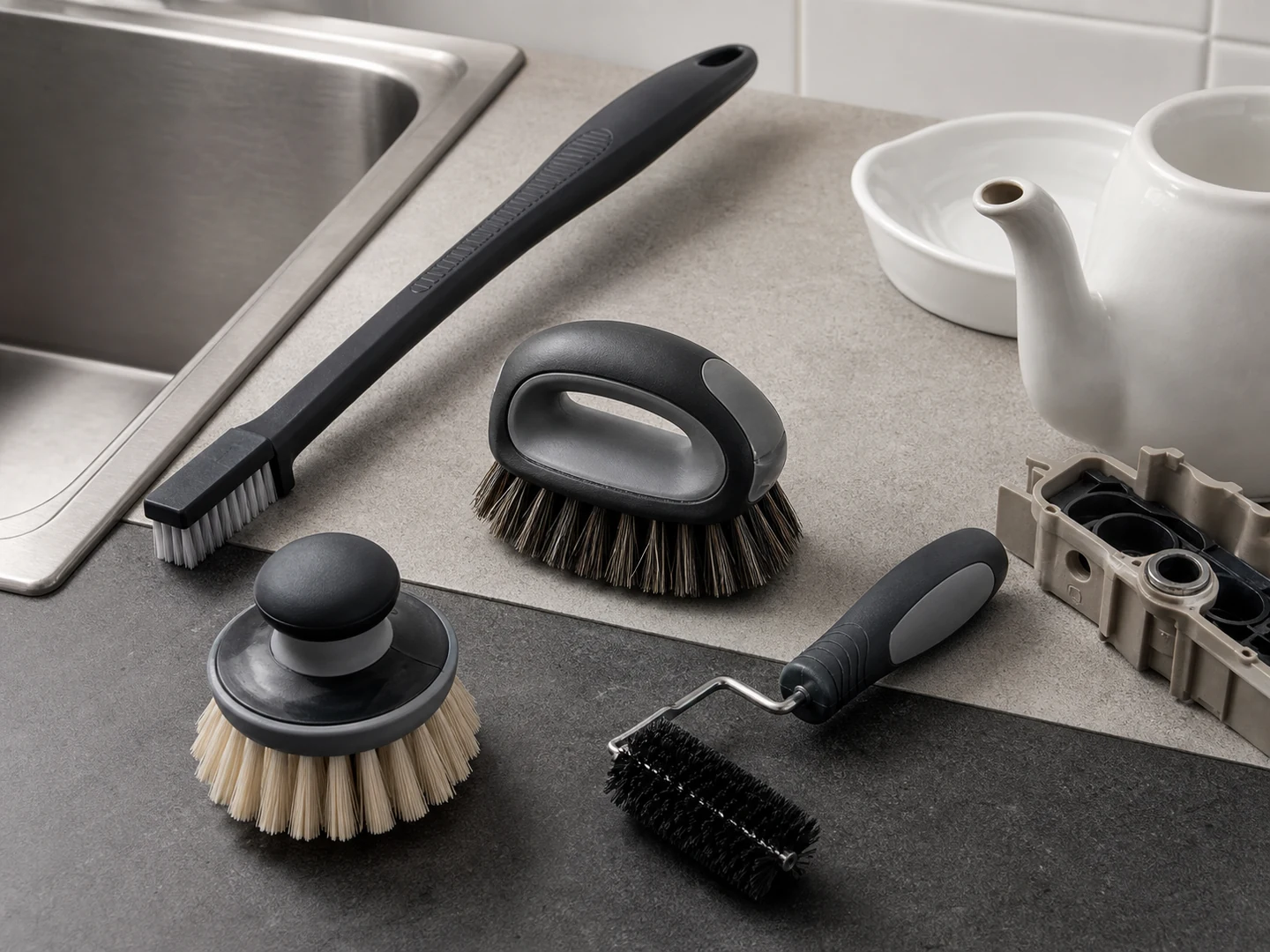
Custom Handheld Detail Brushes
Choose a handheld detail brush when you need direct control in seams, recesses, fittings,…
See how this type is built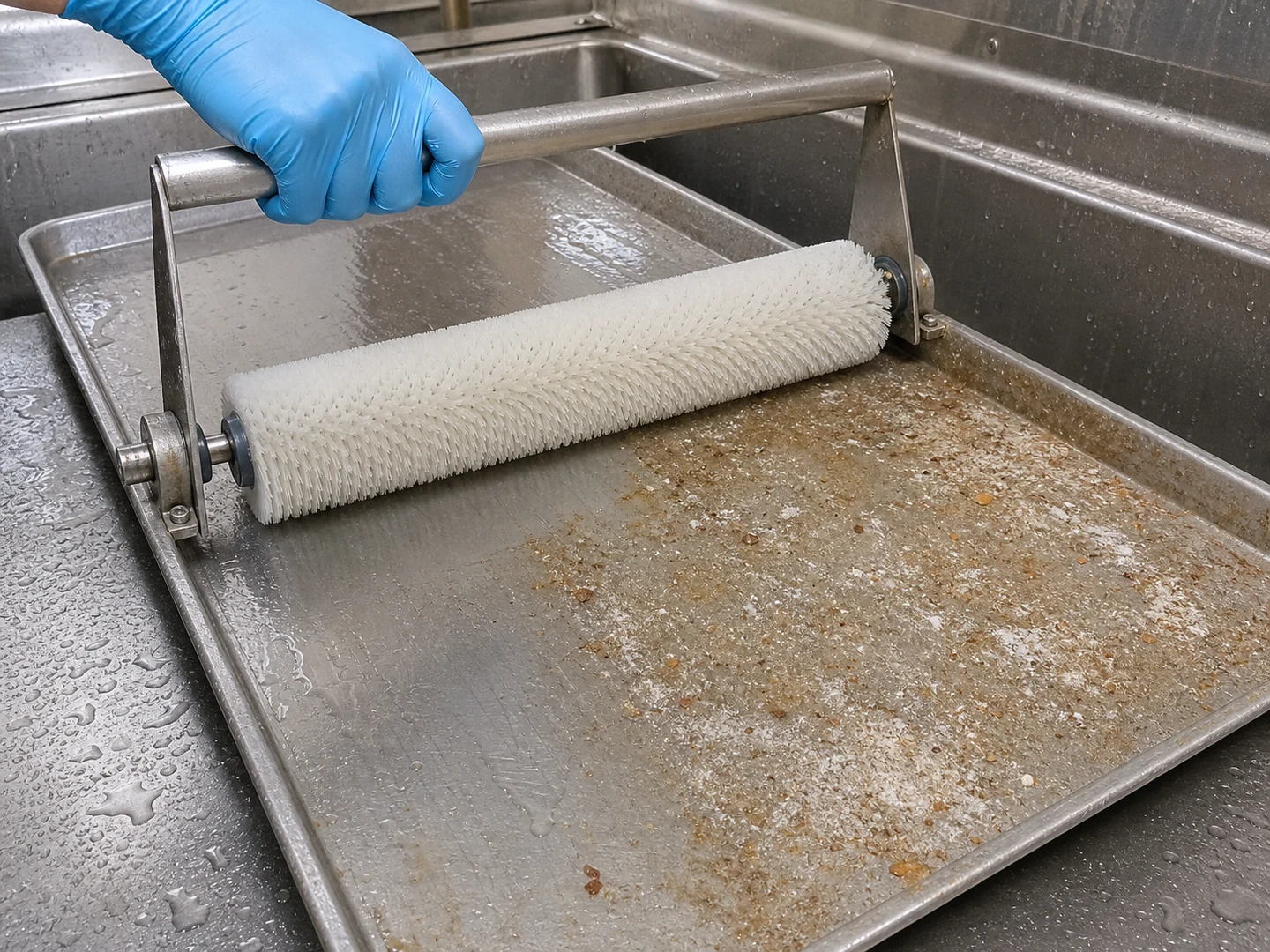
Bakery Tray Cleaning
For Bakery Tray Cleaning, the brush must reach the working area, disturb or collect…
See the cleaning job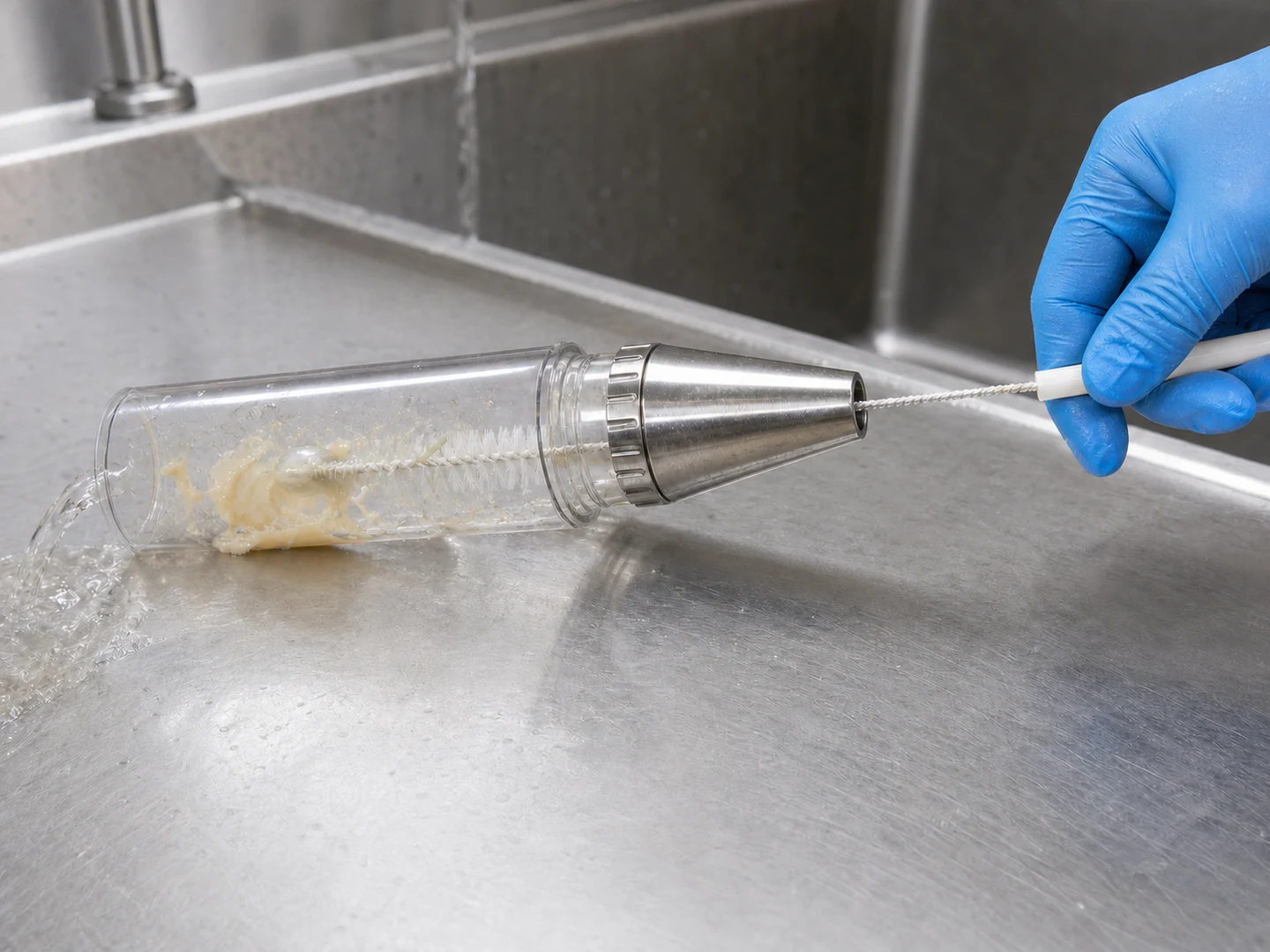
Pastry Tube Cleaning
For Pastry Tube Cleaning, the brush must reach the working area, disturb or collect…
See the cleaning job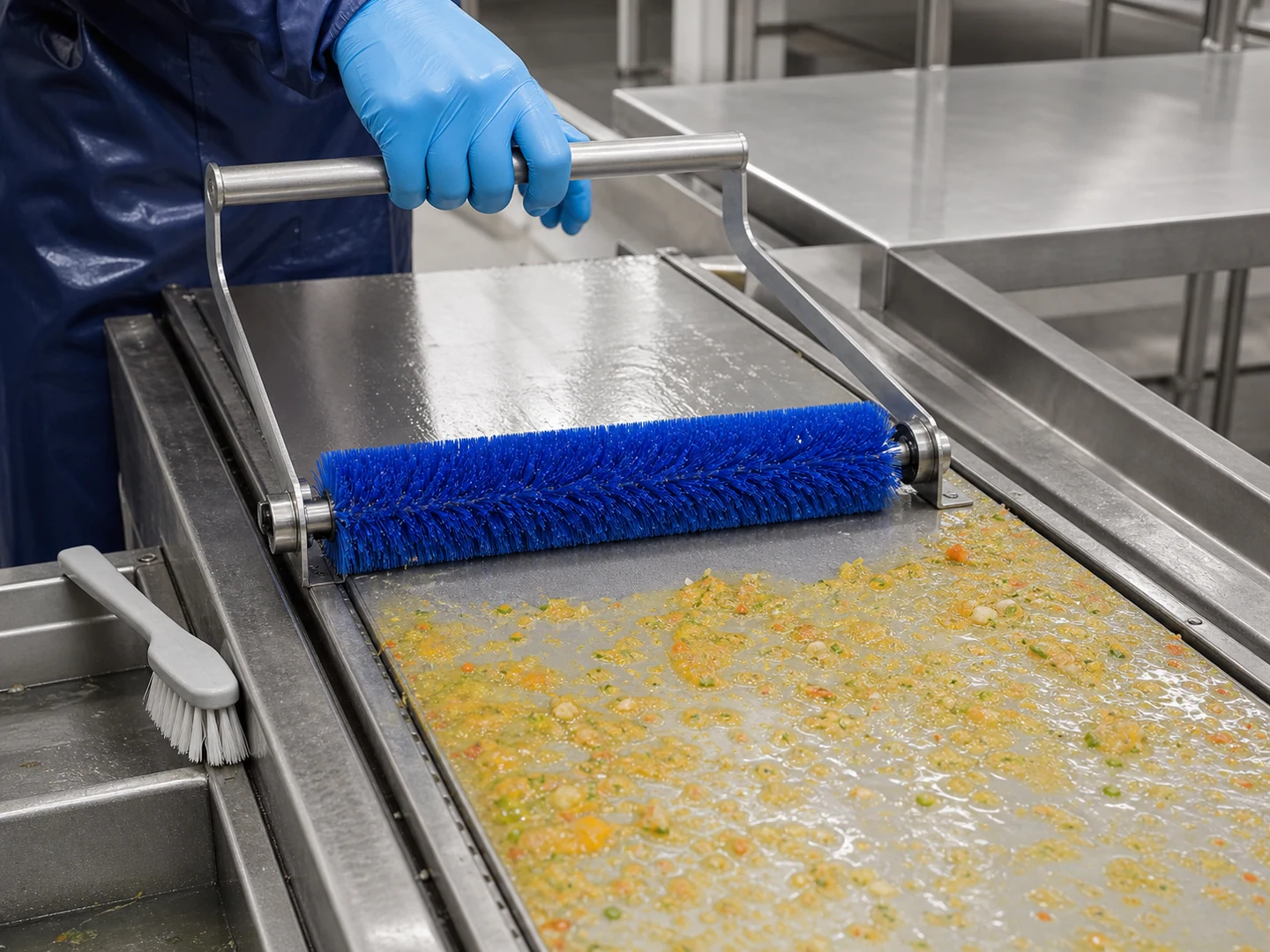
Food Equipment Cleaning
For Food Equipment Cleaning, the brush must reach the working area, disturb or collect…
See the cleaning jobCustom Manufacturing RFQ
Describe Your Application
An accurate custom quote starts with the dimensions, working surface, residue, material choice, connection, quantity, and reference files.
Drawing or photo optional — it speeds things up, it does not gate the enquiry.
Custom Brush RFQ
Send Your Brush Project
Upload a drawing, product photo, or sample photo and provide the core dimensions and cleaning conditions.
“We need a brush to remove wet residue from a stainless steel conveyor, about 800mm wide. The current brush wears quickly. We can send photos.”
“We sell drinkware and need a cleaning brush to include with the product. Quantity around 5,000 pieces.”