
Custom Cleaning Brush
Gutter Cleaning Brush
Clear rain gutters without a ladder. Pole-mountable gutter brush with stiff PP/PA fill, curved heads from 100–300 mm, and M18/3/4 inch or ACME threads.
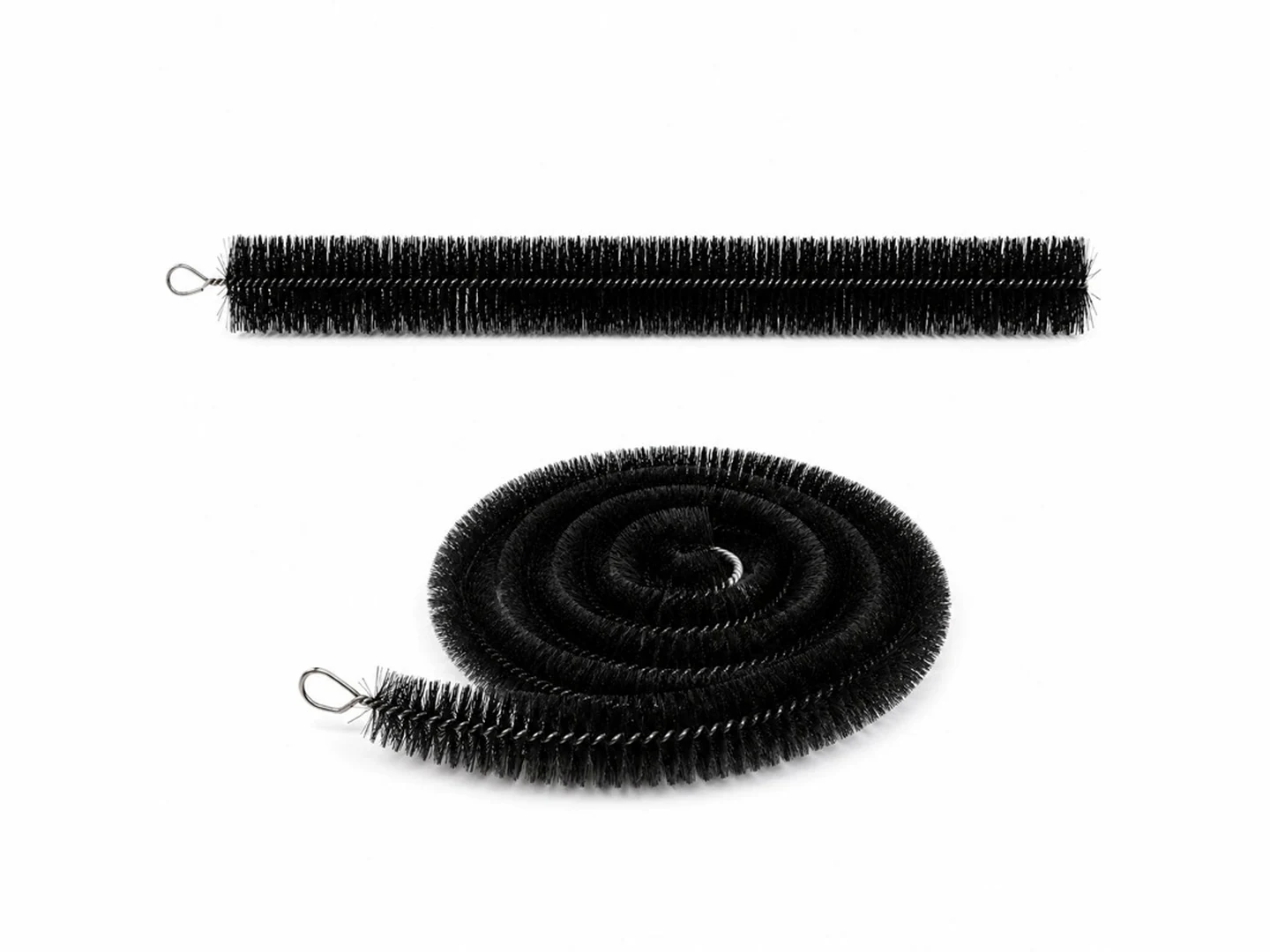
Medium brush
100 pcs
Minimum order
Worked with two hands or on a pole: chimney, gutter and pond-filter brushes, discs, cups and tank brushes.
Production lead time, once the specification is confirmed
- Up to 100 pcsWithin 7 days
- 101–5,000 pcsWithin 14 days
- 5,001–50,000 pcsWithin 21 days
- Over 50,000 pcsConfirmed with your quotation
Peak season can extend these times; the shipping date is confirmed in writing with your quotation. Sampling and shipping are quoted separately.
A pole-mountable gutter brush with a contoured head and stiff synthetic fill that clears leaves, pine needles, moss, and packed silt from open rain gutters while you stay on the ground.
What can this brush do for you?
Rides the gutter trough instead of pivoting in it
The backing block is formed to common gutter profiles, including curved half-round and squared K-style channels. Bristles stay in contact across the bottom and the inside corners, so one pass removes material that a flat brush would slide over. The brush follows the channel, not the operator’s wrist angle.
Lifts matted debris instead of skimming the top
Leaves, pine straw, and wind-blown grit pack into a wet mat after a few rainfalls. Stiff PP and PA filaments in 0.25–1.20 mm diameters push under the edge of the mat and break it loose. The fill works beneath the layer, loosening material that a scoop or soft broom would ride over.
Keeps ladder work to a minimum
The threaded block accepts standard extension poles and telescopic handles, so most single-story gutters and many two-story reaches can be cleared from the ground. That puts the operator behind the brush stroke with both hands on the pole instead of balanced on a ladder rung.
Stays stiff when wet and exposed
Polypropylene and nylon both resist moisture absorption, so the fill does not go limp after first contact with water, and it does not hold mold the way natural fiber does. UV-stabilized grades hold their stiffness and color through seasons of sun and roof heat.
Reaches the corners, hangers, and downspout mouth
The working edge can be narrowed or angled so the tip catches debris behind gutter brackets and in the tight turn at the downspout outlet. That is the zone where the next clog forms first.
What is a Gutter Cleaning Brush?
A gutter cleaning brush is a pole-driven brush head built for open rain gutter channels. It combines a contoured backing block—typically polypropylene or glass-filled nylon—with a fill face of stiff synthetic filaments. The operator moves the head back and forth along the channel, and the fill hooks, lifts, and pushes debris to a collection point or over the outer edge.
It is a mechanical loosening and displacing tool, not a vacuum. Wet leaves, pine needles, moss, seed pods, asphalt grit, and decomposing organic sludge come away from the gutter bottom by bristle action. The brush does not suck up material; it moves it so a hose rinse or gravity can carry it away.
The brush works best when the head width roughly matches the gutter bottom and the fill stiffness matches the debris condition. A too-narrow head misses the edges; a too-stiff fill wastes effort and can scratch thin painted metal. A too-wide head catches on every hanger. The right setup clears a full run in a few passes.
This is not a tool for breaking ice, reaming blockages inside a downspout, or scraping hardened roofing cement. Those jobs need other tools.
Technical Specifications
| Parameter | Value / Options |
|---|---|
| Head width | 100–300 mm, matched to gutter bottom width |
| Head profile | Curved U, V-channel, flat with angled ends, or custom to gutter shape |
| Trim length | 25–100 mm, shorter for heavy scraping, longer for sweeping light debris |
| Filament diameter | 0.25–1.20 mm, thicker for stubborn mats, thinner for fine dust and grit |
| Fill material | UV-stabilized polypropylene (PP) and nylon (PA); co-polymer PA and PP/PA blends available |
| Backing block | Polypropylene, glass-filled nylon (PA6+GF), or ABS per project |
| Pole connection | M18, 3/4 inch, ACME, or custom thread; adapter available |
| Overall reach | 1–4 m pole and brush assembly; longer with additional pole sections |
| Operating temperature | -20 to 100°C (-4 to 212°F) |
| Fill density | Standard 2–4 rows; custom high-density fill for heavy debris |
| Brush type | Custom Handheld Detail Brushes |
| How it is driven | Hand-guided |
| Cleaning target | residential k-style gutter, half-round copper, and commercial low-slope building and multi-unit complex cleaning |
| Surface or part | gutters, corners, profiles, channel, edges, thread, aluminum, and asphalt |
| Residue or debris | moss, leaves, silt, seeds, and sludge |
| Mounting / connection | M18, 3/4 inch, ACME, or custom thread; adapter available |
Dimensions, materials, thread, and fill density can be adjusted to the project. The table shows the standard configuration range; custom tools are built from the same component set.
Where does this brush work best?
- Residential K-style gutters in aluminum, vinyl, steel, or painted finish, 10–20 cm wide, with open tops and standard hanger spacing.
- Half-round copper, galvanized, or painted gutters where a curved head follows the bottom radius.
- Commercial low-slope buildings and multi-unit complexes with regular leaf, needle, or moss loading along gutter runs.
- Gutter runs under maple, oak, pine, or cypress trees where debris loads are seasonal and heavy.
- Roof-to-gutter transitions and valleys where material slides down and piles at the first hanger or corner.
- Pre-winter and post-storm maintenance when gutters need to be cleared before freeze-thaw cycles or heavy rain.
How do I choose the right one?
Start with the gutter cross-section. Measure the inside bottom width and the clear space between the hanger brackets. The brush head should be 10–20 mm narrower than the bottom width so it slides freely, but wide enough that the fill reaches both lower corners in one pass.
Match the head profile to the gutter shape. Half-round gutters call for a curved or U-profile fill face. Squared K-style gutters work with a V-channel or a flat face with angled end blocks. If the profile is unusual, send a cross-section sketch and we will form the block to it.
Choose fill diameter for the debris you actually remove. Loose leaves and light dust can be handled with 0.25–0.50 mm PP or PA. Wet, compacted mats of leaves, pine needles, and moss need 0.70–1.20 mm stiff PA or a PP/PA blend. If the gutter has a thin painted or copper finish, move down one filament diameter or specify PA, which is less aggressive than very stiff PP.
Verify the pole thread before ordering. Common threads are M18, 3/4 inch, and ACME, but different pole brands use different pitch. Measure the outside diameter and thread count, or send the pole model. Adapters can bridge many mismatches.
Set the total reach from standing height to gutter height. For a typical one-story eave, a 1.5–2.5 m assembly works. For a two-story reach, specify 3–4 m, keeping in mind that a longer, flexing pole reduces brush pressure and control. If the reach is unsafe or requires extreme angles, a professional gutter service is the better choice than a longer pole.
When this brush is not the right tool: solid ice and frozen debris need thawing or mechanical breaking first; downspout blockages need a tube brush or drain snake; heavy tar, paint, or cured foam needs a scraper or solvent. Use the gutter brush for organic debris and silt, not for hardened or adhesive deposits.
Can I customize this brush?
All key dimensions and materials can be set to the actual gutter and pole. We need the inside bottom width, gutter profile or a cross-section sketch, hanger spacing, debris type, desired pole thread, and total reach. A photo of the installed gutter helps.
Typical adjustments include:
- Head width and overall block length, including tapered ends for corner entry.
- Profile curvature or V-angle to match half-round, K-style, or custom profiles.
- Trim length and fill density for light sweeping or heavy matted debris.
- Filament material and diameter: PP, PA, co-polymer PA, or PP/PA blends; 0.25–1.20 mm.
- Backing block material and reinforcement, including glass-filled nylon for repeated commercial use.
- Pole thread and mating interface: M18, 3/4 inch, ACME, push-fit, or clamp-on.
- Overall pole length or provision for extension sections.
- Color of block and fill, molded-in markings, pad printing, or laser branding.
- Retail or bulk packaging, including display sleeves or private-label boxes.
For project-specific requirements, we can also support material documentation, batch inspection, or third-party testing as part of the customization process.
What size should a gutter cleaning brush be, and how long does it last?
How do I know the head width fits my gutter?
Measure the inside width at the bottom of the gutter. The brush head should be 10–20 mm narrower. If the head catches on hangers or side seams when pushed, it is too wide. If it leaves material along both edges and forces you to make two passes, it is too narrow.
Will this brush scratch painted or thin metal gutters?
Standard PP and PA filaments will not scratch aluminum, vinyl, steel, or copper under normal stroke pressure. If the gutter has a delicate painted finish or soft copper, specify a finer filament diameter or PA fill, and avoid pressing down hard. The brush should move debris, not sand the surface.
Should I push debris toward the downspout or out over the edge?
If you plan to flush the gutter with water after brushing, push debris toward the nearest downspout outlet but stop short of feeding a dense mass into the downspout. Brush the outlet last and remove the pile. If you are not flushing, push material out over the outer edge away from walkways and flowerbeds.
How can I verify the gutter is actually clean after brushing?
Run water from the far end and watch the flow. If it moves smoothly past the brushed area and drains, the channel is clear. If water pools, backs up, or leaves dark silt trails behind, re-brush that section and flush again. Standing water after rain is the simplest check.
Will this brush head fit my existing extension pole?
Only if the thread matches. Common threads are M18, 3/4 inch, and ACME, but pitch and direction vary. Measure the outside diameter and count threads per 10 mm or inch, or send the pole model. Adapters are available for many mismatches.
When should I replace the brush head?
Replace the head when the bristles no longer spring back after a stroke, when multiple filament stems break near the block, or when the backing block shows cracks. If it takes extra passes to lift a wet leaf mat that it used to clear in one pass, the fill has lost its working stiffness.
Guides that go deeper on this
Gutter Brush vs Standard Brushes: Leaf and Sludge Buildup
Read this guideGuideGutter Cleaning Brush Mistakes in Outdoor Wet Cleaning
Read this guideGuideRoof Gutter Brush Mistakes in Leaf and Sludge Buildup
Read this guideGuideRoof Gutter Brush: Specs for Outdoor Wet Cleaning
Read this guideGuideWhen to Use a Gutter Cleaning Brush on Roof Gutters
Read this guideCustom Manufacturing RFQ
Describe Your Application
Send the key measurements, cleaning requirement, residue, material direction, mounting method, quantity, and drawing or photo.
Drawing or photo optional — it speeds things up, it does not gate the enquiry.
Custom Brush RFQ
Send Your Brush Project
Upload a drawing, product photo, or sample photo and provide the core dimensions and cleaning conditions.
“We need a brush to remove wet residue from a stainless steel conveyor, about 800mm wide. The current brush wears quickly. We can send photos.”
“We sell drinkware and need a cleaning brush to include with the product. Quantity around 5,000 pieces.”