
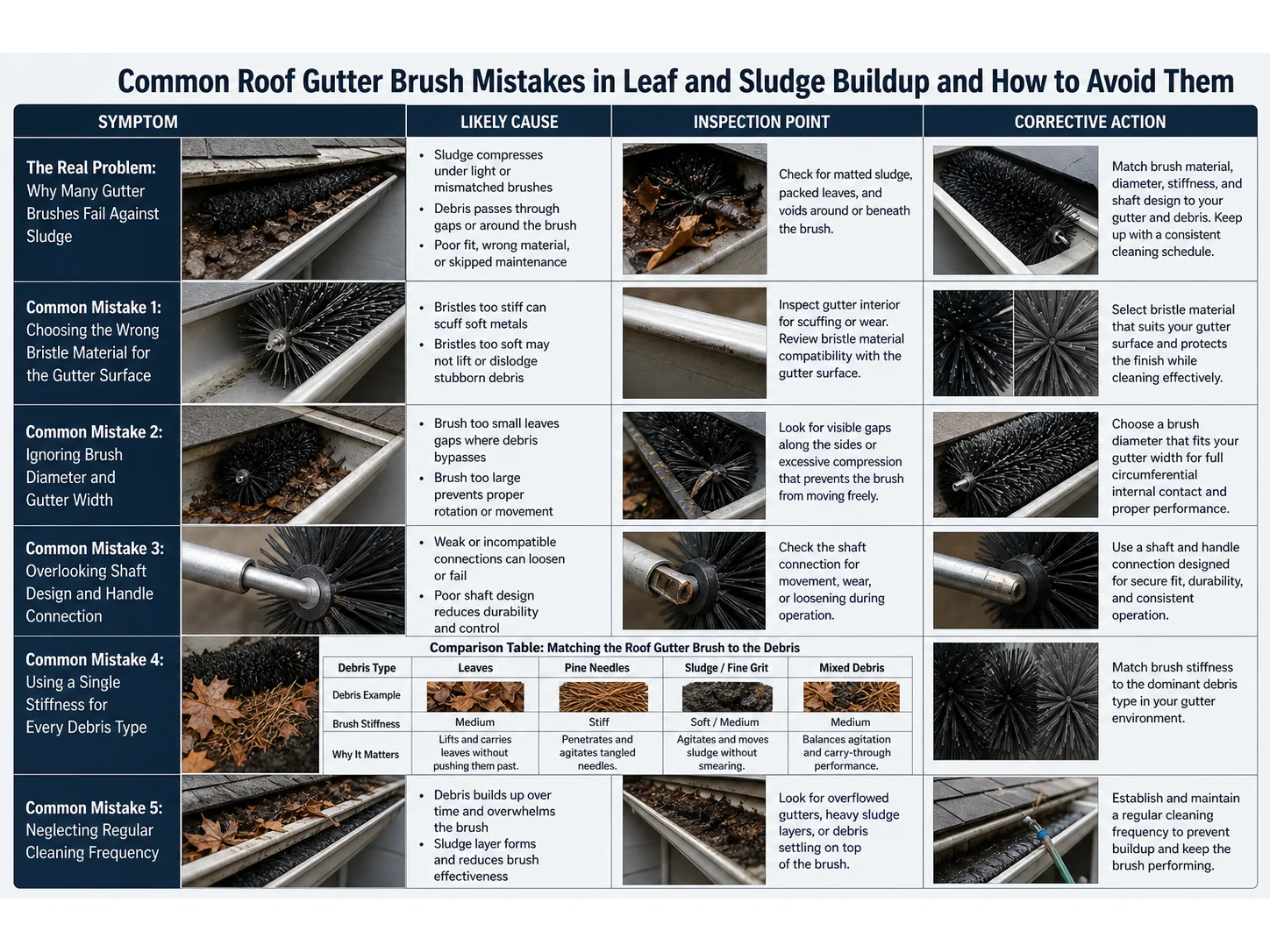
The Real Problem: Why Many Gutter Brushes Fail Against Sludge
Most off-the-shelf gutter brushes are built for loose, dry debris. When you face wet, compacted leaves mixed with roof grit and pollen sludge, bristles that are too soft bend without scraping, while bristles that are too stiff can gouge the gutter material. The gap between the brush’s reach and the gutter’s cross‑section is another hidden failure point. Once you understand how material, diameter, and stiffness interact, you stop buying brushes that simply push the problem around.
Common Mistake 1: Choosing the Wrong Bristle Material for the Gutter Surface
Bristle material determines cleaning aggression and surface safety. A nylon brush for roof cleaning is gentle on painted metal and vinyl, but it may struggle with dried sludge. A wire brush for roof cleaning—especially a steel wire brush—cuts through hardened debris but can strip protective coatings or leave micro‑scratches that invite rust. Polypropylene is a middle ground: stiff enough for wet leaves, yet safe on most gutter materials. The mistake is grabbing the first brush you see without matching the filament to both the debris and the gutter finish.
Common Mistake 2: Ignoring Brush Diameter and Gutter Width
A brush that is narrower than your gutter’s internal width misses debris in the corners; one that is too wide jams or pushes sludge deeper. Residential K‑style gutters typically range from 5 to 6 inches across. For a 5‑inch gutter, a 4‑ to 5‑inch diameter brush head usually fits well. Round or half‑round gutters need a brush that arcs with the contour, not a flat‑faced tool. Always measure your gutter’s inside width before purchasing, and check that the brush can reach into the back channel where debris collects.
Common Mistake 3: Overlooking Shaft Design and Handle Connection
Long‑reach handles are only useful if they stay connected under torque. Press‑fit wooden or fiberglass poles often loosen when you twist the brush to scrape. A threaded metal or fiberglass handle with a locking mechanism holds better. Many people also choose a handle that is too short, forcing them to lean precariously from a ladder. Look for telescoping poles that extend safely and for brushes with a universal acme thread or quick‑connect adapter if you plan to switch heads.
Common Mistake 4: Using a Single Stiffness for Every Debris Type
Stiffness should match the job. Soft bristles work for light pollen and dry leaves; medium stiffness tackles wet leaves; firm or extra‑firm bristles are needed for pine needles, roof moss, and sludge layers. But using a firm wire brush on a warm summer day when only a fine dusting of debris is present can wear the gutter’s paint unnecessarily. Keep a couple of brush heads—or choose a brush with replaceable, dual‑stiffness bristle strips—so you can adjust the aggressiveness without replacing the whole tool.
Comparison Table: Matching the Roof Gutter Brush to the Debris
| Debris / Use Case | Recommended Bristle Material | Bristle Stiffness | Typical Diameter (for 5‑6″ gutters) | Handle / Connection Advice | Notes |
|---|---|---|---|---|---|
| Loose dry leaves | Polypropylene or soft nylon | Medium | 4–5 inches | Threaded fiberglass, 12–20 ft | Light pressure only; focus on sweeping, not scraping. |
| Wet, compacted leaves | Nylon or polypropylene | Firm | 4–5 inches | Locking telescoping pole | Work at an angle to lift the mat instead of packing it. |
| Pine needles / fir needles | Stiff nylon or mixed nylon‑wire | Firm to extra‑firm | Matches gutter width closely | Rigid, non‑flex handle | Needles wedge in seams; a brush with dense tufts helps dislodge them. |
| Sludge and roof grit | Wire (brass‑coated steel) or stiff nylon | Extra‑firm | 4 inches | Threaded metal pole with grip | If gutter is painted, brass‑coated wire is safer than bare steel. |
| Moss or algae buildup | Wire brush or mixed wire/nylon | Extra‑firm | 3.5–4.5 inches | Heavy‑duty locking pole | Follow with a rinse; avoid on thin aluminum gutters unless you test first. |
| Light rinse and dusting | Soft nylon or flagged polypropylene | Soft to medium | Any size that fits | Standard threaded broom handle | Flagged bristles hold water and cleaning solution better. |
Common Mistake 5: Neglecting Regular Cleaning Frequency
The best brush still fails when gutters are clogged to the brim. Many homeowners wait until water overflows, then discover the sludge has hardened to a cement‑like layer. Set a seasonal cleaning rhythm—at least twice a year in moderate climates, more often under heavy tree cover. A quick pass with the right brush while debris is still loose prevents the hard‑pack cycles that demand scraping and risk damage.
Common Mistake 6: Skipping Post‑Use Brush Inspection and Maintenance
After cleaning, rinse the brush head to remove dirt and acidic residue that can degrade bristles. Check for bent, splayed, or broken filaments; a misshapen brush works against you. For wire brushes, dry them thoroughly to prevent rust, and replace any head where the wire tufts are separating from the core. Loose ferrules or cracked handle connections are a safety hazard that can send you off balance on a ladder.
When a Roof Gutter Brush Is the Wrong Choice: Recognizing the Limits
A gutter brush is a mechanical, manual tool—it cannot clear a fully blocked downspout, remove roots from a hidden elbow, or scrape away layers of asphalt‑like sludge that have baked on for years. In those cases, a plumber’s snake, a pressure washer with a gutter attachment, or a professional vacuum service is safer and more effective. If your gutters have an unusual cross‑section, a standard off‑the‑shelf brush may never reach the corners; you may need a supplier‑drawn custom brush or a multi‑section tool designed for that specific profile. And if you are working on a steep second‑story roof without a secure anchor point, the job is not worth the fall risk—even with the best brush.
Final Takeaway: Build a Cleaning System, Not a One‑Size‑Throws‑All Approach
Effective gutter maintenance isn’t about owning one magic brush. It’s about matching bristle material and stiffness to the worst debris you expect, choosing a diameter that fits your gutters without jamming, using a handle that won’t disconnect under torque, and cleaning often enough that sludge never cures. Pair a medium nylon brush for regular sweeps with a firmer wire brush for the heavy spring and fall clean‑outs, and you’ll avoid the mistakes that turn a simple task into an expensive repair.
Frequently Asked Questions
Can I use a roof gutter brush from a ladder, or do I need to be on the roof?
A long‑handle gutter brush is designed so you can stand safely on the ground or on a stable ladder platform. If you must be on a ladder, make sure the handle extends far enough that you are not reaching sideways, which can tilt the ladder. Never walk on a wet roof to use a short brush—that defeats the purpose of having a long‑reach tool.
What bristle material is safest for painted metal gutters?
Nylon or flagged polypropylene bristles are the safest choice. If you must use a wire brush for tough sludge, look for brass‑coated steel wire rather than plain steel, as it is less likely to scratch through the paint. Always test on an inconspicuous area first.
How do I clean and store a roof gutter brush after use?
Rinse the bristles with a garden hose to remove acidic leaf residue. For wire brushes, shake off excess water and let them dry completely in a ventilated space before storing in a dry area. Hang the brush by the handle loop—never rest it on the bristles, which can permanently bend the filaments.
Is a wire brush for roof cleaning the same as a chimney brush?
Not exactly. A chimney cleaning brush typically has a round, dense wire or poly head designed for round flues, while a roof gutter brush is often flatter or cylinder‑shaped to fit rectangular gutters. Some all‑purpose wire brushes can be used for both, but a dedicated gutter brush with the right profile will clear corners better. For chimney‑specific tasks, look for a best chimney cleaning brush designed for your flue diameter.
Can I use a roof gutter brush on gutter guards or screens?
You can use a soft nylon brush on top of screens or micro‑mesh guards to whisk away surface debris, but avoid stiff wire brushes that may tear or dent the guard. If the guard is removable, take it off and clean the actual gutter underneath with the appropriate brush.
What diameter brush fits half‑round gutters?
Measure the inside width of the half‑round profile. Choose a brush diameter that is about 80–90% of that width so that the bristles contact the curved bottom without jamming. A cylindrical brush often works better than a flat‑faced brush for half‑round shapes.
When should I replace my roof gutter brush head?
Replace the head when bristles are permanently bent, splayed, or worn down more than 25% of their original length. For wire brushes, any sign of rust spreading or filaments breaking off means it is time for a new one. A damaged brush head is less effective and can scratch your gutters.
Is a nylon brush better than a wire brush for removing roof moss from gutters?
A stiff nylon brush can scrape moss from the gutter itself without scratching, but if moss is tightly bonded to the gutter edge or roof, a dedicated moss‑removing wire brush may be more effective. Many professionals start with nylon and only switch to a brass‑coated wire brush if necessary.
Technical References
Which bristle material fits this job — Nylon PA, Brass Coated Wire or Polypropylene PP?
| Material | Continuous temperature (°C) | Peak temperature (°C) | Water absorption | Hardness |
|---|---|---|---|---|
| Nylon PA | 93 | 121 | 0.3–9% by PA grade and conditioning | Medium to firm; filament diameter and trim length control bending force. |
| Brass Coated Wire | 200 industry reference range | 250 industry reference range | — | Firm non-ferrous metallic wire; softer than carbon/stainless steel wire and less aggressive on softer metal parts. |
| Polypropylene PP | 80–100 | 120–140 | ≤0.03% | Shore D 65–75 |
| UV-resistant Anti-aging Filament | 140 | 170 | 0.1–1.0% | Defined by the carrier polymer, diameter and weathering condition. |
Figures as published by Brushtec / DuPont; Perlon. Confirm the exact grade against the supplier datasheet before ordering.
What should replace Handheld Detail Brushes for gutter?
- Handheld Detail Brushes — Handheld detail brushes cover general precision cleaning; auto-detailing brushes impose tighter controls for painted, polished, leather, display, and trim surfaces.
- Nylon PA — Compare Nylon PA with PP, PBT, PET. Change material when wet stiffness, temperature, chemical resistance, conductivity, particle shedding, or surface marking becomes the limiting factor.
- Brass Coated Wire — Compare Brass Coated Wire with Steel wire, stainless wire, nylon. Change material when wet stiffness, temperature, chemical resistance, conductivity, particle shedding, or surface marking becomes the limiting factor.
- Polypropylene PP — Compare Polypropylene PP with Nylon, PBT, PET. Change material when wet stiffness, temperature, chemical resistance, conductivity, particle shedding, or surface marking becomes the limiting factor.