
Material
Thunderon Conductive Fiber
Conductive synthetic fiber
Choose Thunderon Conductive Fiber based on its stiffness, recovery, wear, wet-service, chemical, and temperature behavior. The same material can produce different stiffness, so filament diameter, trim length, density, grade, and service conditions must also be defined.
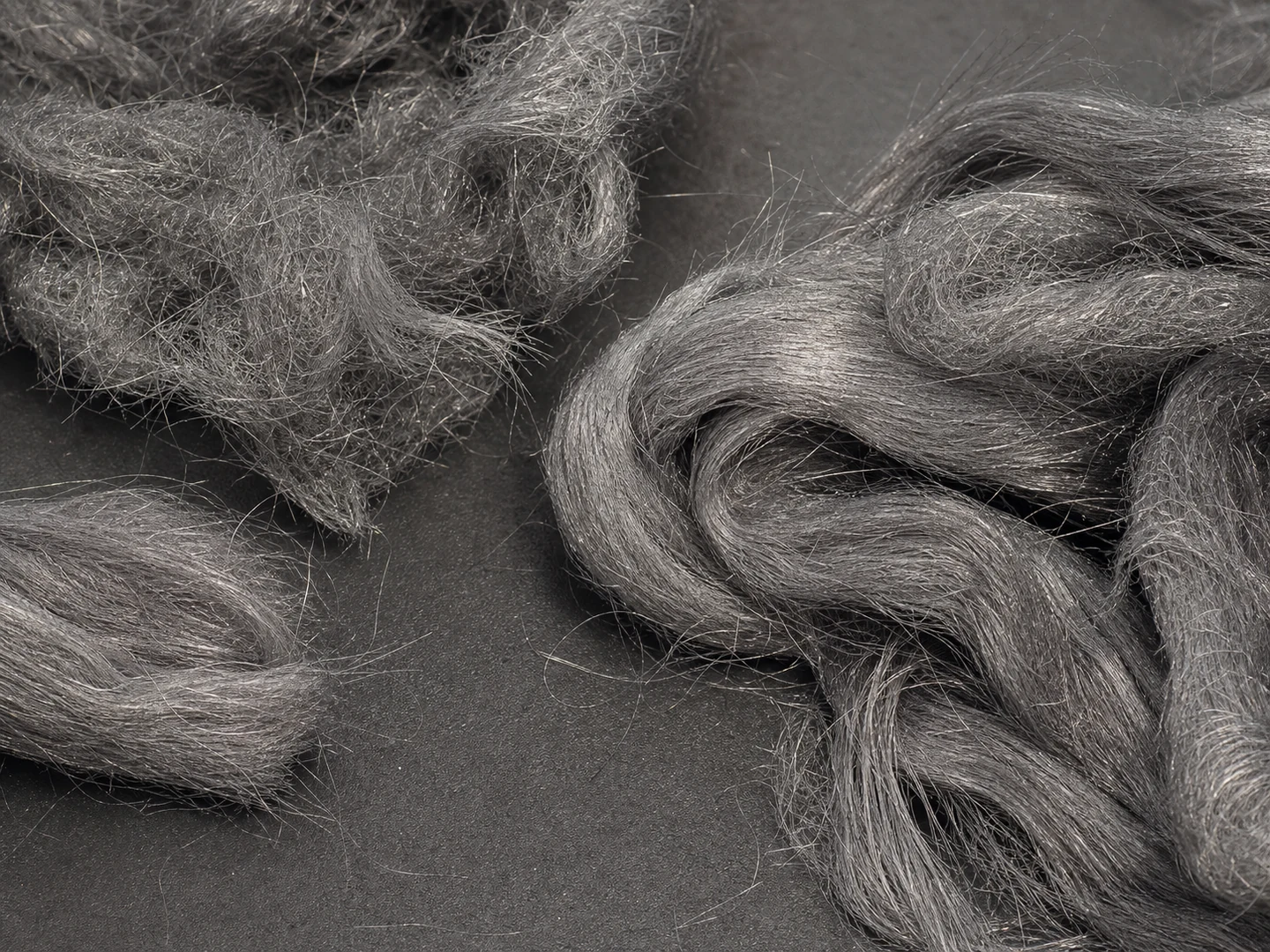
Datasheet values
- Fill construction
- Fine conductive fiber bundles; mixed or full fill
- Temperature range
- -20–80°C
- Stiffness
- Soft; flexible static-dissipative contact
Thunderon is an acrylic or nylon fibre with copper sulfide chemically bonded into its surface, so the conductive layer is part of the fibre rather than a coating that wears off.
What is Thunderon Conductive Fiber, and what makes it different from other brush filaments?
Thunderon is made by chemically bonding copper sulfide into the surface of an acrylic or nylon fibre, forming a conductive layer 300–1,000 Å thick that becomes part of the host fibre. That is the difference from every other conductive fill: the conductivity is not a plating on the outside and not a carbon loading in the middle, so bending and abrasion do not strip it away.
It is supplied in two diameters, 0.07 mm and 0.11 mm, and used in custom brushes for electronics, film, optical surfaces, printing and static-sensitive dust removal.
The realistic alternatives are Conductive Nylon, Anti-static Filament and Carbon Fiber. What separates them is where they sit on the resistance scale and how much mechanical work the fill can do — not headline strength.
Use Conductive Nylon where the brush also has to scrub; use Carbon Fiber where the lowest resistance matters more than the fibre staying intact.
What stiffness and contact pressure can I expect from Thunderon Conductive Fiber?
Thunderon is soft and highly flexible: it makes static-dissipative contact rather than acting as a self-supporting scrubbing bristle. Because the fibre is fine, contact pressure comes from bundle density and free trim, not from filament diameter as it would in a nylon fill.
Published ranges for the filament itself. A finished brush runs below them, because the fill carries load and heat at the same time.
| Property | Thunderon Conductive Fiber | Conductive Nylon | Anti-static Filament | Carbon Fiber |
|---|---|---|---|---|
| Hardness | Not applicable; characterized by resistance and bundle density | Shore D 75–88 | Shore D 72–86 | Not applicable; characterized by modulus |
| Continuous temperature (°C) | 80 | 80–110 | 80–110 | 200–350 (limited by sizing / binder) |
| Peak temperature (°C) | 110 | 130–160 | 130–160 | 400–500 (inert environment, short-term) |
| Water absorption, 24 h | 1–4% (acrylic or nylon carrier fibre; industry reference range) | 0.5–2.5% (depending on nylon base material, ISO 62/ASTM D570) | 0.5–2.5% (depending on nylon base material, ISO 62/ASTM D570) | ≤0.10% (fibre itself) |
| Filament diameter (mm) | 0.07 and 0.11 (two supplied sizes) | 0.05–1.00 | 0.05–1.00 | 0.005–0.012 |
| Electrical behaviour | Specific resistance 101–102 Ω/cm | Surface resistance 102–106 Ω | Surface resistance 106–109 Ω | Surface resistance down to 101–104 Ω |
| Flexibility | High (fine conductive fibre) | Medium | Medium to high | High (fine bundle) |
The part people get wrong: Thunderon is bought for its resistance, and resistance is a property of the finished brush, not of the fibre. A conductive fill in a plastic holder with no bonded path to earth measures like an insulator. Specify the holder and the grounding point in the same breath as the fill.
How does water affect Thunderon Conductive Fiber performance?
Thunderon takes up 1–4%, which is the moisture regain of its acrylic or nylon carrier fibre rather than anything the copper-sulfide layer contributes.
That is low enough that trim length and tip pressure barely move between dry and damp service, so a brush measured dry behaves the same in a conditioned room.
What this means for your application: water is not the risk here — what water carries is. Chlorides and acidic condensate attack the copper-sulfide layer, and once that layer is damaged the resistance rises while the fibre still looks intact.
A practical check: measure resistance on the finished brush before and after a representative wet cycle. A fibre that still looks and feels right but has lost a decade of conductivity has already failed.
What temperature limits apply to Thunderon Conductive Fiber?
Continuous service to 80°C, with 110°C as a short-term peak.
The limit comes from the acrylic or nylon carrier, not from the copper-sulfide layer. The carrier softens and takes a permanent set well before the conductive layer is affected, so a bent-over tuft is a thermal failure of the fibre, not a loss of conductivity.
Where it stops working: If the process sits near the top of that band, step up to Conductive Nylon, which holds 80–110°C continuous, or to Carbon Fiber where the requirement genuinely runs hot.
The usable limit also moves with trim and contact pressure. A short trim under light load tolerates more than a long trim being pressed against a moving surface.
What chemicals attack Thunderon Conductive Fiber?
Two different things are being attacked, and they fail in different ways. The acrylic or nylon carrier is attacked by strong acids, phenols and hot alkali. The copper-sulfide layer is attacked by oxidising agents, chlorides, ammonia and strong acids, which dissolve or convert the copper compound.
The carrier failing is visible — the fibre goes brittle or limp. The conductive layer failing is not: the brush looks unchanged and stops doing its job. That asymmetry is why chemical exposure on this fibre is verified by measurement rather than by inspection.
Before you commit to a quantity: send the cleaning fluid with its concentration and dwell time, the working temperature, and the resistance value the finished brush has to meet.
What is the practical lower limit for filament diameter?
Thunderon is not specified by diameter in the way a nylon fill is. It is supplied in two sizes, 0.07 mm and 0.11 mm, and the choice between them is a contact decision: 0.07 mm for the softest touch on optical and coated surfaces, 0.11 mm where the tuft has to stay upright against a moving web.
Free trim runs 3–100 mm, and bundle density does the work that diameter does in other fills. A denser bundle on a shorter trim raises contact pressure and lowers the resistance path at the same time.
Tip treatment on this fibre is the copper-sulfide bonding itself, followed by end trimming; nothing is added to the tip afterwards, because a coating over the conductive layer would defeat it.
In practical brush terms: reaching into a slot or connector with Thunderon is a trim and density problem, not a diameter problem. Both supplied diameters are fine enough to enter almost anything; what fails is a tuft too sparse to hold contact.
What applications typically use Thunderon Conductive Fiber?
Electronics, film, optical surfaces, printing and static-sensitive dust removal.
The applications that keep coming back to this grade:
- Dust Removal
- Connector & Slot Cleaning
- PCB Cleaning
- Printer & Scanner Cleaning
- Brick, Tile & Building Material Machine Brush Use
- Carpet Machine Cleaning
The constructions that usually carry it:
- Custom Roller and Conveyor Brushes
- Custom Handheld Detail Brushes
If the sample comes back rejected: the usual cause is the holder, not the fill. Thunderon needs an electrically continuous holder and a verified path to earth, and it is not an abrasive cleaning fibre — asking it to remove bonded residue will wear the tufts without cleaning the surface.
How do I specify Thunderon Conductive Fiber for a custom brush?
A usable specification carries the construction, the supplied diameter, the free trim and bundle density, the holder material and grounding arrangement, and the resistance the finished brush has to measure.
The mistakes that most often send a sample back:
- Specifying the fibre but leaving the holder in plain plastic, so the assembly has no path to earth
- Quoting a fibre resistance figure when the acceptance test measures the assembled brush
- Expecting scrubbing action from a fill chosen for static dissipation
- Ignoring chloride, ammonia or oxidiser exposure that degrades the copper-sulfide layer without any visible change
Reference standards behind the figures on this page: IEC 61340-5-1:2024; IEC TS 61340-5-4:2021; ASTM D257; ISO 20743; JIS L 1902.
Source: Electrostatic Discharge Association — Principles of ESD control. Thunderon is an acrylic or nylon carrier with copper sulfide bonded into the fibre surface, produced by Nihon Sanmo Dyeing. Fibre composition, conductive-layer thickness, supplied diameters and specific resistance come from that manufacturer data; the brush-construction ranges on this page are our own build experience, and the resistance band a job needs comes from its ESD control programme.
What else does the datasheet specify for Thunderon Conductive Fiber?
| Filament cross-section | Round (Drawn Acrylic or Nylon Monofilament) |
|---|---|
| Electrical behaviour | Conductive; Specific Resistance 10^1–10^2 Ω/cm(Nihon Sanmo Thunderon Data) |
Questions this page is asked
What should prove that a brush contains Thunderon rather than generic conductive fibre?
Record the brand owner or authorized source, Thunderon product form, acrylic or nylon host fibre, construction or blend percentage, filament or bundle dimensions, lot, and any supplier resistance data with its method and conditioning. Keep substitute carbon, plated, metal, or conductive-compound filaments under separate qualification because they do not share the same conductor geometry or discharge behavior.
How should an installed Thunderon brush be verified for static control?
Measure resistance through the fibre, retention point, holder, bonding hardware and designated ground using a documented electrode, voltage, electrification time, temperature and humidity, then measure charge generation or decay on the actual handled item. Repeat the checks at the facility's driest relevant condition and after cleaning and wear, because fibre conductivity alone does not prove a maintained control path.
What cleanliness checks are needed before Thunderon touches optics or electronics?
Run representative contact and flex cycles, then inspect the part and collection media for loose fibre, particles, discoloration, ionic or metal transfer where relevant, and any surface marking under the required magnification. Recheck electrical performance after the same cycles and reject the construction if cleaning, abrasion or chemistry damages the conductive layer or creates unacceptable residue.
Guides that go deeper on this
We have not written a guide specific to this one yet. The material that covers selection, filament, dimensions, maintenance and sourcing is collected in the technical resources library.
No catalogue item for this yet
Every brush here is made to order, and this one has no catalogue entry so far. Send the working surface, the residue, the access opening and the quantity, and it is quoted through the same specification route as the rest of the range.
Custom Manufacturing RFQ
Discuss This Material
Share the working surface, residue, dimensions, material direction, interface, quantity and drawing or sample photo.
Custom Brush RFQ
Request a Custom Cleaning Brush Quote
Upload a drawing, product photo, or sample photo and provide the core dimensions and cleaning conditions.
“We need a brush to remove wet residue from a stainless steel conveyor, about 800mm wide. The current brush wears quickly. We can send photos.”
“We sell drinkware and need a cleaning brush to include with the product. Quantity around 5,000 pieces.”