
Application
Motorcycle Chain Cleaning
For Motorcycle Chain Cleaning, the brush must reach the working area, disturb or collect grease/road grit/metal wear debris/mud slurry, and release it without creating unacceptable surface damage or process interference. Access, contact movement, and the selected cleaning method determine which brush structure will work.
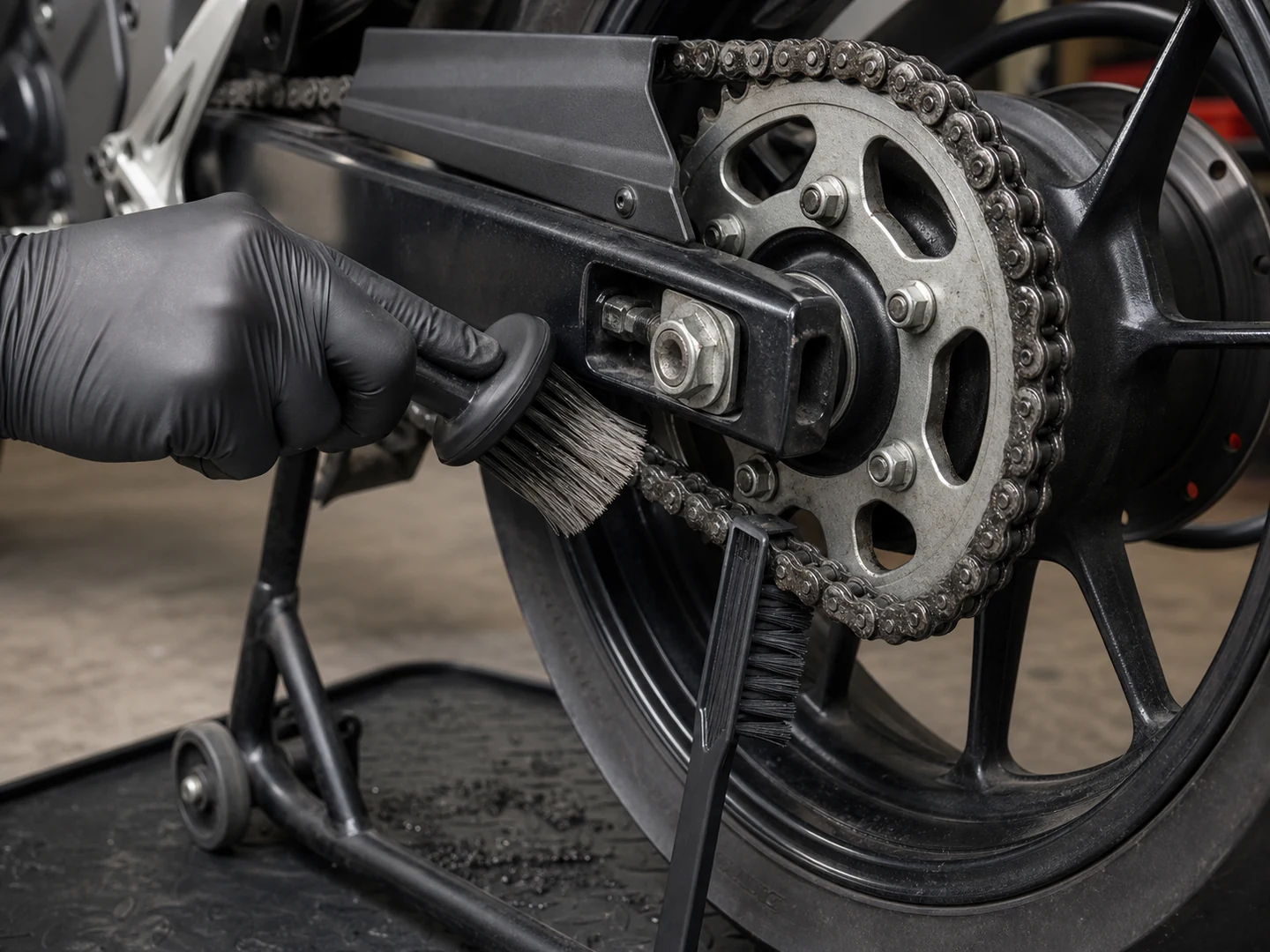
At a glance
- Cleaning target
- Grease/Road Grit/Metal Wear Debris/Mud Slurry
- Working environment
- Dry Indoor Area / Outdoor
- Cleaning method
- Dry Brushing / Wet Brushing / Soaking
- Requirements to check
- Compatibility with Chain O-Rings and Surface Coatings; Flammable-Solvent Work Requirements
A drive chain is cleaned on three faces at once with the bike stationary, and the solvent is chosen first — the brush only has to survive that solvent and reach between the plates.
What makes Motorcycle Chain Cleaning different from other automotive and transportation cleaning?
The main difficulty is removing brake dust, road film, grease, mud, carbon, and loose particles from paint, wheels, tires, chains, vents, grills, and vehicle details without damaging the surface, loading the brush, or carrying contamination back into the process.
The work happens in dry indoor area and outdoor against grease, road grit, metal wear debris and mud slurry.
The part people get wrong: the surface, the residue and the access opening decide the brush together. Fix on any one of them alone and the geometry comes out wrong.
What are the most common cleaning targets in Motorcycle Chain Cleaning?
One target carries the whole job, and it is an awkward one: chain plates, rollers and sprocket teeth are cleaned together, in place, with the wheel turning.
| Part or area | Residue type | Cleaning requirement |
|---|---|---|
| Drive Chain and Sprocket | Grease, Road Grit, Metal Wear Debris, Mud Slurry | The head must reach the working face and apply even contact without marking the surface. |
The dimensional envelope those targets impose on the brush:
| Parameter | Typical range |
|---|---|
| Overall length | 180–300 mm |
| Head width | 15–50 mm |
| Brush section length | 30–100 mm |
| Filament diameter | 0.25–0.60 mm |
| Head size | 10–250 mm |
| Trim length | 10–80 mm |
Which brush types work for each cleaning target?
Three-sided chain brush, narrow block brush or small detail head used on a stationary drivetrain.
| Cleaning target | Recommended brush type | Why it fits |
|---|---|---|
| Drive Chain and Sprocket | Handheld Detail Brushes | A chain has to be cleaned on four sides and between the plates, so a hand-guided head reaches the side plates and the roller gap without forcing lube past the O-rings. |
The layouts this application is normally built in:
- Driven brush — use when brake dust, road film, grease, mud, carbon, and loose particles needs repeatable scrubbing or controlled relative movement
- Passive or free-running brush — use for loose contamination and lower process complexity on paint, wheels, tires, chains, vents, grills, and vehicle details
- Localized hand, strip, or tube brush — use where only an edge, gap, port, or maintenance point needs contact
In practical brush terms: reach first, then residue. A brush that fits but is too soft can be stiffened; a brush that does not fit is simply the wrong tool.
What filament materials work best for Motorcycle Chain Cleaning?
Solvent-compatible nylon or polypropylene; brass only for approved robust metal areas and controlled manual use.
| If the condition is… | Filament to start with | Why |
|---|---|---|
| Sensitive or coated surface | Nylon PA | balanced flex life and abrasion resistance |
| Wet, washdown, or detergent service | Polypropylene PP | acid, alkali, water, and detergent resistance |
| Bonded residue or aggressive cleaning | PA612 Nylon | low water absorption and strong bend recovery |
The constraints this application puts on the filament:
| Constraint | Value for this application |
|---|---|
| Filament hardness | Medium–Hard |
| Maximum service temperature | 80°C |
| Chemical exposure | Neutral or Alkaline Degreaser pH 7–12; Hydrocarbon or Citrus-Based Solvent |
| Cleaning method | Dry Brushing, Wet Brushing, Soaking |
How do I choose the right brush for my motorcycle chain equipment?
Chain pitch and width size the three-sided head, and whether the chain is sealed decides both the fill and the solvent it has to survive.
The sequence that gets a usable sample first time:
- Identify the target part and measure the access opening or clearance
- Describe the residue: what it is, how thick it sits, and how strongly it holds
- Choose the construction that can physically reach that target
- Set the filament from surface risk, working temperature and cleaning chemistry
- Fix filament diameter, free trim length and density for the contact pressure you need
- Run one cycle and check the result before committing to a production quantity
Before you commit to a quantity, send the chain pitch and width, say whether it is a sealed O-ring chain, and name the solvent you use.
When is a motorcycle chain brush the wrong tool?
A chain past its stretch limit is replaced, not cleaned, and a sealed O-ring chain is damaged by aggressive solvents and stiff fill long before it is helped by them. Where the manufacturer specifies wipe-and-lube only, follow that and leave the brush out.
What common mistakes should I avoid in Motorcycle Chain Cleaning?
- Not saying whether the chain is sealed O-ring or plain, which decides both the fill and the solvent
- Changing brush material while leaving excessive engagement, poor alignment, or no discharge path unchanged
- Copying a worn brush without recording motion, direction, mounting, and the original working diameter
When a brush is running but not cleaning, start here rather than adding pressure:
| Symptom | What to change |
|---|---|
| Residue remains | Increase relative motion or discharge, then change filament diameter or density; do not add pressure before checking loading by brake dust, road film, grease, mud, carbon, and loose particles. |
| Surface marks or scratches | Reduce engagement, use finer or softer fill, and remove trapped abrasive particles from contact with paint, wheels, tires, chains, vents, grills, and vehicle details. |
| Rapid wear or uneven cleaning | Check alignment, runout, support, motion, temperature, chemical attack, and whether the brush covers the complete working path. |
| Brush loads or redeposits residue | Open the fill pattern or add wash, vacuum, air, scraping, or a collection path so removed brake dust, road film, grease, mud, carbon, and loose particles leaves the contact zone. |
Questions this page is asked
Which brush contact should be excluded on a sealed drive chain?
Use only the soft tool and seal-safe cleaner permitted by the chain maker, and exclude wire brushing, steam and volatile solvents when the applicable instructions prohibit them. Brush the accessible side plates and spaces without prying at seals or forcing grit into the pin-and-bushing area.
What checks should follow motorcycle-chain brushing?
With the engine off and the wheel positioned by the method specified in the vehicle manual, inspect the complete chain for stiff links, rust, damaged or missing seals, abnormal elongation and brush fragments. Dry and lubricate the chain with the approved product and method before use, keeping cleaner and lubricant away from tire and brake friction surfaces.
Guides that go deeper on this
No catalogue item for this yet
Every brush here is made to order, and this one has no catalogue entry so far. Send the working surface, the residue, the access opening and the quantity, and it is quoted through the same specification route as the rest of the range.
Custom Manufacturing RFQ
Discuss This Application
Share the working surface, residue, dimensions, material direction, interface, quantity and drawing or sample photo.
Custom Brush RFQ
Request a Custom Cleaning Brush Quote
Upload a drawing, product photo, or sample photo and provide the core dimensions and cleaning conditions.
“We need a brush to remove wet residue from a stainless steel conveyor, about 800mm wide. The current brush wears quickly. We can send photos.”
“We sell drinkware and need a cleaning brush to include with the product. Quantity around 5,000 pieces.”