
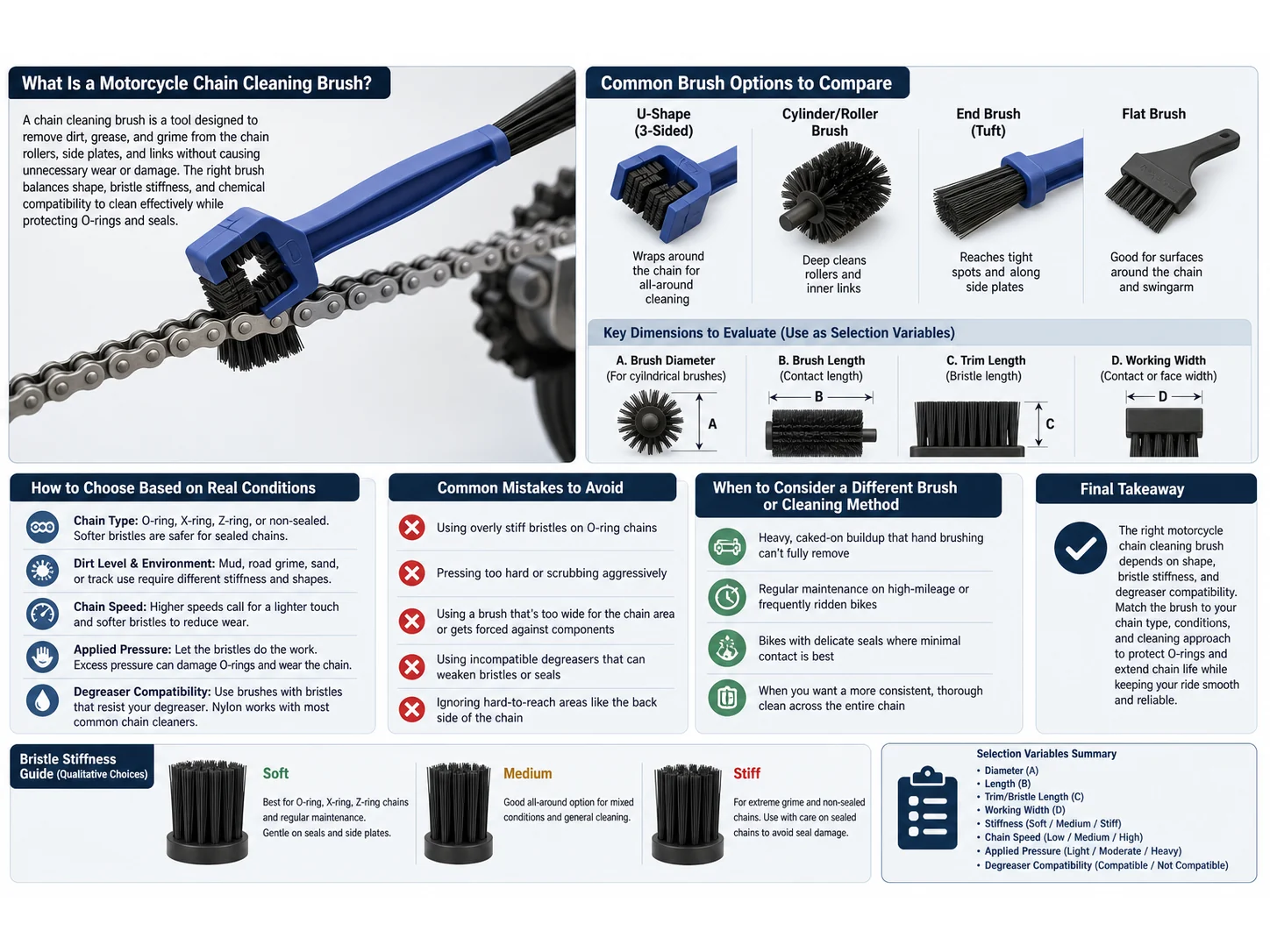
What Is a Motorcycle Chain Cleaning Brush?
A motorcycle chain cleaning brush is a hand brush shaped to reach the running surfaces of a drive chain: the top of the rollers and both rows of side plates. Most are one of three forms — a three-sided brush that wraps the chain, a single-row brush for one face at a time, and a narrow stiff brush for the sprocket teeth. What separates it from a general parts brush is not the bristles but the constraint it works under: on a sealed chain, the part you must not damage sits between the plates, exactly where the brush is trying to reach.
Why the Seals Decide the Brush
Almost every modern street chain is a sealed chain. Small rubber rings — O-rings, X-rings or similar profiles depending on the maker — sit between the inner and outer side plates and hold the factory grease inside the pin and bush. That grease is the only lubrication those surfaces will ever get; the lube you spray on afterwards protects the rollers and the sprocket contact, not the pins.
Once a seal is nicked, torn or chemically swollen, the grease leaves and road grit gets in. The chain does not fail that day. It stretches unevenly over the following weeks, starts to bind at tight spots, and takes the sprockets with it. That is why a chain brush is specified defensively: the job is to remove the black paste of old lube and road dirt from the plates and rollers without the bristle tips or the cleaning fluid ever working on the seals.
An unsealed chain — still common on small-displacement and off-road machines — has no such constraint, and can take a stiffer brush and a more aggressive solvent. Confirm which one you have before choosing either.
Three Brush Shapes, Three Jobs
| Shape | What it reaches | What to watch |
|---|---|---|
| Three-sided (grunge-style) | Top of the rollers and both side plates in one stroke, with the chain pulled through the brush by hand | The side faces must be soft enough to flex over the plates; a tight, hard channel drags on the seals instead of the plates |
| Single-row hand brush | One face at a time, and the inner faces a wrapped brush cannot open up to | Slower, and it is the shape most likely to be pressed too hard because progress feels slow |
| Sprocket / detail brush | Between the sprocket teeth and the chain guard, where caked lube collects | This is the one place stiffer filament earns its keep — but the sprocket is steel, the seals are not, so it is not the brush to take back to the chain |
Handle length matters more than it looks. The chain is turned by hand, and a short handle puts your knuckles close to the rear sprocket while the wheel is free to move. A handle long enough to keep the hand out of the run is a safety specification, not a comfort one.
Which Bristle Material Is Safe on a Sealed Chain?
- Nylon — the default. Enough stiffness to move set lube, soft enough that the tips deflect off a seal rather than cut it. Nylon takes up water and loses some stiffness when soaked, so a wet nylon brush works less aggressively than it did dry.
- PBT — holds its stiffness better when wet and tolerates more of the chemistry used in chain cleaners. A reasonable choice where the brush lives in the solvent for the length of the job.
- Brass — soft enough not to scar sprocket teeth, and useful on baked-on deposits between teeth. On the chain itself it adds risk without adding much: the deposit that needs brass usually needs soaking instead.
- Steel wire — not on a sealed chain. Steel tips find the gap between plates, which is exactly where the seal is, and they strip the plating that keeps the chain from rusting.
Stiffness is chosen against the deposit, not against the chain. Waxy lube that has collected grit comes off with medium nylon and a solvent that has been allowed to soak for a minute. Reaching for a stiffer brush is almost always a substitute for giving the cleaner time to work.
Degreaser Compatibility: What the Brush Has to Survive
The brush is in the solvent as long as the chain is, so the filament, the block or channel holding it, and any adhesive in the head all have to survive that chemistry. A brush whose head softens or sheds into the chain has made the job worse: loose bristles lodge between roller and sprocket.
Match the cleaner to the chain first, then the brush to the cleaner. Chain makers generally specify a mild solvent such as kerosene for sealed chains, and warn against strong or chlorinated solvents, petrol, and high-pressure washing, all of which attack or lift the seals. Follow the chain and lubricant manufacturer’s instructions for your specific chain — the seal compound differs between makers, and so does what it tolerates.
How to Use It Without Getting Hurt
The rule that matters: the engine is off. Cleaning a chain with the engine running and the bike in gear puts a hand next to a moving chain and sprocket, and it is a well-documented way to lose fingers. Put the machine on a stand, select neutral, and turn the wheel by hand, a section at a time.
- Work in sections and rotate the wheel by hand; do not hold the brush against a chain being driven by the engine.
- Give the cleaner time to soften the deposit before brushing, then brush along the chain rather than jabbing into the plate gaps.
- Wipe and let the chain dry before lubricating. Lube applied over solvent does not stay where it is put.
- Keep the sprocket brush and the chain brush separate once the sprocket brush has picked up grit.
When a Brush Is Not the Answer
A brush cleans a chain. It does not fix one. If the chain has tight spots when you rotate it, if the rollers are stiff on their pins, if the O-rings are visibly flattened or missing, or if the sprocket teeth have hooked over, the chain and sprockets are worn out and cleaning only postpones the diagnosis. The same is true of rust that has already reached the pins: surface rust on the plates cleans off, rust inside a sealed joint does not, because the brush cannot get there and neither can the lubricant.
Frequently Asked Questions
Can I use a wire brush on a motorcycle chain?
Not on a sealed chain. Steel tips reach into the gap between the side plates where the seals sit, and they take off the chain’s protective plating. Nylon or PBT does the same cleaning job without that risk.
How stiff should the bristles be?
Stiff enough to move set lube from the side plates, which in practice means medium nylon or PBT. If that is not shifting the deposit, let the cleaner soak longer rather than moving up a grade.
Does the brush need to be resistant to the degreaser?
Yes. The filament, the holding block and any adhesive are in the solvent for the whole job. A head that softens sheds bristles into the chain, where they lodge between the roller and the sprocket.
Is a three-sided brush better than a single-row brush?
It is faster, because it cleans the top and both side faces in one pass. A single-row brush is still worth having for the faces a wrapped brush cannot open up to, and for the sprocket.
Can I clean the chain with the engine running?
No. The bike belongs on a stand in neutral with the engine off, and the wheel turned by hand. Brushing a chain driven by the engine is how people lose fingers.
Which bristle material fits this job — Nylon PA, PBT or AISI 304 Stainless Steel Wire?
| Material | Continuous temperature (°C) | Peak temperature (°C) | Water absorption | Hardness |
|---|---|---|---|---|
| Nylon PA | 93 | 121 | 0.3–9% by PA grade and conditioning | Medium to firm; filament diameter and trim length control bending force. |
| PBT | 120–140 | 160–180 | 0.05–0.20% | Shore D 80–90 |
| AISI 304 Stainless Steel Wire | 400 | 500 | 0% | Rockwell B 70–95 depending on temper and cold work |
| Rubber | 100 | 130 | very low | Specified by compound and Shore hardness; published TPE families can span roughly 50–80 Shore A, but that is a product-family example rather than a universal rubber range. |
| Polypropylene PP | 80–100 | 120–140 | ≤0.03% | Shore D 65–75 |
Figures as published by Brushtec / DuPont; Perlon; Alleima. Confirm the exact grade against the supplier datasheet before ordering.
When are Handheld Detail Brushes the wrong choice for motorcycle chain cleaning?
- Handheld Detail Brushes — Use a tube brush, powered brush, scraper, wipe, sponge, or vacuum when the target is internal, heavily bonded, or highly delicate.
- Nylon PA — The nylon family spans several grades, so heat, moisture and chemical limits should follow the selected PA resin rather than a generic nylon value.
- PBT — Not for heavy rust removal or high-cutting deburring.
- AISI 304 Stainless Steel Wire — Avoid using AISI 304 as the default in marine, brine, hypochlorite, and persistent chloride environments; use AISI 316 when higher pitting and crevice-corrosion resistance is required.
What should replace Handheld Detail Brushes for motorcycle chain cleaning?
- Handheld Detail Brushes — Handheld detail brushes cover general precision cleaning; auto-detailing brushes impose tighter controls for painted, polished, leather, display, and trim surfaces.
- Nylon PA — Compare Nylon PA with PP, PBT, PET. Change material when wet stiffness, temperature, chemical resistance, conductivity, particle shedding, or surface marking becomes the limiting factor.
- PBT — Compare PBT with Nylon, PP, PET. Change material when wet stiffness, temperature, chemical resistance, conductivity, particle shedding, or surface marking becomes the limiting factor.
- AISI 304 Stainless Steel Wire — Use AISI 316 stainless steel wire for chloride, marine, dairy, beverage, chemical washdown, or higher pitting-resistance requirements. Use carbon steel for dry aggressive cutting and brass or abrasive nylon for lower marking risk.