
Application
Fish Tank Cleaning
For Fish Tank Cleaning, the brush must reach the working area, disturb or collect algae/biofilm/mineral scale, and release it without creating unacceptable surface damage or process interference. Brush selection starts with access, contact motion, and the cleaning method used in the process.
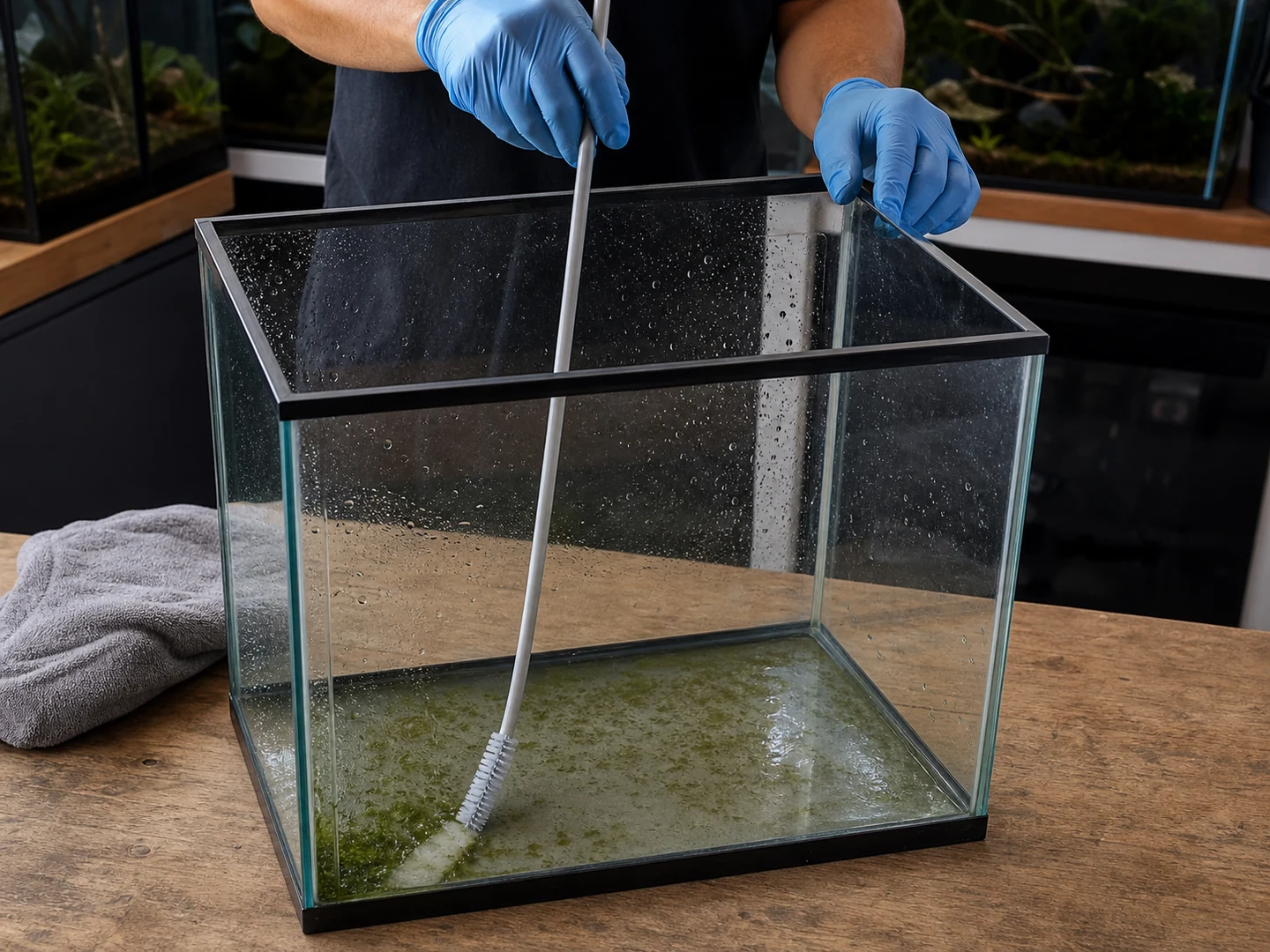
At a glance
- Cleaning target
- Algae/Biofilm/Mineral Scale
- Working environment
- Underwater
- Cleaning method
- Wet Brushing / Soaking
- Requirements to check
- Aquatic-Life Safety; Avoid Materials Leaving Toxic Residues
Acrylic scratches and glass does not, so tank cleaning separates by surface first: a panel pad for the wall, a corner brush for the silicone seam, a tube brush for the intake.
What makes Fish Tank Cleaning different from other facility, floor and outdoor cleaning?
The main difficulty is removing algae, biofilm, suspended solids, and organic debris from filter chambers, tanks, ponds, media, and aquatic equipment without damaging the surface, loading the brush, or carrying contamination back into the process.
The work happens in underwater against algae, biofilm and mineral scale.
The part people get wrong: this is not one job. The same equipment carries several targets, each with a different opening and a different residue, and one brush rarely covers them all.
What are the most common cleaning targets in Fish Tank Cleaning?
There are 5 distinct targets here, and the brush that suits one will usually not reach another.
| Part or area | Residue type | Cleaning requirement |
|---|---|---|
| Glass and Acrylic Wall | Algae, Biofilm, Mineral Scale | The face must stay flat against the surface so the whole working width contacts, with filament soft enough not to mark it. |
| Corner and Silicone-Seam | The head must be narrower than the opening and stiff enough to lift residue without splaying at the mouth. | |
| Decoration and Rock | The head must reach the working face and apply even contact without marking the surface. | |
| Substrate and Gravel Detail | Soil, mud and packed aggregate fines | |
| Overflow and Intake | Algae, Biofilm, Mineral Scale |
The dimensional envelope those targets impose on the brush:
| Parameter | Typical range |
|---|---|
| Brush length | 300–2000 mm |
| Brush diameter | 100–200 mm |
| Core diameter | 2–8 mm |
| Filament diameter | 0.30–1.00 mm |
| Water temperature | 5–40°C |
Which brush types work for each cleaning target?
Panel pad, corner brush, tube brush and small detail head as separate tools.
| Cleaning target | Recommended brush type | Why it fits |
|---|---|---|
| Glass and Acrylic Wall | Handheld Detail Brushes | Acrylic scratches under a single grain of sand, so a flat soft head spreads the pressure across the pane and lifts the film with no hard point anywhere. |
| Corner and Silicone-Seam | The silicone seam is a soft bead in a right-angle corner, so a narrow head reaches the corner without cutting or lifting the sealant. | |
| Decoration and Rock | Ornaments and rock are irregular and deeply textured, so a hand-guided head lets the operator follow the shape and work only where the algae actually is. | |
| Substrate and Gravel Detail | Detail work in gravel has to lift debris without stirring the bed, so a hand-guided head works the surface layer at a pressure the operator sets. | |
| Overflow and Intake | Overflow combs and intake strainers are slotted and permanently wetted, so a hand-guided head clears each slot before the flow through them drops. |
The layouts this application is normally built in:
- Driven brush — use when algae, biofilm, suspended solids, and organic debris needs repeatable scrubbing or controlled relative movement
- Passive or free-running brush — use for loose contamination and lower process complexity on filter chambers, tanks, ponds, media, and aquatic equipment
- Localized hand, strip, or tube brush — use where only an edge, gap, port, or maintenance point needs contact
In practical brush terms: reach first, then residue. A brush that fits but is too soft can be stiffened; a brush that does not fit is simply the wrong tool.
What filament materials work best for Fish Tank Cleaning?
Soft nylon/PBT, sponge or microfiber for acrylic and delicate areas; firmer pad only for specified glass.
| If the condition is… | Filament to start with | Why |
|---|---|---|
| Sensitive or coated surface | Nylon PA | balanced flex life and abrasion resistance |
| Wet, washdown, or detergent service | PBT | stable wet stiffness and low moisture uptake |
| Bonded residue or aggressive cleaning | PA612 Nylon | low water absorption and strong bend recovery |
The constraints this application puts on the filament:
| Constraint | Value for this application |
|---|---|
| Filament hardness | Soft–Medium |
| Maximum service temperature | 50°C |
| Chemical exposure | Water; Dilute Acetic Acid pH 2–4; Neutral Detergent |
| Cleaning method | Wet Brushing, Soaking |
How do I choose the right brush for my fish tank equipment?
Glass or acrylic is the first decision and it governs the whole set; panel height, corner radius and intake bore then size the individual tools.
The order that avoids rework:
- Identify the target part and measure the access opening or clearance
- Describe the residue: what it is, how thick it sits, and how strongly it holds
- Choose the construction that can physically reach that target
- Set the filament from surface risk, working temperature and cleaning chemistry
- Fix filament diameter, free trim length and density for the contact pressure you need
- Run one cycle and check the result before committing to a production quantity
Before you commit to a quantity, say glass or acrylic first, then send the panel height, the corner radius and the intake bore.
When is a fish tank brush the wrong tool?
A magnetic scraper handles routine glass algae without a hand in the water, and mineral scale at the waterline needs an acid treatment during a drain-down. On acrylic, anything stiffer than a soft pad is the wrong tool at any pressure.
What common mistakes should I avoid in Fish Tank Cleaning?
- Not stating glass or acrylic, which is the single decision that changes every tool in the set
- Changing brush material while leaving excessive engagement, poor alignment, or no discharge path unchanged
- Copying a worn brush without recording motion, direction, mounting, and the original working diameter
When a brush is running but not cleaning, start here rather than adding pressure:
| Symptom | What to change |
|---|---|
| Residue remains | Increase relative motion or discharge, then change filament diameter or density; do not add pressure before checking loading by algae, biofilm, suspended solids, and organic debris. |
| Surface marks or scratches | Reduce engagement, use finer or softer fill, and remove trapped abrasive particles from contact with filter chambers, tanks, ponds, media, and aquatic equipment. |
| Rapid wear or uneven cleaning | Check alignment, runout, support, motion, temperature, chemical attack, and whether the brush covers the complete working path. |
| Brush loads or redeposits residue | Open the fill pattern or add wash, vacuum, air, scraping, or a collection path so removed algae, biofilm, suspended solids, and organic debris leaves the contact zone. |
Questions this page is asked
Why should fish-tank brushes be kept separate from household cleaning tools?
A brush used with household cleaner, metal polish, pesticide or another incompatible residue can transfer that material into aquarium water even when it looks dry. Keep aquarium tools clearly identified, rinse them by the equipment maker's permitted method and store them away from chemical and non-aquatic cleaning supplies.
What should be checked before cleaned aquarium parts return to the tank?
Complete the specified rinse, inspect for cleaner odor or film, and account for loose filaments, exposed core, chipped ornaments and damaged seals. Reassemble and restart equipment under its manual, confirming normal flow and no leakage before livestock is exposed to the serviced component.
Guides that go deeper on this
No catalogue item for this yet
Every brush here is made to order, and this one has no catalogue entry so far. Send the working surface, the residue, the access opening and the quantity, and it is quoted through the same specification route as the rest of the range.
Custom Manufacturing RFQ
Discuss This Application
Share the working surface, residue, dimensions, material direction, interface, quantity and drawing or sample photo.
Custom Brush RFQ
Request a Custom Cleaning Brush Quote
Upload a drawing, product photo, or sample photo and provide the core dimensions and cleaning conditions.
“We need a brush to remove wet residue from a stainless steel conveyor, about 800mm wide. The current brush wears quickly. We can send photos.”
“We sell drinkware and need a cleaning brush to include with the product. Quantity around 5,000 pieces.”