
Custom Cleaning Brush
Blanketweed Brush
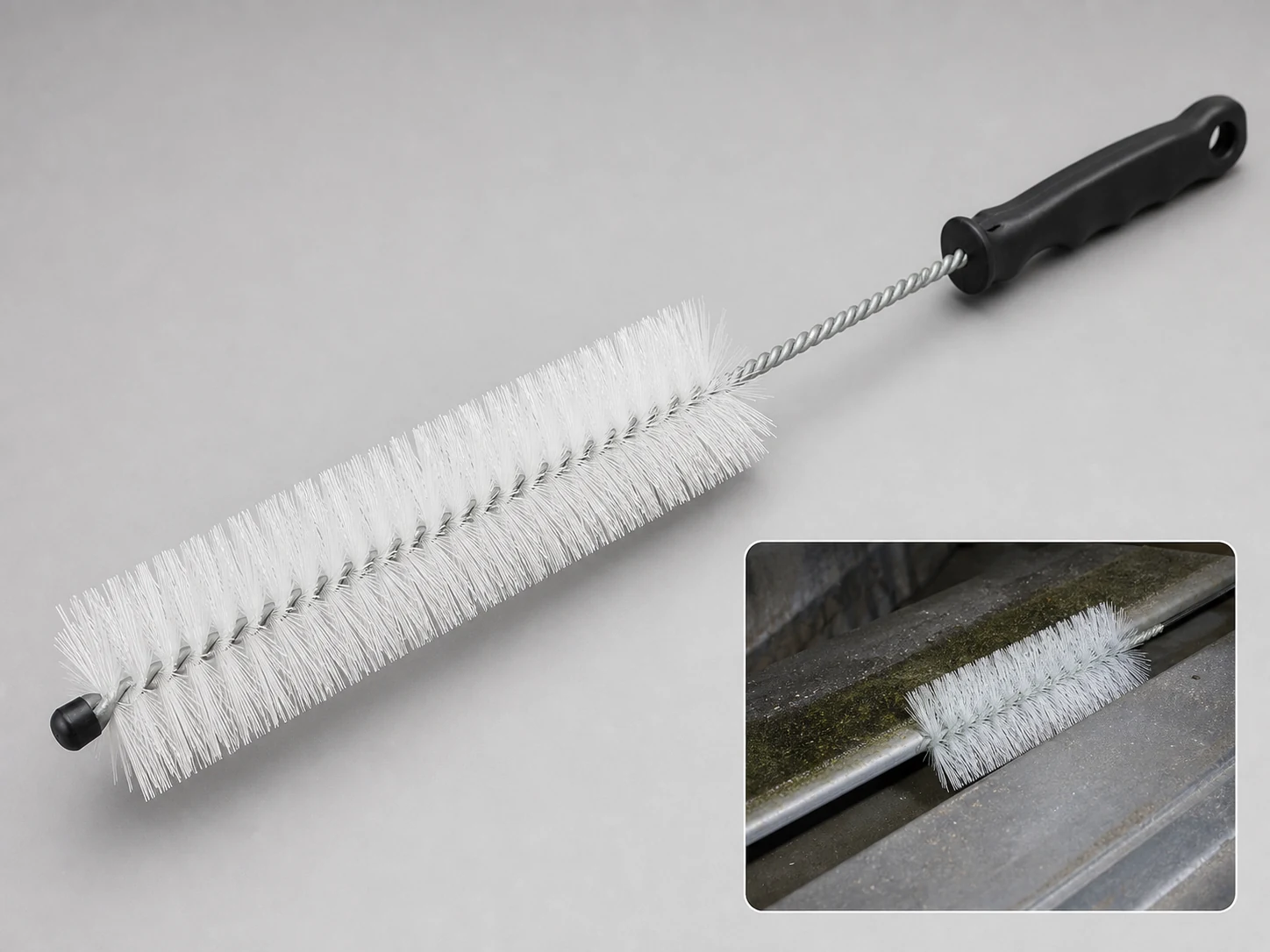
Custom pole-mounted blanketweed brushes remove string algae from pond liners, edges, and water features.
Medium brush
100 pcs
Minimum order
Worked with two hands or on a pole: chimney, gutter and pond-filter brushes, discs, cups and tank brushes.
Production lead time, once the specification is confirmed
- Up to 100 pcsWithin 7 days
- 101–5,000 pcsWithin 14 days
- 5,001–50,000 pcsWithin 21 days
- Over 50,000 pcsConfirmed with your quotation
Peak season can extend these times; the shipping date is confirmed in writing with your quotation. Sampling and shipping are quoted separately.
A pole-mounted pond maintenance brush with long nylon filaments that catches and lifts blanketweed and string algae from liners, edges, and rock work — without wading or scraping the pond surface.
What can this brush do for you?
Long Nylon Filaments Catch Filamentous Algae Instead of Sliding Over It
Blanketweed forms slippery, hair-like mats that short or densely packed bristles tend to push aside. The brush uses trim lengths from 25 to 100 mm so filaments can wrap around and between individual algae strands. A slow pull-and-twist motion gathers the mat so it can be lifted out rather than broken into fragments that resettle on the liner.
Threaded Pole Connection Lets You Work From the Bank or Deck
The brush head is built around a pole connection — M18, 3/4 in, ACME, or a thread you already use on site. Mounted on a 0.6–1.8 m maintenance pole, the brush reaches edge mats, submerged shelves, and intake areas without entering the water, which keeps the operator dry and reduces disturbance of fish and sediment.
Nylon PA Fill Stays Functional When Wet
Nylon PA filament absorbs very little water, resists rot and mildew, and recovers its shape after flexing. In pond service — where a brush may be wet, dried, and reused repeatedly — this means the working end keeps its stiffness and does not become foul or matted between maintenance sessions.
Wide Head Covers Ledges and Open Edges in Fewer Strokes
The 140–180 mm working width lays a broad contact path along liner shelves and edge zones. Wider heads clear open banks quickly; narrower or curved profiles can be specified where rock pockets or planted margins require more controlled contact.
Trim Is Tunable for Liners or Hard Surfaces
Filament diameter, trim length, and tip finish can be matched to the surface being cleaned. Finer, flagged filaments give gentler contact on EPDM or PVC liner; thicker, shorter filaments apply more mechanical pull on concrete edges, rock faces, and heavily anchored mats. The result is a brush that removes algae without turning the pond liner into the wear surface.
What is a Blanketweed Brush?
A Blanketweed Brush is a hand-guided pond maintenance tool that uses long nylon filament fill on a threaded head to gather and remove string algae and attached organic debris from accessible water surfaces. It is typically mounted on a standard maintenance or extension pole, passed over the affected area with a dragging, rolling, or twisting motion, and then cleared by hand or by rinsing the head.
In practice, the brush contacts the pond liner, sidewall shelves, rock edges, and other hard or soft surfaces where filamentous algae anchors. The open filament fill is intentional: it lets individual strands enter between the filaments, where they wrap during the pull stroke and release when the brush is lifted clear of the water. The tool works best as part of a regular maintenance routine, not as a one-time removal device for heavily embedded mats.
This is not a sludge pump, a rooted-weed cutter, or a chemical treatment. It does not remove fine suspended particles and it does not prevent future algal growth by itself. Its job is mechanical removal of the visible string-algae biomass from surfaces that can be reached from the water’s edge.
Technical Specifications
The values below are the standard configuration range. Dimensions, fill pattern, and connection type can be adjusted to your pond profile and existing pole equipment.
| Parameter | Value / Options |
|---|---|
| Head width | 140–180 mm |
| Trim length | 25–100 mm |
| Filament diameter | 0.25–1.20 mm |
| Fill material | Nylon PA (grade selected for water and chemical exposure) |
| Pole connection | M18, 3/4 in, ACME, or custom thread |
| Overall reach with pole | 0.6–1.8 m |
| Operating temperature | -20°C to 100°C |
| Head profile | Flat strip, curved, or multi-row layout as required |
| Trim finish | Straight cut, flagged, crimped, or tipped |
| Brush type | Custom Handheld Detail Brushes |
| How it is driven | Hand-guided |
| Cleaning target | garden pond and water garden, koi and ornamental fish pond, and fountain basin and reflecting pool cleaning |
| Surface or part | edges, strings, concrete, pvc, sidewalls, profiles, thread, and bands |
| Residue or debris | algae, blanketweed, filamentous algae, sludge, suspended particles, and sediment |
| Mounting / connection | M18, 3/4 in, ACME, or custom thread |
Where does this brush work best?
- Garden ponds and water gardens with EPDM or PVC liners where blanketweed attaches to shelves, sidewalls, and the waterline band.
- Koi and ornamental fish ponds where string algae collects around returns, skimmers, bottom drains, and planted margins and needs mechanical removal between filter maintenance.
- Fountain basins and reflecting pools where algae builds on concrete or liner surfaces and access is limited to the rim or walkway.
- Natural swimming ponds and recreational water features where blanketweed forms in shallow bays and along entry steps and must be pulled without chemicals.
- Commercial water features, irrigation ponds, and intake zones where filamentous algae accumulates on screens, edges, or accessible structures and requires scheduled manual removal.
How do I choose the right one?
Start with the surface the brush will contact
If the pond has an EPDM, PVC, or other flexible liner, specify the finer end of the filament range — roughly 0.25–0.40 mm — with longer trim and flagged tips. The brush should feel softer than a deck scrub brush but still catch the algae. For concrete basins, stone edges, or rock work, thicker filament from about 0.60 mm upward with shorter trim gives the pull force needed to dislodge anchored mats without excessive flex.
Match trim stiffness to the algae load
Light seasonal blanketweed on a smooth liner can be handled by long, fine, softly finished filaments. Dense mats on hard surfaces need shorter, stiffer fill. If the brush flexes to the base of the trim under normal pull force, the filament is too soft for the job; if it skates across the mat without catching strands, the fill may be too stiff or too short.
Select the connection before other dimensions
The brush head has to mount to the pole you already use for pond nets, leaf rakes, or debris skimmers. Confirm whether your site is standardized on M18, 3/4 in, ACME, or a proprietary thread. A custom insert or adapter can be specified if your poles are a mix, but a single standard connection keeps replacement heads simple.
Size the reach and head width to the pond’s access geometry
Overall reach should be the distance from your normal standing point to the farthest mat you need to touch, plus enough overlap to keep the head under control at full extension. In open-edge ponds, a wider head reduces the number of passes. In planted or rock-lined margins, a narrower head or curved profile prevents the brush from jamming between stones or pulling up desirable plants.
Consider water chemistry and temperature
Nylon PA performs well in fresh water and common pond treatment levels, but high chlorine, salt, or extreme pH will affect the grade selection. If the pond is chlorinated, saline, or heated, give the full water chemistry and temperature range early so the filament and any insert hardware are rated for the actual service.
When another tool is the better choice
Use a pond vacuum or sludge pump for loose bottom detritus and decomposed organic sediment. Use a weed cutter or rake for rooted plants with woody stems. Use UV, aeration, or nutrient-management methods for single-celled green water, which this brush cannot capture. For very large lakes or inaccessible mats beyond pole reach, a mechanical harvester or boat-based removal will be more practical.
Can I customize this brush?
Every pond differs in liner type, access, and algae pressure, so the brush is configured around the job rather than supplied as a single fixed design. To define the configuration, provide the pond surface material, typical algae thickness, the pole thread you use, the farthest reach needed, and the water chemistry. A few photos of the affected edges or a sketch of the shelf profile speed up the design process.
Common customization points include:
- Head geometry — width, profile, working angle, and row layout for flat ledges, curved edges, or tight rockwork.
- Trim construction — filament diameter, trim length, density, tip finish, and material grade for the liner or hard-surface requirement.
- Pole interface — M18, 3/4 in, ACME, custom thread, quick-release, or fixed-pole integration.
- Reach support — overall pole range from 0.6 to 1.8 m, single-piece or telescoping construction as project preference.
- Finish and identification — head color, custom marking, laser marking, or color-coded trim for maintenance frequency cues.
- Packaging — bulk, individual bag, retail label, or project-specific packing.
If the project requires material declarations, water-contact documentation, inspection, or third-party testing, we can support those requirements during the customization process.
What size fits the opening, and how is a blanketweed brush cleaned afterwards?
How can I tell whether the brush is too stiff for my pond liner?
Run a short test pass on a hidden section of liner or on a spare piece of the same material. Check the surface in direct light for visible scuff lines or a whitened appearance. If marks remain after rinsing, move to a finer filament diameter, longer trim, or flagged tips. A correctly matched brush should leave the liner clean but visually unchanged.
Does the brush remove blanketweed at the attachment point?
It removes the filament mass and much of the attached organic matter when the mat is wound and lifted. Small remnants can remain in textured surfaces or tight joint lines, and regrowth will occur as long as nutrient and light conditions support it. Treat the brush as the mechanical removal step, not as a growth preventer.
Can I use it in a stocked pond without risking the fish?
Yes, when the brush is used with slow, controlled strokes and the fish are not spawning in the area being cleaned. Use the gentler trim configurations around fish and avoid jabbing the head into crevices where fish shelter. Lift the brush clear of the water before shaking algae off the head into a bucket or compost area.
How should the brush be cleaned and stored between uses?
Rinse the head with clean water after each use, pull out any wrapped algae by hand, and hang it to dry. Do not leave the brush submerged for extended periods or store it with the head resting on the floor. Check the pole thread periodically for grit, and remove any buildup from the thread insert before mounting the head.
What reach do I actually need?
Measure from your normal working position to the farthest point you expect to clean, then add roughly 0.3 m so the pole does not need to be held at maximum extension. If operators work from different sides of the pond, size for the longest practical reach. If the pond cannot be covered from a single position, consider multiple brush heads or shorter poles assigned to different zones.
When should I use a different cleaning method instead of this brush?
Choose a pond vacuum for fine sludge and decomposed material, a cutter or rake for rooted weeds, and UV or chemical treatment for green-water algae. If mats are too heavy to lift by hand, too far from the edge to reach, or attached to structures that cannot withstand mechanical contact, the brush is not the right tool for that section of the water feature.
Guides that go deeper on this
We have not written a guide specific to this one yet. The material that covers selection, filament, dimensions, maintenance and sourcing is collected in the technical resources library.
Custom Manufacturing RFQ
Describe Your Application
For a custom quote, we need the key dimensions, surface or part, residue, material preference, quantity, and reference image or drawing.
Drawing or photo optional — it speeds things up, it does not gate the enquiry.
Custom Brush RFQ
Send Your Brush Project
Upload a drawing, product photo, or sample photo and provide the core dimensions and cleaning conditions.
“We need a brush to remove wet residue from a stainless steel conveyor, about 800mm wide. The current brush wears quickly. We can send photos.”
“We sell drinkware and need a cleaning brush to include with the product. Quantity around 5,000 pieces.”