
Application
Pond & Water Garden Maintenance
For Pond & Water Garden Maintenance, the brush has to reach from the bank, gather filamentous algae rather than break it, and do it against a liner that sets the hardness ceiling. Access, contact movement, and the selected cleaning method determine which brush structure will work.
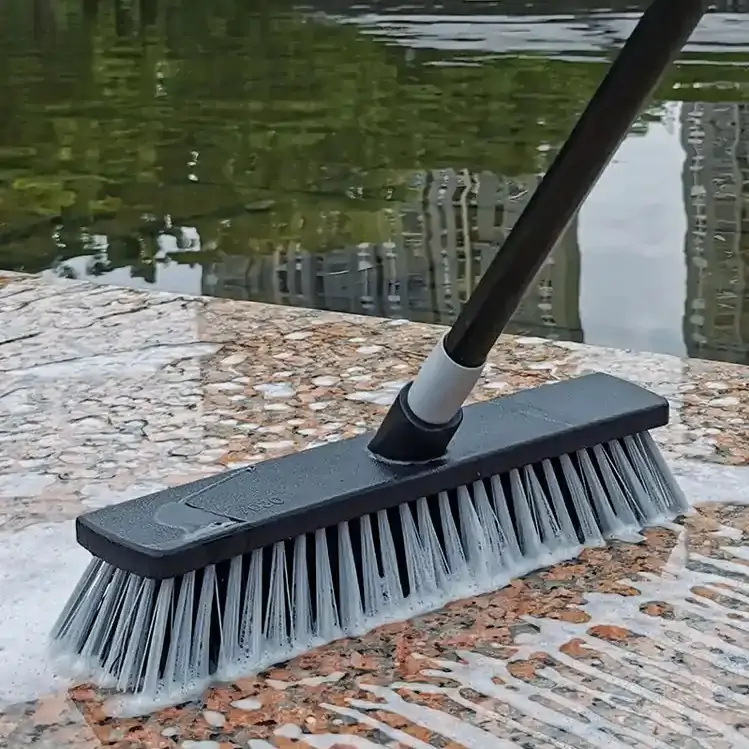
At a glance
- Cleaning target
- Blanketweed/String Algae/Silt/Biofilm
- Working environment
- Outdoor / Submerged Edge
- Cleaning method
- Wet Brushing from the Bank
- Requirements to check
- No drinking-water contact. Where fish are present, any chemistry is dosed to water volume by the pond keeper, not applied to the brush.
A pond is cleaned from the bank, and the softest thing in it is the liner underneath the algae — so reach and a hardness ceiling decide the brush before the residue does.
What makes Pond & Water Garden Maintenance different from other facility, floor and outdoor cleaning?
The main difficulty is lifting blanketweed, string algae, silt and biofilm off liners, rock edges, waterfall courses and intake screens without tearing the liner, stirring the sediment bed, or leaving the algae in the water to sink and decay.
The work happens outdoors, at the submerged edge, in water between 2 and 35°C, usually with fish in it.
The part people get wrong: loosening the algae is only half the job. What is brushed off has to leave the water. Left in, it sinks, breaks down, and arrives at the filter a week later — which is why the easy step turns into the heavy one.
What are the most common cleaning targets in Pond & Water Garden Maintenance?
There are 5 targets here, and the surface under each one is different: sheet liner, cut stone, flowing water and a moulded screen.
| Part or area | Residue type | Cleaning requirement |
|---|---|---|
| Pond Liner | Blanketweed, String Algae, Silt, Biofilm | The face must stay flat against the surface so the whole working width contacts, with filament soft enough not to mark it. |
| Rock and Cobble Edge | The head must reach the working face and apply even contact without marking the surface. | |
| Blanketweed and String Algae | ||
| Waterfall and Stream Course | ||
| Pump Intake Screen | The head must enter a shallow recess and contact the screen or seat face without scratching it or dislodging the gasket. |
The dimensional envelope those targets impose on the brush:
| Parameter | Typical range |
|---|---|
| Pole length | 0.6–4 m |
| Head width | 100–300 mm |
| Trim length | 25–100 mm |
| Water temperature | 2–35°C |
Which brush types work for each cleaning target?
Long-trim pole-mounted pond brush, narrow detail brush for rock pockets and a soft head for the intake screen.
| Cleaning target | Recommended brush type | Why it fits |
|---|---|---|
| Pond Liner | Handheld Detail Brushes | A liner is a thin sheet with soft ground under it, so a wide flat head spreads the load across the whole working width instead of concentrating it on one point that can drag or crease the sheet. |
| Rock and Cobble Edge | Edge stone is an irregular surface with algae rooted in the texture, so a hand-guided head follows the profile and works into the pockets a flat pass rides straight over. | |
| Blanketweed and String Algae | Filamentous algae is a slippery mat that short bristles push aside, so a long-trim head wraps between the strands, gathers the mat and lifts it clear of the water in one piece. | |
| Waterfall and Stream Course | A stream course is a shallow run of wetted stone with flow over it, so a hand-guided head reaches the wetted face and the algae is carried off downstream instead of being pressed into the joints. | |
| Pump Intake Screen | The intake screen is a recessed grille where flow drops first, so a small soft head clears the face without pushing debris through it or dislodging the screen from its seat. |
The layouts this application is normally built in:
- Pole-mounted head — the normal case, worked from the bank or a deck so the operator stays dry and the sediment stays put
- Short-handled detail head — for rock pockets, planted margins and the intake screen, where a wide head cannot be placed accurately
- Fixed or floating brush media — a different product entirely; it belongs in the filter, not against the liner
In practical brush terms: the liner sets the ceiling. A butyl or EPDM sheet has nothing but soft ground behind it, so whatever hardness the algae would justify, the liner overrules it.
What filament materials work best for Pond & Water Garden Maintenance?
Nylon PA for wet service and shape recovery; polypropylene PP where the brush sits in water for long periods; filament diameter set by whether the surface under it is a liner or stone.
| If the condition is… | Filament to start with | Why |
|---|---|---|
| Butyl or EPDM liner | Nylon PA, fine diameter | flexes against a thin sheet instead of dragging on it |
| Rock, cobble and concrete edging | Nylon PA, coarser diameter | works into the stone texture where the algae is rooted |
| Left submerged between sessions | Polypropylene PP | takes up almost no water, so it does not rot or go foul on the pole |
The constraints this application puts on the filament:
| Constraint | Value for this application |
|---|---|
| Filament hardness | Soft–Medium |
| Maximum service temperature | 60°C |
| Chemical exposure | Pond Water; Barley Straw Extract; Algaecide Dosed to Water Volume |
| Cleaning method | Wet Brushing from the Bank |
How do I choose the right brush for my pond and water garden?
Measure the reach you need before anything else: the distance from where you can stand to the furthest point you have to clean is what decides the pole, and the pole decides how much head weight you can hold out over water.
The sequence that gets a usable sample first time:
- Name the softest surface the brush will touch — liner, concrete, or stone — and set the hardness ceiling from it
- Measure bank-to-target reach and the pole thread already in use on site
- Decide whether the algae is being gathered (long trim) or scrubbed off stone (shorter, coarser trim)
- Size the head to the widest open run, then specify a second narrow head for rock pockets and the intake screen
- Confirm fish are present, because that rules out anything applied to the brush rather than dosed to the water
- Run one maintenance session and check the liner for drag marks before committing to a quantity
Before you commit to a quantity, send the pond surface area, the liner type, and the bank reach in metres.
When is a pond and water garden brush the wrong tool?
Three jobs here are not brush work, and treating them as brush work is what makes a pond harder to keep.
- Green water. Suspended single-cell algae is in the water column, not on a surface. That is filtration, UV, or dosing to water volume; a brush has nothing to touch.
- The silt bed. Sediment that has to be removed rather than stirred is pond-vacuum work. Brushing it puts it back into suspension and clouds the pond for days.
- Algae that keeps coming back. When the cause is overfeeding or too little shade, the brush is maintenance, not the fix. Change the cause or you will be brushing weekly.
What common mistakes should I avoid in Pond & Water Garden Maintenance?
- Choosing filament hardness from the algae instead of from the liner underneath it
- Breaking the algae mat up instead of gathering and lifting it, so it sinks, decays and arrives at the filter a week later
- Wading in to reach the middle, which lifts the sediment bed and undoes the work
When a brush is running but not cleaning, start here rather than adding pressure:
| Symptom | What to change |
|---|---|
| Algae breaks up and resettles | Slow the stroke and lengthen the trim so the mat is gathered rather than cut; lift each pass clear of the water before releasing. |
| Liner marks or drag lines | Reduce filament diameter and engagement; the liner, not the algae, sets the hardness ceiling. |
| Water clouds and stays cloudy | Stop brushing the sediment bed — that is vacuum work, not brush work. |
| Algae returns within days | The brush is maintenance; check feeding rate, shade and filter capacity before changing the brush. |
No catalogue item for this yet
Every brush here is made to order, and this one has no catalogue entry so far. Send the working surface, the residue, the access opening and the quantity, and it is quoted through the same specification route as the rest of the range.
Custom Manufacturing RFQ
Discuss This Application
Share the working surface, residue, dimensions, material direction, interface, quantity and drawing or sample photo.
Custom Brush RFQ
Request a Custom Cleaning Brush Quote
Upload a drawing, product photo, or sample photo and provide the core dimensions and cleaning conditions.
“We need a brush to remove wet residue from a stainless steel conveyor, about 800mm wide. The current brush wears quickly. We can send photos.”
“We sell drinkware and need a cleaning brush to include with the product. Quantity around 5,000 pieces.”