
Application
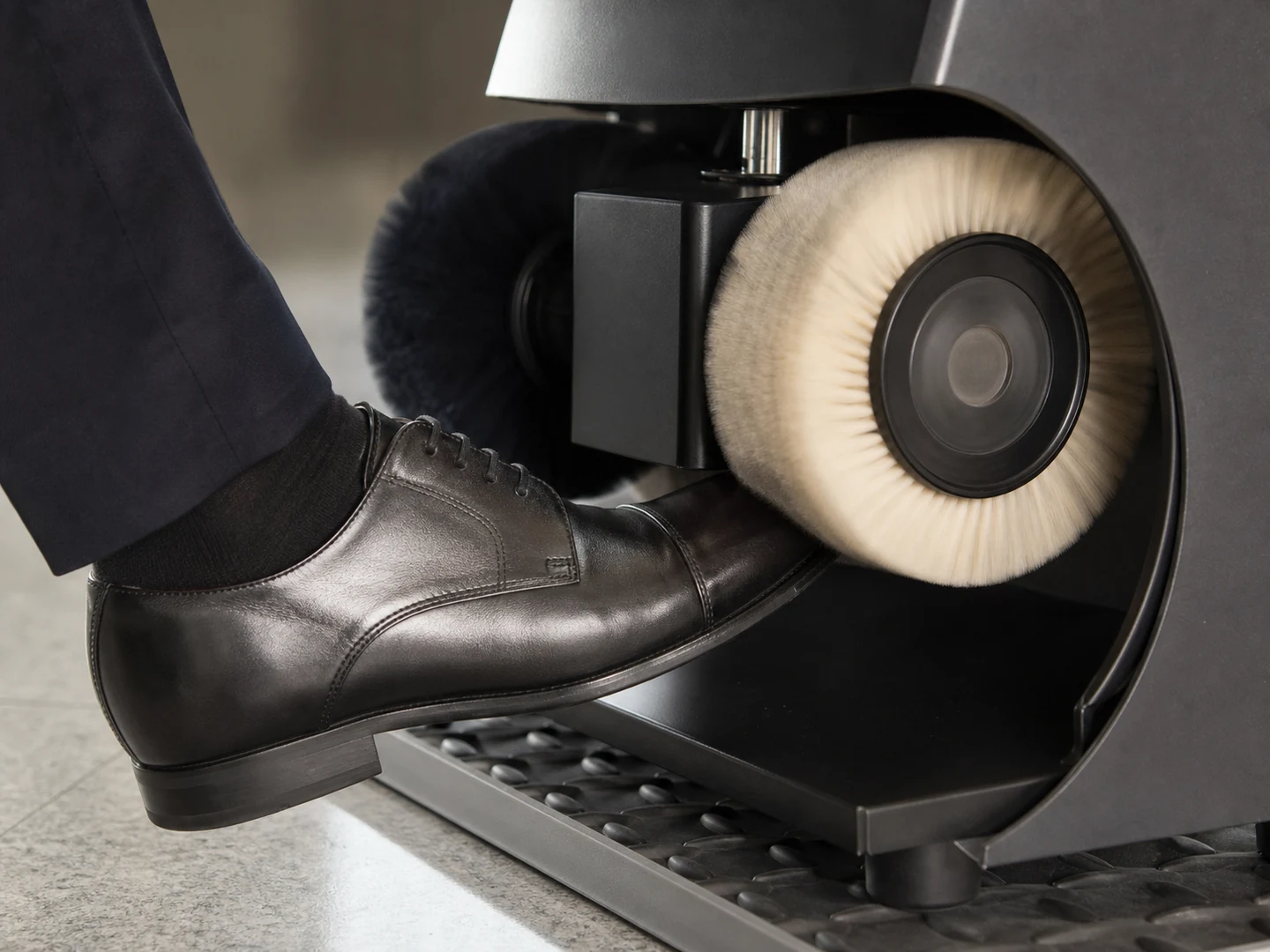
Automatic Shoe Polishing & Footwear Surface Brushing
For automatic shoe polishing, match the brush fill and contact pressure to the footwear material, polish, curved upper, and desired gloss. The goal is to spread or buff the care product without cutting the finish, overheating the surface, or transferring color.
At a glance
- Cleaning target
- Dust/Soil/Shoe Polish/Wax/Fibers
- Working environment
- Dry Indoor Area / Public Area
- Cleaning method
- Dry Brushing / Application
- Requirements to check
- Machine Guarding and Pinch-Point Control; Low Shedding; Footwear-Upper Material Compatibility
Shoe finishing runs from cleaning through wax to buffing, and each stage wants a different wheel — which is why polishing machines carry paired brushes rather than a single one.
What makes Automatic Shoe Polishing & Footwear Surface Brushing different from other specialty brush functions cleaning?
The main difficulty is removing burrs, oxide, glaze, coating, sanding dust, and texture peaks from metal, wood, ceramic, glass, leather, and machined surfaces without damaging the surface, loading the brush, or carrying contamination back into the process.
The work happens in dry indoor area and public area against dust, soil, shoe polish, wax and fibers.
The part people get wrong: this is not one job. The same equipment carries several targets, each with a different opening and a different residue, and one brush rarely covers them all.
What are the most common cleaning targets in Automatic Shoe Polishing & Footwear Surface Brushing?
There are 5 distinct targets here, and the brush that suits one will usually not reach another.
| Part or area | Residue type | Cleaning requirement |
|---|---|---|
| Automatic Shoe-Polishing Machine Brush | Dust, Soil, Shoe Polish, Wax, Fibers | The head must reach the working face and apply even contact without marking the surface. |
| Manual Leather-Shoe Polishing | ||
| Suede and Nubuck | The filament must cut at a controlled depth and hold the same profile across the whole contact band, because here the surface the brush leaves is the product rather than a by-product. | |
| Sole and Edge | The brush must concentrate contact on a small feature without touching the surrounding surface. | |
| Boot Buffing and Finishing | The head must reach the working face and apply even contact without marking the surface. |
What the equipment leaves you to work inside:
| Parameter | Typical range |
|---|---|
| Wheel diameter | 50–1000 mm |
| Face width | 10–300 mm |
| Arbor diameter | 6–150 mm |
| Tool diameter | 20–500 mm |
| Filament / abrasive size | 0.15–2.0 mm or 46–1,000 grit |
Which brush types work for each cleaning target?
Paired machine-mounted polishing wheels, cylindrical shoe brush, edge brush, or handheld polishing brush.
| Cleaning target | Recommended brush type | Why it fits |
|---|---|---|
| Automatic Shoe-Polishing Machine Brush | Handheld Detail Brushes | In a machine the brush is the working element that both applies and buffs, so filament choice sets the polish pickup and the final shine together. |
| Manual Leather-Shoe Polishing | Hand polishing runs in stages, so a hand-guided head lets the user apply, work in and buff at the pressure each stage needs. | |
| Suede and Nubuck | Suede is cleaned by lifting the nap rather than shining it, so the head is worked in one direction with filament stiff enough to raise the pile. | |
| Sole and Edge | Roller and Conveyor Brushes | The sole edge is finished as a narrow band next to the upper, so a brush on a driven shaft keeps the contact on that band alone. |
| Boot Buffing and Finishing | Handheld Detail Brushes | A boot has a large shaft area and a welt line, so a hand-guided head covers the panel and still gets into the welt where wax collects. |
How the brush is usually carried on the machine:
- Driven brush — use when burrs, oxide, glaze, coating, sanding dust, and texture peaks needs repeatable scrubbing or controlled relative movement
- Passive or free-running brush — use for loose contamination and lower process complexity on metal, wood, ceramic, glass, leather, and machined surfaces
- Localized hand, strip, or tube brush — use where only an edge, gap, port, or maintenance point needs contact
In practical brush terms: match the construction to the access before anything else. A geometry that cannot reach the target will not be rescued by a better filament.
What filament materials work best for Automatic Shoe Polishing & Footwear Surface Brushing?
Horsehair, soft natural fiber, cloth, wool, or soft synthetic media suits dusting and final gloss; sisal or abrasive media is limited to defined roughing steps.
| If the condition is… | Filament to start with | Why |
|---|---|---|
| Sensitive or coated surface | Sisal Fiber | firm compound-carrying polishing |
| Wet, washdown, or detergent service | Nylon PA | balanced flex life and abrasion resistance |
| Bonded residue or aggressive cleaning | Wool | soft compound retention and polishing |
What the duty rules out before you start comparing grades:
| Constraint | Value for this application |
|---|---|
| Filament hardness | Soft–Medium |
| Maximum service temperature | 80°C |
| Chemical exposure | Shoe Wax; Water-Based Care Product; Hydrocarbon-Based Care Product |
| Cleaning method | Dry Brushing, Application |
How do I choose the right brush for my automatic shoe polishing & footwear surface brushing equipment?
Specify per stage — cleaning, waxing, buffing — then match arbor size and wheel diameter to the machine’s running speed.
The order that avoids rework:
- Identify the target part and measure the access opening or clearance
- Describe the residue: what it is, how thick it sits, and how strongly it holds
- Choose the construction that can physically reach that target
- Set the filament from surface risk, working temperature and cleaning chemistry
- Fix filament diameter, free trim length and density for the contact pressure you need
- Run one cycle and check the result before committing to a production quantity
Before you commit to a quantity, say which stage the wheel serves, and send the arbor size, the wheel diameter and the machine speed.
When is an automatic shoe polishing and footwear surface brush the wrong tool?
Suede and nubuck take a rubber or crepe block rather than a polishing wheel, and heavily scuffed leather needs re-colouring before buffing helps. A machine wheel is also wrong on a cracked finish, because buffing opens the crack further.
What common mistakes should I avoid in Automatic Shoe Polishing & Footwear Surface Brushing?
- Ordering one wheel for a machine that runs cleaning, waxing and buffing as separate stages
- Changing brush material while leaving excessive engagement, poor alignment, or no discharge path unchanged
- Copying a worn brush without recording motion, direction, mounting, and the original working diameter
If the brush is already in service and the result is wrong, work from the symptom:
| Symptom | What to change |
|---|---|
| Residue remains | Increase relative motion or discharge, then change filament diameter or density; do not add pressure before checking loading by burrs, oxide, glaze, coating, sanding dust, and texture peaks. |
| Surface marks or scratches | Reduce engagement, use finer or softer fill, and remove trapped abrasive particles from contact with metal, wood, ceramic, glass, leather, and machined surfaces. |
| Rapid wear or uneven cleaning | Check alignment, runout, support, motion, temperature, chemical attack, and whether the brush covers the complete working path. |
| Brush loads or redeposits residue | Open the fill pattern or add wash, vacuum, air, scraping, or a collection path so removed burrs, oxide, glaze, coating, sanding dust, and texture peaks leaves the contact zone. |
Questions this page is asked
How should a powered shoe-polishing brush be qualified?
With guards and emergency controls in place, use a representative witness shoe or matched material and hold speed, engagement, dwell, pass direction and compound quantity constant. Inspect after cooling for finish lift, color movement, streaks, nap change, heat marks, seam damage and achieved gloss before releasing the setting to normal use.
How are shoe-polishing brushes kept from transferring color or compound?
Dedicate and label wheels by cleaning, application or buffing role and by compatible light, dark or special-finish product family. After cleaning or changeover, test on a clean witness material and reject the wheel for retained pigment, tack, abrasive grit, shedding or an uneven contact band.
Guides that go deeper on this
No catalogue item for this yet
Every brush here is made to order, and this one has no catalogue entry so far. Send the working surface, the residue, the access opening and the quantity, and it is quoted through the same specification route as the rest of the range.
Custom Manufacturing RFQ
Discuss This Application
Share the working surface, residue, dimensions, material direction, interface, quantity and drawing or sample photo.
Custom Brush RFQ
Request a Custom Cleaning Brush Quote
Upload a drawing, product photo, or sample photo and provide the core dimensions and cleaning conditions.
“We need a brush to remove wet residue from a stainless steel conveyor, about 800mm wide. The current brush wears quickly. We can send photos.”
“We sell drinkware and need a cleaning brush to include with the product. Quantity around 5,000 pieces.”