
Brush Type
Custom Bottle & Container Brushes
Bottle / Container Brush
Choose a bottle or container brush when the head must pass through an opening and clean internal walls, shoulders, corners, and the bottom without the handle or core striking the vessel.
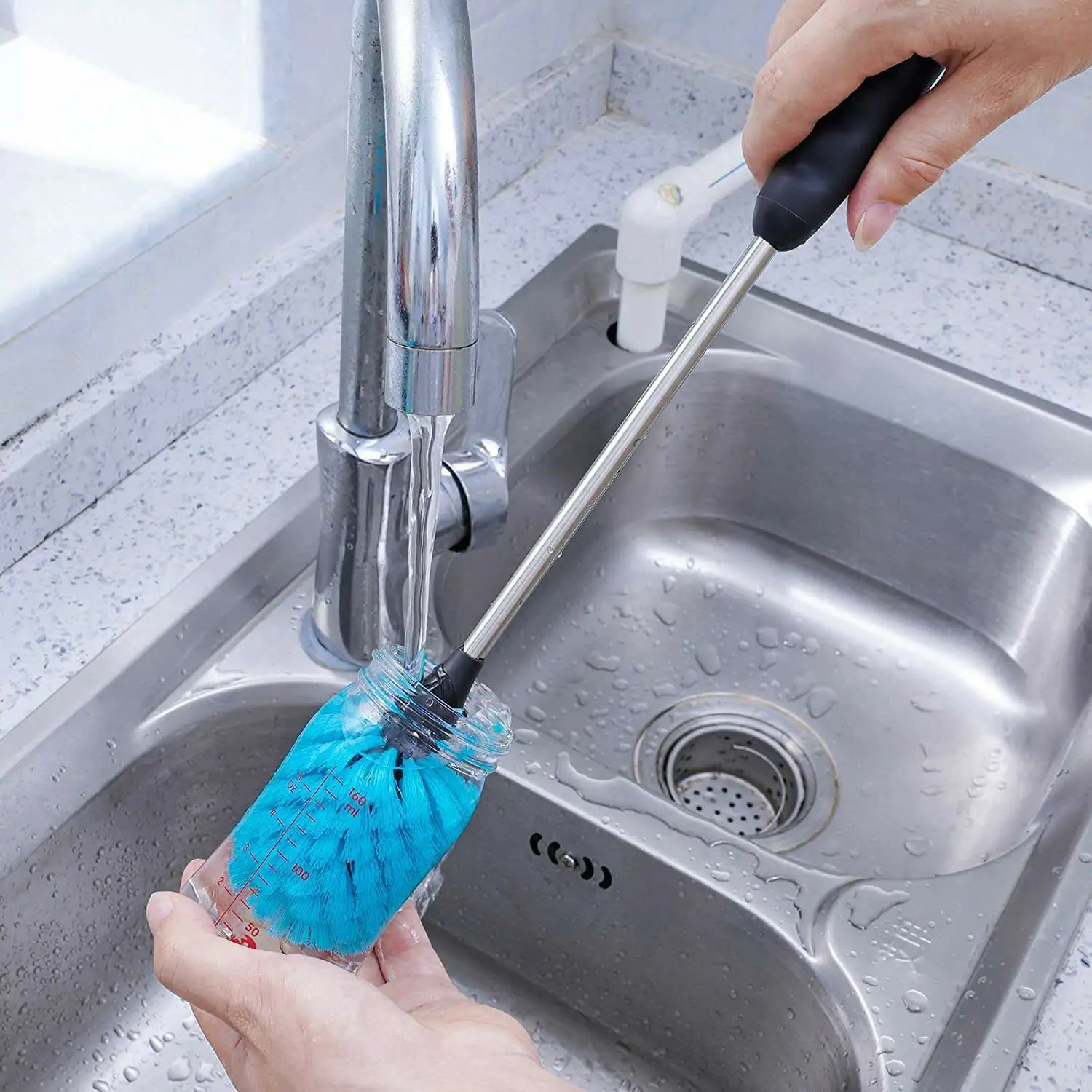
At a glance
- How it is driven
- Hand-guided
- How it mounts
- Fixed;Threaded Removable;Quick-Change Coupling
When should you choose this brush type?
Choose a bottle or container brush when the brush must pass through a neck or opening and then contact the sidewall, shoulder, or base of a vessel. Move to a tube or bore brush when the passage is long and diameter-controlled, with the cleaning task focused on a pipe, bore, lumen, or channel rather than a container body and bottom geometry.
What are Bottle & Container Brushes?
Bottle and container brushes combine a radial, tapered, rounded, fan-shaped, or end-filled head with a handle or extension sized for the vessel. The brush must enter through the neck, expand or conform to the internal profile, and maintain contact at the wall and bottom.
Head diameter is chosen based on the opening and chamber dimensions, while working length and handle length are set from the vessel depth and safe hand clearance. Trim, density, end shape, and filament material determine how the brush reaches shoulders and corners, releases residue, and tolerates rinsing, chemicals, or steam.
What dimensions can I customize?
| Head diameter | 35–300 mm |
|---|---|
| Head or working length | 90–500 mm |
| Handle or support length | 180–1200 mm |
| Mounting interface | Fixed;Threaded Removable;Quick-Change Coupling |
Where is this brush type commonly used?
Start with the job the brush needs to do, then confirm dimensions, contact direction, material, and mounting.
What configurations are available?
Straight cylindrical head
A consistent diameter for tubes, bottles, and vessels with relatively uniform internal walls.
Tapered or stepped head
Different diameters clean a neck, shoulder, and body where the internal profile changes.
Rounded or fan end
Extra end contact reaches the bottom and transition radius without exposing a hard core tip.
Long-handle or tank brush
Extended rigid or reinforced reach for drums, tanks, reactors, and deep containers.
Replaceable or quick-change head
Different heads share one handle or extension for cleaning several vessel sizes or controlled hygiene zones.
What material is right for this brush type?
PBT
Repeated wet cleaning and good recovery with lower water absorption than common nylon grades.
Nylon PA
General bottle and vessel cleaning with broad stiffness and trim options.
Polypropylene PP
Chemical-contact and economical wet service where the temperature is suitable.
PTFE filament
Selected chemical or temperature environments where project-specific compatibility justifies it.
Silicone or soft elastomer
Soft contact, wiping, or squeegee-like action where rigid filament is unsuitable.
Filament materials to compare
What do I need to know before ordering?
Supply the opening diameter, maximum internal diameter, depth, shoulder and bottom profile, access angle, residue, cleaning chemistry and temperature, preferred handle or extension, hygiene requirements, and quantity.
Questions this page is asked
How can a bottle brush be checked for neck, shoulder and base coverage?
Use a transparent sample, sectioned container or equivalent geometry gauge to confirm that the brush passes the opening and contacts the shoulder, sidewall corner and base without forcing the stem. Check the withdrawn pattern for untouched zones and ensure the tip cannot gouge glass, coating or a molded base feature.
What prevents a custom bottle brush from becoming a retained-part risk?
Specify a positive handle or machine interface, a stem and tip that tolerate the defined insertion path, and a construction that can be completely inspected before and after use. Stop if the brush binds or twists abnormally, and account for every fill bundle, tip and coupling before the container proceeds.
What should happen after a bottle or container is brush-cleaned?
Remove loosened soil with the approved rinse or extraction step, inspect the complete internal surface and opening, and drain the container in a position that does not trap liquid. Dry or continue to sanitation or sterilization as the controlled use requires, and release it only against that process's documented acceptance method.
Guides that go deeper on this
Baby Bottle Brush Mistakes in Home and Pro Kitchens
Read this guideGuideBaby Bottle Brush: Material and Size for Feeding Items
Read this guideGuideBottle Brush Mistakes on Baby Feeding Items
Read this guideGuideBottle Brush Set Mistakes on Glass Cups
Read this guideGuideBottle Brush Set: Material and Size for Narrow Mouth Bottles
Read this guideGuideBottle Brush Set: Which Pieces Do Baby Bottles Need?
Read this guideGuideBottle Brush Sponge: Material and Size for Baby Bottles
Read this guideGuideBottle Brushes for Narrow-Mouth Containers: Picking a Size
Read this guideGuideBottle Washing Brushes: Machine Fit and Material Safety
Read this guideGuideDo Glass Cups Need a Long Handle Bottle Brush?
Read this guideGuideDoes a Silicone Bottle Brush Survive Chemical Exposure?
Read this guideGuideElectric or Hand Bottle Brush: Which Cleans Baby Bottles?
Read this guide31 guides are indexed against this one. The rest are in the technical resources library.
No catalogue item for this yet
Every brush here is made to order, and this one has no catalogue entry so far. Send the working surface, the residue, the access opening and the quantity, and it is quoted through the same specification route as the rest of the range.
Custom Manufacturing RFQ
Discuss This Brush Type
Share the working surface, residue, dimensions, material direction, interface, quantity and drawing or sample photo.
Custom Brush RFQ
Request a Custom Cleaning Brush Quote
Upload a drawing, product photo, or sample photo and provide the core dimensions and cleaning conditions.
“We need a brush to remove wet residue from a stainless steel conveyor, about 800mm wide. The current brush wears quickly. We can send photos.”
“We sell drinkware and need a cleaning brush to include with the product. Quantity around 5,000 pieces.”