
Custom Cleaning Brush
Small Container Bottle Cleaning Brush
Custom small container bottle cleaning brush with 20–70 mm head diameter, tufted or sponge heads, and PP, PBT, nylon, or PU fill.
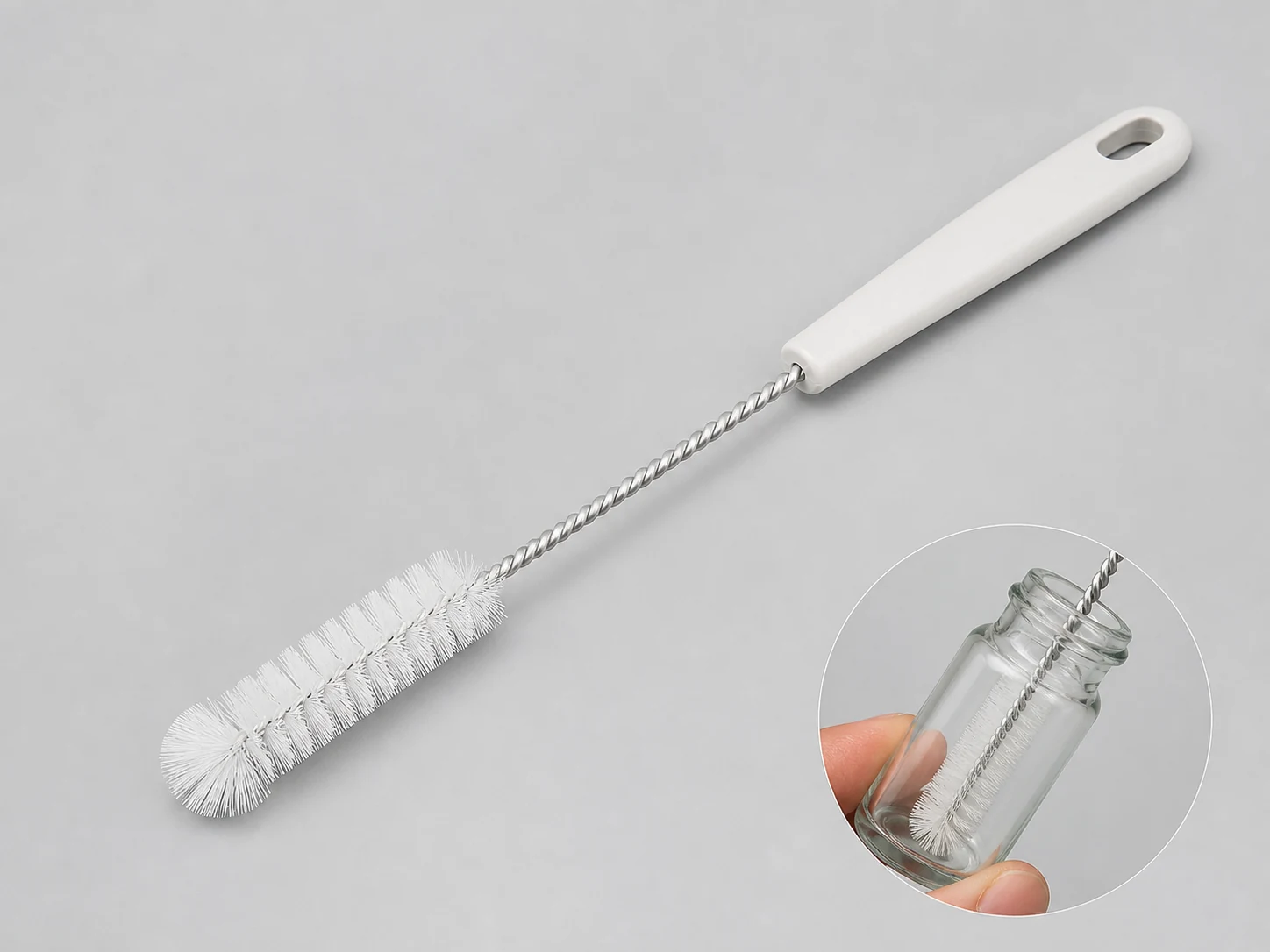
Small brush
500 pcs
Minimum order
Held in one hand: tube, bottle, detail and swab brushes — including long-handled ones with a small head.
Production lead time, once the specification is confirmed
- Up to 500 pcsWithin 7 days
- 501–50,000 pcsWithin 14 days
- Over 50,000 pcsWithin 21 days
Peak season can extend these times; the shipping date is confirmed in writing with your quotation. Sampling and shipping are quoted separately.
A compact, multi-configuration cleaning brush designed to reach the internal walls, shoulders, bases, necks, and threads of small containers, vials, and narrow-necked bottles. Available with tufted, sponge, or molded heads in PP, PBT, nylon, or PU foam, it removes film, residue, and debris from spaces that larger brushes cannot access.
What can this brush do for you?
Reaches Restricted Openings and Short Interior Depths
With a selectable head diameter from 20 mm and a working length as short as 120 mm, the brush enters openings that standard bottle brushes cannot clear and cleans the full interior without over-inserting into the base. This matters especially for vials, sample bottles, and cosmetic jars where neck clearance is tight and the interior is shallow.
One Tool Cleans Multiple Container Zones
The head can be configured with a tufted end to scrub the base, side tufts to clean the walls, and an optional sponge tip to wipe film from shoulders and threads. This reduces the number of tools needed to clean a small container thoroughly.
Matches the Residue Without Damaging the Surface
Filament diameter from 0.10 mm to 0.50 mm, plus soft PU sponge options, let you match contact intensity to the surface. Fine PBT or nylon filaments scrub stuck residue from glass and coated interiors without scratching, while sponge heads lift and absorb liquid film.
Chemical and Temperature Compatibility for the Process
Choose PP filaments for general chemical resistance, PBT for stiffness and durability in warm wash solutions, nylon for flexibility and wear life, or PU sponge for absorbent, low-abrasion cleaning. Specify your cleaning agent and wash temperature so the brush material is selected to survive the process, not just the residue.
Short, Controlled Stroke for Operator Precision
The compact working length and slim stem keep the operator close to the cleaning zone, allowing controlled push-pull and rotating strokes in small containers. This reduces splash and prevents the brush from bottoming out violently in short vessels.
Easy to Rinse and Inspect
Open filament tufts release loosened debris when rinsed, and sponge heads can be squeezed and rinsed clean. A brush that does not trap residue is easier to inspect and maintain between production runs.
What is a Small Container Bottle Cleaning Brush?
A Small Container Bottle Cleaning Brush is a hand-guided cleaning tool with a small-diameter head and a short working section, mounted on a handle or integral stem. It is used to clean the internal surfaces of containers that are too small, too narrow, or too shallow for standard bottle brushes. The head may be cylindrical, tapered, tufted-end, sponge, or molded silicone, and it is built to enter restricted openings while still contacting the sidewall, shoulder, base, and neck features.
During use, the operator inserts the head through the container opening and applies push-pull or rotating strokes. Filament tufts scrub attached residue, a tufted end reaches the base and shoulder transition, and a sponge head wipes away liquid film. The brush is selected not by container volume alone, but by the narrowest opening, interior depth, surface sensitivity, residue type, and cleaning chemical.
This is a precision cleaning tool for small-volume containers, not a scrub brush for large tanks or heavy industrial deposits. Neck clearance is a primary design consideration: the brush body must pass the opening without excessive force while still providing enough contact pressure inside. The stem and handle materials also need to resist the cleaning agent and wash temperature specified for the process.
Technical Specifications
All dimensions and materials are project-configurable. The table lists the standard selection range for this product category.
| Parameter | Value / Options |
|---|---|
| Head diameter | 20–70 mm, selected to pass the narrowest opening and contact the largest internal surface |
| Working length | 120–300 mm, adjusted to container depth and cleaning reach |
| Overall length | 200–450 mm, including stem and handle |
| Filament diameter | 0.10–0.50 mm per strand; finer for soft cleaning, coarser for heavier residue |
| Neck clearance | 10–60 mm annular clearance between brush body and container neck, depending on configuration |
| Head form | Cylindrical tufted, tapered tufted, tufted-end with side tufts, PU sponge, molded silicone, or custom geometry |
| Fill materials | Polypropylene (PP), PU sponge, PBT, Nylon PA, selectable per project |
| Stem / core | Stainless steel (304/316), coated wire, or plastic core for metal-free applications |
| Handle | Integral stem, loop handle, ergonomic grip, or mounting shank as required |
| Operating environment | Material grade selected for detergent type, wash temperature, and chemical exposure |
| Brush type | Custom Bottle & Container Brushes |
| How it is driven | Hand-guided |
| Cleaning target | laboratory vial, essential oil and fragrance bottle, and cosmetic jar and cream pot cleaning |
| Surface or part | containers, necks, shoulders, bases, thread, sidewalls, walls, and internal walls |
| Residue or debris | liquid film, cream, oil, and syrup |
| Mounting / connection | Fixed |
To specify an exact configuration, provide the container opening ID, interior depth, residue type, and cleaning chemical. We will confirm head diameter, filament selection, and stem material against your actual process.
Where does this brush work best?
- Laboratory vials, sample bottles, and small flasks with neck openings under 50 mm, where residue collects on sidewalls and curved bases.
- Essential oil and fragrance bottles with small orifices and buildup around threads and valve seats.
- Cosmetic jars and cream pots where internal shoulders and bases need film removal without scratching coated or polished interiors.
- Small beverage bottles (shot-size, extracts, syrup bottles) with deposit buildup at the bottom and neck.
- Medical and dental instrument cleaning for small internal cavities that require controlled scrubbing without cross-contamination.
- Precision parts cleaning for small nozzles, fittings, and valve bodies with restricted bores.
How do I choose the right one?
Start with the opening and interior dimensions. Measure the minimum internal neck diameter (or the smallest opening the brush must pass through) and the interior depth to the deepest surface you need to clean. Head diameter must be slightly smaller than the narrowest point, but large enough to contact the sidewall with some compression. Working length should reach the base without forcing the operator to over-insert the handle.
Choose the head form by cleaning task. A tufted-end head scrubs the base and shoulder transition. Side tufts clean the walls. A sponge head absorbs and wipes liquid film from smooth surfaces. A molded silicone head is best for very scratch-sensitive interiors. For containers with both walls and base, a combined tufted-end with side tufts is often the most efficient.
Select the fill material by residue and environment. PP offers broad resistance to acids and alkalis. PBT is stiff, dimensionally stable, and tolerates warm wash solutions. Nylon is flexible and wear-resistant but may absorb some solvents. PU sponge is soft, non-abrasive, and absorbs liquid film. Always consider the cleaning chemical, wash temperature, and any requirement for food-contact or metal-free construction.
Match filament diameter to surface and residue. Fine filaments (0.10–0.20 mm) are appropriate for polished glass, coated interiors, and light film. Coarser filaments (0.30–0.50 mm) provide more scrubbing force for thicker deposits on durable surfaces. If the container has a delicate coating, choose sponge or silicone rather than coarse filament ends.
Consider handle and control. Short handles give better control in vials and small jars. Loop or ergonomic grips reduce fatigue for repetitive use. In automated or semi-automated lines, specify a mounting shank instead of a hand grip.
When to use a different brush. For very narrow passages below about 10 mm, a wire-handle tube brush may be more suitable. For large-diameter containers, a larger bottle brush is more efficient. For heavy scale, baked-on carbon, or aggressive mechanical scrubbing, an abrasive or wire brush may be required. This brush is built for precision cleaning of small containers, not for bulk or heavy industrial removal.
Can I customize this brush?
Yes. This brush is configurable because small containers vary widely in opening, depth, and residue. To define a custom configuration, provide the container opening ID, interior depth, surface material, residue type, cleaning chemical, wash temperature, and preferred handle form. A sample container or drawing helps us confirm the geometry.
We can adjust:
- Head geometry – diameter, working length, taper, tuft density, tuft length, end profile, or custom molded shape
- Filament material and diameter – PP, PBT, Nylon PA, or PU sponge, with strand diameter selected from 0.10 mm to 0.50 mm
- Stem / core – length, stiffness, 304/316 stainless steel, coated wire, or metal-free plastic core
- Handle – straight, loop, ergonomic grip, mounting shank, color, or molded branding
- Color and marking – custom color, pad print, laser marking, or identification coding
- Packaging – bulk, individual bag, retail sleeve, kit, or project-specific packing
If your project requires documentation, material declarations, inspection, or third-party testing support, we can assist with those requirements during the customization process.
Which filament survives the cleaning chemicals a small container bottle cleaning brush meets?
How do I measure my container to confirm this brush will fit?
Measure the minimum internal neck diameter (or smallest opening the brush must pass through) and the interior depth to the deepest surface you need to clean. Compare your measurements to the head diameter and working length. Allow at least 10 mm annular clearance around the brush body at the neck to avoid binding during insertion and removal.
Can this brush clean around internal valves, threads, or inserts?
Yes. Choose a tapered or tufted-end head to reach threads and shoulder transitions. For valve bodies or small bores, a smaller head diameter or a custom contoured head may be required. Provide the internal obstruction dimensions so the head does not snag or damage the component during use.
How do I know which filament material is right for my cleaning chemical?
PP offers broad resistance to acids and alkalis. PBT is stiff and tolerates warm water. Nylon is flexible and wears well but may absorb some solvents. PU sponge is best for absorbent wiping. Always test a sample of the brush with your actual cleaning solution and temperature before committing to full production. If you need a specific chemical compatibility statement, we can provide material data sheets.
How should I clean and store the brush between uses?
Rinse the head thoroughly after each use to remove loosened residue, then shake or squeeze excess water (sponge heads). Hang or store the brush bristles-up in a dry area. For process-critical applications, sanitize according to your facility protocol after each shift. Avoid leaving the brush submerged in cleaning solution for prolonged periods, as this can degrade filament or sponge materials.
When should I replace the brush?
Replace when filaments become permanently bent, flattened, or lose spring-back; when the sponge head tears, delaminates, or no longer absorbs; or when the stem shows corrosion, cracks, or bending that affects control. A worn brush reduces contact efficiency and may leave residue behind.
Will this brush scratch glass or coated container interiors?
Fine filaments (0.10–0.20 mm) in PBT or nylon and PU sponge heads are designed for scratch-sensitive surfaces. For coated or polished interiors, select a sponge or silicone head and avoid coarse filaments above 0.30 mm. Always test on a sample container before using the brush in full production.
Guides that go deeper on this
Custom Manufacturing RFQ
Describe Your Application
Please include the main sizes, application, residue, preferred material, interface, quantity, and any drawing or sample available.
Drawing or photo optional — it speeds things up, it does not gate the enquiry.
Custom Brush RFQ
Send Your Brush Project
Upload a drawing, product photo, or sample photo and provide the core dimensions and cleaning conditions.
“We need a brush to remove wet residue from a stainless steel conveyor, about 800mm wide. The current brush wears quickly. We can send photos.”
“We sell drinkware and need a cleaning brush to include with the product. Quantity around 5,000 pieces.”