
Material
PU Foam
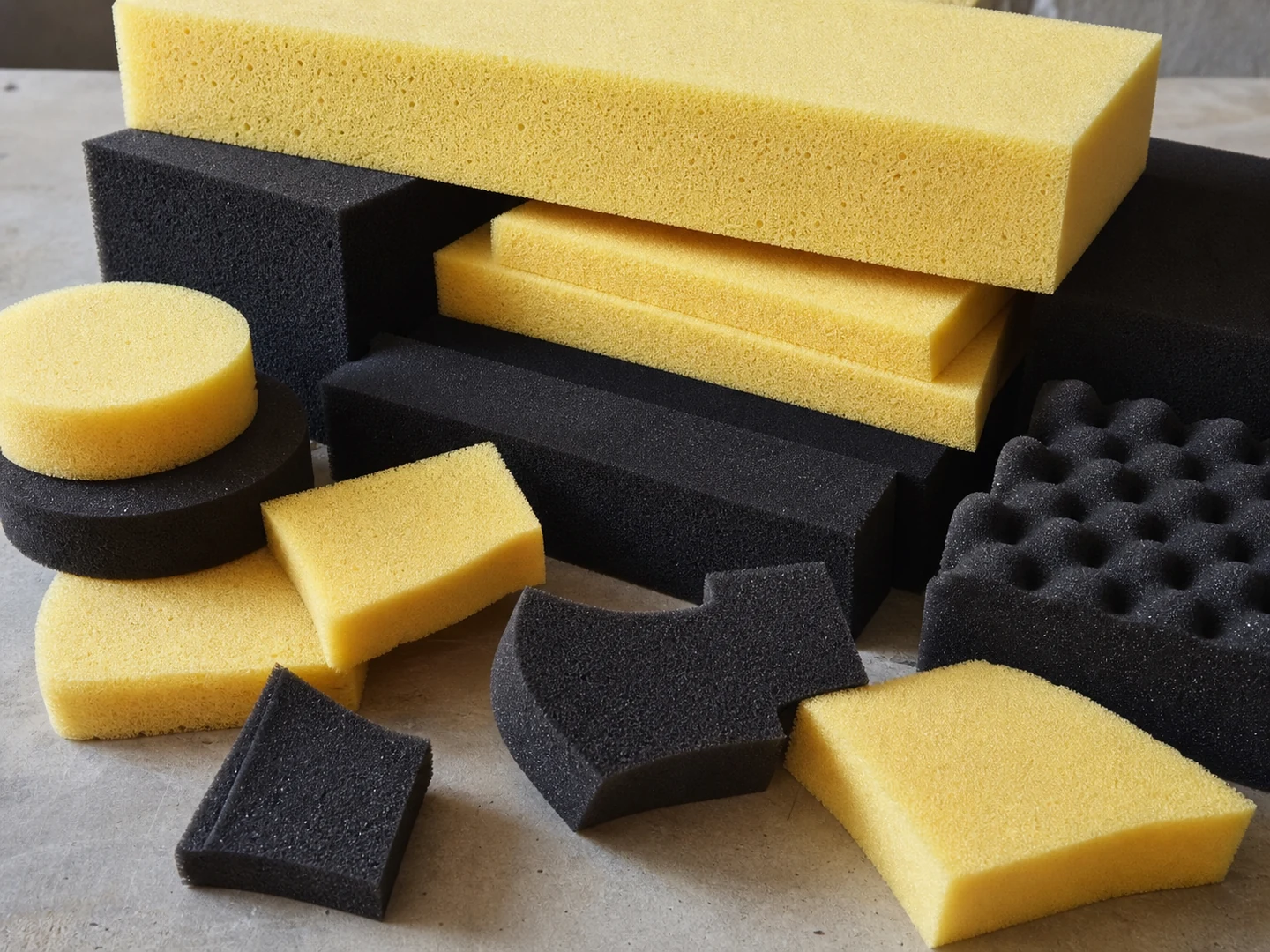
Polyurethane porous material
Choose PU Foam based on its stiffness, recovery, wear, wet-service, chemical, and temperature behavior. Do not select stiffness from the material name alone. Specify filament diameter, free trim, density, grade, and service conditions as one set.
Datasheet values
- Density
- 20–200 kg/m³
- Hardness
- 10–80 Shore 00
- Use temperature
- -30–100°C
- Compression set
- 5–25% by grade
- Cell structure
- open or closed cell
Polyurethane foam is an open- or closed-cell cellular material whose density, hardness and hydrolysis behavior vary widely by formulation.
What is PU Foam, and where is it used?
PU Foam sits in the polyurethane porous material family, supplied as foam head and pad, drawn in open-cell network and closed-cell structure sections and set in solid block, annular, strip and zoned fill patterns.
PU Foam is used in custom cleaning brushes for compliant wiping, coating and cushioning contact where cell structure and compression recovery can be specified.
Where a project stalls on material choice, the comparison is normally against PVA Sponge, and it turns on working temperature.
Compare PU Foam with PVA, PVC sponge, PP sponge. Change material when wet stiffness, temperature, chemical resistance, conductivity, particle shedding, or surface marking becomes the limiting factor.
What stiffness and contact pressure can I expect from PU Foam?
PU Foam is soft absorbent contact material; hardness/compression is controlled by foam or sponge density. Contact pressure here is set by foam density and by how far the pad is compressed against the surface. A thicker, lower-density pad follows an uneven surface; a denser pad carries more pressure on a flat one.
The published material figures, set against the grades it competes with. The finished brush is rated from the whole assembly: face, backing and adhesive each have their own limit.
| Property | PU Foam | PVA Sponge |
|---|---|---|
| Shore hardness | Shore OO 20–80 or Shore A 10–40 (Grade/Formulation Dependent) | Soft absorbent contact material; hardness/compression is controlled by foam or sponge density. |
| Continuous temperature (°C) | 80–100 | 60 |
| Peak temperature (°C) | 110–130 | 90 |
| Water absorption, 24 h | Open-Cell Structure Can Absorb 5–30 Times Its Own Weight; Polymer Itself 1–5% (industry reference range) | Not applicable (Closed-Cell / Sheet Structure; Grade Dependent) |
| Filament diameter (mm) | 0.10–2.00 | Not applicable (Sheet / Foam Structure) |
| Flexibility | High Flexibility | Low to High Flexibility(Structure Dependent) |
The part people get wrong: the number that decides scrubbing pressure is diameter over trim length, not the grade name. Two brushes in this material can behave nothing alike.
How does water affect PU Foam performance?
PU foam works as a structure, not as a polymer: the open cells hold on the order of five to thirty times the foam’s own weight in liquid, while the polymer itself takes up only about 1–5%.
Absorbent porous structure for wiping, washing, drying and liquid transfer.
What this means for your application: the foam softens and gets heavier as it loads with liquid, and its pickup drops off once it is saturated. Wring it out rather than pressing harder.
A practical check: saturate a sample and check that it still releases liquid under hand pressure. A grade that holds everything it takes up is a carrier, not a wiper.
What temperature limits apply to PU Foam?
-20 to 80°C.
The published material tables quote 80–100°C continuous and 110–130°C peak. The tighter number above is the one to build to, because a brush is loaded while it is hot.
Where it stops working: A face that stays compressed after the load comes off means the answer is a different compound or foam grade, not more thickness.
Thickness, density and applied load all shift the real limit, so a thick pad touching lightly survives conditions that would crush a thin one under pressure.
What chemicals attack PU Foam?
Compatible with water and mild detergent; solvent and oxidizer resistance follows the fiber, foam and binder chemistry.
Compatibility is a function of concentration, temperature and contact time together. A short rinse in a dilute solution is a different exposure from an overnight soak in a concentrated one, even with the same chemical on the label.
Before you commit to a quantity: Give the foam chemistry and density, the sheet thickness, and the cut shape and backing. Then say whether it runs wet, at what temperature, and what cleaner it meets.
What thickness and density should I specify for PU foam?
PU foam is supplied as sheet and moulded shapes, 3–100 mm thick, with an open-cell network on the order of 0.10–2.00 mm. Thickness and foam density are the two figures that decide contact: thickness sets how far the face travels before it bottoms out, density sets how hard it pushes back.
Ether- and ester-based grades behave differently in water, microbial and solvent exposure, so name the chemistry as well as the density. A thick low-density pad follows an uneven surface; a denser pad keeps pressure on a flat one.
Finishing available on this material: reticulation, hydrophilic treatment, anti-static treatment, antibacterial treatment and abrasive impregnation.
What applications typically use PU Foam?
Compliant wiping, coating and cushioning contact where cell structure and compression recovery can be specified.
The cleaning work it is specified for most often:
- Industrial Machine Cleaning
- Dust Removal
- CNC Machine Chip Cleaning
Brush types built with this fill:
- Custom Disc Brushes
If the sample comes back rejected: Not for strong solvents or abrasive surface finishing without grade data.
How do I specify PU Foam for a custom brush?
Send the brush type, the thickness, the density or Shore figure, the cut shape and backing, wet or dry duty, working temperature and the actual cleaning chemistry together. Any one of them on its own leaves the stiffness undefined.
What usually goes wrong at this step:
- Selecting PU Foam from the material name alone without setting thickness, density or Shore hardness, and the cut shape
- Using dry stiffness to predict wet behavior without checking moisture absorption or liquid exposure
- Ignoring trapped abrasive particles, chemical concentration, temperature, or contact motion when assessing surface risk
Reference standards behind the figures on this page: ISO 527-1:2019; ASTM D638; ISO 62:2008; ASTM D570-22; ISO 868:2003; ASTM D2240-15(2021); ISO 4892-3:2024; ASTM G154-23; UL 94.
Source: Covestro — Polyurethane chemical properties. Cell structure decides how a polyurethane foam behaves in a brush: open cell carries and releases fluid, closed cell wipes. Hydrolysis in warm wet service is the usual failure mode, not abrasion.
What else does the datasheet specify for PU Foam?
| Filament cross-section | Open-Cell Network / Closed-Cell Structure |
|---|---|
| Electrical behaviour | Insulating; Anti-Static Foam 10^6–10^9 Ω; Conductive Foam 10^2–10^5 Ω |
Where these figures come from
| Property | Published value | Source |
|---|---|---|
| Chemical resistance | Compatible with water and mild detergent; solvent and oxidizer resistance follows the fiber, foam and binder chemistry. | Covestro Retrieved 2026-07-20 |
| Published datasheet figures |
|
Covestro Retrieved 2026-07-20 |
| Hardness and stiffness | Soft absorbent contact material; hardness/compression is controlled by foam or sponge density. | Covestro Retrieved 2026-07-20 |
| Limitations | Not for strong solvents or abrasive surface finishing without grade data. | Covestro Retrieved 2026-07-20 |
| Temperature resistance | -20 to 80°C. | Covestro Retrieved 2026-07-20 |
| Water resistance | Absorbent porous structure for wiping, washing, drying and liquid transfer. | Covestro Retrieved 2026-07-20 |
Guides that go deeper on this
We have not written a guide specific to this one yet. The material that covers selection, filament, dimensions, maintenance and sourcing is collected in the technical resources library.
No catalogue item for this yet
Every brush here is made to order, and this one has no catalogue entry so far. Send the working surface, the residue, the access opening and the quantity, and it is quoted through the same specification route as the rest of the range.
Custom Manufacturing RFQ
Discuss This Material
Share the working surface, residue, dimensions, material direction, interface, quantity and drawing or sample photo.
Custom Brush RFQ
Request a Custom Cleaning Brush Quote
Upload a drawing, product photo, or sample photo and provide the core dimensions and cleaning conditions.
“We need a brush to remove wet residue from a stainless steel conveyor, about 800mm wide. The current brush wears quickly. We can send photos.”
“We sell drinkware and need a cleaning brush to include with the product. Quantity around 5,000 pieces.”