
Custom Cleaning Brush
300mm PU Foam Absorbent Disc Brush
300mm PU foam absorbent disc brush for industrial machines. Removes water, coolant and oil films without scratching.
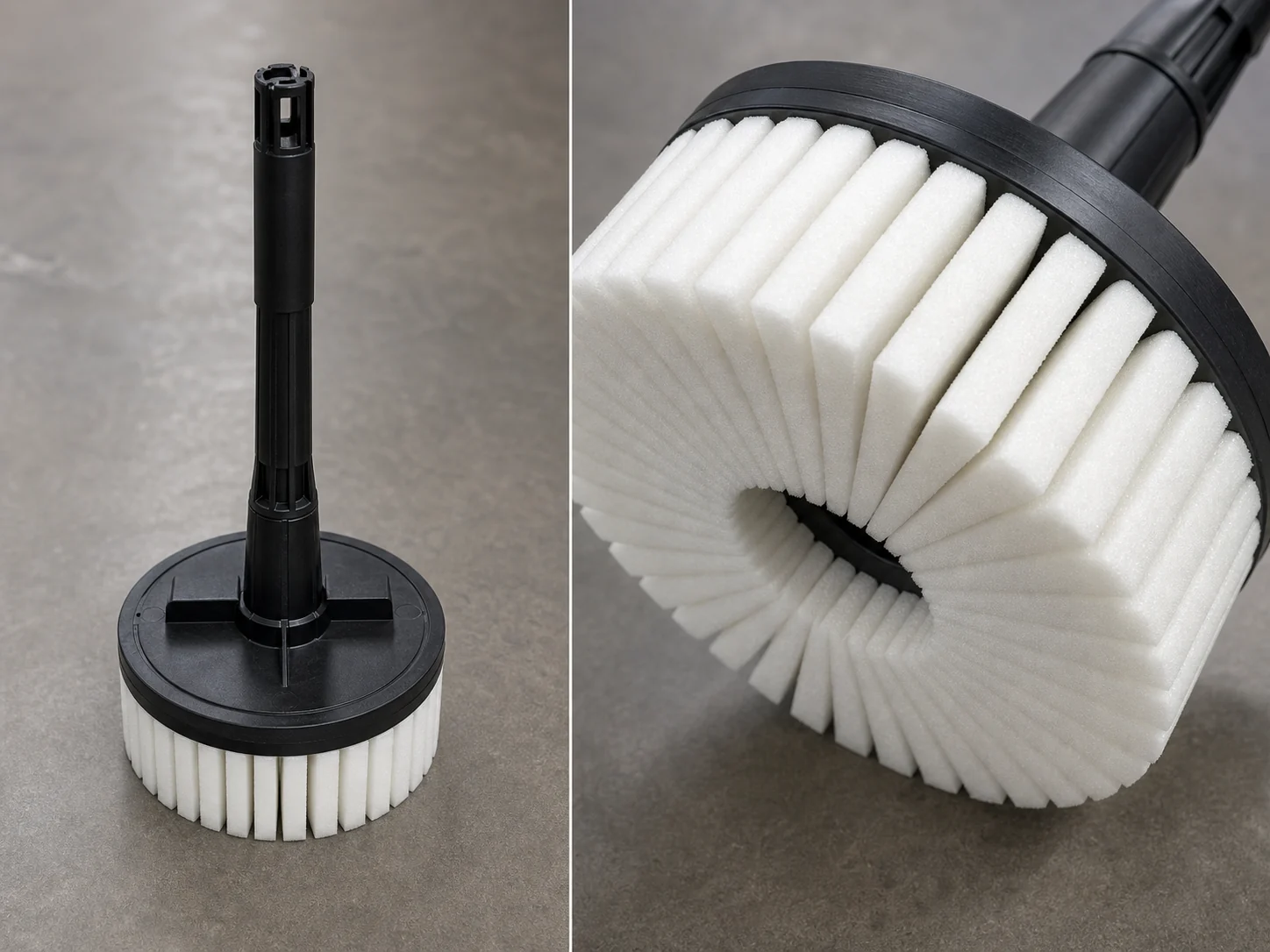
Medium brush
100 pcs
Minimum order
Worked with two hands or on a pole: chimney, gutter and pond-filter brushes, discs, cups and tank brushes.
Production lead time, once the specification is confirmed
- Up to 100 pcsWithin 7 days
- 101–5,000 pcsWithin 14 days
- 5,001–50,000 pcsWithin 21 days
- Over 50,000 pcsConfirmed with your quotation
Peak season can extend these times; the shipping date is confirmed in writing with your quotation. Sampling and shipping are quoted separately.
A machine-mounted absorbent disc brush with a 300 mm working diameter and 40 mm open-cell PU foam face, built for continuous liquid removal, film wiping, and light residue pickup on industrial process lines. The snap-fit polypropylene core mounts direct to a drive hub, so a saturated or worn disc can be changed in seconds without tools.
What can this brush do for you?
Wide Contact Face Covers More Surface per Pass
The 300 mm working diameter and 40 mm face width put a continuous band of foam in contact with the sheet, belt, panel, or roll. A single rotating disc removes liquid across the full width it touches, reducing the number of discs or passes needed to clear a production line.
Absorbs Films Instead of Pushing Them Around
Open-cell polyurethane foam pulls water, water-based coolant, and light oil into its pore structure as the disc rolls over the surface. The liquid is carried away from the contact zone instead of being flicked, streaked, or redistributed behind the disc. Fine chips and loose dust that mix with the fluid are also trapped in the pores and carried out of the wipe zone.
Soft Contact That Protects Coated and Polished Surfaces
There are no bristle tips to scratch, mark, or shed. The foam face wipes coated sheet, display glass, laminated panels, and finish-sensitive parts without leaving filament ends or abrasive marks in the product surface.
Snap-Fit Drive Keeps Changeover Short
The polypropylene core engages the machine drive hub with a snap-fit connection. An operator presses a fresh disc into place and resumes production without handling threaded fasteners or special tools. When the foam saturates or wears, replacement is a quick exchange rather than a planned shutdown.
Releases Liquid Under Compression for Continuous Use
Foam absorbs fluid at the work surface and releases it when the disc passes a wringing roll, compression plate, or drip zone. This recharges the open-cell structure so the same disc keeps absorbing through long runs instead of becoming a soaked sponge that simply redistributes moisture.
What is a 300mm PU Foam Absorbent Disc Brush?
A 300mm PU Foam Absorbent Disc Brush is a short cylindrical foam disc that mounts to a rotating drive shaft or hub on industrial cleaning and processing machines. The 300 mm diameter and 40 mm face width form a disc-like working profile, with open-cell polyurethane foam bonded to a rigid polypropylene backing and a snap-fit engagement at the center.
In service, the disc is driven against a moving surface such as sheet metal, glass, conveyor belting, or a process roll. The outer foam face absorbs residual liquid, moisture, and loose film as it travels across the work zone. The foam then passes through a compression or wringing point that squeezes the absorbed fluid out, or the disc is removed and replaced when saturated.
This is not a hand brush and it has no handle. It is a machine component selected for automated wiping, drying assistance, and light particulate pickup. It is also not an abrasive tool: hard scale, rust, carbon, or baked-on deposits need a wire, abrasive, or stiffer filament brush rather than this foam disc.
Technical Specifications
Values shown are the standard configuration. Diameter, foam depth, foam grade, and drive pattern can be adjusted to the machine.
| Parameter | Value / Options |
|---|---|
| Working diameter | 300 mm |
| Foam face width / depth | 40 mm |
| Foam material | Open-cell polyurethane (PU); density and pore size selected for the fluid |
| Core / backing material | Polypropylene (PP) |
| Mounting interface | Snap-fit engagement to machine drive hub; lug or receiving pattern matched to drive |
| Handle | None — machine mounted only |
| Typical fluid compatibility | Water, water-based coolants, neutral detergents, light oils; strong solvents require compatibility check |
| Continuous service temperature | Up to 60°C with water-based fluids; higher temperatures reduce foam life |
| Replacement configuration | Foam disc can be supplied as replacement on reusable PP core per project |
| Brush type | Custom Disc Brushes |
| How it is driven | Machine-driven, mounted in the equipment |
| Cleaning target | strip processing line, flat glass and display panel washer, and conveyor belt and return roller wiping station cleaning |
| Surface or part | hubs, sheets, panels, glass, conveyors, belts, rolls, and finished surfaces |
| Residue or debris | coolant, oil, light residue, rust, scale, hard scale, process film, and carbon |
| Mounting / connection | Snap-fit engagement to machine drive hub; lug or receiving pattern matched to drive |
The open-cell structure is what makes the disc absorbent: it captures fluid inside the foam rather than only wiping surface liquid. Fine-pore or closed-cell alternatives may be specified when a drier wipe or longer compression life is required.
Where does this brush work best?
- Coil, sheet, and strip processing lines where residual rinse water or coolant must be wiped before drying or recoating.
- Flat glass and display panel washers that need final moisture removal without scratching the finished surface.
- Conveyor belt and return roller wiping stations where oil, water, or chemical carryover is picked up continuously.
- Machine tool beds, guideways, and index tables that need coolant and light chip film removed between cycles.
- Printing, laminating, and coating lines where condensate, coating drips, or process film are wiped from rolls or panels.
- Solar module and electronic panel production where a lint-free, non-marking wipe is required.
How do I choose the right one?
First confirm the machine mounting. Check the drive hub snap-fit pattern, shaft size, rotational direction, and clearance around the 300 mm diameter and 40 mm foam depth. The disc should fit without rubbing guards or adjacent discs, and the drive must not overload when the foam compresses against the work.
Then choose the foam grade for the fluid. Fine-cell, softer PU wipes thin water films and leaves a drier surface. Coarse-cell, denser PU clears oils and fluids carrying fine particles and tolerates more compression for longer life. If the machine has a wringing or compression system, the disc can be continuously reconditioned; without a release mechanism, plan spare discs or shorter run times before saturation.
Check operating temperature and chemistry. PU foam is a good match for ambient and warm water-based processes, but continuous service above about 60°C, strong caustics, ketones, or chlorinated solvents can soften or break down the foam. Confirm the full cleaning chemistry before locking the material.
Finally consider what the brush is not designed to remove. Hard scale, carbonized residue, rust, burrs, and abrasive swarf call for a wire disc brush or abrasive brush instead. This foam disc is the right choice when the job is liquid absorption, film removal, and non-scratch wiping.
| Condition | Recommended configuration |
|---|---|
| Thin water film on coated or polished sheet | Fine-pore soft PU, light compression |
| Coolant with fine chips or process oil | Coarse-pore denser PU, wringing station |
| Continuous fluid above 60°C or strong solvent | Not standard PU; use special foam or mechanical wiper |
| Baked-on scale, rust, or carbon | Wire or abrasive disc brush, not this product |
Can I customize this brush?
Yes. The 300 mm disc is a standard starting point, not a fixed limit. We build the disc around your machine’s drive and your process fluid.
We can adjust:
- Outside diameter and foam face width to match roll spacing, panel width, or machine guards.
- Foam density, pore size, hardness, and color for the fluid and surface finish.
- Core material and snap-fit geometry: lug pattern, keyway, center bore, or bolt circle on the PP backing.
- Replaceable foam design so new foam discs mount onto an existing reusable core.
- Multi-layer or scrim-backed foam for added edge stability on high-speed lines.
- Bulk, individual bag, or project-specific packaging.
To specify a custom version, provide the drive hub drawing or existing disc sample, machine clearance dimensions, fluid type and temperature, surface material, and required changeover method. If your project requires material declarations, inspection reports, or third-party testing on the foam or PP backing, we can assist with those requirements during the quoting process.
When is a 300mm PU foam absorbent disc brush worn out rather than just dirty?
How do I know the foam disc is ready for replacement?
Check the outside diameter, face width, and foam recovery after compression. If the foam no longer returns to its original thickness, the surface shows permanent grooves or torn areas, or liquid starts streaking behind the disc instead of being absorbed, replace the disc. A quick field check is to compress the dry foam by hand: it should spring back fully and quickly.
Does the disc remove all liquid by itself?
No. The foam pulls away bulk liquid and films, but a thin moisture layer usually remains. Most installations still need an air knife, dryer, evaporation stage, or absorbent roller downstream if the part must be completely dry or spot-free. The disc is a liquid-removal aid, not a full drying system.
What should I check before mounting a new disc?
Inspect the snap-fit lugs or receiving features on the PP core for cracks, chips, or wear. The disc should click cleanly onto the drive hub and not rock or slip when rotated by hand. Run the machine at slow speed for the first revolution to confirm there is no wobble, rubbing, or drive slippage before returning to production speed.
Can the foam disc be cleaned and reused after a saturated run?
Yes, within the limits of the process fluid. Flush the foam with clean water, compress it several times to release absorbed fluid, and allow it to air dry away from direct heat. Avoid wringing or twisting the foam aggressively, and do not use strong solvents unless they are confirmed compatible with the PU grade.
What happens if the process fluid is hot or strongly alkaline?
Standard PU foam has practical limits. Continuous hot water or steam above about 60°C degrades the foam, and strong alkalis or solvents can cause softening, swelling, or loss of strength. Provide the fluid SDS and operating temperature so we can select a resistant foam grade or advise a mechanical wiper instead.
Can I use this disc on sharp-edged or rough surfaces?
Avoid running the foam face over burrs, sharp edges, weld spatter, or other protrusions that can tear the open-cell structure. If the surface is rough or has heavy scale, a filament, wire, or abrasive brush is the better first tool; the foam disc should be used after those steps or on smooth surfaces only.
Guides that go deeper on this
Custom Manufacturing RFQ
Describe Your Application
Please share the brush dimensions, working area, residue type, material direction, quantity, and a drawing or photo for quotation.
Drawing or photo optional — it speeds things up, it does not gate the enquiry.
Custom Brush RFQ
Send Your Brush Project
Upload a drawing, product photo, or sample photo and provide the core dimensions and cleaning conditions.
“We need a brush to remove wet residue from a stainless steel conveyor, about 800mm wide. The current brush wears quickly. We can send photos.”
“We sell drinkware and need a cleaning brush to include with the product. Quantity around 5,000 pieces.”