
What Is a Floor Scrubber Brush?
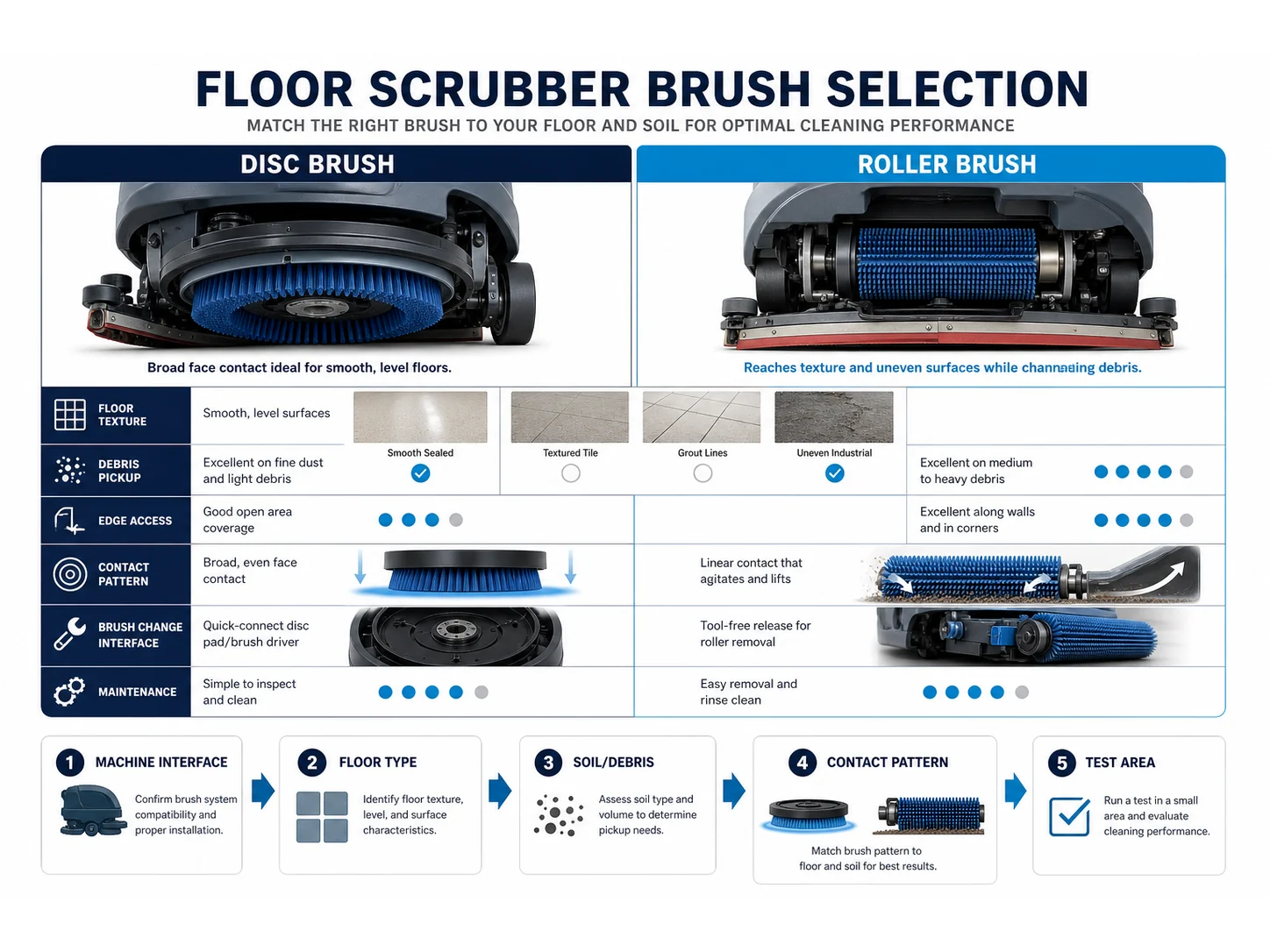
A floor scrubber brush is a rotating cleaning attachment that agitates the floor surface to remove dirt, grime, and stains. These brushes can be made of various bristle materials or can accept abrasive pads, and they come in two main styles: disc brushes (flat and circular) and roller brushes (cylindrical). The choice between them affects how well the scrubber cleans edges, handles debris, and adapts to uneven surfaces.
Disc Brush vs Roller Brush: Key Differences
The table below summarizes the practical differences between disc and roller brushes to help you quickly identify which suits your environment.
| Feature | Disc Brush | Roller Brush (Cylindrical) |
|---|---|---|
| Shape & Motion | Flat circular disc that rotates horizontally (parallel to the floor) | Cylindrical roller that rotates vertically (like a rolling pin) |
| Best For | Large, open, smooth surfaces such as warehouse floors, retail aisles, and polished concrete | Edges, corners, uneven floors, grouted tile, and areas with light debris |
| Edge Cleaning | Limited; often requires side skirts or a separate edge tool to get close to walls | More effective near edges and baseboards due to the brush design |
| Pressure Application | Even downward pressure across the disc; good for scrubbing without streaks | Concentrated pressure along the contact line; helps dislodge dirt in grout lines and textures |
| Typical Applications | Daily cleaning of coated concrete, epoxy, terrazzo; can use pads for polishing or light scrubbing | Scrubbing textured concrete, tile and grout, and floors with mixed debris (fine dust, crumbs) |
| Maintenance | Pads or brush discs are easy to replace; bristles wear less aggressively on smooth floors | Bristles can trap hair and string; more frequent debris clearing needed; some models self-clean |
| Compatibility | Fits most walk-behind and ride-on scrubbers with a disc drive hub | Requires a cylindrical brush deck, common on compact scrubber dryers and specialty machines |
How to Choose Based on Floor Type
The floor surface is the single most important factor in brush selection. Use this table to narrow down the appropriate brush type and bristle/pad recommendation.
| Floor Type | Recommended Brush Type | Notes |
|---|---|---|
| Smooth sealed concrete | Disc brush with soft (nylon or polyester) bristles or a white/red pad | Prevents scratching; good for daily dust and light soil removal |
| Uncoated or textured concrete | Roller brush with medium (polypropylene) bristles | Aggressive enough for embedded dirt; roller follows contours better |
| Tile and grout | Roller brush with stiff bristles | Cylindrical motion digs into grout lines; disc brushes often miss deep grout |
| Epoxy or coated floors | Disc brush with soft pad or gentle bristles | Protects the coating; avoid abrasive brushes that can dull the finish |
| Polished concrete / terrazzo | Disc brush with a non-abrasive pad | Maintains high-gloss appearance; roller brushes may leave marks |
| Vinyl (VCT) / linoleum | Disc brush with a soft to medium pad | Use only after checking manufacturer’s floor care guide; avoid stiff bristles |
| Uneven or sloped floors | Roller brush | Disc brushes lose contact on dips and bumps; roller floats better |
Matching Brushes to Your Scrubber Model
Not every scrubber can run both disc and roller brushes. The machine’s drive mechanism determines compatibility:
- Disc scrubbers use a motor hub that spins a flat disc. You can often swap between bristle discs and pad holders, but the machine cannot accept a cylindrical roller.
- Roller scrubbers have a cylindrical brush housing and typically run two contra-rotating rollers. They usually cannot mount a disc brush.
- Some larger industrial scrubbers offer interchangeable decks, but always check the manufacturer’s specifications for brush size (diameter or length), attachment type, and RPM.
Common disc brush diameters include 13″, 15″, 17″, 20″, and larger. Roller brushes are measured by length and diameter; matching the exact part number is essential for proper fit and squeegee alignment.
Common Mistakes in Floor Scrubber Brush Selection
Avoid these frequent errors to prevent poor cleaning results, floor damage, or unnecessary wear on your machine:
- Using too aggressive a brush on delicate floors. A stiff grit brush or black pad on polished concrete will permanently scratch the surface.
- Pairing the wrong pad with the brush type. For example, securing a high-speed burnishing pad to a low-speed scrubber disc may not achieve the desired shine.
- Ignoring the floor’s texture and condition. Smooth floors need less aggressive bristles; rough or uneven floors need a brush that can conform, like a roller.
- Choosing by cost alone. Inexpensive brushes may wear out faster, shed bristles, or fail to provide uniform contact, leading to higher long-term costs.
- Neglecting brush replacement signs. Worn bristles (shorter than 1/2 inch or visibly matted) reduce scrubber performance and force the machine to work harder.
- Forgetting to consider debris type. Large debris like wood chips can clog roller brushes; disc brushes may simply push it around.
- Not testing a brush on a small area first. What works on a warehouse floor may damage a retail showroom tile; always spot-test before full application.
When a Cylindrical (Roller) Brush Is Necessary for Uneven Floors
Disc brushes rely on a flat, consistent surface for full contact. On uneven floors—such as those with deep grout lines, spalled concrete, or heavy texture—a disc will skip over low spots and fail to clean them. In these situations, a roller brush is the better choice because its cylindrical shape maintains contact across ridges and dips. Additionally, roller brushes can sweep small debris directly into the recovery tank, an advantage over discs that may leave debris behind.
However, recognize the limits: extremely rough or broken floors may require a sweeper before scrubbing, or a specialized deep-cleaning system. For daily maintenance on moderately uneven floors, a cylindrical brush scrubber often eliminates the need for pre-sweeping.
Final Takeaway
Floor scrubber brush selection comes down to matching the brush type (disc or roller) to your floor surface and machine capabilities. For large, smooth expanses, a disc brush with the appropriate pad or bristle gives efficient, streak-free cleaning. For edges, textured surfaces, and grout-filled floors, a cylindrical roller brush reaches where discs cannot. Always verify compatibility with your scrubber model, check the condition of your brushes and pads regularly, and test new brush configurations on an inconspicuous area. Thoughtful selection prevents damage, lowers maintenance costs, and keeps your floors looking their best.
When a Floor Scrubber Brush Is the Wrong Choice
This brush is not enough when the main problem is blocked access, unsafe working conditions, damaged equipment, incompatible chemicals, or a process setting that keeps recreating the residue. In those cases, review screen opening, belt or surface material, carryback, uptime risk, and whether the brush can clean without process damage and confirm the surrounding cleaning method before increasing brush stiffness or contact pressure.
Frequently Asked Questions
Can I use a disc brush on tile floors with deep grout lines?
Disc brushes can clean the tile surface but will not effectively reach into deep grout lines. A cylindrical roller brush is much better for grout because the rotating bristles can penetrate the recesses. If you only have a disc machine, consider pre-treating grout lines manually or with a low-pressure spray before scrubbing.
How often should I replace scrubber brushes or pads?
Replace bristle brushes when the bristles are worn to less than half their original length, become matted, or no longer stand straight. Pads should be replaced when they are clogged with debris, torn, or have lost their abrasive surface. As a general guideline, inspect after based on wear condition, operating load, and the equipment maintenance plan of use, but high-traffic facilities may need more frequent changes.
What’s the difference between a brush and a pad on a floor scrubber?
A brush uses bristles to agitate dirt, while a pad is a non-woven fiber material (often impregnated with abrasive) that acts more like sandpaper. Pads are commonly used for light scrubbing, polishing, or stripping finishes, while brushes are preferred for deep cleaning textured or heavily soiled floors. Some disc drives accept both, but you must match the correct driver to the pad.
Does brush pressure affect cleaning performance?
Yes. Higher brush pressure increases friction and dirt removal, but too much pressure can damage floors or overload the drive motor. Most scrubbers allow pressure adjustment; start low and increase only if needed. Roller brushes often have inherent pressure due to the weight of the machine, but still require proper calibration.
Can one machine use both disc and roller brushes?
Generally no. Most floor scrubbers are designed for either disc or cylindrical brushes, and the scrub deck is not interchangeable without major modifications. However, some large industrial machines offer optional decks that can be swapped, but this is uncommon. Always check the manufacturer’s documentation.
How do I clean a roller brush that keeps getting tangled with hair and string?
Manually remove any large debris after each use. Some roller scrubbers have a built-in comb or self-cleaning system that clears the brush, but if not, use a stiff comb or hook tool to pull out tangles. Regular cleaning prevents motor strain and uneven brush wear.
What bristle material is best for concrete?
For smooth or sealed concrete, soft nylon or polyester bristles are sufficient and gentle. For rough or unsealed concrete, medium polypropylene bristles offer more scrubbing power. Avoid very stiff wire or abrasive-impregnated bristles unless the floor is unsealed and heavily embedded with dirt, as they can leave permanent scratches.
Should I use a brush or pad for stripping floors?
Stripping typically requires an aggressive pad (such as black or high-productivity stripping pad) mounted on a disc drive. Brushes can be used with the right stripping chemical, but pads are more common because they provide consistent abrasion and are easier to replace when loaded with old finish. Always follow the chemical manufacturer’s recommendations for scrubbing motion and dwell time.
Technical References
- OSHA — 1910.242 Hand and Portable Powered Tools
- OSHA — 1910.215 Abrasive Wheel Machinery
- OSHA — Personal Protective Equipment
- OSHA — Combustible Dust
Which bristle material fits this job — Nylon PA, PET Polyester or Polypropylene PP?
| Material | Continuous temperature (°C) | Peak temperature (°C) | Water absorption | Hardness |
|---|---|---|---|---|
| Nylon PA | 93 | 121 | 0.3–9% by PA grade and conditioning | Medium to firm; filament diameter and trim length control bending force. |
| PET Polyester | 120–150 | 170–190 | 0.10–0.30% | Shore D 80–90 |
| Polypropylene PP | 80–100 | 120–140 | ≤0.03% | Shore D 65–75 |
| Rubber | 100 | 130 | very low | Specified by compound and Shore hardness; published TPE families can span roughly 50–80 Shore A, but that is a product-family example rather than a universal rubber range. |
| PBT | 120–140 | 160–180 | 0.05–0.20% | Shore D 80–90 |
Figures as published by Brushtec / DuPont; Perlon. Confirm the exact grade against the supplier datasheet before ordering.
What should replace Floor Scrubber Sweeper Brushes for floor scrubber brush?
- Floor Scrubber Sweeper Brushes — Floor scrubber and indoor sweeper brushes are selected around a scrub deck and controlled downforce; road-sweeper brooms are designed for outdoor debris pickup, gutter reach, impact, and dust-control systems. Closest alternative: Road Sweeper Brooms.
- Roller and Conveyor Brushes — Roller and conveyor brushes hold cylindrical line contact across a working width, including helix-wound builds where the filament path is set to move loosened material toward one side; a strip brush holds the same line without rotating, so it seals or wipes but cannot carry residue along the width.
- Disc Brushes — Disc brushes use a flat circular working face; cylindrical floor or roller brushes use tangential line contact and are better when debris pickup or continuous width contact is important. Closest alternative: Floor Scrubber Sweeper Brushes.
- Nylon PA — Compare Nylon PA with PP, PBT, PET. Change material when wet stiffness, temperature, chemical resistance, conductivity, particle shedding, or surface marking becomes the limiting factor.