
Application
Automotive Interior Crevice Cleaning
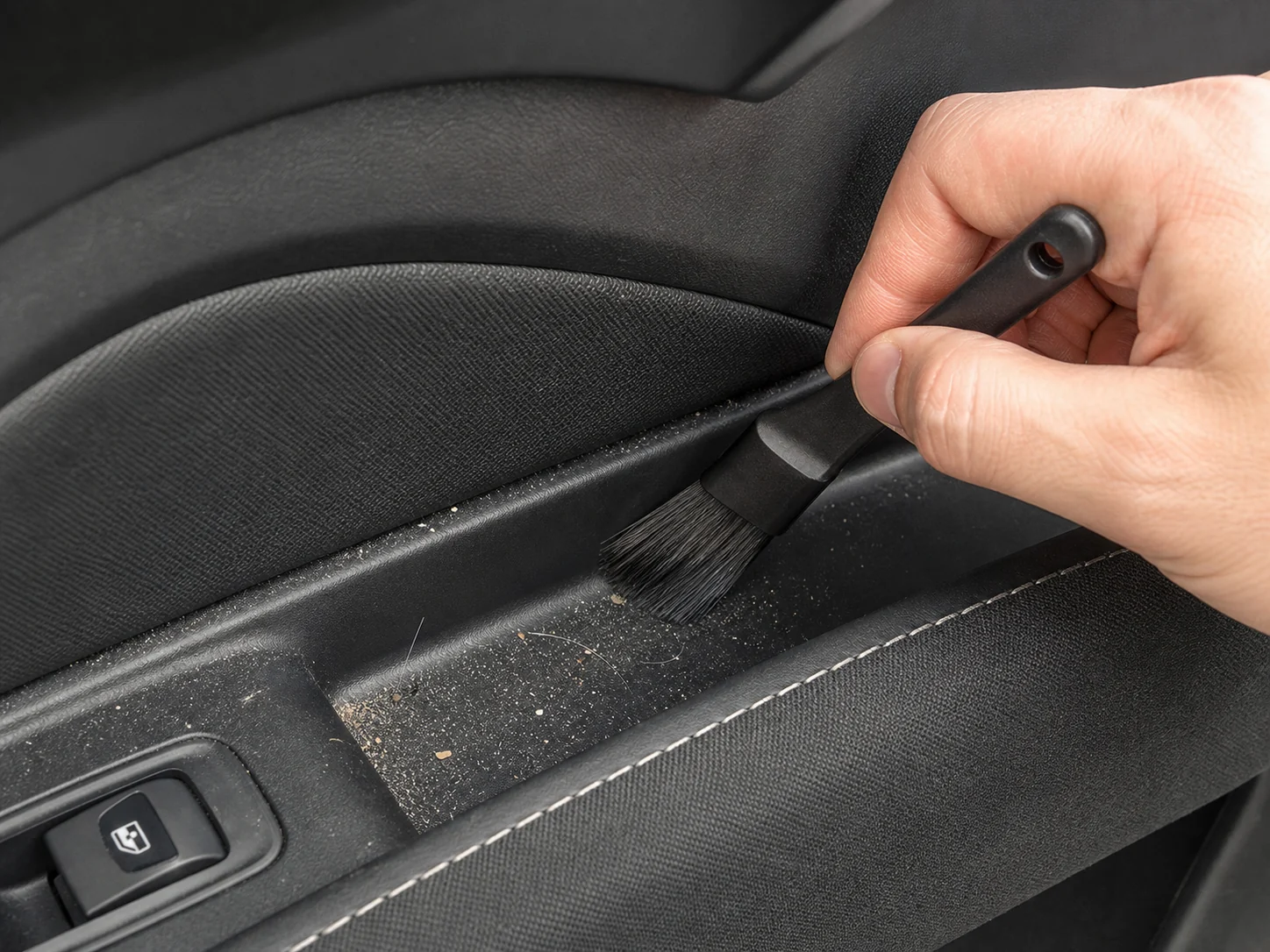
For Automotive Interior Crevice Cleaning, the brush must reach the working area, disturb or collect dust/hair/sebum/food debris, and release it without creating unacceptable surface damage or process interference. Access space, brush movement, and cleaning method are the main factors in selecting the structure.
At a glance
- Cleaning target
- Dust/Hair/Sebum/Food Debris
- Working environment
- Dry Indoor Area / Vehicle Interior
- Cleaning method
- Dry Brushing / Wet Brushing
- Requirements to check
- Low Shedding; Low Scratching; Automotive Interior-Surface Compatibility
Interior soil collects along seams and rails rather than on surfaces, so crevice brushes are chosen by gap width and by whether the trim beside that gap is soft-touch coated.
What makes Automotive Interior Crevice Cleaning different from other automotive and transportation cleaning?
The task is to remove Dust/Hair/Sebum/Food Debris while controlling surface damage, residue carryover, brush shedding and chemical or temperature degradation.
The work happens in dry indoor area and vehicle interior against dust, hair, sebum and food debris.
The part people get wrong: the surface, the residue and the access opening decide the brush together. Fix on any one of them alone and the geometry comes out wrong.
What are the most common cleaning targets in Automotive Interior Crevice Cleaning?
The work breaks into 5 targets. They look similar from outside the machine and behave nothing alike at the brush.
| Part or area | Residue type | Cleaning requirement |
|---|---|---|
| Seat-Rail | Dust, Hair, Sebum, Food Debris | The head must reach the working face and apply even contact without marking the surface. |
| Dashboard and Console Seam | The head must be narrower than the opening and stiff enough to lift residue without splaying at the mouth. | |
| Door-Pocket and Trim-Gap | ||
| Vent and Louver Detail | ||
| Upholstery Seam |
What the equipment leaves you to work inside:
| Parameter | Typical range |
|---|---|
| Contaminant | Dust/Hair/Sebum/Food Debris |
| Required hardness | Soft |
| Maximum temperature | 70°C |
| Chemical exposure | Neutral Detergent pH 6–9; Isopropyl Alcohol ≤70% |
| Cleaning method | Dry Brushing/Wet Brushing |
| Environment | Dry Indoor Area/Vehicle Interior |
Which brush types work for each cleaning target?
Select hand, tube, strip, roller, disc or machine-mounted geometry from access and motion.
| Cleaning target | Recommended brush type | Why it fits |
|---|---|---|
| Seat-Rail | Handheld Detail Brushes | A seat rail is an open channel under the seat that collects grit, and a slim hand-guided head reaches along it while the operator feels the rail before forcing the head. |
| Dashboard and Console Seam | Dash and console panels meet in fine seams, so a narrow head lifts the dust line out of the seam rather than packing it deeper into the joint. | |
| Door-Pocket and Trim-Gap | Door pockets have a deep square corner that a vacuum nozzle bridges over, so a narrow head is needed to sweep that corner out into the open. | |
| Vent and Louver Detail | Vent blades are thin, movable and mark easily, so a fine head is worked between them without loading the blade pivots. | |
| Upholstery Seam | Seam stitching sits in a recessed line that holds sebum and crumbs, so a narrow head follows the stitch line and brings the debris back to the surface. |
All hand work, normally with a vacuum nozzle held alongside the brush so the loosened debris leaves the car instead of moving further down the seat.
In practical brush terms: match the construction to the access before anything else. A geometry that cannot reach the target will not be rescued by a better filament.
What filament materials work best for Automotive Interior Crevice Cleaning?
PA612 in a soft grade: it absorbs less water than standard nylon, so the tips dry straight, and it does not mark piano-black trim or perforated leather the way a stiffer fill does.
| If the condition is… | Filament to start with | Why |
|---|---|---|
| Piano-black and coated trim | PA612 Nylon, soft grade | flexes away before it marks the finish |
| Brush washed and re-used | PA612 Nylon | low water uptake, so the tips dry straight |
What the duty rules out before you start comparing grades:
| Constraint | Value for this application |
|---|---|
| Filament hardness | Soft |
| Maximum service temperature | 70°C |
| Chemical exposure | Neutral Detergent pH 6–9; Isopropyl Alcohol ≤70% |
| Cleaning method | Dry Brushing, Wet Brushing |
How do I choose the right brush for my automotive interior crevice equipment?
Start with soft fill, a 70°C ceiling and a neutral detergent at pH 6–9, then size to gap width and check what trim sits beside it.
The sequence that gets a usable sample first time:
- Identify the target part and measure the access opening or clearance
- Describe the residue: what it is, how thick it sits, and how strongly it holds
- Choose the construction that can physically reach that target
- Set the filament from surface risk, working temperature and cleaning chemistry
- Fix filament diameter, free trim length and density for the contact pressure you need
- Run one cycle and check the result before committing to a production quantity
Before you commit to a quantity, send the gap widths and seam depths, and say which adjacent trim is soft-touch coated.
When is an automotive interior crevice brush the wrong tool?
A vacuum with a crevice tool captures what a brush would only push deeper into the seam. Fabric and leather staining is a chemistry and extraction job, and soft-touch coating is damaged by exactly the stiffness that would clear a tight gap.
What common mistakes should I avoid in Automotive Interior Crevice Cleaning?
- Specifying by vehicle model instead of gap width and whether the adjacent trim is soft-touch coated
- Changing the filament while leaving excessive engagement, poor alignment or no discharge path unchanged
- Copying a worn brush without first recording its motion, direction, mounting and original working diameter
If the brush is already in service and the result is wrong, work from the symptom:
| Symptom | What to change |
|---|---|
| Residue remains | Increase discharge or relative motion before adding pressure |
| Surface marks | Reduce engagement and use finer/softer fill |
| Rapid wear | Check alignment, temperature and chemical attack |
| Redeposition | Add wash, vacuum or collection path |
Questions this page is asked
Why should a crevice brush be tested separately on each vehicle-interior component?
A seat coating, display, gloss trim, vent vane, switch legend and fabric seam can have different scratch, liquid and solvent limits even within one cabin. Check the owner's instructions and trial the clean brush and cleaner on a concealed matching area before working the visible crevice.
What sequence keeps crevice debris from scratching automotive trim?
Remove or capture loose sand, crumbs and hard particles with the component-approved vacuum or gentle dry method before applying wiping pressure or moisture. Brush toward collection with short strokes and stop if particles remain trapped between the fill and a coated, glossy or display surface.
When should an interior-detail brush be cleaned or changed before moving to another crevice?
Change or clean it after oily seat tracks, food residue, abrasive floor debris or an incompatible cleaner so contamination is not transferred to screens, switches or light trim. Inspect for grit, dye, loose filaments and chemical attack, then dry and store the accepted tool away from exterior and wheel brushes.
Guides that go deeper on this
We have not written a guide specific to this one yet. The material that covers selection, filament, dimensions, maintenance and sourcing is collected in the technical resources library.
No catalogue item for this yet
Every brush here is made to order, and this one has no catalogue entry so far. Send the working surface, the residue, the access opening and the quantity, and it is quoted through the same specification route as the rest of the range.
Custom Manufacturing RFQ
Discuss This Application
Share the working surface, residue, dimensions, material direction, interface, quantity and drawing or sample photo.
Custom Brush RFQ
Request a Custom Cleaning Brush Quote
Upload a drawing, product photo, or sample photo and provide the core dimensions and cleaning conditions.
“We need a brush to remove wet residue from a stainless steel conveyor, about 800mm wide. The current brush wears quickly. We can send photos.”
“We sell drinkware and need a cleaning brush to include with the product. Quantity around 5,000 pieces.”