
Custom Cleaning Brush
Crevice Cleaning Brush
Custom crevice cleaning brush with tapered PBT or nylon heads for grout lines, window tracks, appliance seams and fixture edges.
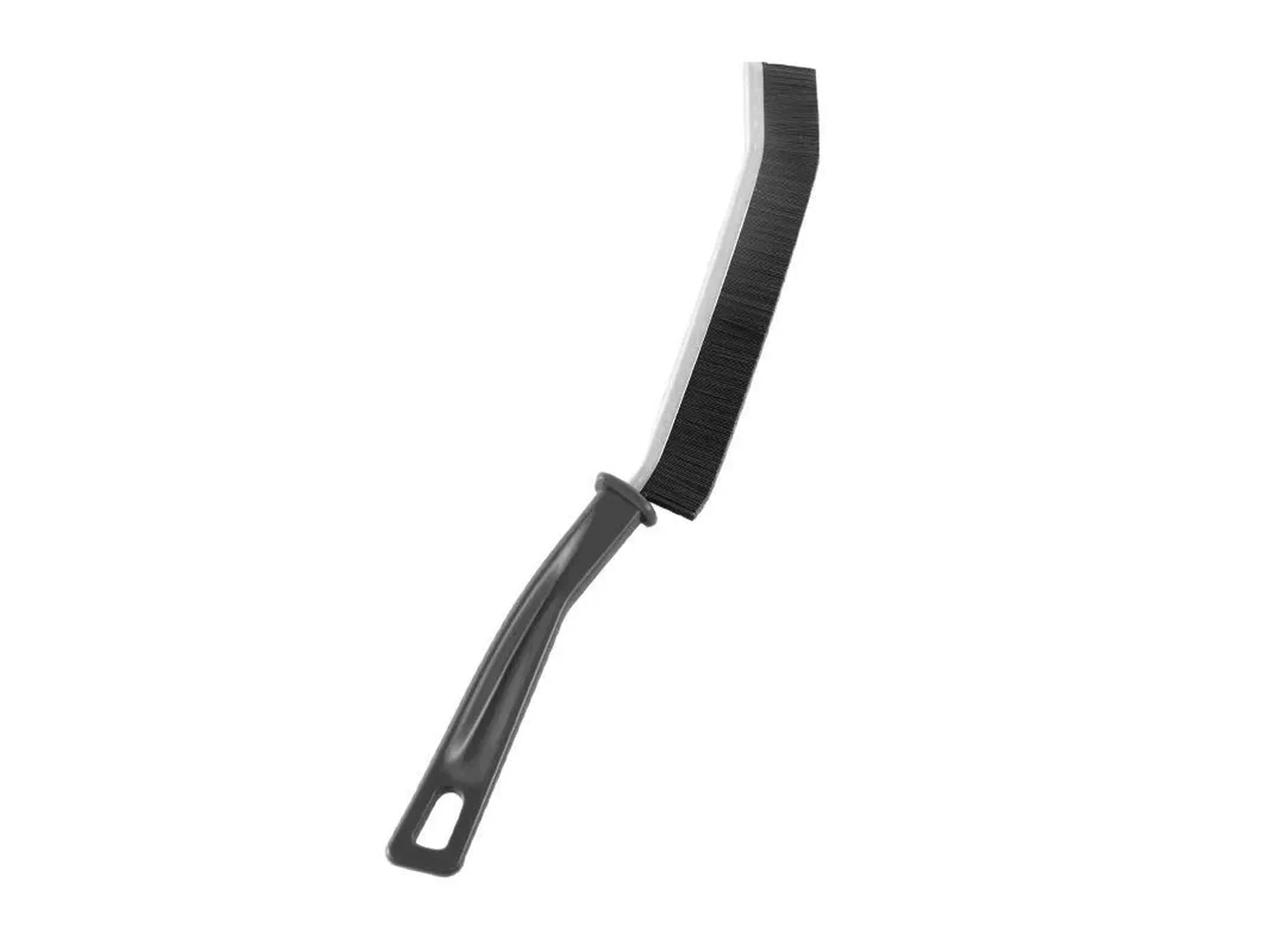
Small brush
500 pcs
Minimum order
Held in one hand: tube, bottle, detail and swab brushes — including long-handled ones with a small head.
Production lead time, once the specification is confirmed
- Up to 500 pcsWithin 7 days
- 501–50,000 pcsWithin 14 days
- Over 50,000 pcsWithin 21 days
Peak season can extend these times; the shipping date is confirmed in writing with your quotation. Sampling and shipping are quoted separately.
A narrow-profile hand brush with a tapered, densely filled head built to enter grout lines, track channels, appliance seams and fixture edges where conventional brushes cannot fit. The stiff but non-marring filament tip removes trapped soap film, grease, limescale and food debris without scratching surrounding glazed tile, stainless steel or coated trim.
What can this brush do for you?
Reaches the residue at the bottom of a narrow channel
The head tapers to a narrow nose, wedge or chisel edge, so the trimmed filament lines press into the base of the crevice instead of sweeping across the top. That is the difference between cleaning a visible grout line and removing the packed soap film at the bottom of it.
Keeps brushing pressure on the deposit when wet
PBT filament is used for many crevice configurations because it holds its stiffness in warm water and detergent. The tufts stay upright under load instead of flattening against the surrounding surface, which keeps the stroke working on the residue inside the gap rather than skimming over it.
Cleans firmly without leaving scratch lines beside the gap
Filament diameter, tip profile and trim length are matched to the substrate. On glazed ceramic, porcelain, stainless steel and painted or coated surrounds, the distributed tip contact removes attached film but does not leave the visible scratch marks that a wire or abrasive brush would create.
Follows linear channels without repositioning
For window tracks, baseboard profiles and long tile joints, the head can be built as a thin flat blade or set at a slight angle to the handle. The brush then rides along the channel in one direction while the operator keeps consistent pressure, and the contact path stays in the crevice instead of climbing onto the edge.
Combines point, line and corner contact in one head
A single head can carry a pointed nose for tight corners, a flat side for grout lines and a slightly rounded heel for curved seams around sink bases and cooktop edges. This reduces the number of tools in a retail set or housekeeping kit and gives the end user one detail brush for multiple touchpoints.
What is a Crevice Cleaning Brush?
A Crevice Cleaning Brush is a compact, hand-guided scrubbing tool with a deliberately narrow head and a trimmed tip, built to enter and clean linear gaps and detail areas where standard hand brushes, bottle brushes or scrub pads are too wide. It is used by drawing or pressing the filament tip along the crevice, usually with a cleaning solution, so the filaments flex into the gap, dislodge attached residue and carry it out on the next rinse or wipe.
The brush consists of a molded or machined handle, a densely tufted head and filament that is cut to a taper or point. Two general head families are common: a straight blade for heavy push-pull work on grout and seams, and an angled or offset profile for tracks and channels where the handle must stay clear of the surrounding frame. The filament may be PBT, nylon PA or polypropylene, and the handle is most often PP, ABS, TPE-overmolded or wood.
This is a detail-cleaning tool, not a high-volume surface brush. It is designed for spot and line work where access is the limiting factor. It works best on soft to moderately attached film, grease and food residue. Hard mineral scale, cured epoxy or rust need a different tool or a prior chemical treatment.
Technical Specifications
The dimensions below represent the range most buyers specify for household, institutional and equipment detail cleaning. We adjust head width, tip profile, trim, filament and handle to the actual crevice dimensions.
| Parameter | Value / Options |
|---|---|
| Head profile | Tapered wedge, spear point, chisel edge, narrow flat blade, or custom line profile |
| Head width at base | 4–12 mm typical; 3–16 mm on request |
| Tip width at narrowest point | 1.5–3 mm, matched to the channel floor width |
| Trim length | 8–18 mm typical; up to 40 mm for deeper channels or high-wear grooves |
| Overall length | 120–250 mm standard hand use; up to 450 mm for extension reach |
| Filament diameter | 0.15–0.35 mm for fine contact; 0.35–0.50 mm for stronger scrub |
| Filament material | PBT, Nylon PA, Polypropylene PP, or blended option |
| Handle material | PP, ABS, TPE-overmolded grip, or wood |
| Handle orientation | Straight, angled, offset, or extended reach |
| Filament anchoring | Mechanically stapled or thermally fused tufts, selected for pull-out resistance in wet use |
| Operating temperature | 5–100 °C; PP-handle versions should remain at or below 80 °C in continuous use |
| Surface contact | Non-marring on glaze, porcelain, stainless steel and coated metals when filament and trim are matched to substrate |
| Brush type | Custom Handheld Detail Brushes |
| How it is driven | Hand-guided |
| Cleaning target | tile and grout line, window and sliding-door track, and appliance seam, fixture base and sink edge cleaning |
| Surface or part | channel, tracks, seams, grout lines, edges, tile, gaps, tapers, and walls |
| Residue or debris | grease, soap film, limescale, dust, food debris, rust, scale, hair, and insect debris |
| Mounting / connection | Fixed |
Where does this brush work best?
- Tile grout lines in kitchens and bathrooms where soap film, grease, mildew and limescale collect
- Window and sliding-door tracks holding dust, hair, grit and old lubricant in the channel base
- Appliance seams, gasket channels, hinge gaps and control panel edges around stoves, refrigerators and dishwashers
- Sink rim joints, faucet bases, drain strainer grooves and sealed cooktop-to-counter transitions
- Shower door tracks, tile-to-tub joints and drain cover channels in residential or hospitality cleaning
- Deep-cleaning kits for housekeeping crews and post-renovation detail work where access is limited
How do I choose the right one?
Measure the narrowest point, not the opening
A channel often opens wider than it closes. Measure the gap at the floor or the narrowest internal section. The head tip should be 1–2 mm narrower than that point. For a 4 mm grout line, use a 3 mm tip. For a 6 mm track with a 4 mm floor, use a 4 mm blade tip. A taper that is too wide will ride on the walls and never touch the residue; one that is too narrow will flex excessively and lose scrubbing force.
Match the filament to the environment
PBT is the default for wet, warm, detergent-heavy use because it keeps its stiffness and shape and does not absorb water the way nylon does. Nylon PA is tougher and more flexible, and it may be the better choice for dry applications, lower temperatures or curved trim where some give is useful. Polypropylene is the softest and most economical option for gentle release of fresh residue, but it loses shape faster and should not be the first choice for hot or harsh cleaning conditions.
Set trim length and filament diameter to the residue
Fresh soap film and light dust need a shorter trim and thinner filaments, around 0.15–0.25 mm, for fine contact with little pressure. Dried grease, limescale and compacted debris call for a longer trim, 15–25 mm, and a heavier diameter of 0.30–0.50 mm in PBT. If the surrounding surface is very scratch-sensitive, a thinner filament with a slightly longer trim reduces point pressure while keeping the crevice reach.
Choose the handle for the access path
A straight handle works best for grout and seams you can face directly. An angled or offset handle keeps the operator’s hand clear when cleaning window tracks and appliance recesses. Extended lengths up to 450 mm help with overhead or deep fixtures, but longer handles reduce control; if the user needs to apply strong pressure, keep the overall length shorter and use a better grip instead of more reach.
Know when to choose a different tool
If the deposit is cured grout haze, concrete residue, rust scale or baked-on carbon, a PBT, nylon or PP brush will either fail to remove it or wear out quickly. Use a brass or stainless steel wire detail brush, or soften the deposit chemically first. If the opening is below about 1.5–2 mm, use a wire pick or fine wire detail brush. For large open surfaces, a wider utility or scrub brush is faster and more appropriate.
Can I customize this brush?
This is normally configured to a specific crevice rather than bought unchanged from a catalog. To define the build, provide the channel width at top and bottom, the channel depth, the surrounding surface material, the residue being removed, the cleaning chemical and temperature, and the preferred handle form. A photo of the crevice with a ruler, or a section drawing, will shorten the development cycle.
We can adjust:
- Head geometry — tip profile, taper angle, head width and length, single or double working edge, curved heel and double-ended configurations
- Filament — material, diameter, trim length, color, stiffness blend, straight or flagged ends, tuft spacing and pattern
- Handle — shape, length, grip material, overmolded soft-touch zone, hanging hole and molded logo
- Anchoring — mechanical staple-set or thermal fusion, selected for the handle material and retraction resistance needed
- Color and marking — custom filament and handle colors, pad printing, laser marking, hot stamping or color coding
- Packaging — bulk bags, individual sleeves, blister cards, retail kits or project-specific packing
If your project requires material declarations, pre-shipment inspection reports or third-party test support, we can coordinate those as part of the customization scope.
Which filament survives the cleaning chemicals a crevice cleaning brush meets?
How can I check whether the head will reach the bottom of my crevice before ordering?
Cut a strip of paper or card to the planned tip width and run it along the channel. If the strip reaches the floor without catching or folding, the tip geometry can follow the gap. For irregular channels, send a photo with a ruler or a short section sample.
Can this brush remove hardened limescale or old grout haze by itself?
No. The brush removes attached film and loosened residue, but hard mineral scale and cured grout haze need chemical softening or a wire brush. The best sequence is to apply the appropriate cleaner, allow the required dwell time, and then use the crevice brush to lift the softened deposit.
How do I keep the bristles from splaying after repeated track cleaning?
Use a pull stroke along the channel rather than prying or scrubbing at a high angle. Store the brush with the head free rather than resting on the filament. When the trim length has worn down by more than half, or the tufts no longer stand upright, replace the brush.
Is PBT or nylon better for hot dishwater and detergent?
PBT is generally the better choice. It keeps its stiffness and shape in hot, wet conditions and does not absorb water the way nylon does. Nylon is tougher and more flexible, but it can soften in continuous hot water, so it is best reserved for dry or lower-temperature detail work.
What should I check on a pre-production sample?
Check that the tip is centered and symmetrical, the tufts are evenly spaced with no gaps, the filament does not pull out under firm hand pressure, the handle edges are smooth, and the head does not lose shape after ten firm strokes on glazed tile. The sample should also be tested on the actual channel or on an identical fixture.
What is the practical lower limit for crevice width with this type of brush?
Around 1.5–2 mm using very fine filaments around 0.10–0.15 mm and a trimmed point. Below that width, a fine wire detail brush or a pick is more effective because plastic filaments cannot carry enough force to clean the gap.
Guides that go deeper on this
We have not written a guide specific to this one yet. The material that covers selection, filament, dimensions, maintenance and sourcing is collected in the technical resources library.
Custom Manufacturing RFQ
Describe Your Application
To prepare the correct quotation, provide the dimensions, cleaning task, residue, material, mounting details, quantity, and a drawing or photo.
Drawing or photo optional — it speeds things up, it does not gate the enquiry.
Custom Brush RFQ
Send Your Brush Project
Upload a drawing, product photo, or sample photo and provide the core dimensions and cleaning conditions.
“We need a brush to remove wet residue from a stainless steel conveyor, about 800mm wide. The current brush wears quickly. We can send photos.”
“We sell drinkware and need a cleaning brush to include with the product. Quantity around 5,000 pieces.”