
Application
Steel Rust Removal
For Steel Rust Removal, the brush must reach the working area, disturb or collect rust/oxide scale/old paint, and release it without creating unacceptable surface damage or process interference. Access, contact movement, and the selected cleaning method determine which brush structure will work.
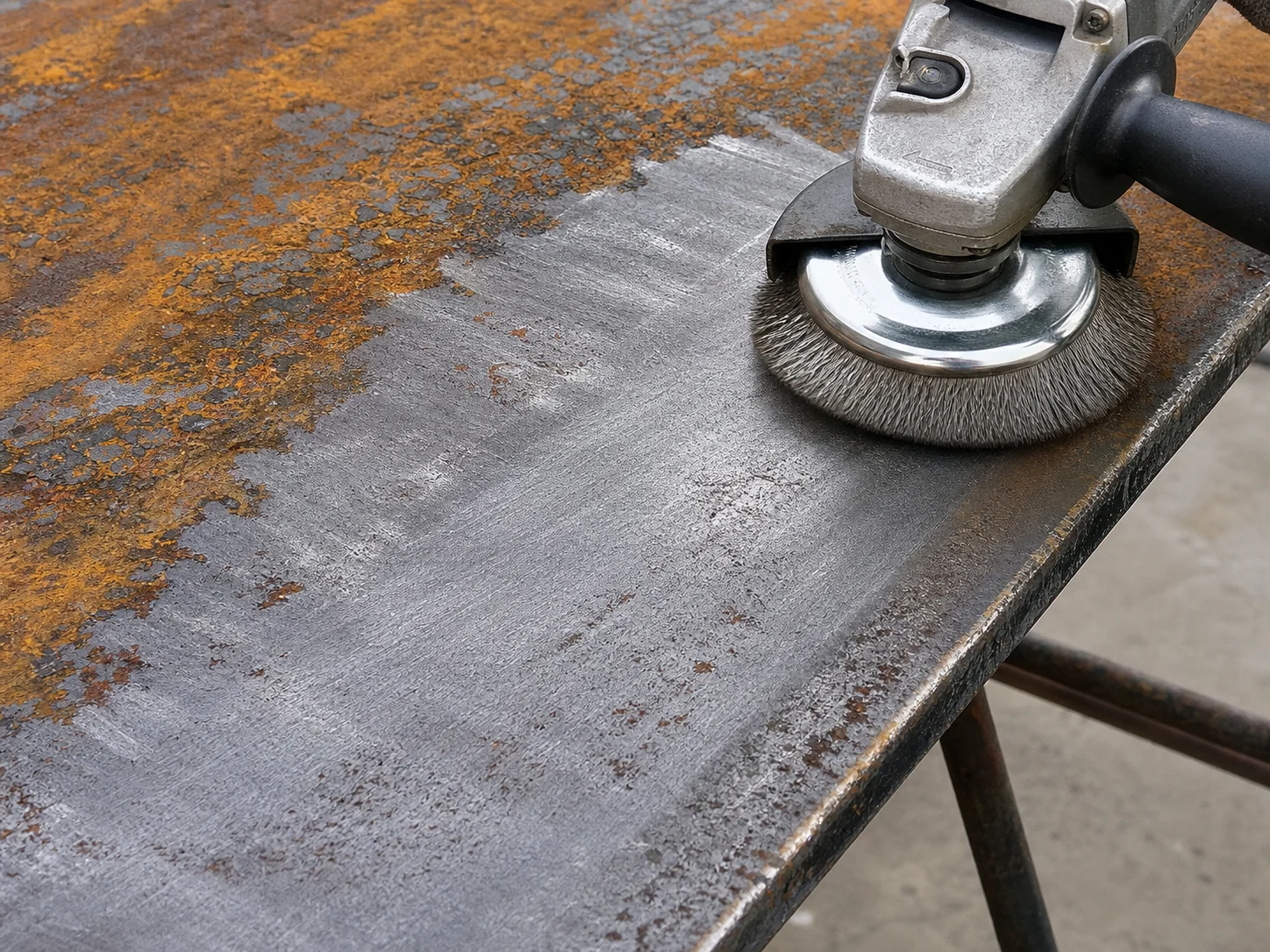
At a glance
- Cleaning target
- Rust/Oxide Scale/Old Paint
- Working environment
- Dry Indoor Area / Outdoor
- Cleaning method
- Dry Brushing / Wet Brushing
- Requirements to check
- Rotary-Brush Guarding and Rated-motion Control; Surface-Finishing SOP
Rust removal is specified by what has to be left behind: light surface rust, weld heat tint and heavy scale each call for different fill, and pre-coating work also sets a required profile.
What makes Steel Rust Removal different from other industrial and manufacturing cleaning?
The task is to remove Rust/Oxide Scale/Old Paint while controlling surface damage, residue carryover, brush shedding and chemical or temperature degradation.
The work happens in dry indoor area and outdoor against rust, oxide scale and old paint.
The part people get wrong: the surface, the residue and the access opening decide the brush together. Fix on any one of them alone and the geometry comes out wrong.
What are the most common cleaning targets in Steel Rust Removal?
The work breaks into 5 targets. They look similar from outside the machine and behave nothing alike at the brush.
| Part or area | Residue type | Cleaning requirement |
|---|---|---|
| Light Surface Rust Removal | Rust, oxide, weld discolouration and carbon | The filament must cut at a controlled depth and hold the same profile across the whole contact band, because here the surface the brush leaves is the product rather than a by-product. |
| Heavy Scale and Corrosion Removal | Rust, mill scale, oxide layer, corrosion product | |
| Weld and Heat-Tint | Rust, oxide, weld discolouration and carbon | The brush must concentrate contact on a small feature without touching the surrounding surface. |
| Pipe and Tube Internal Rust Removal | The brush must pass the full length of the passage and hold contact with the wall without folding over at the far end. | |
| Pre-Coating Rust Preparation | Cured coating, resin and adhesive residue | The filament must cut at a controlled depth and hold the same profile across the whole contact band, because here the surface the brush leaves is the product rather than a by-product. |
What the equipment leaves you to work inside:
| Parameter | Typical range |
|---|---|
| Contaminant | Rust/Oxide Scale/Old Paint |
| Required hardness | Hard |
| Maximum temperature | 100°C |
| Chemical exposure | No Added Medium; Rust Remover pH 1–4; Organic Solvent |
| Cleaning method | Dry Brushing/Wet Brushing |
| Environment | Dry Indoor Area/Outdoor |
Which brush types work for each cleaning target?
Select hand, tube, strip, roller, disc or machine-mounted geometry from access and motion.
| Cleaning target | Recommended brush type | Why it fits |
|---|---|---|
| Light Surface Rust Removal | Handheld Detail Brushes | Light rust sits on the surface, so a flat head takes it off across the full width without cutting into the steel underneath. |
| Heavy Scale and Corrosion Removal | Heavy scale releases in patches, so a hand-guided head lets the operator stay on each patch until it lets go instead of passing evenly over everything. | |
| Weld and Heat-Tint | Cup Brushes | Heat tint is a narrow band beside the weld, so a cup brush concentrates the cut on that band and leaves the parent surface alone. |
| Pipe and Tube Internal Rust Removal | Tube & Pipe Bore Brushes | Inside a tube the cut has to be directed outward at the wall, so a bore form sized over the inside diameter loads its filament against the wall all round as it is drawn through. |
| Pre-Coating Rust Preparation | Handheld Detail Brushes | A coating only holds on a properly prepared surface, so the brushing is judged by the profile it leaves, which is why it stays hand-controlled. |
Three are hand brushes; the two cup brushes go on an angle grinder or die grinder, which is where the guarding and rated-speed rules start to apply.
In practical brush terms: match the construction to the access before anything else. A geometry that cannot reach the target will not be rescued by a better filament.
What filament materials work best for Steel Rust Removal?
Carbon steel wire is the fastest cut on plain steel, 304 stainless where the part must not pick up carbon, and abrasive nylon — silicon carbide or aluminium oxide — where the scale has to come off without wire marks.
| If the condition is… | Filament to start with | Why |
|---|---|---|
| Plain steel, cost-driven | Carbon Steel Wire | the fastest cut per pass |
| Parts that must not pick up carbon | Stainless Steel 304 Wire | no carbon transfer to stain the surface later |
| Finish that has to survive the cleaning | SiC Abrasive Nylon | removes scale without leaving wire marks |
What the duty rules out before you start comparing grades:
| Constraint | Value for this application |
|---|---|
| Filament hardness | Hard |
| Maximum service temperature | 100°C |
| Chemical exposure | No Added Medium; Rust Remover pH 1–4; Organic Solvent |
| Cleaning method | Dry Brushing, Wet Brushing |
How do I choose the right brush for my steel rust removal equipment?
Start with hard fill, a 100°C ceiling and no added medium, then check the surface profile the coating specification requires before committing.
The sequence that gets a usable sample first time:
- Identify the target part and measure the access opening or clearance
- Describe the residue: what it is, how thick it sits, and how strongly it holds
- Choose the construction that can physically reach that target
- Set the filament from surface risk, working temperature and cleaning chemistry
- Fix filament diameter, free trim length and density for the contact pressure you need
- Run one cycle and check the result before committing to a production quantity
Before you commit to a quantity, send the rust condition, the section thickness, and the surface profile the coating specification requires.
When is a steel rust removal brush the wrong tool?
Abrasive blasting is correct wherever a surface profile is specified before coating, and chemical or electrolytic derusting reaches geometry no brush will. Heavy pitted scale needs cutting rather than brushing, and on thin section a brush can polish rust into the surface instead of lifting it.
What common mistakes should I avoid in Steel Rust Removal?
- Asking for rust removal without the surface profile the coating specification requires afterwards
- Changing the filament while leaving excessive engagement, poor alignment or no discharge path unchanged
- Copying a worn brush without first recording its motion, direction, mounting and original working diameter
If the brush is already in service and the result is wrong, work from the symptom:
| Symptom | What to change |
|---|---|
| Residue remains | Increase discharge or relative motion before adding pressure |
| Surface marks | Reduce engagement and use finer/softer fill |
| Rapid wear | Check alignment, temperature and chemical attack |
| Redeposition | Add wash, vacuum or collection path |
Questions this page is asked
What must match before a wire cup or wheel is used for rust removal?
Confirm that the brush type, arbor, diameter and maximum rated speed match the guarded tool and that the brush has no corrosion, loose wire or distortion. Use the required eye, face and body protection, keep bystanders outside the ejection zone, and run the tool only in the orientation permitted by its instructions.
Why are rust-removal brushes often dedicated by steel alloy?
A brush previously used on carbon steel can embed free iron or other debris in stainless or corrosion-resistant surfaces and create later staining or attack. Use an alloy-compatible brush kept clean and clearly dedicated, and correct suspected contamination by the approved cleaning or passivation procedure for the component.
How is a brushed steel surface accepted before recoating?
Inspect against the project-specified rust, coating, edge, dust and surface-profile criteria rather than color alone. Remove loose debris, verify that brushing has not rounded critical edges or exposed unacceptable pits, and apply the specified environmental and time controls before the next coating step.
Guides that go deeper on this
Angle Grinder Wire Wheel Brush Mistakes in Weld Cleanup
Read this guideGuideCup Brush vs Wheel Brush Speed and Pressure Trade-Offs
Read this guideGuideCup Brush vs Wheel Brush: Which One to Use
Read this guideGuideHow to Choose the Right Car Wheel Brush for Rust Removal
Read this guideGuideHow to Choose Wire Wheel Brush
Read this guideGuideSteel Rope Brushes: What Cleans Wire and Rod on the Run?
Read this guideGuideSteel Wire Brushes: What Decides Wire Type and Trim?
Read this guideGuideWheel Brush vs Standard Brushes: Weld Cleanup
Read this guideGuideWheel Brush: Material and Size for Rust Removal
Read this guideGuideWhen to Use an Angle Grinder Wire Wheel Brush on Power Tools
Read this guideGuideNylon Cup Brushes: Polishing or Cleaning, and What Fill?
Read this guideGuideSponge Cup Brushes: Cleaning, Absorbing or Polishing?
Read this guideNo catalogue item for this yet
Every brush here is made to order, and this one has no catalogue entry so far. Send the working surface, the residue, the access opening and the quantity, and it is quoted through the same specification route as the rest of the range.
Custom Manufacturing RFQ
Discuss This Application
Share the working surface, residue, dimensions, material direction, interface, quantity and drawing or sample photo.
Custom Brush RFQ
Request a Custom Cleaning Brush Quote
Upload a drawing, product photo, or sample photo and provide the core dimensions and cleaning conditions.
“We need a brush to remove wet residue from a stainless steel conveyor, about 800mm wide. The current brush wears quickly. We can send photos.”
“We sell drinkware and need a cleaning brush to include with the product. Quantity around 5,000 pieces.”