
Custom Cleaning Brush
200x1500mm Hcs Rust Removal Roller Brush
200mm OD x 1500mm face HCS wire roller brush for inline rust, mill scale, and weld cleanup on steel plate and profiles.
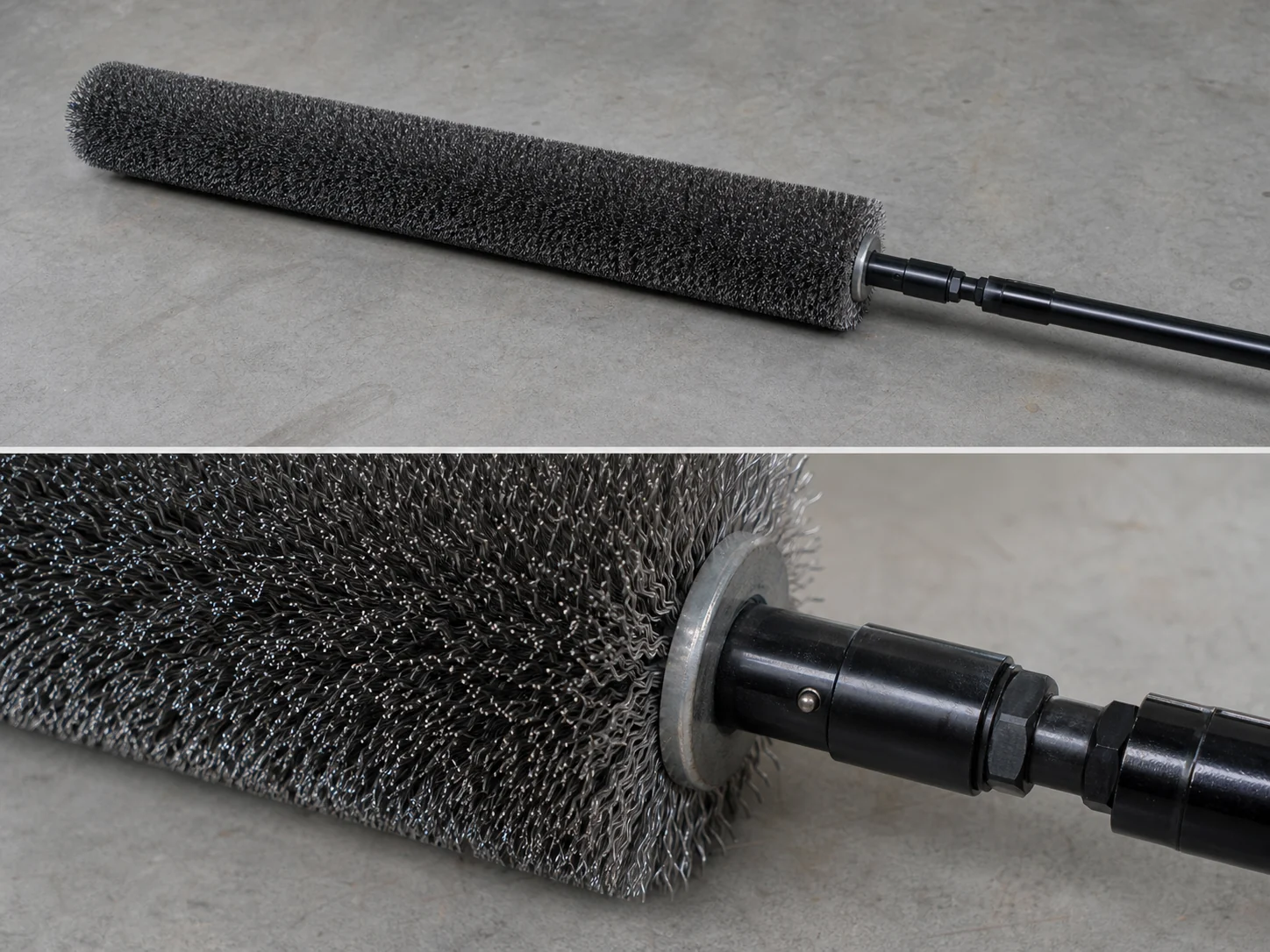
Large-format brush
100 pcs
Minimum order
Built one at a time on a core or channel: full-width rollers, sweeper brooms and long strip.
Production lead time, once the specification is confirmed
- Up to 100 pcsWithin 20 days
- 101–1,000 pcsWithin 30 days
- Over 1,000 pcsConfirmed with your quotation
Peak season can extend these times; the shipping date is confirmed in writing with your quotation. Sampling and shipping are quoted separately.
A 200 mm outside diameter x 1500 mm working face HCS wire roller brush for inline rust, mill scale, and oxide removal on steel plate, wide sheet, weld seams, and fabricated components. The high-carbon-steel fill cuts through heavy residues while the powder-coated steel core and quick-change coupling keep it running as a serviceable consumable in plate processing and surface preparation lines.
What can this brush do for you?
Full 1500 mm working face covers wide plate in one pass
The 1500 mm face length lets the roller contact the entire width of wide steel plate or sheet in a single pass. Instead of indexing a narrow brush back and forth, the machine processes the full strip and reduces the chance of missed lanes between passes.
HCS wire cuts where softer fills only burnish
High-carbon-steel wire is harder and stiffer than low-carbon or stainless wire, so the rotating tips cut into rust, oxide scale, weld discoloration, old coating, and loose slag rather than sliding over them. It is the right fill when the surface is steel and the cleaning objective is removal, not polishing.
Continuous fill reduces banding on flat material
The crimped wire fill is arranged around the core with the density and row spacing set to avoid visible cleaning stripes. On painted or coated plate going into surface prep, an uneven brush pattern shows up later; the fill layout is meant to give repeatable coverage.
Quick-change coupling keeps the line moving
The ends are built around a quick-change coupling, so the worn roller comes off the shaft or drive without pulling the whole machine assembly. Maintenance swaps the consumable, not the line.
Powder-coated core supports even contact across the width
The carbon steel core is powder coated to resist moisture and chemical attack in mill environments. A rigid, straight core is what transfers the drive rotation into even wire contact across 1500 mm; a bent or flexible core shows up as uneven wear.
What is a 200x1500mm Hcs Rust Removal Roller Brush?
A 200x1500mm HCS Rust Removal Roller Brush is a machine-mounted rotating brush, not a hand-held tool. It mounts on a driven shaft or quick-change coupling in a plate cleaning, descaling, weld prep, or surface conditioning line. The 200 mm outside diameter carries HCS wire around a powder-coated carbon steel core, and the 1500 mm dimension is the working face length – the width of material the brush contacts in one rotation.
In operation, the roller rotates against steel plate, sheet, weld seams, edges, or profiles moving past it. The exposed wire tips strike and drag across the surface, breaking loose rust, mill scale, weld discoloration, old coating, and loosely attached slag. The result is a cleaned surface ready for paint, powder coating, further mechanical finishing, or blasting with less abrasive consumption.
Because the fill is carbon steel, this roller is intended for ferrous surfaces and dry or lightly lubricated conditions. HCS wire is aggressive, but it is also brittle: individual wires flex, work-harden, and eventually break. That is normal consumption, and the roller should be monitored for an even wear line rather than run to failure.
Technical Specifications
| Parameter | Value / Options |
|---|---|
| Roller outside diameter | 200 mm |
| Working face length | 1500 mm |
| Brush fill material | High carbon steel (HCS) wire |
| Wire diameter | 0.30-0.50 mm, selected for rust severity and required surface profile |
| Fill construction | Crimped HCS wire, strip or spiral row placement; standard and dense fill options |
| Wire projection / trim length | Set for the target surface profile and wear allowance |
| Core material | Powder-coated carbon steel |
| Mounting interface | Quick-change coupling ends; bore, keyway, flange, or shaft journal matched to the machine |
| Rotation direction | Configured to the drive; directional or reversible fill available |
| Operating environment | Dry or light coolant process; HCS wire and carbon steel core will corrode if left wet |
| Overall assembled length | 1,500 mm working face plus coupling journals, matched to bearing center distance |
| Brush type | Custom Roller and Conveyor Brushes |
| How it is driven | Machine-driven, mounted in the equipment |
| Cleaning target | steel plate and sheet processing, weld preparation and cleanup, and pre-paint and pre-coating line cleaning |
| Surface or part | roller, welds, sheets, seams, steel plate, profiles, edges, and weld seams |
| Residue or debris | rust, scale, oxide, weld discoloration, carbon, old coating, loose slag, and oxide scale |
| Mounting / connection | Quick-change coupling ends; bore, keyway, flange, or shaft journal matched to the machine; Configured to the drive; directional or reversible fill available |
Wire diameter and fill density are the main levers that change the cleaning result: finer wire gives a closer surface profile on moderate rust, while heavier wire lasts longer on thick scale and coatings but leaves a coarser profile. Confirm the machine shaft, coupling, and bearing centers before ordering; the roller is built around those interfaces.
Where does this brush work best?
- Steel plate and sheet processing: descaling and rust removal on hot-rolled or cold-rolled steel up to the 1500 mm face width before forming, painting, or coating.
- Weld preparation and cleanup: removing weld discoloration, heat tint, and loose slag along seams, edges, and fabricated components on long workpieces.
- Pre-paint and pre-coating lines: stripping loose rust, oxide scale, and deteriorated coatings before blasting or primer application.
- Steel service centers and fabrication shops: running wide sheets, plates, or nested profiles through a roller conveyor or plate-cleaning station.
- First-pass conditioning before abrasive blasting: removing the bulk of loose material so blasting focuses on tight scale in pits and improves throughput.
The roller is built for flat or moderately contoured ferrous work, not for small bores, deep profiles, or hand finishing.
How do I choose the right one?
1. Match the machine interface before the face dimensions
Check the shaft bore, keyway, coupling type, bearing centers, and available clearance for the 200 mm swing diameter. The roller has to fit the existing drive first; face length comes second.
2. Select wire diameter by the rust and the profile you can accept
Finer HCS wire removes moderate rust and leaves a closer surface profile. Heavier wire lasts longer on thick scale and old coatings but leaves a coarser surface and may raise edge burrs on thin plate. Choose by the profile tolerance, not only by removal speed.
3. Set the fill density for the workpiece shape
Dense continuous fill gives even coverage on flat plate and wide sheet. A more open fill allows more individual wire movement around weld crowns and edges, but it removes less material per revolution.
4. Use the right pressure, not maximum pressure
HCS wire is brittle. Excess pressure bends and breaks the wires rapidly without increasing removal. Set the drive and line pressure so the wire tips drag across the surface and clean the bottom of light pits instead of folding flat.
5. Decide whether HCS is the right material for the job
Use HCS on carbon steel workpieces where ferrous contamination is acceptable and the process is dry. Switch to stainless or synthetic fill for stainless steel, aluminum, galvanized or coated parts, and for wet lines where carbon steel would corrode the roller between shifts.
| Condition | Recommended configuration |
|---|---|
| Moderate rust, close surface profile needed | 0.30 mm HCS wire, dense fill |
| Heavy rust, mill scale, old coating | 0.40-0.50 mm HCS wire, standard or open fill |
| Weld seams and edges with uneven geometry | Dense fill with controlled projection, lower line pressure |
| Stainless, aluminum, or coated non-ferrous surfaces | Not this roller – use stainless, brass, or synthetic filament |
| Wet process or acid-washed line | Not HCS – use stainless wire or corrosion-resistant synthetic |
If the roller still leaves rust in deep pits or visible stripes across the plate, change wire diameter or fill density before adding more pressure. Heavy tight scale that remains after brushing usually needs abrasive blasting or grinding, not a harder wire alone.
Can I customize this brush?
The 200 mm diameter and 1500 mm face length are the starting point, not a fixed off-the-shelf boundary. For a new line or a retrofit, the roller is built to the shaft, coupling, and material condition. Provide a cross-section or GA drawing with the shaft diameter, keyway, bearing center distance, coupling type, rotation direction, drive speed, line speed, plate width and thickness range, residue type, and surface profile target.
Adjustable parameters include:
- Face length and outside diameter – tuned to machine clearance and workpiece width when the 200×1500 mm baseline needs modification.
- Wire diameter and carbon steel grade – finer or heavier HCS wire for profile, life, and aggressiveness.
- Fill pattern – strip, spiral, dense, or open row placement to control coverage and pressure.
- Wire projection and trim length – shorter for stiffness on edges, longer for contour following and wear life.
- Core and mounting – bore size, keyway, flanges, journals, quick-change coupling ends, shaft material and coating.
- Rotation and balance – directional fill for the machine rotation, and balancing for the operating speed range.
- Finishing and marking – core coating, identification marking, batch traceability, and packaging matched to warehouse or line-side handling.
If the project calls for material documentation, inspection records, or third-party testing on a specific run, that support can be arranged during customization.
Which filament survives the cleaning and still lasts on a 200x1500mm hcs rust removal roller brush?
What is the difference between HCS wire and stainless steel wire for rust removal?
HCS wire is harder and cuts rust, mill scale, and old coatings faster than stainless wire on carbon steel. It is also more brittle and will rust when stored wet. Use HCS when the workpiece is ferrous and maximum removal is the goal; use stainless wire when corrosion resistance or ferrous contamination on stainless surfaces matters more than cutting speed.
How do I know when the roller brush needs replacement?
Check the wire projection or outside diameter against the wear allowance specified for the line. When the wire tips are worn short, the roller cleans a narrower band, leaves rust in the bottom of pits, or the drive sees higher load. Uneven wire loss, missing wire sections, or vibration that started after the run-in period are also replacement signals.
Does a 1500 mm face length clean a full 1500 mm wide plate?
Not edge to edge. The roller contacts the full 1500 mm working face, but practical processing usually keeps a small tracking margin at each end so the edge wires are not the only contact points. For full-width plate coverage, plan the line width with the face length and edge position in the machine.
Can this roller run wet with coolant or on a water-washed line?
HCS wire and the carbon steel core will corrode if left in continuous water or acid conditions. Dry operation is preferred. If the cleaning process must be wet, a stainless steel wire roller or a corrosion-resistant synthetic fill is a better match; specify those conditions at RFQ.
What should I do if the roller vibrates or leaves stripes on the plate?
First check that the shaft is straight, the couplings are seated, and the bearing centers are aligned. Then inspect the fill for debris packed between wires, uneven wear, or missing sections. A bent core or an unbalanced, packed roller transfers the problem into the plate as stripes; clean the fill, recheck the mount, and replace the roller if the wear is uneven.
Will this roller remove all weld slag and deep pitting rust?
No. It removes loose slag, weld discoloration, and surface rust, but welded-on spatter and deep corrosion pits usually require grinding, chipping, abrasive blasting, or a heavier surface-preparation step. The roller is a wide-coverage first-pass tool, not a replacement for aggressive profile work.
Guides that go deeper on this
Abrasive Nylon Grit and Filament Selection
Read this guideGuideBrush Roller Conveyor Mistakes with Dry Dust
Read this guideGuideBrush Speed, Engagement, and Heat
Read this guideGuideConveyor Belt Cleaning Brush Design
Read this guideGuideRail Grinding and Rust Removal Brushes: Types and Safety Checks
Read this guideCustom Manufacturing RFQ
Describe Your Application
Send the key measurements, cleaning requirement, residue, material direction, mounting method, quantity, and drawing or photo.
Drawing or photo optional — it speeds things up, it does not gate the enquiry.
Custom Brush RFQ
Send Your Brush Project
Upload a drawing, product photo, or sample photo and provide the core dimensions and cleaning conditions.
“We need a brush to remove wet residue from a stainless steel conveyor, about 800mm wide. The current brush wears quickly. We can send photos.”
“We sell drinkware and need a cleaning brush to include with the product. Quantity around 5,000 pieces.”