
Custom Cleaning Brush
Plating Line Brush Roller
Plating line brush roller for oxide, salt, and sludge removal in pickling and rinse sections. PP and PBT acid-resistant fill, built to your line drawing.
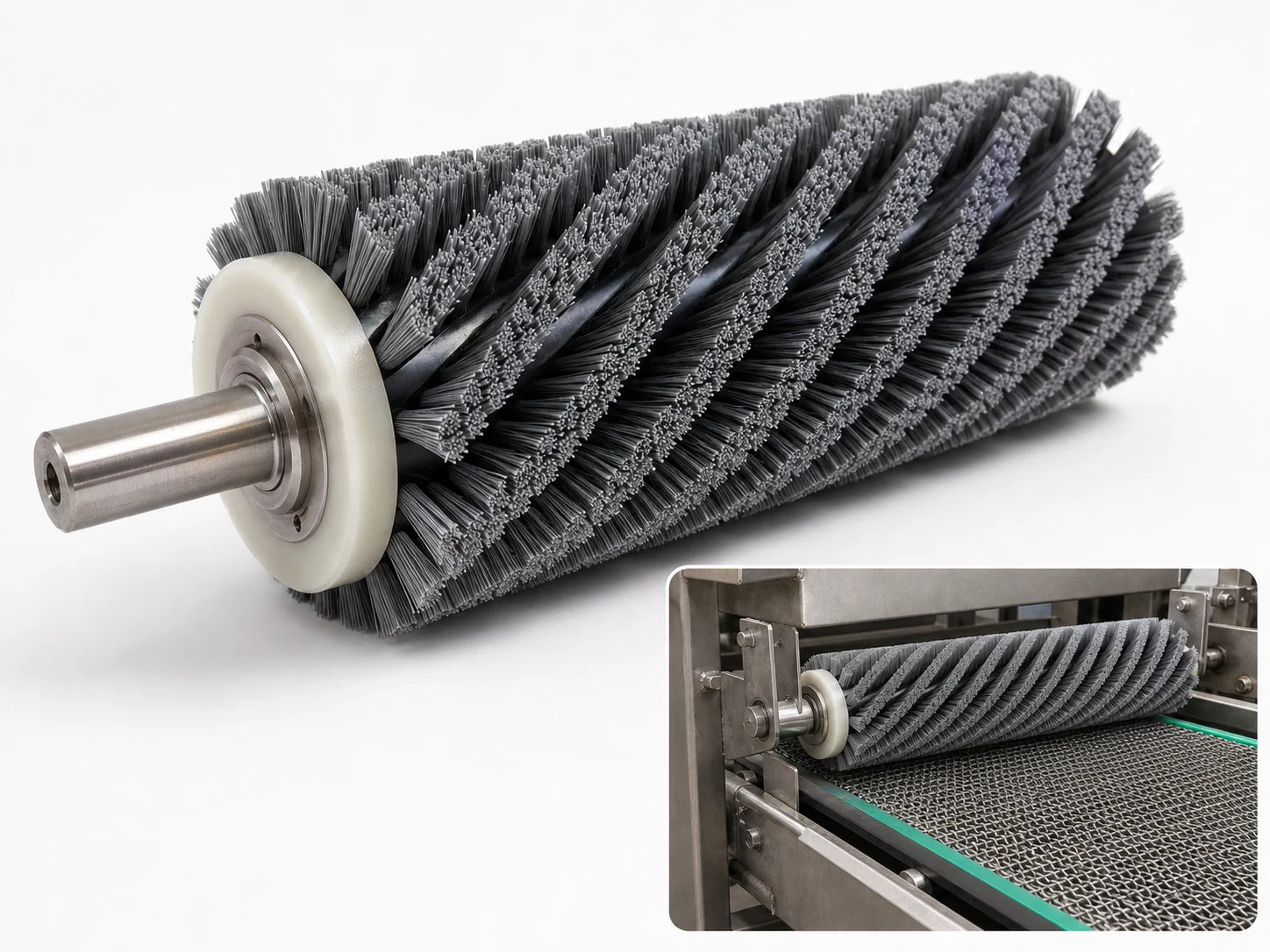
Large-format brush
100 pcs
Minimum order
Built one at a time on a core or channel: full-width rollers, sweeper brooms and long strip.
Production lead time, once the specification is confirmed
- Up to 100 pcsWithin 20 days
- 101–1,000 pcsWithin 30 days
- Over 1,000 pcsConfirmed with your quotation
Peak season can extend these times; the shipping date is confirmed in writing with your quotation. Sampling and shipping are quoted separately.
A continuous-process roller brush for scrubbing oxide, acid salts, plating sludge, and process contamination from moving metal strip, workpieces, and line contact surfaces in wash, pickling, and rinse sections of plating operations. Face width, roll diameter, fill material, and shaft interface are matched to the line drawing, with polypropylene and PBT filament options specified for wet acid service.
What can this brush do for you?
Works the Full Strip Width in One Continuous Pass
The roller face is engineered to the actual line width, so the entire moving strip receives uniform brushing contact without stopping or reducing line speed. Operators get consistent oxide and sludge removal rather than strip-center-only cleaning or hand touch-up after the line.
Acid-Resistant Fill That Keeps Its Shape and Stiffness
Polypropylene and PBT filaments are selected for wet acid duty where nylon would soften, swell, or degrade in concentrated HCl or H2SO4 service. The face stays stiff enough to scrub through salt films without turning mushy or shedding filament particles into the bath.
Sheds Sludge Instead of Loading the Face
Filament diameter, crimp, and spiral angle can be set so removed residue is thrown clear of the face as the roller turns. This keeps the brush working on the strip instead of dragging re-deposited sludge across it, which matters most in high-residue pickling and rinse positions.
Wear-Compensating Engagement
The roller is mounted so engagement depth can be adjusted as filament ends wear. Brushing force stays closer to the original set point through the service life, and the roller keeps cleaning the same area instead of gradually losing contact.
Replaceable Face Keeps Line Downtime Short
The roller can be built as a refillable strip-brush or segmented face so worn sections are replaced without scrapping the core or shaft. Maintenance swaps the working surface and returns the line to production while the worn section is rebuilt offline.
What is a Plating Line Brush Roller?
A Plating Line Brush Roller is a rotating cylindrical brush mounted across the strip path or process-contact zone inside a plating or metal-finishing line. It is positioned in the pre-cleaning, pickling, rinse, or post-treatment section where loose oxides, acid salts, plating residues, and sludge films need to be mechanically removed before they interfere with the next process step.
During operation the driven or idler roller turns against the moving strip, racked parts, or contact rollers. The filament tips scrub the surface while the rotating face carries loosened material away. The brush works as the mechanical part of the cleaning sequence; it does not replace acid pickling or chemical rinsing, but it removes the loosely attached deposits and drag-out films that chemistry alone often leaves behind.
Because the roller spends its working life in spray rinse, acid fumes, or direct bath contact, every component from filament to core and bearing journal must tolerate the line’s chemistry and temperature. That is why the fill material and shaft interface are specified from the line conditions, not from a general-purpose brush catalog.
Technical Specifications
The values below are project-matched. The primary reference for any plating line roller is the line drawing; face length, roll OD, shaft ends, and drive interface are built from it.
| Parameter | Value / Options |
|---|---|
| Brush form | Full-face cylindrical roller, spiral strip brush, or segmented lath brush assembled on a common shaft |
| Face length | Built to strip width plus edge allowance; specified from the line drawing |
| Roller outside diameter | Selected for line space, required engagement, and filament wear allowance |
| Fill material | PP for concentrated acid and pickling duty; PBT where higher temperature or stiffness is required; PA6 or PA612 only after chemistry review |
| Filament diameter | PP 0.07–2.0 mm; PBT 0.15–0.2 mm; nylon 0.05–1.2 mm, matched to residue and surface |
| Filament type | Straight, crimped, or abrasive-impregnated; flagged where higher water carry is needed |
| Trim length | Matched to engagement depth and residue load; longer trim increases conformability, shorter trim increases scrubbing force |
| Fill density | Set from residue type, required finish, and self-cleaning behavior |
| Spiral angle / pattern | Selected for lateral residue discharge and uniform face contact in spiral configurations |
| Core / shaft | Steel, stainless steel, coated steel, or composite core; journals, keyways, and couplings matched to the line drive |
| Mounting | Pillow block or adjustable bracket with engagement adjustment allowance |
| Operating environment | Acid type, concentration, temperature, line speed, and wet or dry duty reviewed before material selection |
| Brush type | Custom Roller and Conveyor Brushes |
| How it is driven | Machine-driven, mounted in the equipment |
| Cleaning target | acid pickling line, and post-treatment rinse section cleaning |
| Surface or part | roller, metal, racks, rolls, coils, conveyors, fixtures, and tanks |
| Residue or debris | sludge, oxide, salt, scale, carbon, loose scale, mineral deposits, and process film |
| Mounting / connection | Pillow block or adjustable bracket with engagement adjustment allowance |
Where does this brush work best?
This roller is designed for continuous metal-processing and plating lines where the surface is moving and mechanical cleaning must happen without stopping the line. Typical positions include:
- Acid pickling lines for steel, stainless, copper, and brass strip, where incoming oxide and smut must be removed before plating.
- Continuous electroplating lines, where the brush roller cleans strip or workpieces ahead of the plating cells and between rinse stages.
- Hot-dip galvanizing and coil coating lines, where the brush removes loose scale, salts, and surface contamination before the coating application.
- Metal finishing lines, where guide rollers, contact rolls, and conveyor rolls collect sludge and scale that must be brushed from the roll face.
- Rack and barrel plating lines, where mounted brush rollers scrub rack contacts, fixtures, or part surfaces between process tanks.
- Post-treatment rinse sections, where drag-out salts and residual plating films must be removed before drying or further processing.
The residue in these positions is normally loose or weakly attached: oxide smuts, acid salts, plating sludge, and process film. Hard rolled-in scale, burned-on carbon, or heavily bonded mineral deposits need a different mechanical step before or instead of this brush.
How do I choose the right one?
Start with the line drawing, not a catalog size
Face length, overall roll diameter, core/shaft length, bearing centers, and drive interface all come from the actual line. A plating line brush roller is not an off-the-shelf size; copying the existing roll drawing or sending the removed roller is the fastest way to get a correct replacement.
Select the filament for the chemistry first
In strong mineral acids such as concentrated HCl or H2SO4, polypropylene is the first-choice fill. PBT is used when the bath runs hotter or the position needs a stiffer, higher-modulus filament. Nylon grades, including PA6 and PA612, are only considered after the specific acid concentration, temperature, and exposure time are reviewed with the line chemistry, because concentrated acids attack nylon and shorten face life.
- Strong mineral acid, room to warm temperature: PP, straight or crimped fill.
- Hot acid or higher brushing force: PBT, with concentration and temperature confirmed.
- Dilute acid, neutral detergent, or mild pH: PA6 or PA612 may be acceptable after chemistry review.
Set engagement from the residue and surface condition
Light oxide films and rinse drag-out need only enough engagement to contact the surface; heavy sludge may need deeper tip deflection and a denser face. Too much engagement scuffs soft metal strip and accelerates filament wear; too little leaves a residue band. Select trim length and engagement so the filament tips deflect through the film but not into the base metal.
Match the core and shaft to wet acid duty
The core material, shaft ends, and bearing interfaces must tolerate the line environment. Where concentrated acid or stray electrical current is present, consider coated or isolated cores and stainless or composite hardware to avoid galvanic corrosion and pitting at the journals.
When this brush is not the right tool
Use a different method when the surface carries rolled-in scale, heavy carbon, or deposits that require abrasive blasting, grinding, or chemical descaling. If the line surface cannot tolerate any mechanical contact, consider spray rinse bars, air knives, or ultrasonic cleaning. And if the process runs above the temperature limit of the available filament materials, the roller needs a different construction or an alternate cleaning position.
Can I customize this brush?
Yes. Plating line brush rollers are built to the line, so nearly every working dimension and material can be set for the project. We will need the line drawing, strip or part width, acid or cleaning solution composition and concentration, bath temperature, line speed, drive interface, and the current roller arrangement. Photos or a removed sample roller also help.
Configurable items include:
- Face length and roller outside diameter
- Fill material, filament diameter, trim length, density, and filament type
- Core and shaft material, diameter, journals, keyways, couplings, and bearing seats
- Brush form: full-face cylinder, spiral strip, or segmented lath assembly
- Spiral angle, helix direction, and face segmentation for self-cleaning
- Mounting adjusters and engagement setting range
- Color coding or identification marking where the line uses visual control
- Packaging configured for long roller shipment and protected filament faces
If the project requires material declarations, inspection documentation, or third-party testing for the line’s quality system, we can support those requirements as part of the customization package.
When is a plating line brush roller worn out rather than just dirty?
What information should I collect before requesting a plating line brush roller?
Collect the line drawing or current roller dimensions, strip or part width, acid type and concentration, bath temperature, line speed, drive shaft detail, bearing centers, and the residue you need to remove. A worn roller sample or photos of the mounting position also help avoid fit errors.
How do I know when the roller face needs replacement?
Compare the shortest filaments in the face with the original trim length. If the shortest have lost roughly half their length, or if the mounting adjustment can no longer maintain contact, the face should be replaced or refilled. Also replace the face if filaments are breaking off, clumping, or leaving visible unreached bands on the strip.
Can a PP or PBT brush roller run in hot acid baths?
PP works in many acid baths at moderate temperatures but softens as temperature rises. PBT carries a higher service temperature and is the usual choice for hot-acid duty. Nylon should not be considered for concentrated hot acid without specific testing. Send the bath temperature and concentration so the fill can be confirmed before building.
Does the brush roller replace the chemical pickling or descaling step?
No. The brush mechanically removes loose oxide, salts, and sludge films, but chemical pickling is still needed to dissolve the remaining oxide layer. The roller improves what enters the next bath and reduces drag-out, but it is not a substitute for the process chemistry.
What should I inspect on the core and shaft in a plating environment?
Check the core for swelling, splitting, or corrosion, and inspect the shaft, journals, and keyways for pitting, wear, and galvanic damage from stray current. If the shaft shows local pitting or the brush runs off-center, the mounting or isolation should be corrected at the same time the roller is rebuilt.
How can I verify that the brush is actually cleaning the strip?
Run a water-break test on the strip after the brush position: a continuous water film indicates a clean surface, while beading or breaking indicates residual oil, film, or salt. A white cloth wipe of the strip edge and center will also show whether residue remains. If cleaning falls off, increase engagement or fill density before changing line chemistry.
Guides that go deeper on this
Abrasive Nylon Grit and Filament Selection
Read this guideGuideBrush Roller Conveyor Mistakes with Dry Dust
Read this guideGuideBrush Speed, Engagement, and Heat
Read this guideGuideCeramic Glaze Line Brushes: Applying and Cleaning Glaze Surfaces
Read this guideGuideConveyor Belt Cleaning Brush Design
Read this guideCustom Manufacturing RFQ
Describe Your Application
For an accurate quotation, please provide the main dimensions, material preference, working surface, residue, quantity, and a drawing or photo.
Drawing or photo optional — it speeds things up, it does not gate the enquiry.
Custom Brush RFQ
Send Your Brush Project
Upload a drawing, product photo, or sample photo and provide the core dimensions and cleaning conditions.
“We need a brush to remove wet residue from a stainless steel conveyor, about 800mm wide. The current brush wears quickly. We can send photos.”
“We sell drinkware and need a cleaning brush to include with the product. Quantity around 5,000 pieces.”