
Custom Cleaning Brush
Spiral Wound Roller Brush
Custom spiral wound roller brushes for conveyor belts, web paths, rails and machine guides. PBT, PP or nylon fill, 100-3000 mm width, shaft-matched.
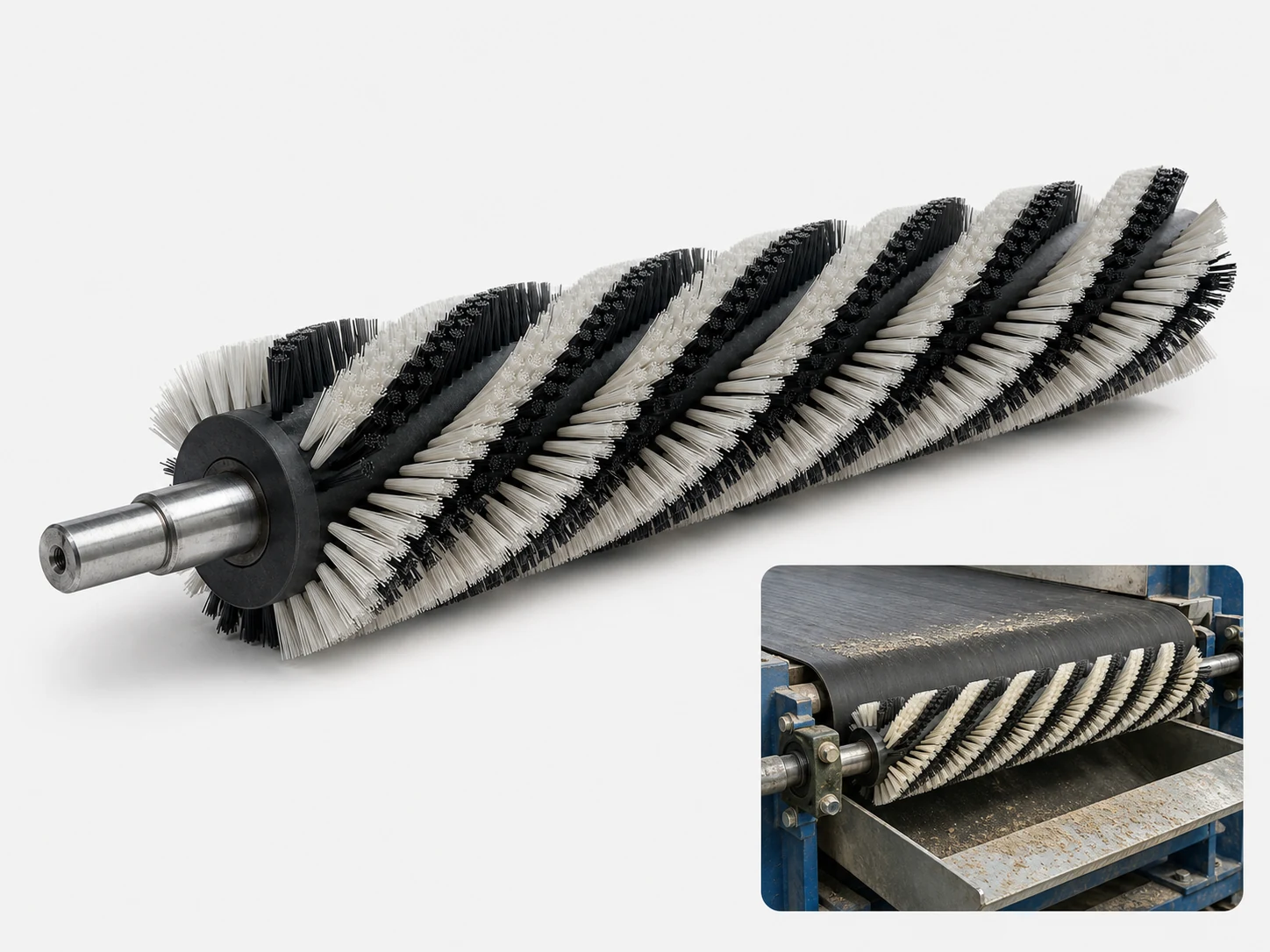
Large-format brush
100 pcs
Minimum order
Built one at a time on a core or channel: full-width rollers, sweeper brooms and long strip.
Production lead time, once the specification is confirmed
- Up to 100 pcsWithin 20 days
- 101–1,000 pcsWithin 30 days
- Over 1,000 pcsConfirmed with your quotation
Peak season can extend these times; the shipping date is confirmed in writing with your quotation. Sampling and shipping are quoted separately.
A spiral wound roller brush is a continuous-helix industrial cleaning roller for conveyor belts, web paths, transfer points, rails, and machine guides. The helical fill maintains uniform contact across the working face, lets loosened powder, crumbs, chips, and carryback escape through the spiral flutes, and can be built to match your shaft, face width, filament material, and engagement.
What can this brush do for you?
One continuous bristle path with no row-to-row gaps
Because the filament strip is wound around the core as a continuous helix rather than placed in separate circumferential rows, there is no dead seam where bristles stop and restart. As the roller rotates, the contact zone sweeps laterally across the face, so belts, webs, and rollers are cleaned edge to edge without leaving narrow uncleaned tracks between tuft rows.
Spiral flutes give loosened debris a way out
The open channel between each coil works as a discharge path. Powder, fibers, crumbs, and chips that the filament tips loosen are thrown outward by rotation or can drop through the flute instead of packing tight between filament rows. On belt return runs and transfer points, this keeps the brush face open longer and reduces the buildup that makes a roller lose contact.
Progressive contact instead of a full-width impact line
The helical lead causes one section of the roller to engage slightly before the next. The result is a gradual wrapping contact along the face, which cuts down chatter, bounce, and the vibration that can mark coated webs, thin film, or sensitive guide surfaces at higher line speeds.
Adjustable radial engagement and edge overlap
The roller is intended to run with 2-10 mm of radial engagement against the moving surface and 5-15 mm of extra working face beyond each edge. That range gives the operator room to tune how hard the filament tips contact the surface and to keep the face fully covered even if the belt or web wanders slightly.
Fill material matched to the line environment
PBT offers stiffness and moisture resistance for dry powder and fine particles. Polypropylene (PP) provides good chemical resistance and a softer, lighter contact for gentler cleaning. Nylon (PA) holds shape well under wear and recovers better in wet or oily conditions. The helical construction works with any of the three, but the right choice changes with residue, temperature, and surface sensitivity.
What is a Spiral Wound Roller Brush?
A spiral wound roller brush is a rotary strip brush in which a filament strip is wound and secured in a helix around a central core. The core is fitted to a shaft or end journals, and the complete roller is mounted across a conveyor, web line, rail, or machine guide so the filament tips contact the moving surface.
During operation, the brush may be driven by its shaft independently at a controlled speed or allowed to rotate freely against the moving surface. In either case, the helix means the filament line meets the surface at an angle, and each rotation advances the contact zone across the face. Loose material is peeled off the surface and then ejected by centrifugal force or carried by the flutes toward one edge, depending on the helix direction.
The working contact is the filament tip area. The rest of the roller is a support system: core wall thickness, shaft diameter, and end connections all carry the bending and torsional loads of a long rotating member. That is why an undersized core or shaft can flex, create a varying center-to-belt distance, and leave an uneven cleaning band even when the brush diameter is correct.
This is a surface-contact cleaning tool for loose, attached, or lightly packed debris. It is not a scraper, deburring tool, or heavy-abrasion device. For carryback that is still soft and mobile, or dust that sits on a web or roller, the spiral wound roller does its job well; for cured, bonded, or heavily sticky deposits, it should be used with or replaced by a scraper, wash-down system, or a harder brush construction.
Technical Specifications
The standard build ranges below cover most conveyor and web cleaning installations. Every value can be changed for the project.
| Parameter | Standard range / option |
|---|---|
| Working face width | 100-3000 mm |
| Brush outside diameter | 60-300 mm |
| Core outside diameter | 25-150 mm |
| Shaft diameter | 12-100 mm, solid or hollow depending on span and load |
| Trim length | 15-100 mm |
| Fill material | PBT, Polypropylene (PP), or Nylon (PA) |
| Filament diameter | Commonly 0.15-0.70 mm; selected for stiffness and surface sensitivity |
| Winding pattern | Single, double, or triple start; left-hand or right-hand helix |
| Core material | Carbon steel, 304/316 stainless steel, aluminum, or polymer |
| Shaft interface | Plain end, keyway, square or hex bore, drive flange, or bearing journal |
| Radial engagement | 2-10 mm |
| Edge overlap | 5-15 mm per side beyond the surface being cleaned |
| Working temperature | Resin and core dependent; typical continuous limits are PP about 80°C, PBT about 120°C, and PA about 100°C dry. Confirm against process heat and chemicals. |
| Brush type | Custom Roller and Conveyor Brushes |
| How it is driven | Machine-driven, mounted in the equipment |
| Cleaning target | return-side conveyor belt, food production belt and guide, and film web path cleaning |
| Surface or part | roller, belts, webs, rails, conveyors, machine guides, transfer points, and web paths |
| Residue or debris | powder, chips, crumbs, dust, fines, fiber, flour, and sugar |
| Mounting / connection | Shaft-Mounted / Fixed |
Shaft outside diameter and core outside diameter are separate dimensions: the core is the brush body, and the shaft passes through or extends from the core. On many long-face rollers, a larger core tube is used specifically to control sag.
Where does this brush work best?
- Return-side conveyor belt cleaning: positioned under the belt near the discharge or head pulley to remove flour, sugar, powder, grains, sand, fines, and other carryback before it drops along the return run or builds on idlers.
- Food production belts and guides: crumbs, dough fragments, flour, sugar, and product fines on belt surfaces, side guides, and transfer rollers where loose material must be removed without damaging the belt.
- Printing, coating, and film web paths: dust, fibers, paper lint, and surface fines on webs, idlers, and nip rollers before printing, laminating, coating, or winding.
- Packaging lines: carton dust, label fragments, film scraps, and adhesive fallout from belt surfaces, rails, and transfer points.
- Wood, board, and plastics processing: sawdust, chips, plastic shavings, and film fragments that accumulate on conveyors, guide rails, and feed rollers.
- Chain, rail, and machine guide cleaning: loose debris carried in chain links, along rails, or into transfer points where a fixed scraper cannot follow and a spiral contact face can sweep without jamming.
How do I choose the right one?
Start with the surface width and add edge overlap
Measure the widest part of the belt, web, or roller that must be contacted, then add 5-15 mm of brush face on each side. If the web has side wander, move to the larger end of that range. A face that is too narrow leaves a visibly dirty edge; a face that is far wider than needed wastes filament and can push debris into the machine frame.
Pick the brush diameter around the mounting envelope and line speed
The outside diameter needs to fit the roller’s mounting space and give the right surface speed for the line. Too large a diameter can hit nearby structure or throw debris harder than you want; too small a diameter shortens filament life and makes the roller more sensitive to belt flap. Check the gap between the brush envelope and the nearest guard, pulley, or frame member before finalizing the diameter.
Match the fill material to the residue and contact surface
PBT is usually the choice for fine dry powders, abrasive fines, and applications where the brush must stay stiff and moisture-stable. PP gives chemical resistance and a gentler contact with lower cost in many cases; use it for light dust, food crumbs, or surfaces that need a softer tip. PA becomes the choice when the brush runs wet, oily, warm, or must absorb repeated bending without early breakage. For coated film, thin gauge filament and a low engagement protect the surface; for coarse chips or clingy carryback, use heavier gauge and higher engagement.
Set the radial engagement, then check the helix direction
Begin with 2-5 mm of radial engagement on a light dust job and move toward 10 mm only if residue remains. More engagement increases cleaning force but also raises filament set, heat, and drive load. The helix direction decides whether debris is carried toward the left or right side of the roller. Specify it so loosened material discharges away from the bearing, motor, or product edge, and do not reverse direction in service unless the roller was built for bidirectional operation.
Size the core and shaft for the full span
Long face widths put a beam load on the core and shaft. A thin-walled core or small shaft will sag in the center, changing the radial engagement in the middle of the roller and creating a light or heavy band. Use a larger core tube, a thicker wall, or center supports when the span is long, and confirm runout before installation.
When a spiral wound roller is not the right tool
For cured, pitch-like carryback, hard scale, paint, or material that needs a cutting edge, use a scraper, wire brush roller, or a wash-down system. If the contact area is a narrow tube or bore, a tube brush or stem-mounted brush is easier to fit. If the line must remove debris and dry the surface at the same time, add an air knife or vacuum pickup, since the spiral roller removes the material but carries no drying function.
Can I customize this brush?
A spiral wound roller brush is normally configured to the line rather than purchased off the shelf. Common adjustable elements include:
- Face width and overall length: working width from 100 mm up to 3000 mm, with shaft extensions and bearing journals set to the frame.
- Brush outside diameter, core diameter, and trim length: these set the outside envelope and how much filament is available for wear before replacement.
- Winding geometry: single, double, or triple start, lead or pitch, left-hand or right-hand direction, and fill angle.
- Filament system: PBT, PP, or PA; filament diameter; color; stiffness; and special additive packages for temperature or chemical exposure.
- Core and shaft: carbon steel, stainless steel, aluminum, or polymer core; solid or hollow shaft; keyway, hex, square, or flanged end; protective coating or washdown finish.
- OD preparation: fully trimmed or ground outside diameter for close-tolerance contact, with diameter and runout checked to the drawing.
- Mounting accessories: bearing blocks, adjustable slide mounts, end collars, or flanges where the line needs them.
- Marking and packaging: part marking, individual protective wrap, carton packing, or palletization to match your receiving process.
To define the custom roller, provide the surface width, belt or web speed, available mounting space, shaft or bore interface, rotation direction, residue description, washdown or temperature conditions, and any existing drawing or sample. We can also assist with material documentation, inspection dimensions, and third-party testing when the project requires them.
How is a spiral wound roller brush mounted, and how long does it last?
How do I check radial engagement after the roller is installed?
Run at low speed and watch the filament tips against the surface. Look for 2-10 mm of flex at the tip line and a return to shape as each section leaves contact. If the filament tips lie flat and do not spring back, engagement is too high or the brush has taken a permanent set. If the tips barely touch, increase adjustment until the lightest visible flick appears on the surface.
Which way should the debris be directed by the helix?
The helix hand and the direction of rotation together determine the discharge side. Specify left-hand or right-hand winding so debris is thrown toward the maintenance aisle or away from product-contact edges. In most installations, loose material should travel across the face and exit at the far end, not be carried back into the incoming side.
Can I reverse a spiral wound roller to get more even wear?
Not unless it was designed for bidirectional operation. Reversing changes the direction that loosened debris travels through the flutes and can pack material at the center or drive it against a side frame. For an existing unidirectional roller, the usual maintenance practice is to inspect tip wear, measure face diameter, and replace or rewind when contact becomes uneven.
How do I detect an undersized core or shaft before it damages the line?
Mount a dial indicator on the roller body and rotate slowly. If the brush outside diameter varies more than about 1 mm along the face, or the roller visibly whips at operating speed, the core or shaft is flexing. The fix is a larger core outside diameter, increased wall thickness, a larger shaft, or an intermediate support, not more filament.
What is the difference between a spiral wound roller brush and a row-wound roller brush?
A row-wound roller places bristles in distinct circumferential rows, creating start-and-stop bands around the face. A spiral wound roller uses one continuous helical strip, so there are no row seams, the contact line progresses across the width, and the spaces between coils form discharge flutes. This makes the spiral version easier to keep clean on dusty and fibrous applications, while the row-wound design may be preferable where a very high fill density is required.
When should I add a scraper, air knife, or wash-down instead of relying on the brush?
Use a scraper first when carryback is thick, pasty, or already consolidated into a layer that a filament tip cannot lift. Use an air knife or vacuum when the material must be removed from the surface after brushing. Use a wash-down when the residue dissolves or must be flushed. The spiral wound roller is the dry, mechanical-contact step; it works best before material hardens and before the surface carries debris into the next process.
Guides that go deeper on this
Custom Manufacturing RFQ
Describe Your Application
For a custom quote, we need the key dimensions, surface or part, residue, material preference, quantity, and reference image or drawing.
Drawing or photo optional — it speeds things up, it does not gate the enquiry.
Custom Brush RFQ
Send Your Brush Project
Upload a drawing, product photo, or sample photo and provide the core dimensions and cleaning conditions.
“We need a brush to remove wet residue from a stainless steel conveyor, about 800mm wide. The current brush wears quickly. We can send photos.”
“We sell drinkware and need a cleaning brush to include with the product. Quantity around 5,000 pieces.”