
Custom Cleaning Brush
Steel Wire Roller Brush
Driven wire cylinder to 3000 mm working length in steel, stainless or brass fill, clearing carryback from belts and rollers while the line runs.
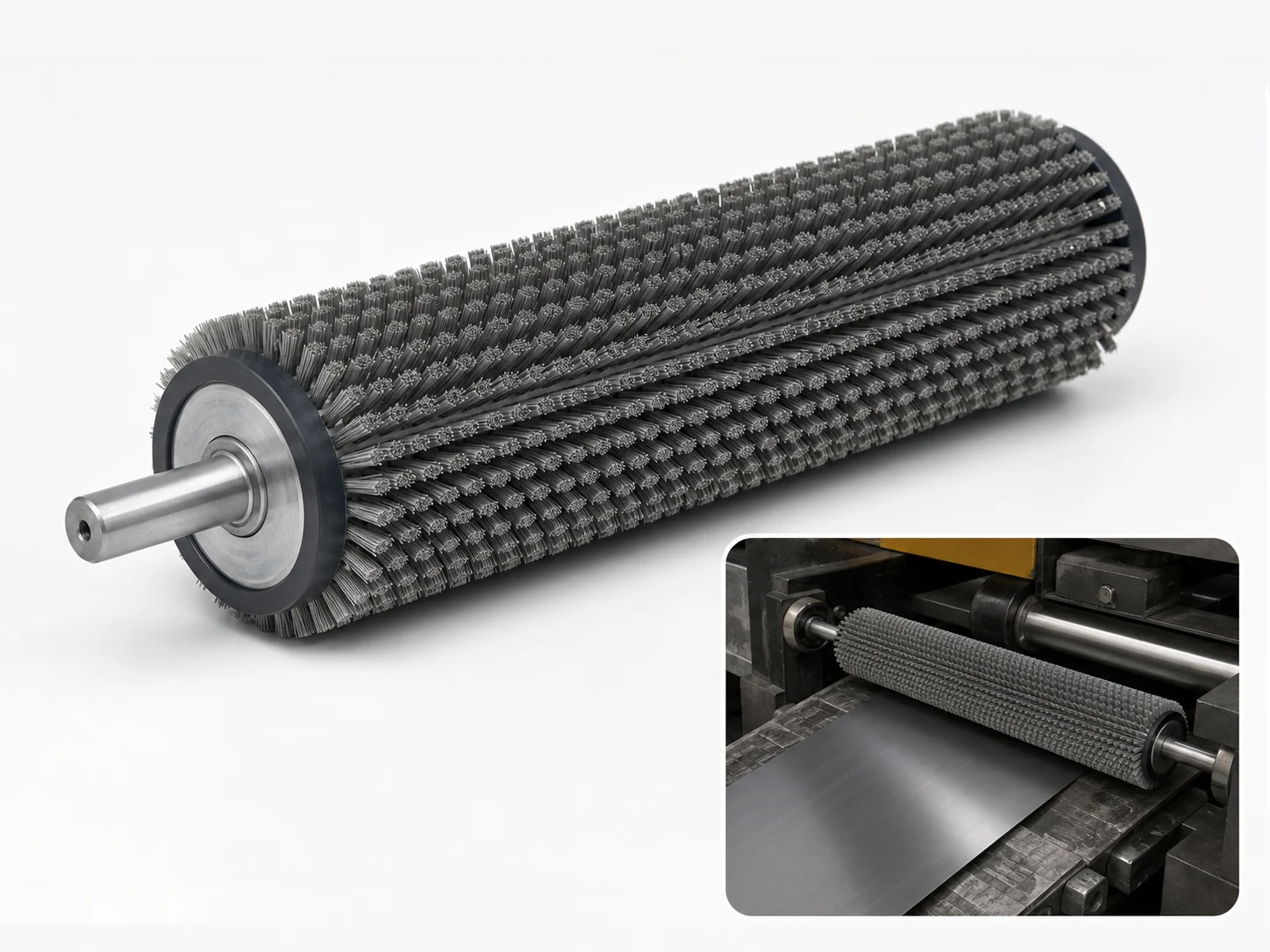
Large-format brush
100 pcs
Minimum order
Built one at a time on a core or channel: full-width rollers, sweeper brooms and long strip.
Production lead time, once the specification is confirmed
- Up to 100 pcsWithin 20 days
- 101–1,000 pcsWithin 30 days
- Over 1,000 pcsConfirmed with your quotation
Peak season can extend these times; the shipping date is confirmed in writing with your quotation. Sampling and shipping are quoted separately.
A driven, wire-filled cylindrical roller brush for continuous removal of carryback, fibers, chips, oil, labels, film fragments, and other line debris from conveyor belts, rollers, rails, transfer points, and web paths. Available with steel, stainless steel, or brass wire fill, working lengths to 3000 mm, and machine-specific cores and shaft ends.
What can this brush do for you?
Keeps the line running while residue is removed
Because the brush is a driven cylinder mounted across the full working width, it cleans continuously while the conveyor, roller, or web stays in motion. Operators do not stop the line, reach in with hand tools, or remove rolls for manual scraping. The brush sweeps the moving surface on every cycle, preventing light residue from building into a bonded layer that eventually forces an unplanned shutdown.
Wire tips reach into grooves, joints, and drum crowns
Formed wire filaments recover after deflection, so the brush follows the slight surface variations of embossed belts, chain links, rail joints, and crowned guide rolls. The fill maintains contact where flat scrapers or static wipers leave material behind in low spots. The result is more complete coverage across the width and fewer protected residue zones.
Removes the film layer other tools leave behind
Wire diameter and trim length control how aggressively the tip contacts the surface. Fine wire removes oil films, label fragments, adhesive residue, and thin carryback without deep scratching. Heavier wire breaks up compacted powder, fiber buildup, and sticky deposits on tough industrial surfaces. One roller design can target the exact residue layer instead of treating every line the same.
Material-matched fill prevents contamination of the line
Stainless steel wire avoids rust particles that can stain product or damage sensitive surfaces. Brass wire is softer and suited to applications where sparking is to be avoided or where the brush contacts aluminum, copper, or coated machine parts. Carbon steel wire gives long service life in general industrial cleaning. Choosing the fill material from the environment keeps the brush from becoming a second source of contamination.
Built for continuous wet, oily, or dusty duty
The core can be specified as steel, stainless steel, or coated construction, and the wire fill is anchored into a rotating cylinder designed for machine mounting rather than hand use. In washdown, oil-mist, or high-fiber environments, the brush holds its balance and fill integrity far longer than improvised brushes mounted on hand tools.
What is a Steel Wire Roller Brush?
A Steel Wire Roller Brush is a machine-mounted, rotating cylindrical brush in which steel, stainless steel, or brass wire filaments are anchored around a central core. It is not a hand-held wire brush, a cup brush for an angle grinder, or a twisted wire tube brush. It is a production-line component: the core fits a through-shaft, keyed hub, or end journals, and the brush is driven by the line or by its own motor so the wire tips sweep the surface continuously.
On a typical installation, the brush is positioned above, below, or alongside the moving belt, roller, chain, or web. The wire fill contacts the surface at a controlled engagement depth and rotates either with or against material travel to loosen and clear debris. The brush normally works with a scraper, washdown, vacuum, or air blow-off to remove debris after it has been dislodged. It is part of a cleaning arrangement, not a complete cleaning system on its own.
The useful operating range for a wire roller brush depends on contact surface hardness, residue type, wire material and diameter, brush speed, and engagement depth. On soft, polished, or contamination-sensitive surfaces, a nylon or abrasive-filled roller brush may be the safer alternative. On very heavy carryback, a mechanical scraper should handle the bulk before the wire brush does finish cleaning.
Technical Specifications
The table below shows the standard build envelope. Because every machine has its own mounting and contact geometry, the final configuration is confirmed from your line drawings or sample machine measurements.
| Parameter | Value / Options |
|---|---|
| Brush form | Wire-filled cylindrical roller brush; straight, staggered, or spiral fill pattern |
| Working length (face length) | 100–3000 mm, matched to belt or web width |
| Brush outside diameter | 60–300 mm, selected from roll gap, contact arc, and tip speed |
| Core outside diameter | 25–150 mm, sized for shaft stiffness and fill retention |
| Wire diameter | 0.10–0.60 mm; finer wire for light film and sensitive surfaces, coarser wire for heavy debris |
| Wire material | Carbon steel, 304 stainless steel, 316 stainless steel, or brass; selected by surface and contamination limits |
| Trim length / radial fill | Determined by brush OD minus core OD; shorter trim for controlled stiffness, longer trim for greater reach |
| Fill density and pattern | Straight rows, staggered, or continuous spiral winding; pitch and density set to residue and operating speed |
| Shaft / journal | Through-shaft, keyed hub, weld-on flange, or end journals; machined to match existing pillow blocks or drive coupling |
| Rotation / drive | Configured for customer direction and speed; balance and fill pattern rated for continuous rotation |
| Operating environment | Dry, wet, oily, washdown, or dusty; material grades selected for exposure |
| Brush type | Custom Roller and Conveyor Brushes |
| How it is driven | Machine-driven, mounted in the equipment |
| Cleaning target | conveyor belt return side, roller, drum and chain guide, and rail and web path cleaning |
| Surface or part | roller, belts, webs, rails, chains, conveyors, web paths, rolls, and carbon steel |
| Residue or debris | fiber, oil, film fragments, chips, powder, adhesive, labels, loose fibers, and carbon |
| Mounting / connection | Configured for customer direction and speed; balance and fill pattern rated for continuous rotation |
Where does this brush work best?
- Return-belt and conveyor cleaning: removes carryback from belt undersides and return idlers in food, packaging, aggregate, and material handling lines.
- Roller and drum cleaning: removes fibers, adhesive film, and dust from embossing rolls, guide rolls, idler rolls, and cooling drums in converting, printing, coating, and laminating processes.
- Chain and rail cleaning: cleans product return chains, oven chains, machining-center guide rails, and transfer rails where powder, chips, oil, and sticky deposits accumulate in link recesses.
- Transfer and infeed/outfeed points: sweeps crumbs, fragments, and fines from dead plates, transfer belts, and loading zones before they fall into downstream equipment.
- Web path cleaning: pre-clears moving web before coating, lamination, inspection, or printing; removes loose fiber and film fragments that would create defects.
How do I choose the right one?
Start from the machine interface, not the brush alone. Confirm the full width of the belt, roller, or web that must be cleaned, the available mounting points, shaft diameters, bearing centers, and drive coupling. The working length must cover at least the contact path, and the core must be stiff enough at that span to prevent bowing under engagement pressure. Long spans above roughly 1500 mm often need a larger core or a center support.
Match the wire material to the substrate and contamination limits.
| Wire material | When to choose it | Points to watch |
|---|---|---|
| Carbon steel | General steel or iron machine parts, dry and non-corrosive environments, heavy carryback | Can rust and shed rust particles; not for stainless or hygienic equipment |
| 304 stainless steel | Washdown, food, pharmaceutical, or damp lines; rust-free operation on stainless machinery | Softer and less abrasive than carbon steel; verify compatibility with cleaning chemicals |
| 316 stainless steel | More aggressive washdown chemistry, chlorides, marine or corrosive environments | Higher material cost; reserve for actual corrosion exposure |
| Brass | Soft, coated, or aluminum surfaces; sparking is to be avoided; light residue | Wears faster on abrasive residues; may leave brass particles |
Choose wire diameter by residue depth and surface hardness. Wire diameter has more influence on aggression than fill density. Fine wire, about 0.10–0.25 mm, suits thin films, label fragments, light oil, and soft or coated surfaces. Medium diameter, about 0.25–0.40 mm, handles general powder, fiber, and soft carryback on standard industrial surfaces. Coarse wire, about 0.40–0.60 mm, is reserved for hardened machine parts and compacted or baked-on deposits. Coarse wire on a soft surface will score or gall the material.
Balance brush OD, trim length, and core stiffness. A brush with the same outside diameter but a smaller core has longer wire trim, which bends more and reaches into grooves but applies less force. A larger core with shorter trim acts stiffer and is better for hard deposits. For irregular surfaces and chain recesses, choose longer trim. For flat hardened belts and high-force removal, choose shorter trim and a larger core.
Check speed, rotation direction, and engagement depth. The brush must rotate in the direction that the cleaning task requires. Running against material travel lifts and clears debris; running with material travel compresses and polishes the surface. Tip speed changes wire behavior: too fast causes wire fatigue and early breakage; too slow fails to clear the residue. Start with light tip engagement and increase only until residue clears, because over-engagement shortens wire life and can damage the substrate.
When to select another product. Choose a nylon or abrasive-filled roller brush when the surface is coated, polished, soft plastic, or cannot tolerate metal particle risk. Choose a scraper or doctor blade ahead of the brush when the residue is thick, wet, or heavy enough to clog the wire fill. For isolated, non-continuous hand cleaning, a hand-held or powered cup wire brush may be more practical than adding a line-mounted roller.
Can I customize this brush?
Wire roller brushes are built to the machine, not selected from a fixed catalog. To prepare a project, provide the cleaned surface material and finish, full working width, roll or belt diameter, available mounting and shaft centers, drive method and speed, rotation direction, residue description and thickness, washdown or chemical exposure, and acceptable contact pressure. A photo or drawing of the existing roll or belt path shortens the layout work.
We can adjust:
- Working length, brush outside diameter, core outside diameter, and trim length
- Wire material, wire diameter, and packing pattern such as straight, staggered, or spiral winding
- Fill density and multi-section zones for different residue across the working width
- Shaft ends: bare core, through-shaft with journals, keyed hub, flanged connection, taper-lock, or customer-specific coupling
- End treatment: filled ends, open ends, end discs, or wear plates
- Core and end cap construction in steel, stainless steel, or coated material
- Marking: engraved or stamped roll ID, color coding, or barcode label
- Packaging: bulk pallet, individual box, export crate, or project-specific packing
If your project requires material documentation, inspection support, or third-party testing against your own specifications, we can assist with those requirements during the customization process.
Which filament lasts longest on a steel wire roller brush?
How do I know if engagement depth is set too high?
Start with the brush just touching the surface, then increase depth until the residue clears without visible heat, discoloring, or heavy sparking. If wire tips are permanently bent after a short run, or the fill begins to throw broken wires, reduce depth or move to a thicker wire diameter. A small increase in engagement often solves removal; excessive depth only shortens the brush life.
Can a wire roller brush run in both directions?
Most wire roller brush designs allow either rotation direction, but the same brush will clean differently in each direction. Running against material travel lifts and clears residue; running with the material compresses and polishes the surface. If the line requires reverse-run cleaning or brush self-cleaning cycles, specify the desired direction before the fill pattern is set so the spiral twist supports rather than fights the rotation.
How do I inspect a wire roller brush for replacement?
Measure brush outside diameter at both ends and the center. Look for flat spots, missing wire sections, clumped fill, core runout, or worn journals. If product debris has embedded between wires at the base, clean the brush and inspect again. If wire continues to break in the same region, alignment or engagement is likely wrong, not just wire wear. Replace the brush when the working diameter falls below the project-specified limit or when residue remains after correct engagement settings are restored.
Will fine wire remove heavy oil or grease?
Fine wire removes thin and uneven films but will clog in heavy wet grease and may smear rather than carry the material away. For heavy oil or grease, combine a scraper or air blast upstream with a coarser stainless steel wire diameter. Otherwise, the brush may polish the residue into the surface. After one pass, wipe the surface to check whether residue remains; if it does, adjust wire diameter, speed, or the pre-cleaning step.
What is the difference between spiral wound and straight fill on the same roller?
Straight row fill gives uniform density and is often used on shorter working faces. Spiral winding provides a continuous helical contact line that can reduce vibration and noise on wide rollers and helps debris move toward one or both ends. The choice depends on line speed, residue type, and width. For most wide conveyor and web applications, spiral fill is the starting point when operator noise and even wear matter.
Does adding more wire density always make the brush more aggressive?
Not necessarily. Higher density can increase the number of contact points and improve cleaning uniformity, but if the density is too high, the wire cannot flex and residue cannot release, causing loading and heat. Aggression comes mainly from wire diameter, trim length, engagement depth, and speed. Begin with the recommended density for the residue, then adjust engagement before requesting more fill.
Guides that go deeper on this
How to Choose Steel Wire Brush Roller
Read this guideGuideWire Roller Brush: Specs for Drill and Grinder Mounting
Read this guideGuideWire Roller Brush: Specs for Weld Cleanup
Read this guideGuideAbrasive Nylon Grit and Filament Selection
Read this guideGuideBrush Roller Conveyor Mistakes with Dry Dust
Read this guideGuideBrush Speed, Engagement, and Heat
Read this guideGuideStainless Steel vs Carbon Steel vs Brass Brush Wire
Read this guideCustom Manufacturing RFQ
Describe Your Application
Please include the main sizes, application, residue, preferred material, interface, quantity, and any drawing or sample available.
Drawing or photo optional — it speeds things up, it does not gate the enquiry.
Custom Brush RFQ
Send Your Brush Project
Upload a drawing, product photo, or sample photo and provide the core dimensions and cleaning conditions.
“We need a brush to remove wet residue from a stainless steel conveyor, about 800mm wide. The current brush wears quickly. We can send photos.”
“We sell drinkware and need a cleaning brush to include with the product. Quantity around 5,000 pieces.”