
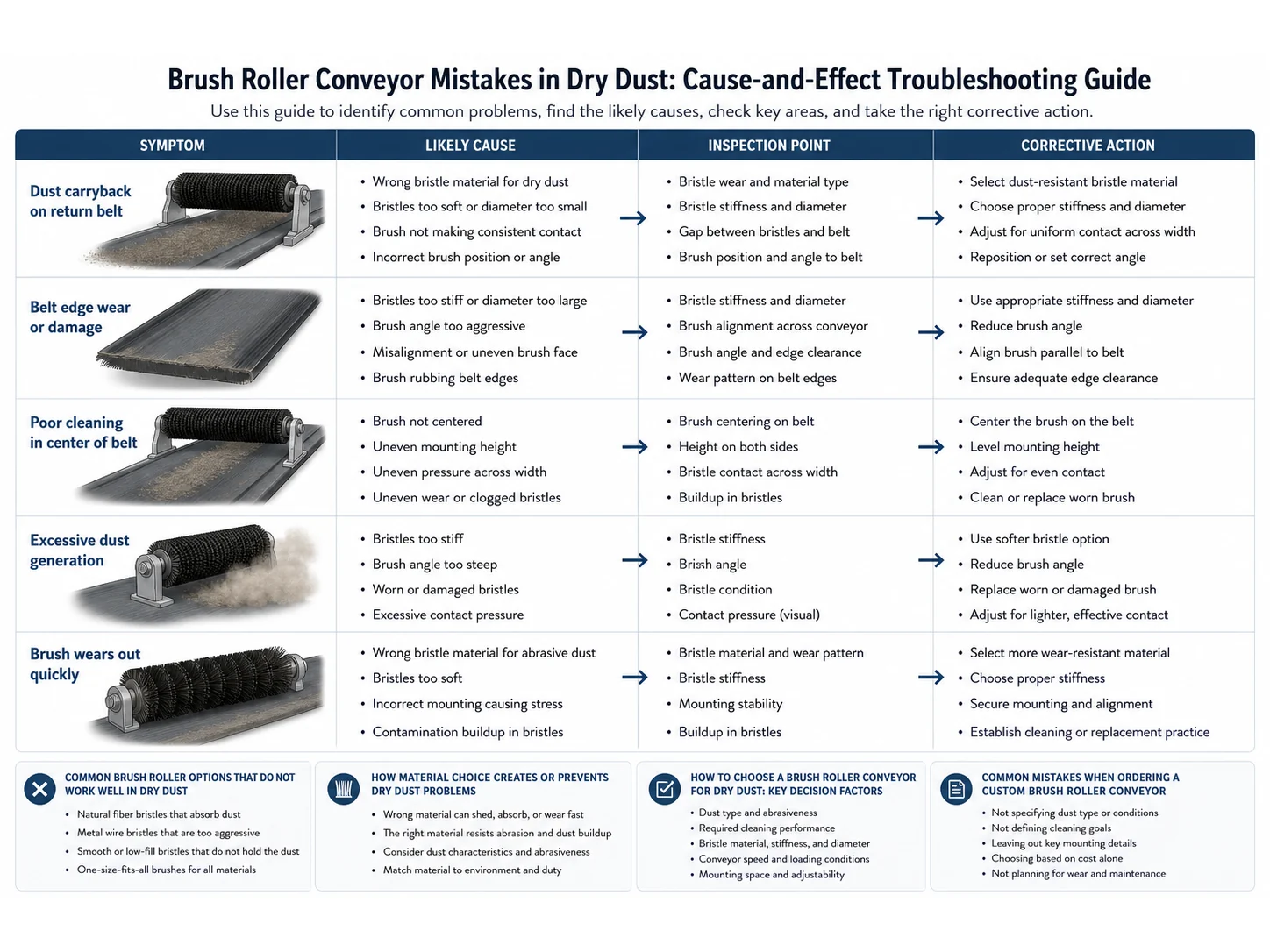
What Is a Brush Roller Conveyor in a Dry Dust Application?
A brush roller conveyor is not a separate conveyor type but a cleaning component that integrates with an existing conveyor system. Its purpose is to dislodge fine, dry particles that adhere to belt or product surfaces. In dry dust settings, the brush must agitate without generating excessive static, pack the dust into the bristles, or create airborne clouds that bypass the cleaning zone.
Common Brush Roller Options That Do Not Work Well in Dry Dust
Not all brush materials, diameters, or mounting configurations suit dry dust. Selecting the wrong combination often leads to rapid bristle wear, dust accumulation, or damage to the belt. The table below summarizes the most frequent mistakes and how to avoid them.
| Feature | Common Mistake | Recommended for Dry Dust | Why It Matters |
|---|---|---|---|
| Filament Material | Standard nylon without anti-static treatment | Conductive polypropylene or static-dissipative nylon | Prevents static charge that traps fine dust on bristles and increases cleaning frequency |
| Bristle Stiffness | Ultra-soft bristles for delicate surfaces | Medium stiffness (unless the surface is extremely fragile) | Provides enough agitation to dislodge dry particles without scuffing the belt |
| Bristle Diameter | Very fine bristles for improved contact | Coarser bristle or wider spacing | Reduces clumping and allows dust to fall through rather than accumulating in the brush |
| Core Material | Wooden core for cost savings | Aluminum or engineered plastic core | Resists moisture absorption and swelling that affect balance, bearing life, and brush alignment |
| Mounting Bracket | Fixed bracket with no adjustment | Adjustable bracket with spring or pneumatic tension | Maintains consistent contact as bristles wear, preventing gaps that let dust pass uncleaned |
How Material Choice Creates or Prevents Dry Dust Problems
Filament material controls how the brush interacts with both the dust and the surface. Standard nylon can absorb ambient humidity, becoming slightly sticky and attracting fine dust. In very dry environments, nylon may also generate static. A common mistake is ignoring the static dissipation requirement. Polypropylene filaments are naturally hydrophobic and lower in static generation, making them a better starting point for many dry dust applications. For explosion-risk atmospheres, conductive or anti-static filaments are mandatory—not optional.
Wrong Bristle Stiffness and Diameter Prevent Effective Cleaning
Bristle stiffness must be matched to the type of dust. Soft bristles may simply glide over caked-on dust without dislodging it. Excessively stiff bristles can scratch the belt or product surface, creating damage that traps more dust later. In dry dust, a medium stiffness often works, but testing on the actual residue is the only way to be sure. Bristle diameter matters too: thin bristles flex into small surface textures but can clump together when loaded with dust; thick bristles resist clumping but may miss fine particle removal. A mistake is specifying a bristle diameter based only on cleaning aggressiveness without considering dust characteristics.
Mounting and Adjustment Mistakes That Reduce Brush Effectiveness in Dry Dust
Even the best brush will fail if it is installed incorrectly. In dry dust applications, three mounting mistakes appear repeatedly:
- Fixed position with no wear compensation: Dry dust is abrasive and wears bristles faster than many users expect. Without an adjustable bracket or spring tensioner, the brush quickly loses contact with the surface.
- Incorrect brush rotation direction: The brush should typically rotate against the belt or product direction to lift dust away. Rotating with the direction can simply push dust along without removal.
- Misalignment to the belt or product flow: A brush angled incorrectly might clean only one side or create uneven pressure that accelerates bristle wear on one edge.
How to Choose a Brush Roller Conveyor for Dry Dust: Key Decision Factors
Use these factors to evaluate options and avoid a mismatch:
- Residue type: Coarse, abrasive dust requires durable bristles; very fine, lightweight dust may need anti-static properties to prevent clinging.
- Surface sensitivity: A bare product surface tolerates different stiffness than a coated belt or delicate skin.
- Equipment interface: Confirm mounting dimensions, shaft size, and available clearance before ordering.
- Environment: Temperature extremes, chemical exposure, or washdown requirements limit material choices.
- Hygiene expectations: For food or pharmaceutical conveyors, brush materials must meet relevant hygiene standards and be easily cleanable.
- Maintenance access: If the brush is hard to reach, consider a design that allows quick change-out without removing the entire assembly.
- Custom size needs: Standard length brushes may not cover the full belt width, leaving edges uncleaned. Always specify the exact cleaning face width required.
Common Mistakes When Ordering a Custom Brush Roller Conveyor
When requesting a quote for a custom brush roller conveyor, these details are often missed:
- Ordering by overall length without specifying the brush face width (the part that actually cleans).
- Forgetting to state the core material or shaft end details (keyway, threads, plain ends) that affect coupling.
- Not providing belt width, conveyor speed, and product clearance—making it impossible for the supplier to recommend the right diameter and bristle density.
- Assuming a standard bristle pattern works for all dust types. Fine dust may need staggered or spiral patterns to prevent tracking lines on the belt.
- Neglecting to mention ambient conditions such as temperature (which can soften or embrittle filaments) or washdown chemicals.
A thorough RFQ should include a simple sketch with mounting centers, belt width, direction of travel, and the type of residue to be removed. This one step prevents most interface errors.
When a Brush Roller Conveyor Is the Wrong Choice in a Dry Dust Environment
A brush roller conveyor can handle many dry dust challenges, but it has clear boundaries:
- Extremely fine, airborne dust: The brush’s rotation can create local air currents that keep fine dust suspended. In these cases, a vacuum extraction hood combined with the brush is often necessary.
- Sticky or oily residues: A brush may smear such residues rather than remove them, leading to faster buildup. A scraper or a combination of scraper and brush could be more effective.
- High-temperature applications (above the filament’s rated range): Always check the filament’s temperature rating. Using the wrong material will cause melting, softening, or brittleness.
- Explosion-prone atmospheres without a certified conductive brush: A standard brush can generate enough static to be a hazard. ATEX or similar certification may be required.
If any of these conditions apply, request a sample brush for on-site testing or a detailed engineering review from the supplier before committing to a full order.
Final Takeaway on Avoiding Dry Dust Brush Roller Mistakes
The most expensive mistakes in brush roller conveyor applications are avoidable with a methodical approach: characterize your dust and surface, choose the filament material for the real operating environment, demand an adjustable mounting that compensates for wear, and always share a dimensional sketch with your supplier. A brush roller conveyor that works excellently in a wet washdown line will likely fail in a dry dust application—and vice versa. Treat brush selection as an application-specific engineering decision, not a commodity purchase.
Frequently Asked Questions
Can a brush roller conveyor replace a belt scraper in dry dust?
Not entirely. A brush roller conveyor excels at removing loose, dry dust from irregular surfaces or product, while a belt scraper is better for wet, sticky residues. In many dry dust applications, a brush is used before or after a scraper to capture what the scraper misses. Evaluate your specific residue before replacing one with the other.
How often should I adjust the brush roller conveyor in a high-dust environment?
In high-dust, abrasive conditions, check bristle wear weekly during the first month. Once you understand the wear rate, set a preventive adjustment schedule. A spring-loaded mounting often reduces the need for manual adjustment by maintaining constant pressure automatically.
Does bristle diameter affect how much dust becomes airborne?
Yes. Finer bristles can whip and create more local turbulence, causing dust to become airborne rather than falling into a collection tray. Coarser bristles with wider spacing tend to knock dust off with less air disturbance. Pair the brush with a containment hood if airborne dust is a safety or cleanliness issue.
Can I use a brush roller conveyor on an incline?
Yes, but the brush rotation direction and mounting angle must be carefully set to avoid pushing material backward or causing uneven wear. Gravity can cause dust to slide differently, so tests on the actual incline are strongly recommended before finalizing the design.
What is the best way to clean a brush roller conveyor itself?
Periodic cleaning prevents dust packing that alters bristle stiffness. For dry dust, compressed air (with appropriate safety precautions) can blow out the bristles. For washdown environments, a quick rinse with water or approved cleaning solution may be used—if the core and bearings are rated for it. Always follow the brush supplier’s cleaning recommendations.
Should I choose a spiral-wound or solid hub brush roller conveyor?
Spiral-wound brushes offer flexibility in bristle pattern and are easier to customize for odd lengths. Solid hub brushes provide better bristle density and are more robust for heavy-duty cleaning. For dry dust that is coarse and abrasive, a solid hub often lasts longer. For light, fine dust, a spiral-wound brush can be sufficient and easier to clean.
How do I know when my brush roller conveyor needs replacement?
Replace the brush or the bristle refill when the bristle length wears down to about 50% of its original length, or when cleaning effectiveness visibly drops. Running a brush with severely worn bristles can damage the belt or product surface and increase the motor load without improving cleaning.
Technical References
- OSHA — Machine Guarding
- OSHA — Control of Hazardous Energy
- OSHA — Combustible Dust
- EPA — Particulate Matter Basics
Which nylon grade fits this job — Nylon PA, PA6 Nylon or PA66 Nylon?
| Grade | Continuous temperature (°C) | Peak temperature (°C) | Water absorption | Hardness |
|---|---|---|---|---|
| Nylon PA | 93 | 121 | 0.3–9% by PA grade and conditioning | Medium to firm; filament diameter and trim length control bending force. |
| PA6 Nylon | 80–100 | 130–160 | 1.5–3.0% | Shore D 75–85 |
| PA66 Nylon | 100–120 | 150–180 | 1.0–1.8% | Shore D 80–88 |
| PA610 Nylon | 90–110 | 130–150 | 0.5–1.0% | Shore D 72–82 |
| PA612 Nylon | 90–110 | 130–150 | 0.3–0.7% | Shore D 70–80 |
Figures as published by Brushtec / DuPont. Confirm the exact grade against the supplier datasheet before ordering.
What should replace Roller and Conveyor Brushes when they stop working?
- Roller and Conveyor Brushes — Roller and conveyor brushes hold cylindrical line contact across a working width, including helix-wound builds where the filament path is set to move loosened material toward one side; a strip brush holds the same line without rotating, so it seals or wipes but cannot carry residue along the width.
- Nylon PA — Compare Nylon PA with PP, PBT, PET. Change material when wet stiffness, temperature, chemical resistance, conductivity, particle shedding, or surface marking becomes the limiting factor.
- Polypropylene PP — Compare Polypropylene PP with Nylon, PBT, PET. Change material when wet stiffness, temperature, chemical resistance, conductivity, particle shedding, or surface marking becomes the limiting factor.