
Application
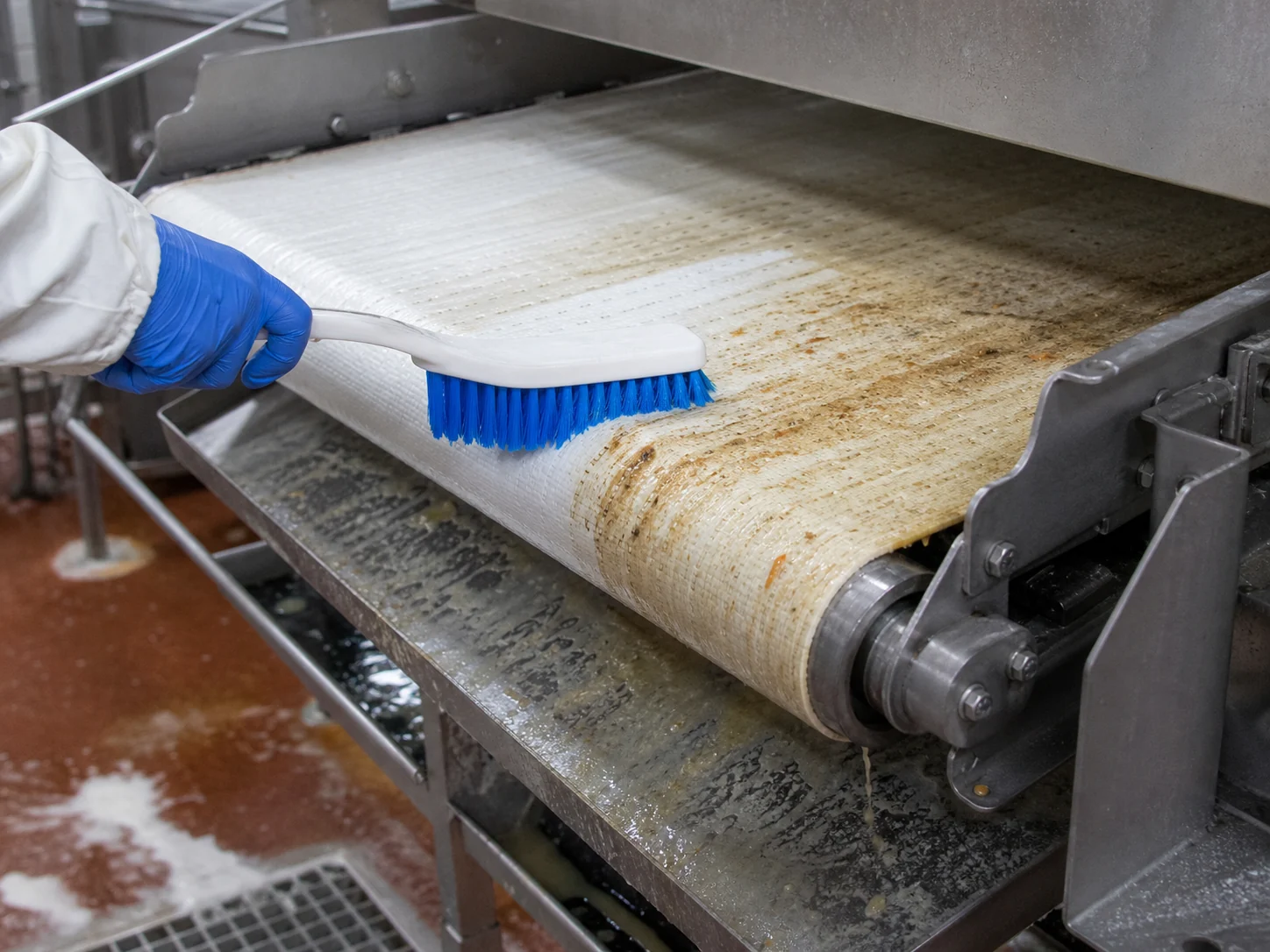
Food Conveyor Grease Cleaning
For Food Conveyor Grease Cleaning, the brush must reach the working area, disturb or collect grease/protein residue/adhered residue, and release it without creating unacceptable surface damage or process interference. Choose the brush structure from the available access, contact direction, and cleaning process.
At a glance
- Cleaning target
- Grease/Protein Residue/Adhered Residue
- Working environment
- Wet Indoor Area
- Cleaning method
- Wet Brushing / Soaking / Steam Cleaning
- Requirements to check
- FDA 21 CFR; EU 10/2011; HACCP; Material-Migration and Traceability Requirements
Grease on a food belt migrates into hinge gaps, cleats and sidewalls, so cleaning has to reach inside the belt’s construction rather than wipe across its running surface.
What makes Food Conveyor Grease Cleaning different from other food and beverage cleaning?
The task is to remove Grease/Protein Residue/Adhered Residue while controlling surface damage, residue carryover, brush shedding and chemical or temperature degradation.
The work happens in wet indoor area against grease, protein residue and adhered residue.
The part people get wrong: the surface, the residue and the access opening decide the brush together. Fix on any one of them alone and the geometry comes out wrong.
What are the most common cleaning targets in Food Conveyor Grease Cleaning?
The work breaks into 5 targets. They look similar from outside the machine and behave nothing alike at the brush.
| Part or area | Residue type | Cleaning requirement |
|---|---|---|
| Flat Food Belt Grease | Grease, Protein Residue, Adhered Residue | The brush must span the working width and hold even contact along the whole face while the surface moves under it. |
| Modular Belt Hinge | ||
| Wire-Mesh Oven Belt | The tips must enter the apertures far enough to push lodged material back out, without wedging in the openings. | |
| Sidewall and Cleat | The head must reach the working face and apply even contact without marking the surface. | |
| High-Care Zone Conveyor | The brush must span the working width and hold even contact along the whole face while the surface moves under it. |
What the equipment leaves you to work inside:
| Parameter | Typical range |
|---|---|
| Contaminant | Grease/Protein Residue/Adhered Residue |
| Required hardness | Medium–Hard |
| Maximum temperature | 100°C |
| Chemical exposure | Alkaline Cleaning Solution pH 9–13; Hot Water |
| Cleaning method | Wet Brushing/Soaking/Steam Cleaning |
| Environment | Wet Indoor Area |
Which brush types work for each cleaning target?
Select hand, tube, strip, roller, disc or machine-mounted geometry from access and motion.
| Cleaning target | Recommended brush type | Why it fits |
|---|---|---|
| Flat Food Belt Grease | Roller and Conveyor Brushes | A grease film is thin and even, so a full-width brush on a driven shaft shears it off continuously where a scraper only polishes it. |
| Modular Belt Hinge | Grease and protein collect in the hinge barrels, so a brush whose filament drops into the hinge line clears them and a flat blade cannot. | |
| Wire-Mesh Oven Belt | An oven mesh is open weave with baked grease on every wire, so the brush is sized for its tips to pass into the openings and wrap each wire. | |
| Sidewall and Cleat | Handheld Detail Brushes | Sidewalls and cleats stand off the belt plane, so a hand-guided head is what reaches their faces and the corner where they meet the belt. |
| High-Care Zone Conveyor | Roller and Conveyor Brushes | In a high-care zone the belt has to be clean at handover, so the brush works in-process and its own construction has to be strippable and inspectable. |
Four of the five are bore work on a rod or flexible shaft, done by hand inside the wash-down window; only the belt underside is brushed in the open.
In practical brush terms: match the construction to the access before anything else. A geometry that cannot reach the target will not be rescued by a better filament.
What filament materials work best for Food Conveyor Grease Cleaning?
PBT holds its stiffness through hot alkaline washdown, PA66 gives the harder fill for baked-on grease, and food-grade silicone is used where a blade or wiper edge has to sit against the belt.
| If the condition is… | Filament to start with | Why |
|---|---|---|
| Hot alkaline washdown at pH 9–13 | PBT | keeps its stiffness wet and hot, where nylon softens |
| Baked-on grease and protein | PA66 Nylon | harder fill that breaks a bonded film |
| Wiping or sealing edge against the belt | Silicone | food-grade contact edge that will not shed filament |
What the duty rules out before you start comparing grades:
| Constraint | Value for this application |
|---|---|
| Filament hardness | Medium–Hard |
| Maximum service temperature | 100°C |
| Chemical exposure | Alkaline Cleaning Solution pH 9–13; Hot Water |
| Cleaning method | Wet Brushing, Soaking, Steam Cleaning |
How do I choose the right brush for my food conveyor grease equipment?
Start with medium-to-hard fill, a 100°C ceiling and an alkaline solution at pH 9–13, then size the head to the hinge gap and the cleat height.
The sequence that gets a usable sample first time:
- Identify the target part and measure the access opening or clearance
- Describe the residue: what it is, how thick it sits, and how strongly it holds
- Choose the construction that can physically reach that target
- Set the filament from surface risk, working temperature and cleaning chemistry
- Fix filament diameter, free trim length and density for the contact pressure you need
- Run one cycle and check the result before committing to a production quantity
Before you commit to a quantity, send the belt width and construction, the hinge gap, the cleat height, and the wash chemistry.
When is a food conveyor grease brush the wrong tool?
Hot caustic foam with dwell time emulsifies grease that no brush lifts cold, and it penetrates hinge gaps the fill cannot enter. Brushing follows the chemistry here; it does not replace it.
What common mistakes should I avoid in Food Conveyor Grease Cleaning?
- Giving belt width without the hinge gap and cleat height the fill has to enter
- Changing the filament while leaving excessive engagement, poor alignment or no discharge path unchanged
- Copying a worn brush without first recording its motion, direction, mounting and original working diameter
If the brush is already in service and the result is wrong, work from the symptom:
| Symptom | What to change |
|---|---|
| Residue remains | Increase discharge or relative motion before adding pressure |
| Surface marks | Reduce engagement and use finer/softer fill |
| Rapid wear | Check alignment, temperature and chemical attack |
| Redeposition | Add wash, vacuum or collection path |
Questions this page is asked
How is a brush qualified for food-conveyor sanitation work?
Document every food-contact component and its conditions of use, then assess the assembled tool for cleanable joints, secure fill, chemical and temperature compatibility, identifiable segregation and low foreign-material risk. Trial the full clean-rinse-dry cycle and reject a design that retains grease, liquid or filament fragments where inspection cannot reach.
What releases a food conveyor after grease brushing?
Complete the site's defined sequence for soil removal, detergent contact, rinse, sanitizing where required, drainage and reassembly, including guards and hidden belt features. Inspect for residue, damaged belt or brush material and use the plant's established verification and records before production; a visual check by itself should not replace the validated sanitation program.
Guides that go deeper on this
No catalogue item for this yet
Every brush here is made to order, and this one has no catalogue entry so far. Send the working surface, the residue, the access opening and the quantity, and it is quoted through the same specification route as the rest of the range.
Custom Manufacturing RFQ
Discuss This Application
Share the working surface, residue, dimensions, material direction, interface, quantity and drawing or sample photo.
Custom Brush RFQ
Request a Custom Cleaning Brush Quote
Upload a drawing, product photo, or sample photo and provide the core dimensions and cleaning conditions.
“We need a brush to remove wet residue from a stainless steel conveyor, about 800mm wide. The current brush wears quickly. We can send photos.”
“We sell drinkware and need a cleaning brush to include with the product. Quantity around 5,000 pieces.”