
Custom Cleaning Brush
Wire Tube Brush
Custom wire tube brush with brass, stainless, or carbon steel fill for bores, tubes and ports. Diameter 3-100 mm, section 20-150 mm, hand or powered use.
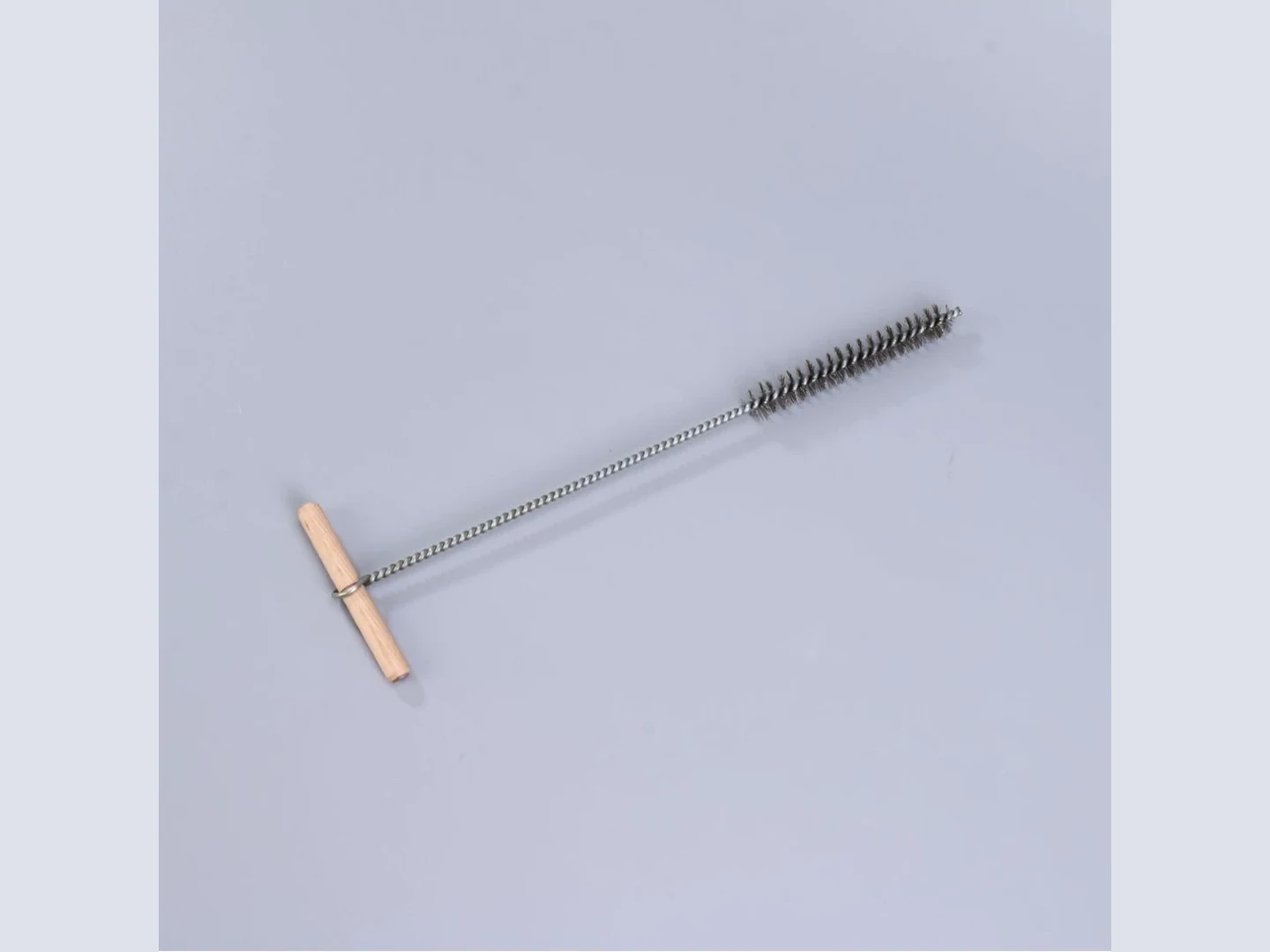
Small brush
500 pcs
Minimum order
Held in one hand: tube, bottle, detail and swab brushes — including long-handled ones with a small head.
Production lead time, once the specification is confirmed
- Up to 500 pcsWithin 7 days
- 501–50,000 pcsWithin 14 days
- Over 50,000 pcsWithin 21 days
Peak season can extend these times; the shipping date is confirmed in writing with your quotation. Sampling and shipping are quoted separately.
A twisted-in-wire tube brush with radial metal wire fill for cleaning internal bores, tubes, ports, and passages. The brush removes chips, oil, coolant, scale, rust, carbon, and powder deposits from internal walls, threads, blind holes, cross-drilled ports, and curved passages, and can be built as a handheld or power-driven tool in diameters from 3 to 100 mm.
What can this brush do for you?
Covers the full bore circumference in one pass
The wire fill radiates outward from a twisted wire stem, so the bristle tips contact the wall, corners, threads, and port edges around the full circle at once. When you rotate the brush inside a tube, each pass scrubs the complete internal surface instead of just one side.
Follows elbows, tapers, and blind-end bores
The stem can be formed or flexed to follow a bend, and the twisted-in fill stays anchored in the stem while the wire tips conform to changes in diameter. This lets the brush work through return bends, tapered seats, and blind holes without losing contact at the far end.
Releases chips and carbon instead of packing them in
Wire bristles flex under load and snap back as the brush rotates, which throws off loose chips, oil, and dry deposits. Reversing rotation direction between strokes clears the fill and keeps the brush cutting for the next pass.
Brass, stainless steel, or carbon steel wire for the base material
Brass fill cleans soft alloys, brass, copper, and aluminum without scouring the base metal. Stainless steel handles rust, scale, and carbon in wet or high-temperature service. Carbon steel offers aggressive removal on steel and iron at lower cost when rust transfer is not a concern.
Dimensioned to the passage, not an off-the-shelf compromise
Brush diameter, fill section length, overall length, wire gauge, density, and stem end are selected around the actual bore ID, depth, and drive method. A tube brush sized this way loads the tool lightly, runs without binding, and reaches the end of the passage without being too short.
What is a Wire Tube Brush?
A Wire Tube Brush is a cylindrical cleaning tool built by twisting steel wire around a central stem while capturing shorter wire fill strands that radiate outward. It is inserted into a bore, tube, or port and then rotated or stroked so the bristle tips scrub the internal surface.
During use, the stem transmits rotation or push force while the wire fill does the removal work. The fill reaches internal walls, threads, blind-hole bottoms, cross-hole edges, tapers, and curved sections that a solid brush cannot enter. The tool removes machining chips, oil and coolant residue, carbon, scale, rust, powder, and other process deposits.
The brush is normally selected around three measurements: the bore ID, the length of the cleaning zone, and the depth from the opening to the far end. Fill material is then matched to the base material and residue. A wire tube brush can be used by hand with a loop or handle, in a corded or cordless drill, or on production equipment when the stem is cut and gripped for a specific drive.
This is a mechanical cleaning tool. It is not a finishing hone, and it does not replace flushing, chemical cleaning, or final particle removal in applications where those steps are required.
Technical Specifications
The table lists the practical parameters we use to select or build a wire tube brush. Values shown are standard ranges; project-specific dimensions outside these ranges are often possible when the passage geometry supports them.
| Parameter | Value / Options |
|---|---|
| Brush diameter (OD) | 3–100 mm, selected to the bore ID; standard and custom sizes |
| Brush section length | 20–150 mm, adjusted to the cleaning zone |
| Overall length | 150–600 mm, matched to passage depth and drive method |
| Fill wire material | Brass wire, stainless steel wire, or carbon steel wire |
| Fill wire gauge | Typically 0.10–0.50 mm; thinner for fine bores, thicker for heavy deposits |
| Fill density | Standard, heavy, or extra-heavy, selected by residue loading |
| Stem / core | Twisted steel wire stem, galvanized carbon steel or stainless steel; loop or formed end available |
| Brush geometry | Straight, tapered, partially filled, double-diameter, or formed to tube profile |
| Drive interface | Bare shank for drill chuck, loop handle, fixed handle, hex shank, or other project-specified end |
| Rotation | Hand or powered; rotation direction and tool speed matched to brush diameter and stem construction |
| Brush type | Custom Tube & Pipe Bore Brushes |
| How it is driven | Hand-guided |
| Cleaning target | hydraulic cylinder, heat exchanger and boiler tube, and fuel system cleaning |
| Surface or part | tubes, bores, passages, ports, thread, blind holes, walls, and metal |
| Residue or debris | carbon, rust, oil, scale, chips, coolant, powder, and mineral deposits |
| Mounting / connection | Bare shank for drill chuck, loop handle, fixed handle, hex shank, or other project-specified end; Hand or powered; rotation direction and tool speed matched to brush diameter and stem construction |
For wet or elevated-temperature service, the stem and fill material are selected for the actual cleaning fluid, rinse, and operating temperature. Specify these conditions early so the brush is built for the process rather than only the tube dimensions.
Where does this brush work best?
- Hydraulic cylinders, manifolds, and valve bodies: cleans cross-drilled ports, internal galleries, threads, and blind holes where machining chips and oil residue remain after drilling or tapping.
- Heat exchanger and boiler tubes: removes scale, rust, and carbon from straight and U-bend tubes where the formed stem follows the return bend.
- Fuel system, nozzle, and injector bores: clears carbon and gum from small ports and seats without enlarging the bore when the correct wire gauge and diameter are used.
- Threaded pipe fittings and couplings: brushes pipe dope, rust, and scale out of internal threads before reassembly or sealing.
- Machine coolant and oil galleries: reaches long straight passages and blind galleries during scheduled service to remove sludge and fine chips.
- Mold cooling channels and spindle bores: removes mineral deposits, rust, and residue from internal water or oil passages in tooling and machine components.
How do I choose the right one?
Start with the bore ID and cleaning zone length
Measure the smallest internal diameter the brush must enter, including any opening smaller than the main bore. Brush diameter should contact the wall with light interference or a controlled clearance, not force its way through. The fill section length should cover the area that actually needs cleaning; too long adds drag, too short leaves uncleaned zones at the ends of the stroke.
Match fill wire to the base material and residue
Use the table below as a starting selection guide.
| Fill wire | Typical use |
|---|---|
| Brass wire | Brass, bronze, copper, aluminum, and soft alloys; removes deposits without aggressive base-metal removal and leaves no ferrous contamination |
| Stainless steel wire | Steel, stainless steel, and cast iron; removes rust, scale, and carbon in wet, washdown, or higher-temperature service |
| Carbon steel wire | Steel and iron bores only; fastest stock removal for heavy scale and rust at lower cost, but avoid on stainless, aluminum, or wet environments where corrosion or carbon transfer matters |
Choose hand or powered use
For powered cleaning, match the stem rotation to the twist direction. Most straight-stem tube brushes are right-hand twist and run clockwise. Running a brush dry at high speed can whip a long stem and scatter bristles; use the shortest stem that reaches the cleaning zone and control RPM as the brush OD increases.
Pick the right fill density and wire gauge
Coolant, oil, and loose chips clear well with standard fill. Carbon, scale, and rust respond to heavier fill and thicker wire. Fine bores and delicate base metals call for thinner wire and lower density so the bristle tips remove the deposit without raising the surface.
Know when to use a different brush
If the passage is too small for metal wire fill, use a nylon or abrasive nylon tube brush. If the internal surface is polished, plated, ceramic, or coated, metal wire may scratch or contaminate it; choose nylon or another soft-filament tube brush. If the deposit is a hard baked-on polymer, heavy machining burrs, or a coating that must be dimensionally controlled, pair the brush with a chemical pre-softener or switch to a machining/rework process rather than relying on brushing alone.
Can I customize this brush?
Wire tube brushes are rarely worth forcing into a stock size. We build the brush around the passage it must enter. To define a custom configuration, provide the bore ID, smallest opening ID, total depth, cleaning-zone length, bend radius if any, base material and surface condition, residue type, cleaning fluid, and whether the brush is hand-held or power-driven.
- Dimensions: brush OD, fill section length, overall length, and stem diameter can be set to any passage within the production range.
- Fill: brass, stainless steel, or carbon steel wire; wire gauge, density, trim length, and fill profile all adjustable.
- Stem and ends: galvanized or stainless steel stem, loop handle, fixed handle, hex shank, bare shank, or formed end for a specific drive.
- Geometry: straight, tapered, double-diameter, partially filled, or formed to a bent or curved tube profile.
- Color and marking: handle color, stem marking, or packaging identification for kit assembly or maintenance programs.
- Packaging: bulk, individual bag, kit, labeled pack, or project-specific packing configuration.
If your project requires material documentation, inspection records, or third-party testing support, we can assist during the customization process and build the specification package to your purchasing requirements.
Which filament survives the cleaning chemicals a wire tube brush meets?
How do I check whether the brush diameter fits my tube before full production?
Insert the dry brush into the target tube by hand. It should enter with light even resistance and recover from any contact without bending the stem. If it binds at the opening or requires significant force, the OD is too large. If it slides through without touching the wall, the OD is too small for reliable cleaning.
Can I use the same brush for both hand and powered cleaning?
Yes, if the stem end and length are set up for it. A bare shank can be gripped by hand or in a drill chuck. For hand use, a loop handle reduces strain on long or narrow bores. For powered use, confirm the max RPM for the brush diameter and keep the stem short enough to avoid whipping.
What should I do to keep wire bristles from breaking off in the tube?
Use the correct OD, avoid forcing the brush through stepped or undersized openings, and do not run it at excessive RPM. Reverse the rotation briefly to clear chips before withdrawing the brush. Replace the brush when the wire is flattened, the stem shows a kink, or the fill no longer rebounds after flexing.
Does brushing remove all residue from the bore?
No. Brushing loosens and removes attached deposits, but loosened particles must be flushed, blown out, or vacuumed before final assembly or use. On critical surfaces, a final solvent rinse, ultrasonic cleaning, or particle-count check may still be required depending on the cleanliness specification.
When should I choose brass wire instead of stainless steel or carbon steel?
Choose brass when the base metal is brass, bronze, copper, aluminum, or a soft alloy that a steel wire could score, or when ferrous contamination from bristle wear is unacceptable. Brass is the gentler wire option. It still removes carbon, gum, scale, and light rust, but it wears faster on hardened steel bores.
Can a wire tube brush clean a curved tube?
It depends on the bend radius. The stem can flex or be preformed for large-radius bends such as heat-exchanger U-tubes. A tight 90-degree elbow or a passage with a sharp step can kink the stem or prevent the fill from passing through. Send the bend drawing with the inquiry so we can confirm whether the stem can be formed to follow it.
Guides that go deeper on this
Custom Manufacturing RFQ
Describe Your Application
Send the key measurements, cleaning requirement, residue, material direction, mounting method, quantity, and drawing or photo.
Drawing or photo optional — it speeds things up, it does not gate the enquiry.
Custom Brush RFQ
Send Your Brush Project
Upload a drawing, product photo, or sample photo and provide the core dimensions and cleaning conditions.
“We need a brush to remove wet residue from a stainless steel conveyor, about 800mm wide. The current brush wears quickly. We can send photos.”
“We sell drinkware and need a cleaning brush to include with the product. Quantity around 5,000 pieces.”