
Custom Cleaning Brush
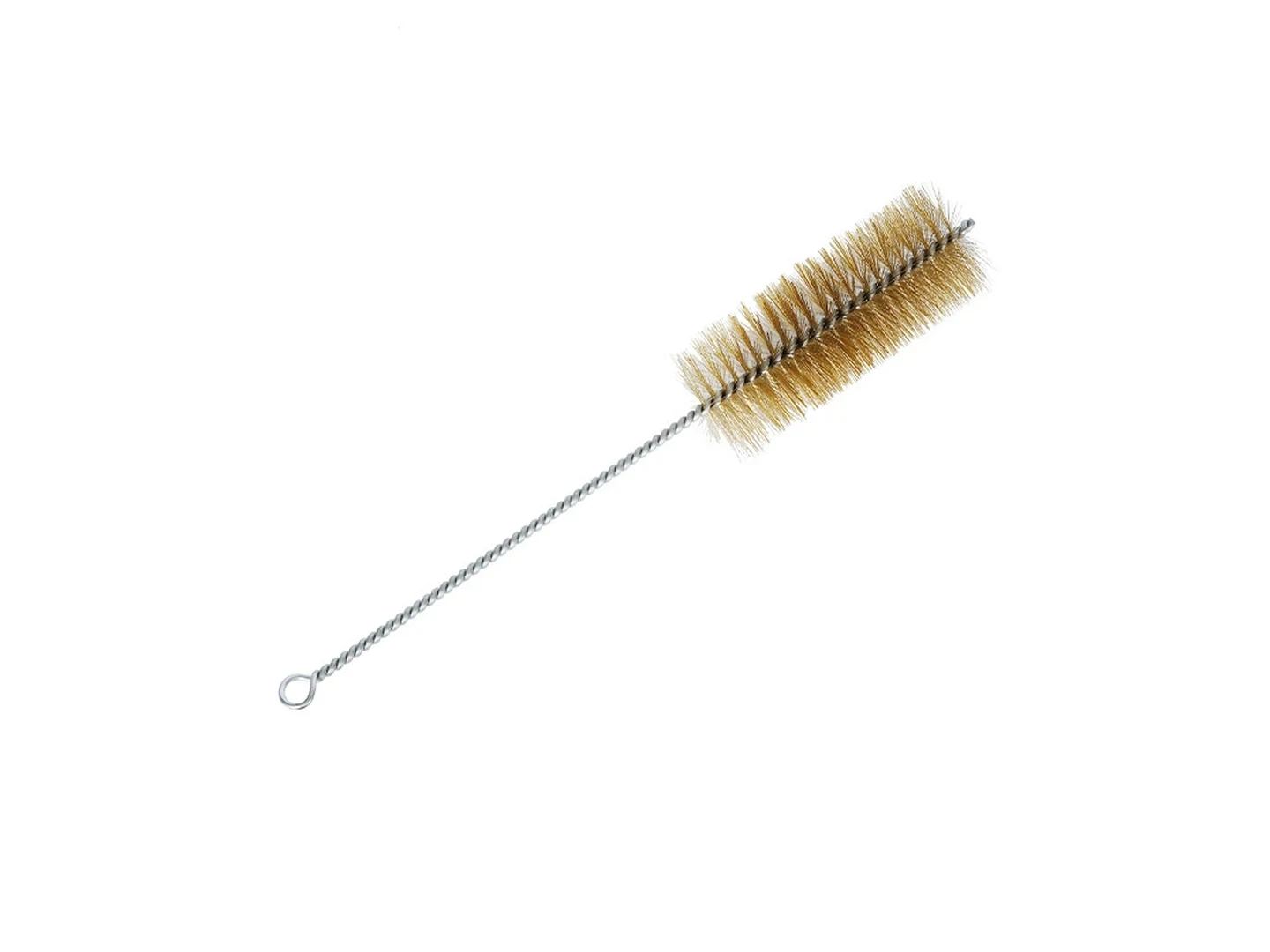
Copper Wire Tube Brush
Custom copper wire tube brushes for bores, tubes, and ports. Copper fill removes deposits without ferrous contamination; 3.2–50.8 mm, four stem ends.
Small brush
500 pcs
Minimum order
Held in one hand: tube, bottle, detail and swab brushes — including long-handled ones with a small head.
Production lead time, once the specification is confirmed
- Up to 500 pcsWithin 7 days
- 501–50,000 pcsWithin 14 days
- Over 50,000 pcsWithin 21 days
Peak season can extend these times; the shipping date is confirmed in writing with your quotation. Sampling and shipping are quoted separately.
A copper wire tube brush is a twisted-wire cleaning tool built for internal bores, tubes, ports, and passages where steel wire is too aggressive or could leave ferrous contamination. The copper wire fill removes light scale, oxidation, flux, carbon, and process deposits while protecting soft-metal tube walls.
What can this brush do for you?
Won’t Leave Steel Particles on Copper or Brass Systems
Steel wire brushes can shed microscopic ferrous particles that embed in copper or brass surfaces and become corrosion sites later. Copper wire fill removes the same deposits without introducing dissimilar metal contamination, which matters in heat exchangers, soldered or brazed joints, and any tube where the internal wall condition affects long-term service.
Aggressive Enough to Remove Deposits, Soft Enough to Protect the Base Metal
The wire tips scrape away oxidation, light scale, solder flux, carbon, and dried coolant without gouging copper tube walls, brass fittings, aluminum bores, or other soft-metal surfaces. Fill wire diameter can be adjusted from fine to heavy to match the deposit, so the cleaning action stays balanced against the substrate.
Lower Sparking Risk for Fuel, Gas, and Solvent Service
Clean copper wire carries a lower sparking risk than steel wire, which is a practical advantage when cleaning fuel system parts, gas fittings, and solvent-washed passages. Keep the fill free of embedded grit or steel fragments to preserve this property.
Follows Bore Walls and Cross Holes Without Losing Contact
The twisted stem keeps the fill centered while the wire tips flex against the tube ID, maintaining contact through straight runs, cross holes, tapers, and mild bends. Loop, ring, and flexible shaft ends allow the brush to be pulled through passages that a rigid rod cannot traverse.
Works by Hand or Under Power
A straight shank version chucks into a cordless drill for fast bore cleaning; loop or ring ends suit manual pull-through work; threaded ends mount in motorized tube cleaners. The same copper wire fill is available across these drive configurations.
What is a Copper Wire Tube Brush?
A Copper Wire Tube Brush is a cylindrical cleaning device with a twisted wire stem and copper wire filaments anchored between the twists. The stem is most often carbon steel or stainless steel; the copper wire is the fill, and it is the only part of the brush that contacts the bore wall.
In use, the brush enters the bore, the operator rotates it by hand or drill, and the wire tips scrape the internal wall. A push-pull stroke covers the full length of the contact area. The diameter over the fill should mate closely to the bore ID; copper wires do not need the large oversize that polymer filaments use, and excessive interference simply folds the wires over.
Copper wire is a consumable fill. It is softer than steel or brass wire, so it wears during the job and sheds copper particles. That trade-off is acceptable when surface protection and contamination control are the priorities. If the tube has hard scale, deep rust pitting, or requires aggressive stock removal, a steel wire tube brush is the stronger choice.
Technical Specifications
The table below shows the standard engineering ranges for this brush; exact dimensions are selected to match the bore and drive method.
| Parameter | Standard Range / Options |
|---|---|
| Fill material | Solid copper wire (hard-drawn; annealed available) |
| Brush diameter over fill | 3.2–50.8 mm (0.125–2.000 in) |
| Brush section length | 25–127 mm |
| Overall length | 152–406 mm |
| Fill wire diameter | 0.08–0.25 mm |
| Stem construction | Single spiral, double spiral, double stem, single stem with twisted wire |
| Stem material | Carbon steel, galvanized steel, 304/316 stainless steel |
| End / shank | Loop, ring, straight shank, hex shank, threaded, flexible extension |
| Fill density | Light, standard, dense; selected by deposit type and required life |
| Suggested rotary speed | 500–1,500 RPM for hand drill use; use the lower half of the range above 25 mm diameter |
| Chemical exposure | Acceptable for dry, oil, mild solvent, neutral, or mild alkaline environments; avoid acids, ammonia, and strong oxidizers |
| Brush type | Custom Tube & Pipe Bore Brushes |
| How it is driven | Hand-guided |
| Cleaning target | copper pipe and tubing preparation, heat exchanger, and hydraulic and pneumatic port and manifold cleaning |
| Surface or part | tubes, bores, walls, ports, tube walls, passages, carbon steel, and cross holes |
| Residue or debris | carbon, scale, flux, light scale, coolant, corrosion, powder, and coolant residue |
| Mounting / connection | Loop, ring, straight shank, hex shank, threaded, flexible extension |
For fitting the brush, use a diameter equal to the bore ID up to about 5% larger. Copper wire does not recover from heavy oversize the way polymer filaments do.
Where does this brush work best?
- Copper pipe and tubing preparation before soldering or brazing: removes oxide film, flux, and surface contamination from the inside of fittings and tube ends.
- Heat exchanger, condenser, and chiller tubes: soft scale, sludge, biofilm, and light corrosion products from copper, brass, or cupronickel tubes.
- Hydraulic and pneumatic ports and manifolds: machining chips, oil, coolant residue, and fine swarf from threads and cross holes.
- Fuel and gas system components: carbon, varnish, and light deposits from carburetor bores, gas line fittings, and injector ports.
- Aluminum and zinc die-cast parts: powder, carbon, and light flash from internal bores where steel brushes would scratch the substrate.
- Instrumentation and laboratory equipment: light oxidation and process film from non-ferrous tubing and fittings.
How do I choose the right one?
Start with bore ID and accessible length
Measure the smallest internal diameter the brush must pass through. The brush diameter over fill should be equal to the bore ID or up to about 5% larger. For wiping only, a near-size or slightly undersized brush works; for deposit removal, use 3–5% oversize. Do not order a copper wire brush with 10–20% oversize expecting polymer-style scrubbing—the wire tips will fold and contact drops.
Select fill wire diameter by residue and surface
For light film, coolant residue, and powder, 0.08–0.12 mm wire is enough and leaves the least marking. General cleaning of oxidation and flux responds well to 0.12–0.18 mm. For heavier deposits on robust metal walls, 0.18–0.25 mm wire works but wears the surface more. Copper wire is always softer than stainless steel wire, so match the wire diameter to the deposit, not just the base metal.
| Cleaning task | Suggested wire diameter | Suggested brush oversize |
|---|---|---|
| Light film, powder, coolant wipe | 0.08–0.12 mm | 0 to +2% |
| Oxidation, flux, light scale | 0.12–0.18 mm | +2% to +4% |
| Heavier deposit on robust wall | 0.18–0.25 mm | 0 to +5% (check wear) |
Choose stem and end fitting by drive method
- Hand pull-through: loop or ring end on one or both ends.
- Cordless drill or air motor: straight shank sized to the chuck, usually 6.35 mm (1/4 in).
- Motorized tube cleaner or machine: threaded end or quick-connect shank matched to the equipment.
- Curved tubes or offset access: flexible shaft or double stem; the copper fill still needs to reach the wall, so verify the bend radius.
Match stem material to the environment
Carbon steel stems are economical for dry work; galvanized adds some corrosion resistance; 304/316 stainless steel stems hold up in wet, humid, or mildly corrosive service. The stem and fill do not have to be the same material. Copper wire is the contact medium; the stem is the torque carrier.
When to choose a different brush
- Use a stainless steel wire tube brush for hard rust, baked carbon, or heavy scale where copper wears too fast.
- Use a brass wire tube brush where the job needs slightly more aggression than copper but still avoids steel particles.
- Use a nylon or abrasive nylon tube brush where the surface cannot tolerate any metal contact or where no metal shedding is allowed.
- Avoid copper wire in acid, ammonia, or strong oxidizing environments, and where copper contamination is prohibited.
Can I customize this brush?
Copper wire tube brushes are almost always made to a specific bore, length, and drive requirement. Provide the tube ID, bore length, access depth, drive method, residue, and environment, and we will select or wind the brush to match. A sample or drawing of the part is the fastest way to confirm the configuration.
- Brush diameter and brush section length
- Fill wire diameter and density (fine for wiping; heavy or dense for longer wear)
- Fill material grade (hard-drawn copper, copper alloy; brass wire alternative on request)
- Stem construction (single spiral, double spiral, double stem, flexible shaft)
- Stem material (carbon steel, galvanized, 304/316 stainless, or fully non-ferrous custom)
- End configuration (loop, ring, straight shank, hex, threaded, custom tang, quick-connect)
- Handle options for manual use (straight handle, T-handle, swivel handle, ergonomic grip)
- Special geometry (tapered brush for varying bore ID, pilot tip, multi-section fill)
- Packaging and marking (bulk, individual bag, retail card, private label, custom color)
If the project requires material declarations, inspection reports, or third-party testing support for the customer’s application, we can assist with that documentation during the customization process.
Which filament survives the cleaning and still lasts on a copper wire tube brush?
Will copper fill debris remain in the tube after brushing?
Some copper shedding is normal with any wire brush, and copper sheds more than stainless steel because the wire is softer. After brushing, flush or blow out the bore and inspect with a white cloth; if copper-colored material remains, repeat flushing. If the application cannot accept any copper particles, choose a nylon brush instead.
Can I run a copper wire tube brush in reverse in a drill?
It is safer to run the brush in the direction that tightens the wire spiral, usually the normal cutting direction of the twist. Reversing can loosen the fill and accelerate wire loss. If the brush must be reversed, reduce speed and inspect the fill frequently.
How do I know when to replace the brush?
Replace when the fill is flattened to less than about half of its original diameter, when wire ends are missing in a continuous band, or when the brush no longer makes even contact around the bore. A worn brush leaves residue and sheds broken wires, which can block small ports downstream.
Does copper wire brushing replace chemical descaling?
No. The brush removes attached deposit mechanically; chemical descaling or passivation is a separate process if the application requires it. Brushing also cannot remove material from deep pits or rebuild eroded surfaces.
What should I check before putting the brush into a critical bore?
Inspect that the fill is evenly distributed, the stem is straight, the end fitting is secure, and there is no green or black corrosion product on the copper fill. Then make one test pass in a scrap or non-critical tube and wipe the wall to verify contact and debris removal.
Is a copper wire tube brush safe around flammable vapors?
Clean copper wire carries a lower sparking risk than steel wire, but it is not a substitute for a formal non-sparking tool assessment for your specific atmosphere. If the brush has picked up steel swarf or grit, those particles can spark. Use a brush dedicated to that environment and inspect it before each use.
Guides that go deeper on this
Custom Manufacturing RFQ
Describe Your Application
Please share the brush dimensions, working area, residue type, material direction, quantity, and a drawing or photo for quotation.
Drawing or photo optional — it speeds things up, it does not gate the enquiry.
Custom Brush RFQ
Send Your Brush Project
Upload a drawing, product photo, or sample photo and provide the core dimensions and cleaning conditions.
“We need a brush to remove wet residue from a stainless steel conveyor, about 800mm wide. The current brush wears quickly. We can send photos.”
“We sell drinkware and need a cleaning brush to include with the product. Quantity around 5,000 pieces.”