
Custom Cleaning Brush
Pastry Tube Brush
Custom pastry tube brush for piping tips and nozzles. Food-contact PBT/nylon fill, stainless wire core, hot-wash and autoclave options, sized to tube ID.
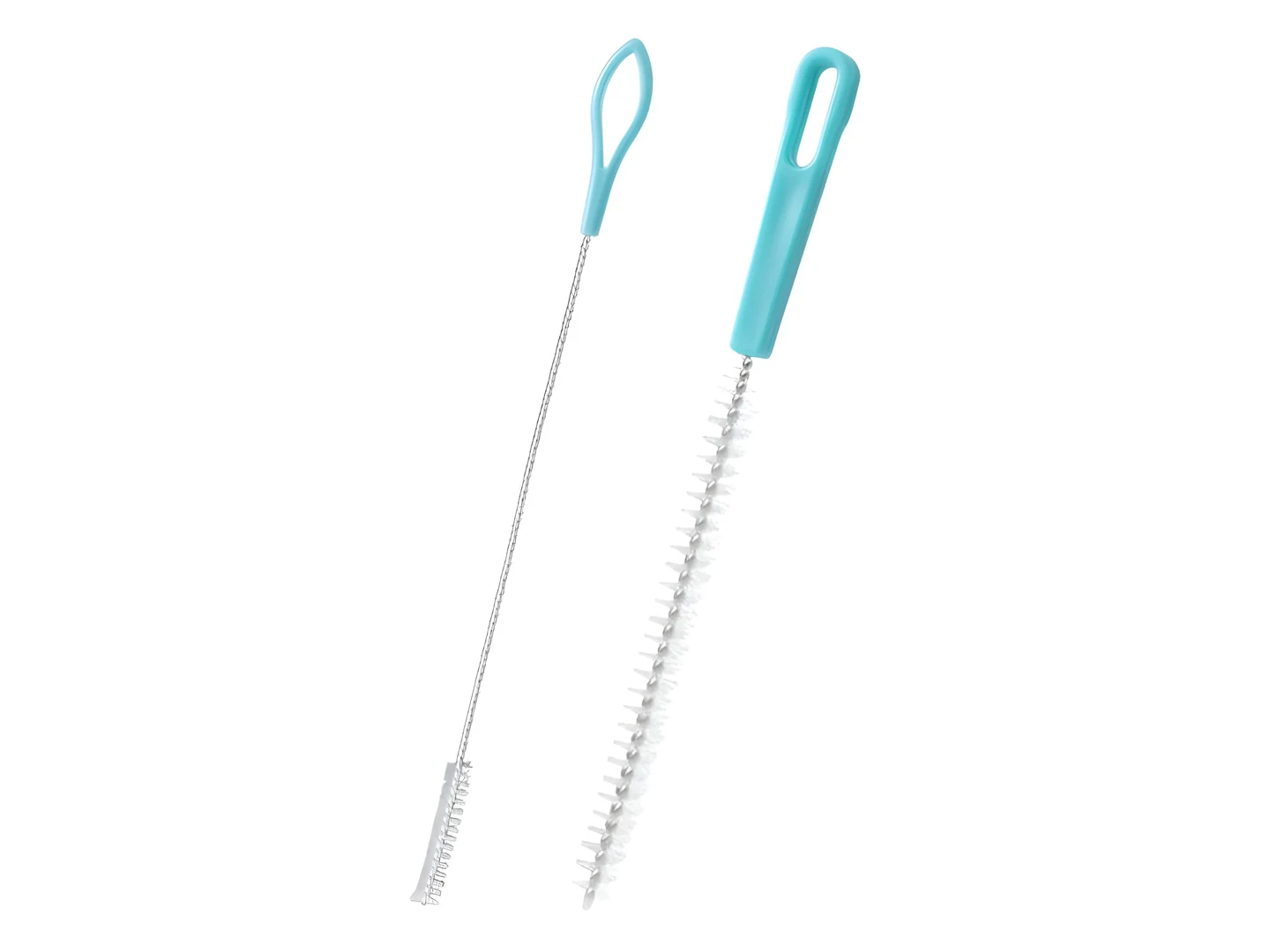
Small brush
500 pcs
Minimum order
Held in one hand: tube, bottle, detail and swab brushes — including long-handled ones with a small head.
Production lead time, once the specification is confirmed
- Up to 500 pcsWithin 7 days
- 501–50,000 pcsWithin 14 days
- Over 50,000 pcsWithin 21 days
Peak season can extend these times; the shipping date is confirmed in writing with your quotation. Sampling and shipping are quoted separately.
A narrow-profile tube brush built to clean dried batter, buttercream, royal icing, and dough from the inside of pastry tubes and piping tips — reaching the internal taper and the small discharge opening without scratching the nozzle surface. The brush uses a twisted stainless wire stem and a food-contact-compatible PBT or nylon fill sized to the tube bore, and it is built for repeated warm-water, dishwasher, or autoclave cleaning in bakery and patisserie environments.
What can this brush do for you?
Reaches the full internal taper, from coupler end to tip opening
A pastry tube narrows from the coupler or rear opening toward the fine decorating slot. A straight, fixed-size brush only contacts the widest section and stops before the tip. This brush uses a tapered fill profile and a small tip tuft that carries contact all the way to the discharge end, including the inside shoulder where icing tends to pack. The result is one pass that removes residue across the entire internal surface instead of only the rear third.
Soft contact that won’t leave marks on polished stainless or plated tips
PBT and food-contact-compatible nylon filaments are firm enough to push softened residue from the wall, but their ends won’t cut into the polished inner surface of a stainless pastry tip the way a wire brush can. If your nozzles are plated, coated, or finished to a specific surface, this is contact that cleans the residue without changing the tool finish.
Removes post-soak film that rinsing leaves behind
Warm water and detergent loosen dried sugar- and fat-based deposits, but they rarely remove the thin tenacious film left on the upper taper and the inner edge of the tip opening. The brush lifts this remaining layer so the tube can go back into service without old icing contaminating the next batch or blocking fine decorating slots.
Small enough to pass through narrow petal, star, and writing-tip openings
Pastry-tube brushes with large bulking filaments can’t pass through the smallest French, petal, or writing tips. The fill can be specified as a slender or tapered tuft with a short working head, so the open star points and small round holes are reached instead of skipped.
Built for the washdown, not just the workbench
The PBT fill and twisted stainless core do not absorb water or retain sugar residues. They withstand routine commercial dishwashing and, when the project requires it, 121°C autoclave cycles. This means the same brush stays in the hygiene process instead of being replaced after the first hot wash.
What is a Pastry Tube Brush?
A Pastry Tube Brush is a small-diameter hand-guided cleaning tool used on pastry tubes, piping nozzles, decorating tips, and similar conical food-contact passages. It is built around a twisted stainless steel wire stem with a filament fill around the working end, usually 60–140 mm long, and a handle long enough to keep the operator’s fingers clear of the tube opening.
In use, the brush is inserted from the rear or coupler end and moved through the internal taper with short push-pull and rotating strokes. The bristle tips contact the inclined inner wall, the tip shoulder, and the edge of the decorating opening, loosening softened batter, icing, chocolate, or dough film. The residue then rinses away, and the brush itself is cleaned at the end of the shift.
This is a tool for removing soft or softened food residues during normal cleaning. It is not designed to grind away burned, carbonized, or heavily polymerized sugar deposits, and it is not a substitute for soaking, detergent action, or sanitizing steps.
Technical Specifications
We can adjust the fill diameter, taper, filament, stem, and handle to fit your specific pastry tube sizes.
| Parameter | Value / Options |
|---|---|
| Brush fill diameter | 3–20 mm, selected to the narrowest tip opening and rear tube ID |
| Working brush length | 60–140 mm, matched to tube depth and taper length |
| Bristle trim length | 1.5–6 mm from core, shorter for fine openings, longer for wide rear sections |
| Fill profile | Tapered, straight, end-tuft, or custom contour to follow the tube taper |
| Filament material | Food-contact-compatible PBT or nylon PA6/PA6.12; PBT preferred for hot wash and spring recovery |
| Filament diameter | 0.10–0.40 mm, selected by stiffness and crevice entry |
| Stem / core | Twisted 304 or 316 stainless steel wire; plastic-coated or polymer-core options for metal-free use |
| Handle | PP, TPE overmold, or stainless steel; loop or straight form |
| Overall length | 180–300 mm, set by operator reach and tube size |
| Temperature capability | Routine dishwasher cleaning to 93°C; specified PBT/PP construction for 121°C autoclave when required |
| Operating environment | Wet, detergent, and food-residue exposure; material grade selected to cleaning chemical and wash method |
| Brush type | Custom Tube & Pipe Bore Brushes |
| How it is driven | Hand-guided |
| Cleaning target | writing piping tip, pastry tube and dispenser cylinder, and screw-thread ring cleaning |
| Surface or part | tubes, tapers, nozzles, holes, bores, walls, blind holes, and internal ports |
| Residue or debris | icing, batter, dough, chocolate, sugar, filler, and food residue |
| Mounting / connection | Threaded Removable / Fixed |
Where does this brush work best?
- Round, star, petal, leaf, and writing piping tips where the internal taper ends in a small shaped opening.
- Pastry tubes and dispenser cylinders in bakery decorating stations, confectionery production, and catering kitchens.
- Couplers, adapters, and screw-thread rings that capture icing at the seam between bag and tip.
- Narrow filler tubes and depositing nozzles exposed to buttercream, ganache, custard, or chocolate.
- Shallow blind holes or short internal ports on food-processing small parts when the geometry accepts a filament brush.
How do I choose the right one?
The two dimensions that determine fit are the smallest tip opening and the full internal taper. Everything else follows from the residue, the wash process, and the operator’s work position.
Start from the narrowest opening
Measure the inside diameter of the smallest opening the brush must pass through — usually the decorating slot or the tip end, not the coupler end. The fill diameter should create light interference in the narrow section without jamming, while remaining large enough to sweep the wider rear area. If the tube taper is long, specify a tapered fill profile rather than a single straight diameter; a straight profile sized for the tip may do little work in the rear bore.
Match the filament to the residue and the wash process
PBT is the usual starting point: it holds its shape in hot water, resists most detergents, and releases sugar-based film quickly. Nylon is softer and more conformable when nozzles have a fragile coating or when only light film is being removed. Choose a finer filament diameter for fine petal and star openings; choose a coarser or stiffer fill if buttercream and batter are left to dry between shifts.
Set the handle and stem to the operator’s process
Operators working over a sink line may prefer a shorter 180–220 mm brush for control. Those cleaning long pastry tubes or working with deep wash tanks may need an overall length of 250–300 mm and a more rigid core. Stainless twisted wire provides the smallest stem diameter and good flex; a plastic-coated or polymer core removes exposed metal when crews insist on a metal-free tool.
When a different brush is the better choice
If the tube has hardened carbon or burned sugar fused to the wall, a filament brush is not the solution — the surface needs a careful stainless or brass wire brush, or reconditioning, with the understanding that the finish will change. If the passage is extremely small and single-use is preferred, a disposable micro applicator may be more practical. Use a filament pastry tube brush for everyday residue removal and finish-safe contact.
Can I customize this brush?
Pastry tube brushes are built around the actual set of tubes and nozzles used on the line. To quote a project, we need the narrowest tip ID, rear opening ID, internal length, taper shape, nozzle material, residue type, cleaning chemicals, wash temperature, and preferred handle form. A sample tube or a drawing is the fastest way to lock the fit.
- Fill geometry — straight, tapered, end-tuft, double-diameter, stepped, or contour-matched to a specific tip family
- Filament — PBT or nylon grade, diameter, trim length, stiffness, color, and fill density
- Stem — twisted wire gauge, 304 or 316 stainless, plastic-coated wire, or polymer core
- Handle — PP, TPE overmold, stainless, loop, hanging hole, grip texture, or molded logo
- Working length and overall length — matched to the tube depth and operator reach
- Packaging and marking — bulk packs, individual sleeves, retail cards, laser or pad-print marking, color coding by size
- Project support — material documentation, wash-cycle data, inspection records, and third-party testing can be arranged for the customer’s project requirements.
Which filament survives the cleaning chemicals a pastry tube brush meets?
How do I check that the brush is the right diameter for my tip?
Insert the brush from the coupler or rear end and push it gently toward the tip opening. It should pass through the smallest opening with light resistance and should spring back to fill the wider rear taper when pulled back. If the bristles fold flat and stay folded, the fill is too large. If it passes through the tip with no contact and leaves residue in the rear bore, the fill is too small or the profile is wrong.
Should I soak pastry tubes before using the brush?
Yes, especially after buttercream or royal icing has dried. A short warm-water or detergent soak softens the sugar and fat, and the brush then removes the remaining film. Brushing a completely dry, hardened deposit without pre-soaking increases operator force and shortens bristle life. The brush is not designed to replace the soak step.
How do I clean the star and petal points on a piping tip?
Use the brush tip or a tapered end tuft and work each opening from inside and outside with short rotating strokes. After brushing, hold the tip up to light or pass a small probe through each point to confirm that the opening is clear. If a specific point remains blocked, the brush tip shape may need to be adjusted to match that slot geometry.
Will the twisted wire stem scratch the inside of stainless pastry tubes?
When the brush is correctly sized, the stem stays inside the filament fill and does not touch the tube wall. Scratches normally appear when the fill is too small, the operator forces the stem against the side, or the brush is used on hardened material. Inspect a used brush before each shift and replace any brush with a bent or exposed core.
How should the brush itself be cleaned and inspected?
Rinse in warm water after each use and run through the normal warewashing cycle. Shake out excess water and hang to dry. Check the wire core for kinks, rust, or exposed ends, and check that the handle is still firmly attached. Replace the brush if the fill is matted, if bristles break off, or if the tip no longer springs back after use.
When is a wire brush the right alternative?
If a tube has blackened, carbonized, or fused sugar that no amount of soaking will soften, a stainless or brass wire brush may be needed for restoration. Use it only when surface finish is not critical, because wire contact will alter the polished inner surface. A filament pastry tube brush is the right daily tool; a wire brush is a last-resort reconditioning tool.
Guides that go deeper on this
Custom Manufacturing RFQ
Describe Your Application
Please share the brush dimensions, working area, residue type, material direction, quantity, and a drawing or photo for quotation.
Drawing or photo optional — it speeds things up, it does not gate the enquiry.
Custom Brush RFQ
Send Your Brush Project
Upload a drawing, product photo, or sample photo and provide the core dimensions and cleaning conditions.
“We need a brush to remove wet residue from a stainless steel conveyor, about 800mm wide. The current brush wears quickly. We can send photos.”
“We sell drinkware and need a cleaning brush to include with the product. Quantity around 5,000 pieces.”