
Custom Cleaning Brush
Centrifuge Tube Brush
Soft nylon and PBT centrifuge tube brushes for 0.5–50 mL tubes. Reach conical bottoms without scratching. Custom sizes, cores, and handles.
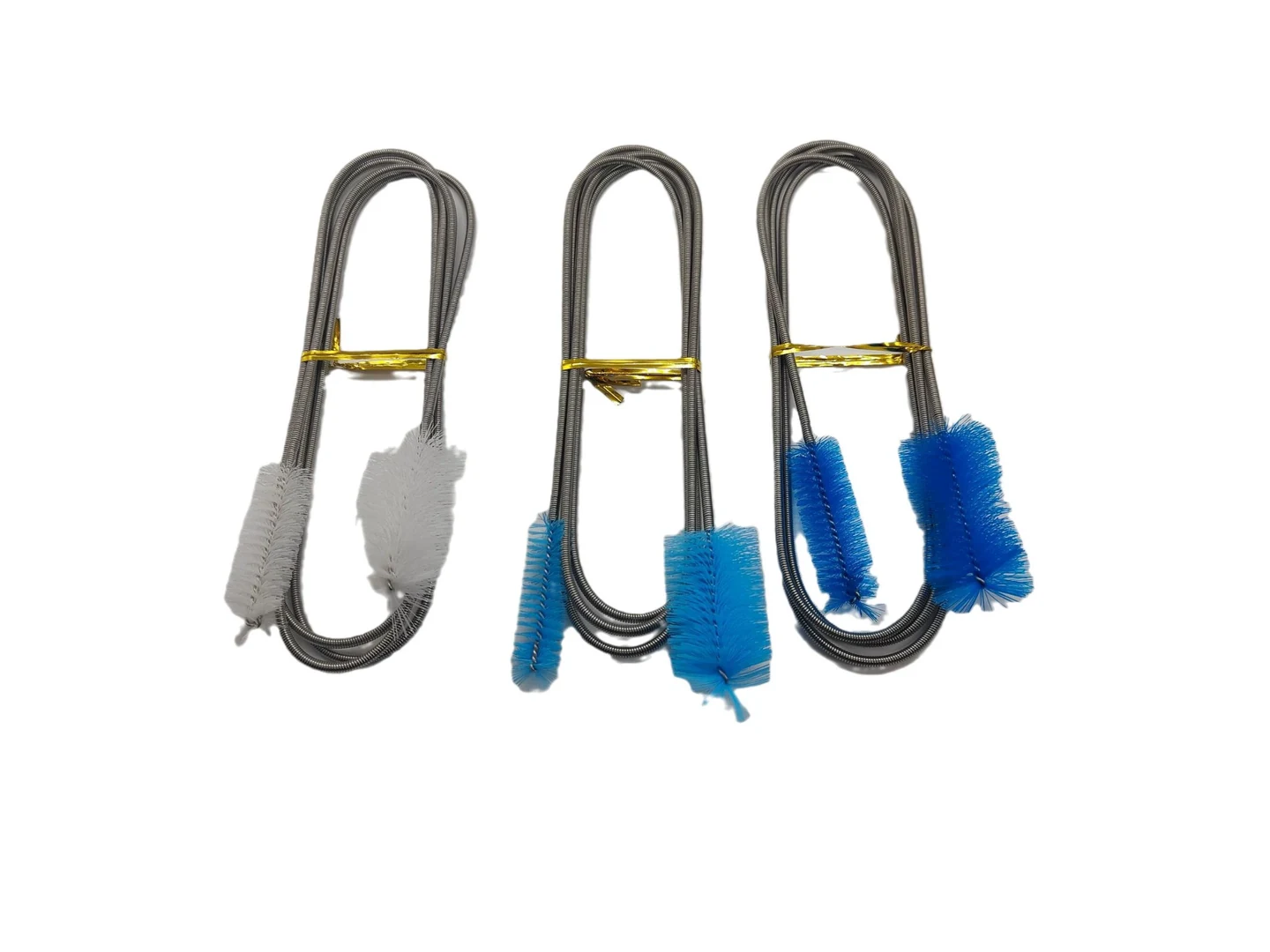
Small brush
500 pcs
Minimum order
Held in one hand: tube, bottle, detail and swab brushes — including long-handled ones with a small head.
Production lead time, once the specification is confirmed
- Up to 500 pcsWithin 7 days
- 501–50,000 pcsWithin 14 days
- Over 50,000 pcsWithin 21 days
Peak season can extend these times; the shipping date is confirmed in writing with your quotation. Sampling and shipping are quoted separately.
A tapered, small-diameter laboratory brush built to reach the conical bottom of 15 mL and 50 mL centrifuge tubes. Soft nylon or PBT filaments remove residual pellets, protein films, and buffer residues from plastic or glass tube interiors without scratching the surface.
What can this brush do for you?
Conical Taper Follows the Tube’s Shape
The brush diameter narrows from base to tip, so the filament section mirrors the 60° cone inside standard centrifuge tubes. The small tip reaches the bottom apex where cell pellets and precipitates collect, while the wider upper portion scrubs the sidewall in one continuous motion.
Soft Filament Ends Protect Tube Surfaces
Nylon PA and PBT filaments are available in soft and medium grades. Their compliant tips remove dried protein films, salt deposits, and buffer crystals without leaving scratches on polypropylene, polycarbonate, or glass tube interiors — scratches that can harbor contamination or alter optical clarity.
Flexible Twisted-Wire Core Keeps the Brush Centered
The bristles are captured in a stainless steel or galvanized twisted-wire core. The core flexes slightly under hand pressure yet remains straight enough to keep the filament section centered in the tube, so you don’t scrape the wall with the core itself.
Washes Clean Between Uses
Because the filaments are dense but non-absorbent, residue releases under running water or detergent instead of embedding between bristles. This helps prevent cross-contamination when the same brush is used across sample batches.
Loop or Straight Handle Supports Lab Workflow
The handle end can be formed as a hanging loop for drying racks, a straight rod for easier rotation, or a color-coded plastic grip for quick identification of dedicated brushes by protocol, reagent, or user.
What is a Centrifuge Tube Brush?
A Centrifuge Tube Brush is a slender hand-cleaning tool designed to remove residues from the internal walls, conical bottom, and shoulder of laboratory centrifuge tubes. It combines a short tapered brush section, a flexible twisted-wire or plastic core, and a handle long enough to reach the bottom of a 15 mL or 50 mL tube without the operator’s hand entering the tube.
During use, the brush is inserted along the tube axis, then rotated and moved in short push-pull strokes. The bristles contact the sidewall and cone, breaking loose attached residue that can then be rinsed away. The brush is not intended for aggressive scrubbing or removal of hard deposits, and the core should not be forced against the tube wall.
Unlike a general-purpose tube brush for pipes or hoses, a centrifuge tube brush is built around laboratory tube geometry: small tip diameter, matched cone angle, lab-friendly filament materials, and a handle form that fits drying racks and autoclave baskets.
Technical Specifications
The table shows typical configurations. We can adjust every dimension and material to match your centrifuge tube size, cleaning protocol, and sterilization method.
| Parameter | Value / Options |
|---|---|
| Tube size compatibility | 0.5–50 mL centrifuge tubes (micro, 15 mL, 50 mL conical; larger on request) |
| Brush diameter | Tapered: 1.5–3 mm at tip, 8–25 mm at base (selected to tube ID and cone angle) |
| Brush section length | 50–120 mm |
| Overall length | 180–300 mm, adjusted to tube depth and handle preference |
| Filament material | Nylon PA 6/6, PBT, or PP |
| Filament flexibility | Soft, medium, or firm — matched to residue type and tube surface |
| Core | 304 stainless steel twisted wire, galvanized steel wire, or plastic-coated wire |
| Handle | Stainless steel loop, straight rod, or color-coded plastic grip |
| Tip style | Tapered cone, rounded dome, or mini-brush tip for microcentrifuge tubes |
| Chemical exposure | Nylon/PBT tolerant of common lab detergents, mild acids, bases, and alcohols; confirm with cleaning agent SDS |
| Autoclave compatibility | Nylon/PBT body generally withstands repeated 121°C autoclave cycles; verify handle and coating material |
| Brush type | Custom Tube & Pipe Bore Brushes |
| How it is driven | Hand-guided |
| Cleaning target | 15 ml and 50 ml polypropylene conical, microcentrifuge tube, and centrifuge tube cap and thread cleaning |
| Surface or part | tubes, plastic, glass, walls, tube walls, sidewalls, racks, and tapers |
| Residue or debris | protein, salt, protein film, pellets, precipitate, and powder |
| Mounting / connection | Threaded Removable / Fixed |
Where does this brush work best?
- 15 mL and 50 mL polypropylene conical tubes after cell culture harvest, centrifugation of precipitates, or density gradient separation — removes pelleted cells, protein aggregates, and salt films from the cone and sidewall.
- Microcentrifuge tubes (0.5–2.0 mL) after PCR cleanup, enzyme digests, DNA/RNA precipitation, or buffer dry-down — the mini-tip configuration reaches the bottom without damaging the thin tube walls.
- Glass round-bottom centrifuge tubes in synthetic chemistry, environmental testing, or sample preparation — cleans residues from solvents, powders, and reaction by-products without scratching the glass.
- Centrifuge tube caps and threads when a short detail-tip section is added — removes dried sample film around the sealing area to maintain a reliable closure.
- Shared lab equipment where tubes may be reused across protocols and thorough interior cleaning is required before the next sample batch.
How do I choose the right one?
Start with the tube’s internal geometry
Measure the smallest internal diameter — usually at the bottom of the cone — and the top internal diameter. The brush tip must be small enough to reach the apex without jamming, while the base should be slightly narrower than the tube mouth to allow free insertion. For standard 15 mL and 50 mL conical tubes, a taper angle near 60° keeps the filaments in continuous contact with the cone wall.
Match filament stiffness to residue and surface
Soft nylon (thinner filaments) is the right starting point for polypropylene and polycarbonate tubes where surface preservation matters. Medium nylon or PBT applies more rubbing force for dried protein layers and salt crusts. PP filaments are lower cost and chemically inert for simple aqueous work but offer less resilience at elevated temperature. If the residue is baked-on clay, hardened scale, or mineral deposits, a soft brush will not remove it — switch to a medium or firm nylon grade, or presoak the tube in a compatible solvent.
Choose the core and handle for your protocol
A stainless steel twisted-wire core is durable and autoclavable, but it must be fully covered by bristles to avoid metal contact with the tube wall. If metal contact is unacceptable, choose a plastic-coated wire core or a molded plastic core. Handle choice depends on workflow: a loop hangs on drying racks and prevents the brush from dropping into the tube, a straight handle allows one-handed rotation, and a color-coded grip supports lab-specific segregation.
Confirm chemical and sterilization compatibility
Review the cleaning agent, solvent, and autoclave temperature against the filament, core coating, and handle material. Nylon PA 6/6 and PBT tolerate most common lab chemicals at room temperature, but prolonged exposure to strong acids or chlorinated solvents may reduce bristle life. Specify your cleaning SOP up front so the brush is built to survive it.
When a centrifuge tube brush is not enough
If the tube is larger than 50 mL, use a wider tube brush with a longer bristle section. If the residue is hardened, carbonized, or requires aggressive mechanical force, consider a stiffer brush or a different cleaning method such as ultrasonic cleaning combined with the brush. For single-use sterile applications, disposable swabs or prefilled cleaning tools are more appropriate.
Can I customize this brush?
Centrifuge tube brushes are project-configured because tube sizes, cone angles, and cleaning protocols vary. To quote a custom brush, provide the tube make and capacity (or internal diameters and cone angle), tube material, residue type, cleaning agent, autoclave or sterilization requirements, and preferred handle form. A drawing or sample tube accelerates the process.
We can adjust:
- Brush geometry — tip diameter, base diameter, taper angle, brush section length, and overall length
- Filament — material (nylon PA 6/6, PBT, PP), filament diameter, stiffness grade, bristle density, and tip treatment
- Core — 304 stainless steel, galvanized steel, plastic-coated wire, or molded polymer core; flexibility and corrosion resistance selected for the process
- Handle — loop, straight rod, plastic grip, overmold, color coding, and hanging feature
- Tip style — conical, dome, blunt, or mini-brush attachment for nested tube sizes
- Color and marking — filament color, handle color, laser marking, pad printing, or product code for lot traceability
- Packaging — bulk, individual bag, lab kit, or project-specific packing
For regulated lab environments, we can support documentation such as material declarations, cleaning validation assistance, and third-party testing coordination as part of the project.
Which filament survives the cleaning chemicals a centrifuge tube brush meets?
What is the smallest tube this brush can clean?
The standard micro-tip configuration reaches 0.2 mL and 0.5 mL PCR tubes, but the practical lower limit depends on tip diameter and bristle coverage. For tubes smaller than 0.2 mL, a twisted-wire brush may be too large; a disposable swab or pipette-tip cleaning tool may be better.
How do I know the brush isn’t scratching my plastic tubes?
Inspect a cleaned tube under strong light after several uses. If you see fine scratches or a cloudy ring where the bristles contact the wall, the filament is too firm for that tube material. Switch to a softer nylon grade or reduce the number of strokes.
Can I use this brush on tubes that will be autoclaved?
Yes, when the bristles, core, and handle are all specified for autoclave conditions. Nylon PA 6/6 and PBT generally withstand 121°C steam cycles, but plastic-coated cores and some handles may soften or discolor. Confirm the full material set with us before ordering if autoclave use is required.
How do I clean the brush itself between samples?
Rinse under running water immediately after use to prevent residue from drying in the bristles. Wash with mild laboratory detergent, rinse thoroughly, and hang to dry. Periodically autoclave or disinfect according to your lab SOP if the brush is shared. Replace the brush if the core is bent, bristles are flattened, or residue no longer releases.
What should I do if a protein pellet is stuck at the bottom of the cone?
Do not force the brush tip into a hardened pellet, as this can bend the core or scratch the tube. Presoak the tube in a compatible buffer or detergent for 10–15 minutes, then use gentle rotation with the brush tip. If the pellet remains attached, repeat the soak or use a soft-tip tool to loosen it before brushing.
Is this the same as a wire tube brush?
No. A wire tube brush uses metal wire bristles for industrial tube and pipe cleaning — too aggressive for plastic laboratory tubes and capable of scratching glass. A centrifuge tube brush uses nylon, PBT, or PP filaments intended for labware contact. For copper or stainless steel process tubing, choose a wire tube brush instead.
Guides that go deeper on this
Custom Manufacturing RFQ
Describe Your Application
For a custom quote, we need the key dimensions, surface or part, residue, material preference, quantity, and reference image or drawing.
Drawing or photo optional — it speeds things up, it does not gate the enquiry.
Custom Brush RFQ
Send Your Brush Project
Upload a drawing, product photo, or sample photo and provide the core dimensions and cleaning conditions.
“We need a brush to remove wet residue from a stainless steel conveyor, about 800mm wide. The current brush wears quickly. We can send photos.”
“We sell drinkware and need a cleaning brush to include with the product. Quantity around 5,000 pieces.”