
Custom Cleaning Brush
Laboratory Brush
Nylon-filament laboratory brush for cleaning beakers, flasks, test tubes, burettes, and tubing.
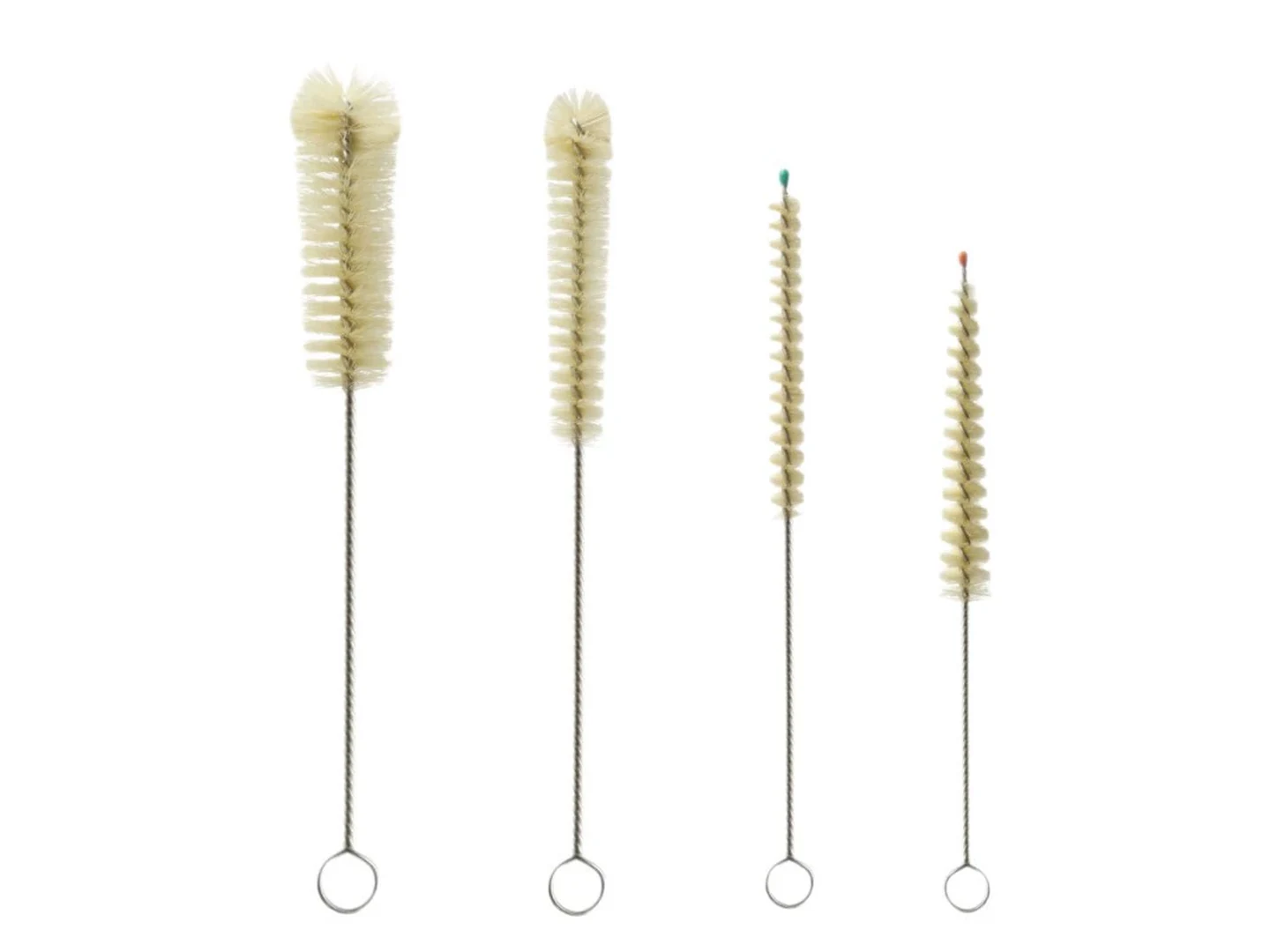
Small brush
500 pcs
Minimum order
Held in one hand: tube, bottle, detail and swab brushes — including long-handled ones with a small head.
Production lead time, once the specification is confirmed
- Up to 500 pcsWithin 7 days
- 501–50,000 pcsWithin 14 days
- Over 50,000 pcsWithin 21 days
Peak season can extend these times; the shipping date is confirmed in writing with your quotation. Sampling and shipping are quoted separately.
A nylon-filament laboratory brush for cleaning the internal and hard-to-reach surfaces of beakers, flasks, test tubes, burettes, and other laboratory glassware. The brush removes reagent film, precipitate, powder, oil, and detergent residue while protecting contact surfaces from scratching.
What can this brush do for you?
Reaches into narrow tubes, necks, and deep vessels
Head diameters from 1 mm and overall lengths up to 600 mm let the brush enter constricted openings and follow the internal contour of tubing, burettes, condenser tubes, and long-necked flasks. The working length is trimmed to place filaments exactly where the residue collects, so no part of the vessel is out of reach.
Soft nylon contact protects glass and precision surfaces
Filament diameters from 0.05 mm to 0.35 mm provide a compliant scrubbing surface that removes residue without scratching borosilicate glass, quartz, or polished metal. This is the contact you need when surface integrity affects measurement accuracy or sample purity.
Lifts reagent films, precipitates, and powders cleanly
The filament density and tip shape can be matched to the residue type. Soft films rinse away, heavier precipitates are loosened by repeated strokes, and loose powders release from the filament mass instead of packing into it.
Tolerates common laboratory chemicals and wet cleaning
Nylon PA and polypropylene construction resists most laboratory detergents, aliphatic solvents, and dilute acids or alkalis used in routine glassware washing. The brush can go directly into the washing sequence without degrading or shedding.
Available in the configuration your cleaning line actually needs
Choose hand brushes for open vessels, tube brushes for small-diameter glassware, double-ended brushes for two sizes in one tool, end-tuft brushes for corners and stopcocks, and disposable versions where cross-contamination must be eliminated.
What is a Laboratory Brush?
A Laboratory Brush is a hand-guided cleaning tool built around a nylon filament working end secured to a stem or handle. It is used to scrub the internal and recessed surfaces of laboratory glassware, tubing, and small instruments after sample handling, reaction, or storage.
Most configurations use a twisted wire or polypropylene stem that holds the nylon filaments in a radial or end-tuft pattern. The brush is inserted into the vessel or tube, moved back and forth with a twisting motion, and withdrawn. The filaments flex to follow the contour while their tips carry the cleaning action.
This is a manual maintenance tool, not a substitute for automated washing systems. It works best for targeted removal of reagent film, precipitate, powder, oil, and detergent residue that routine flushing does not remove. When the operator needs to clean a specific bore, shoulder, or base, the brush provides the contact that a rinse alone cannot.
Important operating limits: the polypropylene handle and stem components are intended for use below 80°C continuous. Nylon filament can tolerate brief higher excursions, but permanent deformation of plastic parts can occur if the brush is left in hot wash water or autoclaved without project-specific validation.
Technical Specifications
The following table shows the typical dimensional and material range for laboratory brushes of this type. Final values are selected to match the vessel geometry, residue, and cleaning environment.
| Parameter | Value / Options |
|---|---|
| Head diameter / width | 1–50 mm, selected to vessel ID |
| Working length (brush portion) | 5–100 mm |
| Overall length | 100–600 mm |
| Filament diameter | 0.05–0.35 mm |
| Stem diameter | 0.5–3.0 mm |
| Stem / core material | Galvanized steel wire, stainless steel wire, or polypropylene |
| Handle material | Polypropylene (standard); loop, straight, or ergonomic forms |
| Fill material | Nylon PA |
| Configuration | Hand, tube, double-ended, end-tuft, wire, or disposable |
| Operating temperature | Up to 80°C continuous for PP components; nylon filament withstands brief higher exposure |
| Chemical environment | Compatible with common lab detergents, aliphatic solvents, dilute acids/alkalis; verify concentrated or aggressive reagents |
| Brush type | Custom Tube & Pipe Bore Brushes |
| How it is driven | Hand-guided |
| Cleaning target | test tube, volumetric glassware, and graduated cylinder cleaning |
| Surface or part | tubes, glassware, vessels, test tubes, beakers, flasks, bores, and instruments |
| Residue or debris | precipitate, reagent film, powder, oil, detergent residue, mineral scale, and carbon |
| Mounting / connection | Fixed |
All dimensions are project-configurable.
Where does this brush work best?
This brush is designed for laboratory vessels and equipment where internal surfaces need targeted manual cleaning. Typical applications include:
- Test tubes, culture tubes, and centrifuge tubes — removing cell debris, precipitate, and residual media from the rounded bottom and sidewall.
- Beakers, flasks, and volumetric glassware — reaching shoulders and base transitions that magnetic stir bars or rinse nozzles miss.
- Burettes, pipettes, and graduated cylinders — cleaning narrow bores and graduation areas without blocking the meniscus.
- Condenser tubes, glass columns, and distillation apparatus — scrubbing internal walls where reagent film or oil builds up.
- Laboratory tubing and fittings — cleaning the ID of flexible or rigid tubing sections before reuse.
- Instrument sample ports and small cavities — removing powder or oil from recessed areas around valves, injectors, and sensors.
The brush removes reagent film, precipitate, powder, oil, and detergent residue. It is not intended for baked-on carbon, mineral scale, or sintered deposits; those require abrasive or metal brush treatment.
How do I choose the right one?
Selection starts with the smallest opening the brush must pass through, not the vessel volume. Follow these steps to narrow down the correct configuration:
- Measure the minimum internal diameter or opening. The head diameter must be slightly larger than the smallest ID to create contact, but not so large that it jams or permanently deforms. For bores below 1 mm, a wire-core brush with very fine filament (0.05–0.10 mm) is usually required.
- Set the working length and overall length. The brush portion should reach the deepest area you need to clean without the handle bottoming out at the vessel mouth. Overall length includes the handle, so operators can control the brush at the opening.
- Choose filament stiffness from the residue. Use finer filament diameters (0.05–0.15 mm) for light films and sensitive surfaces; use coarser filament (0.20–0.35 mm) for heavier precipitates or dried residues. Stiffer filament scrubs harder but bends less in curved areas.
- Match the configuration to access. Hand brushes for open beakers; tube brushes for test tubes and burettes; double-ended for two sizes; end-tuft for stopcocks and corners; wire-stem brushes for deep or angled passages; disposable when cross-contamination is unacceptable.
- Check chemical and thermal limits. Verify the nylon PA and polypropylene components are compatible with the detergents, solvents, and wash temperatures used in your lab. For autoclaving or continuous hot water above 80°C, specify a stainless steel core and validate the plastic parts.
- Decide reusable vs disposable. Reusable brushes are economical for routine cleaning, while disposable versions eliminate carryover between samples or when cleaning hazardous residues.
When to use something else: For hard mineral scale, sintered deposits, or baked-on carbon, choose a stainless steel wire brush or abrasive pad. For very narrow capillaries below 0.5 mm, a twisted wire core with ultra-fine filament or an ultrasonic bath may be more effective. For automated CIP systems, integrated spray nozzles or rotating brush heads are often a better fit than a manual brush.
Can I customize this brush?
Yes. Laboratory brushes are typically built to match the vessel or tube geometry, not purchased off the shelf. To define your configuration, provide the minimum internal diameter, insertion depth, residue type, cleaning chemicals, wash temperature, and whether the brush will be reused or disposed after each batch.
We can adjust:
- Head dimensions — diameter, working length, taper, or end-tuft profile
- Filament — nylon PA diameter, stiffness, density, trim length, or alternative filament material (PBT, polypropylene, PTFE, or others if required)
- Stem / core — galvanized steel, stainless steel, polypropylene, length and flexibility, or twisted wire pattern
- Handle — straight, loop, ergonomic grip, length, color, or integrated marking
- Configuration — hand, tube, double-ended, end-tuft, wire, or disposable, with single or double working ends
- Color and marking — color-coded handles for lab zones, laser marking, pad printing, or identification rings
- Packaging — bulk, individual polybag, labeled sleeve, or kit pack
If your project requires material documentation, inspection reports, or support for laboratory-specific quality requirements, we can assist during the customization process.
When is a laboratory brush worn out rather than just dirty?
How do I verify that the brush fits the tube or vessel opening?
Test-fit the brush by inserting it into the smallest opening it must pass through. The head should slide in with light finger pressure and recover its shape once inside. If it jams or leaves visible filament distortion, the head is too large. If it falls through without touching the sidewall, the head is too small.
What should I check before exposing the brush to a new cleaning chemical?
Confirm the compatibility of nylon PA and polypropylene with the chemical at the intended concentration and temperature. Nylon is attacked by strong acids, some phenols, and certain oxidizing agents; polypropylene can swell in some aromatic and chlorinated solvents. When in doubt, soak a test brush in the solution for the expected contact time and inspect for softening, discoloration, or filament loss.
How do I clean and store the brush after use?
Rinse the brush thoroughly under running water or in the same detergent solution used for the glassware. Squeeze or shake excess water from the filaments and hang the brush downward to air dry. Do not store the brush with the filament head resting on a surface that can trap moisture, and avoid leaving it in strong cleaning solutions overnight.
How do I know when to replace the brush?
Replace the brush when the filaments become bent, matted, or permanently flattened, when the stem shows corrosion or breaks, or when the brush no longer contacts the vessel wall evenly. Visual inspection should be part of the routine glassware cleaning procedure; a brush that sheds filaments into the vessel is no longer fit for use.
Can a laboratory brush replace soaking or ultrasonic cleaning?
No. Brushing loosens and removes attached residue that soaking or ultrasonics may not fully detach, but it is a mechanical step in a cleaning sequence. For heavy or hardened deposits, a soak or ultrasonic pre-treatment may still be needed before brushing. For critical cleanliness requirements, a final rinse or validated washing protocol remains necessary.
What if the vessel has a wide body but a narrow neck?
Select a brush with a head diameter just larger than the neck ID and sufficient working length to reach the body. The filaments will compress through the neck and expand inside to contact the sidewall. If the neck is extremely narrow relative to the body, consider a wire-stem brush with flexible filament that can bend around the shoulder, or combine a tube brush for the neck with a larger hand brush for the open portion if the vessel can be separated.
Guides that go deeper on this
We have not written a guide specific to this one yet. The material that covers selection, filament, dimensions, maintenance and sourcing is collected in the technical resources library.
Custom Manufacturing RFQ
Describe Your Application
Please include the main sizes, application, residue, preferred material, interface, quantity, and any drawing or sample available.
Drawing or photo optional — it speeds things up, it does not gate the enquiry.
Custom Brush RFQ
Send Your Brush Project
Upload a drawing, product photo, or sample photo and provide the core dimensions and cleaning conditions.
“We need a brush to remove wet residue from a stainless steel conveyor, about 800mm wide. The current brush wears quickly. We can send photos.”
“We sell drinkware and need a cleaning brush to include with the product. Quantity around 5,000 pieces.”