
Custom Cleaning Brush
Laboratory Cylinder Cleaning Brush
Custom nylon PA laboratory cylinder cleaning brush for graduated cylinders, test tubes, and narrow glassware.
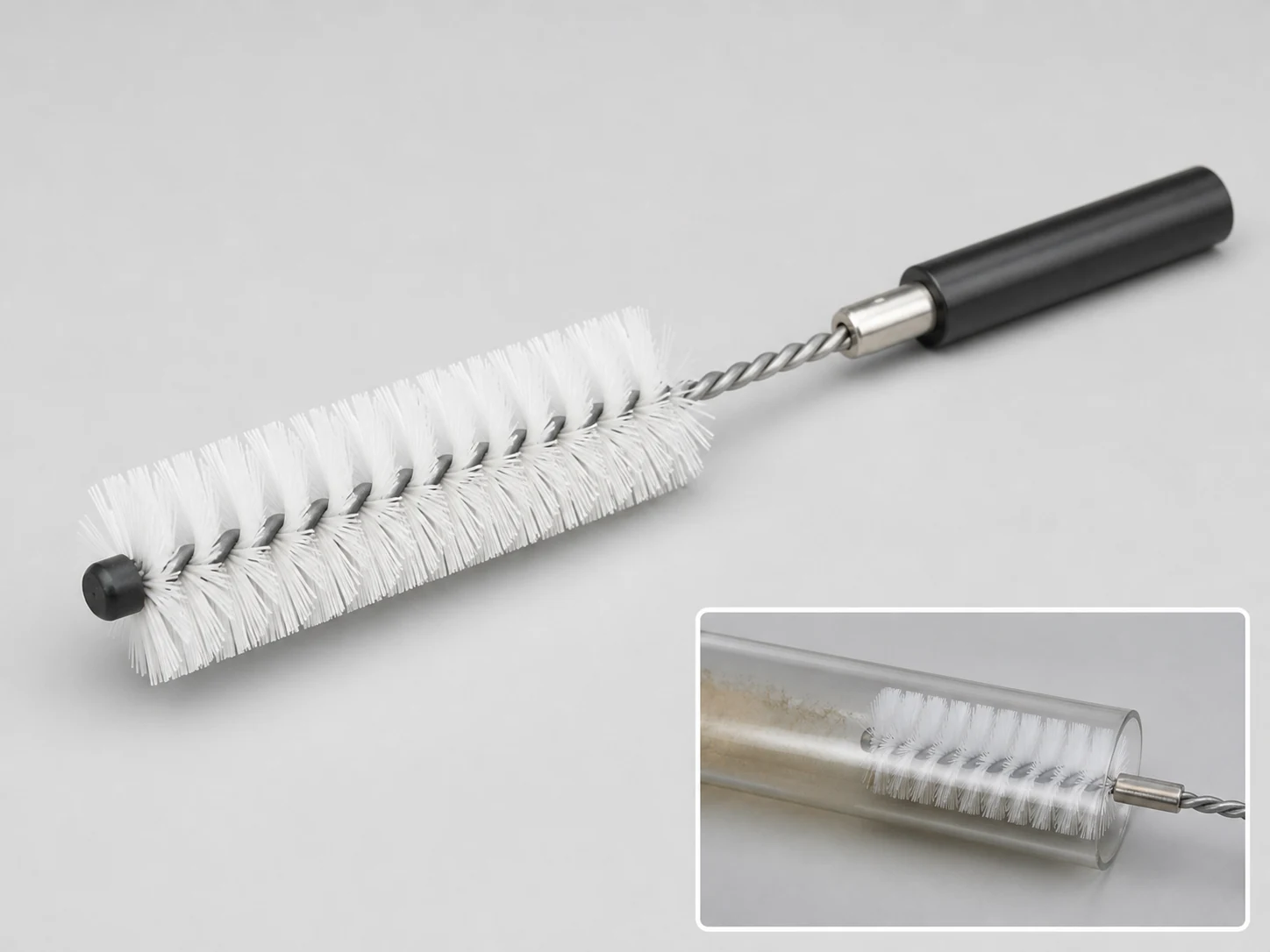
Small brush
500 pcs
Minimum order
Held in one hand: tube, bottle, detail and swab brushes — including long-handled ones with a small head.
Production lead time, once the specification is confirmed
- Up to 500 pcsWithin 7 days
- 501–50,000 pcsWithin 14 days
- Over 50,000 pcsWithin 21 days
Peak season can extend these times; the shipping date is confirmed in writing with your quotation. Sampling and shipping are quoted separately.
A flexible, nylon-filament cleaning brush built for the internal diameters of laboratory cylinders, test tubes, and narrow-mouth vessels. It reaches sidewalls, shoulders, and bottom dead spots to remove chemical film, precipitate, powder, and biological residue without scratching glass or ceramic interiors.
What can this brush do for you?
Full-circumference scrubbing on the vessel wall
The radial nylon filament pattern contacts the complete internal circumference of a cylinder or tube in one pass. Instead of rotating the brush repeatedly to cover every section, the operator gets even contact around the bore with each push-pull stroke. Filament stiffness and density can be set to match the residue, so the brush removes deposits rather than simply moving them.
A flexible stem that follows necks and curved transitions
Twisted-wire construction keeps the brush flexible where the vessel shape changes. The stem bends through narrow necks and curved shoulders of flasks and sample tubes while the filament head continues to contact the wall. A stiff rod would lift off in those zones; the flexible core keeps working contact.
Conical or tufted end reaches the bottom dead zone
The end style can be formed as a compact tuft, fan, or conical section specifically to contact the base and lower corners of a cylinder where straight radial filament sections leave residue behind. This is the area where precipitate settles, and the brush is configured to get into it.
Nylon filaments are gentle enough for glass but firm enough to break the film
Nylon PA has a balanced stiffness that removes laboratory residues such as chemical film, detergent films, oil, and biological deposits without the scratch risk of wire or aggressive abrasive brushes. Filament diameter can be selected from fine to coarse to tune the aggressiveness for the surface and deposit.
Controlled filament retention keeps the brush from leaving its own debris
The tufts are mechanically crimped into the twisted-wire stem core, and edge trimming plus pre-shedding options are available. In laboratory environments, a brush that leaves its own fibers behind becomes a contamination source. This design is built to stay together during repeated push-pull and rotating use.
What is a Laboratory Cylinder Cleaning Brush?
A Laboratory Cylinder Cleaning Brush is a hand-guided internal scrubbing tool with nylon filament radially anchored around a twisted-wire stem. It is sized to enter narrow vessel openings and contact the internal wall along the full working length, including the base when the end profile is configured for it.
In practice, the operator inserts the brush into a cylinder, test tube, or narrow-neck vessel and uses a combination of push-pull and rotating strokes. The flexible stem follows the sidewall while the filament section works against the surface. A tufted or conical end handles the bottom transition where residue collects.
This is a manual cleaning tool, not a replacement for solvent soaking, ultrasonic baths, or chemical cleaning. It loosens attached residue; the rinse that follows removes it. The brush becomes part of a multi-step labware cleaning sequence rather than the entire sequence.
Standard construction uses nylon PA filaments on a twisted-wire core with a loop handle, straight wire end, or polymer grip. The core and filament details can be matched to the chemicals, temperatures, and wash cycles of the laboratory where the brush will be used.
Technical Specifications
The table shows standard configuration ranges for this brush. Every dimension can be adjusted to your vessel drawing and cleaning process.
| Parameter | Available Range / Options |
|---|---|
| Head diameter | 20–100 mm (0.79–3.94 in), sized to vessel ID |
| Working filament length | 30–250 mm (1.18–9.84 in) |
| Overall length | 150–800 mm (5.9–31.5 in) |
| Stem diameter | 1–5 mm (0.039–0.197 in), twisted-wire core |
| Filament diameter | 0.08–0.40 mm; fine for film, coarse for precipitate |
| End style | Tufted, fan, cylindrical, conical, or flat |
| Fill material | Nylon PA (standard) |
| Stem core options | Galvanized steel, type 304 stainless, type 316 stainless, or coated wire |
| Contact fit | Near-size for wiping; 5–20% oversize for flexible nylon scrubbing |
| Temperature limit | Up to 80°C (176°F) continuous for standard nylon PA |
| Brush type | Custom Bottle & Container Brushes |
| How it is driven | Hand-guided |
| Cleaning target | graduated cylinder and mixing cylinder, test tube and centrifuge tube, and narrow-neck erlenmeyer flask and volumetric flask cleaning |
| Surface or part | cylinders, tubes, vessels, sidewalls, glass, test tubes, shoulders, and necks |
| Residue or debris | precipitate, biological residue, powder, chemical film, detergent film, mineral scale, and salt |
| Mounting / connection | Threaded Removable / Fixed |
Where does this brush work best?
- Graduated cylinders and mixing cylinders with residue rings at the fill line or settled precipitate in the lower section.
- Test tubes and centrifuge tubes where the internal diameter is small and the bottom is hard to reach with a cloth or flat brush.
- Narrow-neck Erlenmeyer flasks and volumetric flasks where the brush must bend through the neck and then contact the wider body.
- Burettes, long narrow tubes, and glass bores that need full-length sidewall contact.
- Reagent bottles, storage bottles, and sample vials returned to clean service in laboratory workflows.
- Laboratory apparatus with coatings or calibration marks that require controlled, non-scratching mechanical contact.
How do I choose the right one?
Measure the narrowest internal passage first. The brush must pass through every neck, shoulder, or stopcock zone it will encounter. Head diameter should be near vessel ID for gentle wiping, and 5–20% larger for flexible nylon scrubbing because the filaments bend back under pressure. Never let the head be so large that it jams against glass, quartz, or plastic.
Match filament diameter to the residue. Fine filaments from 0.08 to 0.15 mm work on thin film, light biological residue, detergent film, and sensitive surfaces. Medium filaments from 0.15 to 0.20 mm handle general laboratory residue. Coarse filaments from 0.25 to 0.40 mm are for dried precipitate, powder, and salt deposits. If the residue is hard mineral scale or baked-on carbon, this nylon brush is the wrong tool; an ultrasonic bath, chemical soak, or wire brush will perform better.
Set the reach from the vessel depth. The working filament length should cover the full internal surface from neck to base. For deep narrow tubes beyond 300 mm, the twisted-wire stem must be stiff enough to transmit force. A single-wire core works for short to medium lengths; a double-wire or heavier core is needed for deeper vessels.
Choose the end style for the bottom. A tufted end handles the bottom dead space. A conical end cleans the transition between sidewall and base. A flat-end cylindrical shape gives complete sidewall coverage when base detail matters less. Fan and multi-diameter ends can be specified for specially shaped vessels.
Verify chemical and temperature compatibility. Nylon PA handles water-based laboratory detergents and many mild solvents. Strong oxidizing acids, phenols, and prolonged exposure to aggressive solvents can degrade the filaments. If the cleaning process includes aggressive chemistry, repeated autoclaving, or dry heat, specify the chemistry and cycle at the RFQ stage so the core and fill can be selected accordingly.
| Cleaning situation | Recommended configuration |
|---|---|
| Thin films inside glass cylinder | Near-size diameter, fine filament 0.08–0.12 mm, tufted end |
| Soft precipitates and biological residue | 5–10% oversize, medium filament 0.15–0.20 mm, conical end |
| Dried salts or powder in glassware | 10–20% oversize, coarse filament 0.25–0.40 mm, cylindrical or tufted end |
| Long narrow tubes or burettes | Smaller head, longer stem, heavier core, check full travel length |
Use a wire brush when the deposit is heavy mineral scale or carbonized material. Use a disposable swab when cross-contamination control is the primary requirement. Use an ultrasonic bath or chemical soak when the residue must be dissolved rather than mechanically removed.
Can I customize this brush?
Laboratory cylinder cleaning brushes are configured to the vessel, not picked from a fixed catalog. To start a custom specification, provide the narrowest internal diameter, body diameter, internal depth, neck and shoulder geometry, residue type, cleaning chemicals, wash temperature, sterilizing method if any, and the preferred handle or interface. A vessel drawing or sample photograph helps us define the configuration faster.
We can adjust the following elements:
- Head diameter and profile — radial, flared, tapered, stepped, or custom molded silhouette
- Filament length, trim, and row pattern — spiral rows, multi-section contact, or zone-specific stiffness
- Filament material and diameter — nylon PA standard, with other chemical-resistant fills available on request
- Stem core — galvanized, type 304 or 316 stainless, plain or coated wire, single-wire or double-wire twist
- Handle or interface — straight wire loop, loop with protective cap, polymer grip, or a machine-holder end for semi-automated use
- End style — tufted, fan, conical, flat, or no end tuft
- Color and marking — color-coded filaments, handle marking, pad print, or laser marking for zone identification
- Packaging — bulk, individually sealed, shelf-ready retail, or laboratory kit format
If your project requires certification support, material documentation, inspection, or third-party testing, we can assist with those requirements during the customization process.
Which filament survives the cleaning and still lasts on a laboratory cylinder cleaning brush?
How do I know whether to pick 0.08 mm or 0.40 mm filament?
Fine filament from 0.08 to 0.12 mm is for light films and sensitive surfaces. Medium from 0.15 to 0.20 mm handles general lab residue. Coarse from 0.25 to 0.40 mm is for dried precipitate and powder. When unsure, start at medium; coarse filament removes more but creates more friction and may be unnecessary on glass.
Will this brush damage graduated cylinder markings or internal coatings?
Nylon PA is softer than glass and most ceramic, and under normal hand pressure it will not remove printed calibration marks. If the vessel has an internal coating or fragile surface film, choose fine filament and a near-size diameter. Always test on a sacrificial vessel or inconspicuous area before full production use.
How do I clean and store the brush after use?
Rinse thoroughly with a cleaning solution or solvent matched to the residue. Work the filaments between rinses to release trapped material, and inspect between rows. Hang the brush vertically with the filament end down to dry. Do not leave it immersed in strong reagents, and replace it when the filaments flatten, clump, or no longer spring back.
Can this brush be autoclaved?
Standard nylon PA tolerates occasional steam sterilization, but repeated autoclave cycles degrade the filament over time. Specify any steam, dry-heat, or chemical sterilization schedule during customization so we can select filament and core materials that survive the expected cycle count.
What is the best way to check for filament shedding before putting the brush into service?
Run the brush against a clean white lint-free cloth or in clean deionized water and inspect for loose fibers. A pre-trim and pre-shed step can be requested at production to reduce first-use shedding. Inspect the brush again after the first cleaning cycle in the laboratory.
When is a different cleaning method the right call?
If the deposit is hard mineral scale, burned-on carbon, or requires dissolution, mechanical brushing may be inefficient; use an ultrasonic bath, chemical soak, or wire brush. If cross-contamination risk is critical and cleaning tools cannot be shared, consider single-use swabs. This brush is for routine mechanical residue removal on reusable labware, not for every cleaning problem.
Guides that go deeper on this
We have not written a guide specific to this one yet. The material that covers selection, filament, dimensions, maintenance and sourcing is collected in the technical resources library.
Custom Manufacturing RFQ
Describe Your Application
Send the key measurements, cleaning requirement, residue, material direction, mounting method, quantity, and drawing or photo.
Drawing or photo optional — it speeds things up, it does not gate the enquiry.
Custom Brush RFQ
Send Your Brush Project
Upload a drawing, product photo, or sample photo and provide the core dimensions and cleaning conditions.
“We need a brush to remove wet residue from a stainless steel conveyor, about 800mm wide. The current brush wears quickly. We can send photos.”
“We sell drinkware and need a cleaning brush to include with the product. Quantity around 5,000 pieces.”