
Custom Cleaning Brush
Wire Chimney Brush
Custom wire chimney brushes for round, square, and rectangular flues. Carbon steel, stainless, or nylon fills. M12, NPT, pull ring connections.
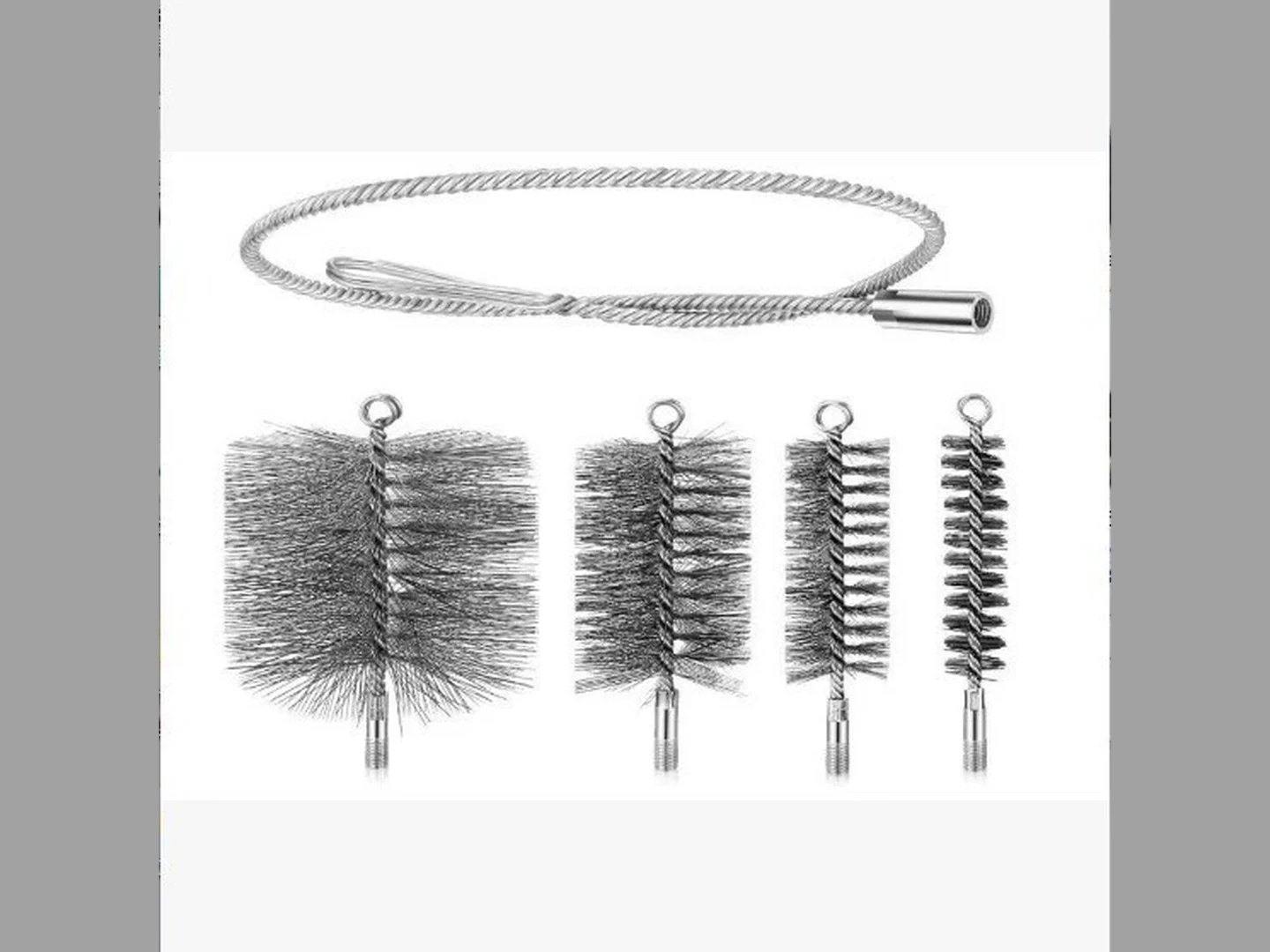
Medium brush
100 pcs
Minimum order
Worked with two hands or on a pole: chimney, gutter and pond-filter brushes, discs, cups and tank brushes.
Production lead time, once the specification is confirmed
- Up to 100 pcsWithin 7 days
- 101–5,000 pcsWithin 14 days
- 5,001–50,000 pcsWithin 21 days
- Over 50,000 pcsConfirmed with your quotation
Peak season can extend these times; the shipping date is confirmed in writing with your quotation. Sampling and shipping are quoted separately.
A wire chimney brush for removing soot, ash, and hardened creosote from round, square, and rectangular chimney flues. Available in carbon steel, stainless steel, or nylon-polymer fills, with connection options for rod, rope, and pull-through cleaning systems.
What can this brush do for you?
Aggressive removal of hardened creosote
Creosote that has cooled and hardened on flue walls resists soft brushes. The wire fill—carbon steel for masonry flues—bites into the deposit and breaks it free in a single pass. Stainless steel wire offers similar action on stainless liners without leaving rust stains.
Covers corners and flat walls in square and rectangular flues
Round brushes leave corners untouched in square or rectangular passages. The brush head is built to the exact flue cross-section, with bristle length and density calculated to reach the corners and scrub the full perimeter, so no ridge of creosote is left behind.
Runs from the roof or the firebox
The head can be fitted with a pull ring for rope lines, an M12 or NPT/NPSM connection for sectional rods, or a custom coupling for your existing rod system. This gives you the ability to clean from the top down or push up from the bottom, depending on roof access and flue configuration.
Protects sensitive liners with polymer fill
For stainless steel chimney liners or other corrosion-prone surfaces, nylon PA filaments remove soot without scratching the metal or creating the potential for rust transfer. The brush still delivers aggressive cleaning, but without the abrasion risk of steel wire.
Withstands repeated pulling and rod torque
The double-spiral twisted wire stem locks each filament bundle in place. Filaments stay anchored during forceful strokes and rod rotation, so the brush maintains its shape and fill density over many cleaning cycles.
What is a Wire Chimney Brush?
A Wire Chimney Brush is a specialized flue-cleaning tool consisting of a twisted wire stem that anchors multiple rows of wire or polymer filaments, formed into a round, square, or rectangular head. It has no handle; instead, it connects to a rod, rope, or cable at one end and is drawn through the chimney or flue to scrape deposits from the interior walls.
The brush works by mechanical abrasion. As it is pulled or pushed through the flue, the bristles deflect against the walls and dislodge soot, ash, and creosote. The debris falls into the firebox or collection area below. The brush itself is not a vacuum; it removes attached material but does not capture the loosened debris, so a proper collection method is still required.
It is suitable for rigid flues—masonry, clay tile, or metal—and for both vertical and horizontal runs when the correct rod or pulling arrangement is used. The wire or polymer fill is selected for the liner material, because steel wire can scratch some stainless liners or transfer rust to them.
Operating considerations: always match the brush head to the flue cross-section with a small clearance; a too-tight fit will cause binding and rod breakage, a too-loose fit will leave residue. Inspect the brush before each use for loose wires or damaged stems, and never use a steel wire brush on a flexible liner unless the liner manufacturer permits it.
Technical Specifications
All dimensions and materials are set per project. Below are the parameters we confirm during ordering.
| Parameter | Specification |
|---|---|
| Flue cross-section | Round, square, or rectangular; nominal dimension matched to project |
| Fits flue size | Custom per flue ID/ID dimensions; typical clearance 6–13 mm (0.25–0.5 in) less than flue interior |
| Head shape | Round, square, rectangular; corner radius can be specified |
| Fill material | Carbon steel wire, 304 stainless steel wire, or nylon PA filament |
| Wire diameter | 0.30–0.80 mm, selected by liner and deposit type |
| Stem construction | Single- or double-spiral twisted wire, galvanized or 304 stainless core |
| Connection | M12 threaded, NPT/NPSM pipe thread, pull ring, or custom quick-coupler |
| Reach system | Sectional rods, flexible rods, rope line, or pull-through line |
| Operating direction | Top-down or bottom-up; vertical or horizontal flue |
| Working environment | Ambient temperature; no heated surfaces |
| Brush type | Custom Tube & Pipe Bore Brushes |
| How it is driven | Hand-driven on rods or a flexible shaft |
| Cleaning target | fireplace chimney flue, wood stove flue pipe, and boiler breeching and stack connection cleaning |
| Surface or part | flues, carbon steel, corners, tile, pipes, walls, metal, and passages |
| Residue or debris | soot, carbon, ash, clay, hardened creosote, rust, and carbon deposit |
| Mounting / connection | M12 threaded, NPT/NPSM pipe thread, pull ring, or custom quick-coupler |
For stainless steel liner applications, specify nylon PA or stainless wire to avoid carbon steel contamination.
Where does this brush work best?
- Fireplace chimney flues in homes and restaurants—masonry or clay tile liners with creosote and soot buildup.
- Wood stove flue pipes—round stainless or black steel pipes, using nylon or stainless wire fill.
- Boiler breeching and stack connections—industrial flue passages with carbon deposits and ash.
- Square or rectangular masonry chimneys—older residential or commercial structures where round brushes miss corners.
- Chimney sweeping service companies—standardized rod connections for quick changeovers between jobs.
- Liner cleaning after installation or maintenance—polymer option for new stainless liners that require non-scratch cleaning.
How do I choose the right one?
Choosing the correct wire chimney brush comes down to the flue cross-section, liner material, deposit type, and your access method. The following checks will narrow the configuration.
Measure the flue cross-section
Measure the narrowest internal dimensions of the flue, including any offset or damper frames. The brush head should be slightly smaller than the narrowest point to avoid jamming, but large enough that bristles deflect and contact all walls. For square or rectangular flues, specify the exact internal width and depth; a custom rectangular head will clean corners that a round brush misses.
Match the fill to the liner
| Liner material | Recommended fill |
|---|---|
| Masonry / clay tile | Carbon steel wire |
| Stainless steel rigid liner | 304 stainless steel wire or nylon PA |
| Flexible stainless liner | Nylon PA |
| Unknown / mixed | Nylon PA to be safe |
Carbon steel wire is aggressive and works well on masonry where rust transfer is not a concern. Stainless steel wire avoids corrosion and is suitable for rigid stainless liners. Nylon PA is the safest choice for flexible liners or when you must avoid any metal scratching.
Set the connection and reach
Choose the connection based on your rod system. M12 is common for sectional fiberglass rods; NPT/NPSM for screw-together pipe rods; pull ring for rope or cable. Determine cleaning direction: top-down requires rope or rods long enough to reach from the roof; bottom-up requires rods that can push upward. Horizontal flue runs require flexible rods or a pull-through line.
Consider the cleaning motion
Manual brushing works for moderate soot and creosote; for heavy or glazed creosote, a rotary power sweeping system or chemical treatment may be needed. The wire brush is not a substitute for chemical creosote removers when deposits are in the third degree of creosote.
Use a poly brush instead of wire when the liner is fragile or when avoiding metal contact is critical. And remember that brushing loosens debris but does not collect it—pair the brush with a proper chimney vacuum or collection method.
Can I customize this brush?
Every wire chimney brush is built to order for the flue it will clean. To define your configuration, provide the internal flue dimensions (width, depth, or diameter), liner material, deposit type, access direction, and rod/rope system you use.
We can adjust:
- Head geometry—round, square, or rectangular; custom corner radius or tapered profile
- Filament material and wire diameter—carbon steel, 304 stainless steel, or nylon PA; gauge selected for deposit aggressiveness
- Fill density—number of filament rows and bristles per row to match residue load
- Stem construction—single-spiral or double-spiral; galvanized or stainless core
- Connection type—M12, NPT/NPSM, pull ring, or custom coupling to match your rods or rope system
- Head marking—laser marking, stamped identification, or color coding for size differentiation
- Packaging—bulk, individual bag, retail sleeve, or project-specific packing
If your project requires documentation support, material declarations, inspection, or third-party testing, we can assist with those requirements during the customization process.
Which filament survives the cleaning and still lasts on a wire chimney brush?
How do I measure my flue to get the right brush size?
Measure the flue interior at its narrowest point—usually at the damper frame, thimble, or offset. For round flues, measure the inside diameter; for square or rectangular, measure width and depth. Provide those measurements to us, and we will build the brush head approximately 6–13 mm (0.25–0.5 in) smaller than the narrowest point. Do not order by nominal chimney size because clay tile flues often vary in actual dimension.
Can a wire chimney brush be used on a stainless steel liner?
Yes, but only with the correct fill. Carbon steel wire will scratch and can leave rust particles on the liner. Use 304 stainless steel wire if the liner is rigid and the manufacturer permits mechanical brushing, or use nylon PA filament for maximum protection. Always check the liner manufacturer’s cleaning recommendations before ordering.
How do I know when the brush needs to be replaced?
Inspect the brush before each cleaning. Replace if the wire filaments are flattened, broken, or missing; if the stem is bent, corroded, or shows signs of unwinding; or if the head no longer holds its shape against the flue walls. A brush with reduced fill density will leave deposits behind. For commercial sweeping operations, track cleaning cycles and replace based on observed wear.
What is the difference between single-spiral and double-spiral construction?
Single-spiral uses one wire twisted around the stem, which is lighter and works for light to medium deposits. Double-spiral uses two opposing spiral wires that lock each filament more tightly, giving a denser fill and better retention during heavy scraping or rod rotation. Choose double-spiral for hardened creosote or when using a rotary rod system.
Does brushing remove all creosote, or do I still need chemical treatment?
Brushing removes first- and second-degree creosote (sooty or flaky deposits) and loose debris. Third-degree glazed creosote is a hard, tar-like layer that mechanical brushing alone often cannot remove completely. In that case, use a chemical creosote remover before brushing, or consider professional rotary cleaning. Brushing is a mechanical step, not a complete creosote elimination method.
Guides that go deeper on this
Custom Manufacturing RFQ
Describe Your Application
An accurate custom quote starts with the dimensions, working surface, residue, material choice, connection, quantity, and reference files.
Drawing or photo optional — it speeds things up, it does not gate the enquiry.
Custom Brush RFQ
Send Your Brush Project
Upload a drawing, product photo, or sample photo and provide the core dimensions and cleaning conditions.
“We need a brush to remove wet residue from a stainless steel conveyor, about 800mm wide. The current brush wears quickly. We can send photos.”
“We sell drinkware and need a cleaning brush to include with the product. Quantity around 5,000 pieces.”