
What Is a Cup Brush?
Choosing between a cup brush and a wheel brush should be judged by the actual job conditions, not by the product name alone. Start with base material, residue or burr severity, target finish, speed, pressure, and scratch tolerance. The right brush reaches the area, removes the target soil or finish defect, and avoids creating a second problem such as scratching, shedding, jamming, static risk, or contamination.
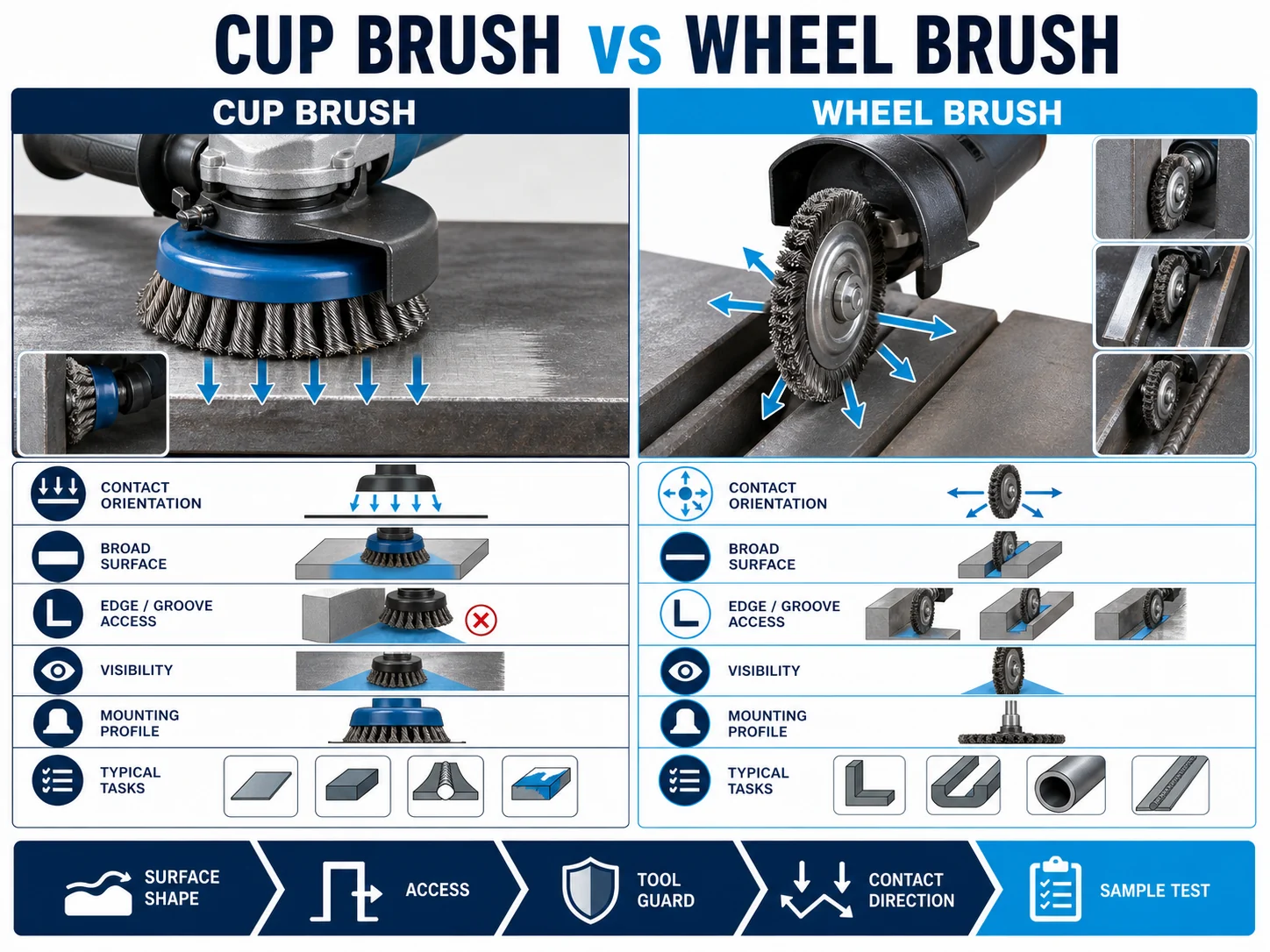
A cup brush is a power tool accessory with wire bristles arranged perpendicularly around a central hub, forming a shape like a shallow cup. The bristles fan out from the rim, creating a circular working face. Most cup brushes mount directly to an angle grinder spindle via a threaded arbor (typically 5/8‑11 UNC) or a quick‑change nut. A cup brush excels on large flat surfaces such as plates, decks, and structural steel, but its cup shape also allows it to reach into inside corners and tight spaces. You move the brush with its full face against the work, letting the wire tips do the cleaning, deburring, or paint removal.
What Is a Wheel Brush?
A wheel brush is a power tool accessory with wire bristles radiating outward from a central hub like the spokes of a wheel. The bristles are arranged only around the perimeter, so the working edge is the outer rim of the wheel. Wheel brushes usually have a centre arbor hole and mount on a bench grinder shaft, but many are also available with a threaded arbor for an angle grinder or a shank for a die grinder. Their thin edge makes them ideal for cleaning narrow grooves, weld seams, pipe edges, and irregular profiles where you need good line‑of‑sight control.
Cup Brush vs Wheel Brush: Key Differences
| Feature | Cup Brush | Wheel Brush |
|---|---|---|
| Shape | Cup shape with wide face | Flat wheel with narrow edge |
| Bristle contact | Full circular face contacts surface | Only rim/edge contacts surface |
| Best applications | Large flat areas, corners, heavy‑duty cleaning | Grooves, fillets, weld seams, edges, profiles |
| Typical grinder | Angle grinder (common), some bench grinder models | Bench grinder, angle grinder (with adapter), die grinder |
| Working angle | Brush face kept flat or slightly tilted | Perpendicular to edge, or at an angle along seams |
| Surface coverage | Good for broad surfaces; limited on tight radii | Excellent for narrow, precise work; slow on large flats |
| Common wire types | Crimped, knotted, stringer | Crimped, knotted |
How to Choose Between a Cup Brush and a Wheel Brush
Use these factors to decide which brush fits your job:
- Workpiece geometry: Pick a cup brush when you need to clean a broad, flat area or reach an inside corner. Choose a wheel brush when the target is a narrow groove, a weld seam, a pipe edge, or a contoured surface where only a thin edge can engage.
- Access: If the area is open and you can hold the grinder flat, a cup brush is productive. If you must get into a tight space with limited swing room, a smaller wheel brush may be the only tool that fits.
- Grinder type: Angle grinders commonly run both cup and wheel brushes (check arbor thread and max RPM). Bench grinders are best suited to wheel brushes (through‑arbor mount). Die grinders work well with small shank‑mounted wheel brushes.
- Desired finish: A cup brush with a full face gives a more uniform finish on flats. A wheel brush can leave a sharper “hit” pattern that is useful for fine weld cleaning but may be less consistent over a wide area.
- Stock removal speed: For heavy material removal over a large area, a large‑diameter cup brush often works faster. For precise, light‑touch cleaning, a narrow wheel brush gives better control.
Common Mistakes When Using Cup and Wheel Brushes
- Using a wheel brush on a large flat surface: A wheel brush touches only along a thin line, so covering a broad plate is slow and leads to uneven cleaning. Use a cup brush instead.
- Running a cup brush at a steep tilt on a flat surface: To get full performance and even wear, keep the cup brush face flat against the work. Heavy tilting concentrates pressure on a small arc of bristles, causing uneven wear and a rough finish.
- Using the wrong spindle size: A cup brush with a threaded arbor that does not match the grinder (e.g., M14 instead of 5/8‑11) will not mount securely. Wheel brushes must fit the bench grinder arbor diameter exactly.
- Exceeding the brush’s max RPM: Every brush has a safe maximum RPM marked on it. Running a brush faster can throw bristles and is a serious safety risk.
- Applying too much pressure: Excessive force bends bristles permanently, reduces cutting action, and shortens brush life. Let the wire tips do the work.
- Using a heavily worn brush: A brush with bristles worn to half their original length no longer cleans effectively and requires more pressure, which can damage the workpiece.
When a Disc Brush Is a Better Alternative
A disc brush (sometimes called a disc‑type wire brush) is a flat, circular brush with a large working face and threaded arbor. It sits between a cup brush and a wheel brush in performance. Consider a disc brush when:
- The surface is uneven or contoured and a rigid cup brush face cannot stay in full contact.
- You need light‑duty blending, surface cleaning, or coating removal without the aggressive cut of a knotted cup brush.
- You are working with non‑ferrous materials and want a softer brushing action (e.g., brass or nylon disc brushes).
- The workpiece has variable geometry that would cause a cup brush to chatter or a wheel brush to gouge.
Disc brushes are available in a range of filament types (abrasive‑impregnated nylon, carbon steel, stainless, brass) and are often used on variable‑speed grinders for delicate surface finishing.
Final Takeaway
Select a cup brush for rapid cleaning of large flat surfaces and corners where you can keep the brush face flat. Choose a wheel brush when you need to clean edges, weld seams, or tight profiles that demand a narrow contact point. Always match the brush to your grinder’s arbor size and maximum RPM, and switch to a disc brush if your workpiece shape prevents full face or edge contact. Using the right brush not only improves your finish but also extends tool life and keeps the job safer.
Frequently Asked Questions
Can I use a cup brush on a bench grinder?
Most cup brushes are designed for angle grinders with a threaded spindle. Bench grinders usually have a smooth shaft and require a wheel‑type brush with a centre arbor hole. Some specialty cup brushes exist with a hub that fits bench grinders, but you must verify the arbor size and RPM rating before use. In most shops, a wheel brush is the safer, more practical choice for a bench grinder.
What is the difference between a knotted and crimped wire cup brush?
A crimped cup brush uses wires that are individually bent (crimped) to create a more flexible brushing face. It is gentler on the workpiece and produces a finer surface finish. A knotted (twist‑knot) cup brush has bundles of wire twisted together, making it far more aggressive for heavy rust, scale, and weld spatter removal. Choose crimped for paint preparation and light cleaning; choose knotted for tough material removal.
How do I attach a cup brush to an angle grinder?
Ensure the grinder is unplugged or battery removed. Thread the cup brush onto the spindle by hand until it seats against the inner flange. Engage the arbor lock and tighten with a wrench, but do not overtighten. Many cup brushes have a built‑in nut that replaces the standard backing flange. Always check that the brush spins freely without wobble before starting.
What size cup brush should I use for my angle grinder?
Angle grinders are sized by disc diameter (4‑1/2 inch, 5 inch, 6 inch, etc.). The cup brush diameter should not exceed the grinder’s disc rating unless the guard is removed or a different guard is used—and guard removal is a safety hazard. A 4‑1/2‑inch grinder commonly uses a 3‑ to 3‑1/2‑inch cup brush; a 5‑inch grinder can handle a 4‑inch cup brush. Always confirm the brush’s max RPM is higher than the grinder’s no‑load RPM.
Why does my wheel brush wear out quickly on the edges?
Rapid edge wear usually means you are using the wheel brush on large flat surfaces. The edge is the only contact point, so it takes all the load. Switch to a cup brush for flats and reserve the wheel brush for edges and grooves. Also check that you are not exceeding the brush’s rated speed or applying too much pressure, which accelerates wire fatigue.
Is a cup brush or wheel brush better for removing paint?
For stripping paint from large flat areas (metal siding, panels, boat hulls), a cup brush with crimped wire works well because its broad face avoids deep scratching. A wheel brush is better for narrow areas and edges where you need precise control. If the paint layer is thick and gummy, a knotted cup brush may load up; a coarse abrasive disc or chemical stripper is sometimes a better first step.
Can I use a cup brush for weld cleaning?
Yes, especially for heavy slag removal and post‑weld cleaning on flat weld seams. A knotted cup brush with a stringer bead design can reach tight fillet welds. However, for intricate TIG weld joints or thin material, a narrow wheel brush or a stringer bead wheel brush gives finer control and less chance of washing out the weld profile.
When should I replace my wire brush?
Replace a wire brush when bristles are broken, bent beyond their natural shape, or worn to less than half their original length. Also replace if you notice vibration, wobble, or if the brush no longer cleans without excessive pressure. A worn brush is less effective and more likely to throw wires, creating a safety hazard.
Technical References
- ABMA — ANSI B165.1 Power Brush Safety Slips
- OSHA — 1910.242 Hand and Portable Powered Tools
- OSHA — 1910.215 Abrasive Wheel Machinery
- OSHA — Personal Protective Equipment
Which bristle material fits this job — Nylon PA, Carbon Steel Wire or AISI 304 Stainless Steel Wire?
| Material | Continuous temperature (°C) | Peak temperature (°C) | Water absorption | Hardness |
|---|---|---|---|---|
| Nylon PA | 93 | 121 | 0.3–9% by PA grade and conditioning | Medium to firm; filament diameter and trim length control bending force. |
| Carbon Steel Wire | 200–300 | 350–450 | 0% | Rockwell C 40–60 |
| AISI 304 Stainless Steel Wire | 400 | 500 | 0% | Rockwell B 70–95 depending on temper and cold work |
| AISI 316 Stainless Steel Wire | 400 | 500 | 0% | Rockwell B 70–95 depending on temper and cold work |
Figures as published by Brushtec / DuPont; Alleima. Confirm the exact grade against the supplier datasheet before ordering.
When are Cup Brushes the wrong choice for wire cup brush?
- Cup Brushes — Use a wheel brush for a narrow edge or profile, an end brush for a confined recess, or a non-brush method when the surface cannot tolerate rotating filament contact.
- Wheel Brushes — Use a cup brush for broad open surfaces, an end brush for confined recesses, or a non-brush process when the target finish or surface cannot tolerate rotating filament contact.
- Nylon PA — The nylon family spans several grades, so heat, moisture and chemical limits should follow the selected PA resin rather than a generic nylon value.
- Carbon Steel Wire — Not for soft plastic, glass, PCB, coated solar glass or polished paint.
What should replace Cup Brushes for wire cup brush?
- Cup Brushes — Cup brushes cover a broader face than wheel brushes; end brushes are better for small recesses or pockets where the cup body blocks access.
- Wheel Brushes — Wheel brushes give narrow edge contact; cup brushes cover a broader open face, while end brushes concentrate contact at the end of a small stem for recesses.
- Nylon PA — Compare Nylon PA with PP, PBT, PET. Change material when wet stiffness, temperature, chemical resistance, conductivity, particle shedding, or surface marking becomes the limiting factor.
- Carbon Steel Wire — Compare Carbon Steel Wire with Carbon steel wire, brass wire, abrasive nylon. Change material when wet stiffness, temperature, chemical resistance, conductivity, particle shedding, or surface marking becomes the limiting factor.