
What Is Angle Grinder Brush Selection?
Angle grinder brush selection is the process of choosing the right brush geometry, filament type, and mounting specifications for an angle grinder to safely and effectively remove rust, paint, scale, weld spatter, or burrs from a workpiece. Unlike abrasive discs, wire and nylon brushes clean without excessive base material removal, making them ideal for surface preparation, edge blending, and coating removal. The three primary shapes—cup, wheel, and disc—each excel in different contact patterns and access angles, so understanding their differences prevents rework, damage, and safety hazards.
Common Types of Angle Grinder Brushes
Three main brush geometries dominate angle grinder applications. Each serves a distinct purpose based on surface geometry and cleaning requirements.
Cup Brush
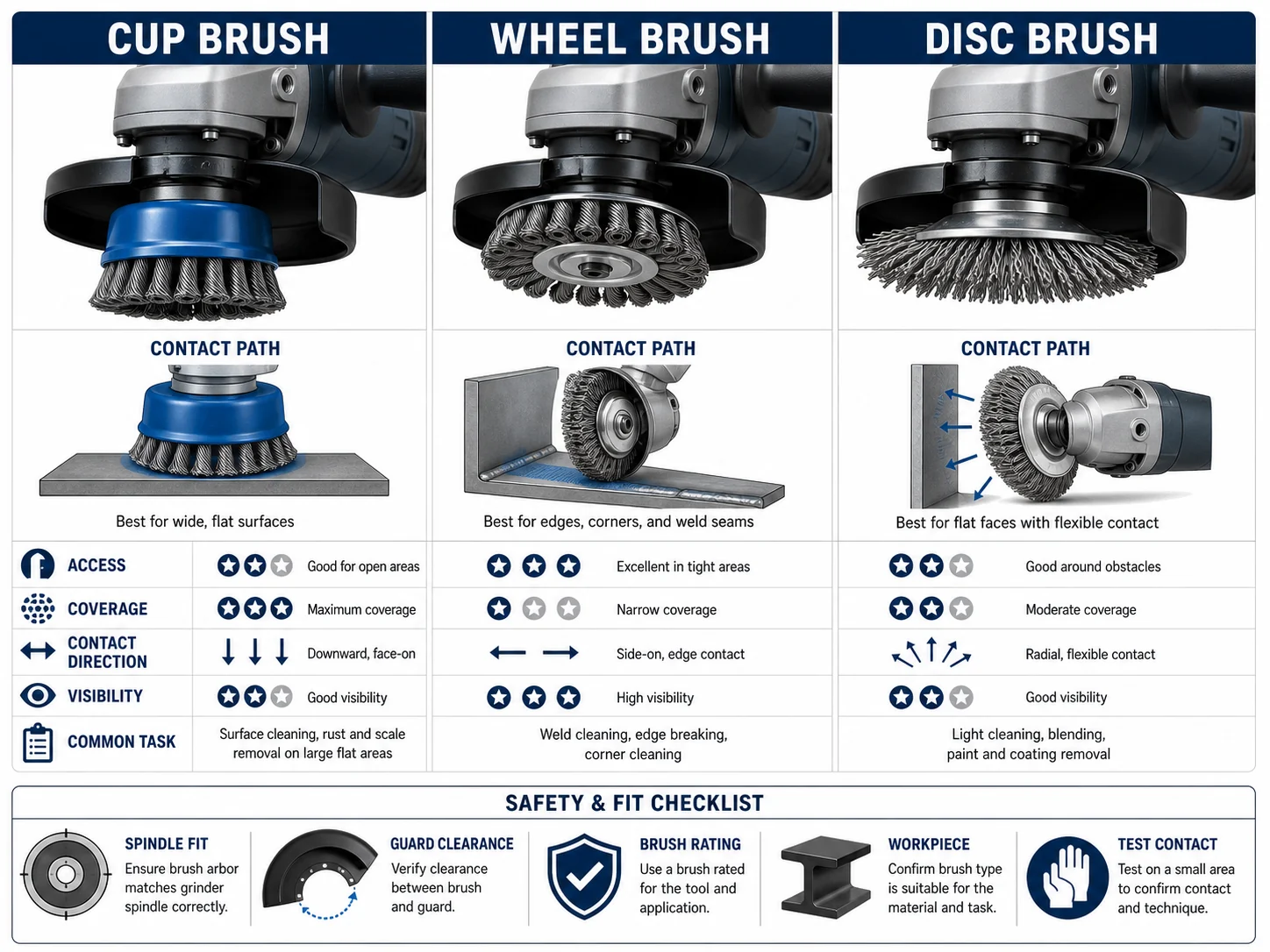
A cup brush has bristles mounted perpendicular to the arbor, forming a circular brushing face parallel to the workpiece. It provides broad, flat contact and is ideal for large, open surfaces like plates, tanks, and structural steel. Cup brushes come in wire (crimped or twisted) and nylon abrasive versions, with diameters typically from 2” to 5”.
Wheel Brush
A wheel brush features bristles radiating outward from a central hub, producing a narrow brushing edge. This shape excels at cleaning edges, grooves, corners, and tight spaces where a cup or disc cannot reach. Wheel brushes are available in knotted, crimped, and abrasive-impregnated nylon styles and are commonly sized from 3” to 6”.
Disc Brush
A disc brush, also called a flattening or radial brush, has bristles extending radially from a flat hub, creating a flexible, wide brushing face that conforms slightly to contours. It is lighter than a cup brush and often used for delicate deburring, light rust removal, and cleaning irregular surfaces without gouging. Typical sizes range from 3” to 7”.
Cup vs Wheel vs Disc Brush: Detailed Comparison
| Feature | Cup Brush | Wheel Brush | Disc Brush |
|---|---|---|---|
| Contact Area | Large, flat | Narrow, edge | Flat, moderately flexible |
| Best for Geometry | Flat surfaces | Edges, corners, grooves | Flat & slightly curved surfaces |
| Typical Residues | Heavy rust, scale, thick paint, weld spatter | Rust in tight spots, deburring edges | Light rust, paint, surface blending |
| Access Angle | Perpendicular only; limited to open areas | Angled access; reaches into confined areas | Perpendicular, but conforms to mild contours |
| Material Removal Rate | High (can be aggressive with twisted wire) | Moderate to high on edges | Low to moderate; gentle on base material |
| Tool Mounting | Threaded arbor (M10 or 5/8”-11) | Arbor hole with nut (M10 or 5/8”-11) | Arbor hole with nut or threaded insert |
| Guard Compatibility | Requires guard; check for interference | Guard usually fits; bristle length matters | Guard may need adjustment; bristles can flex |
| Common Wire Types | Crimped or twisted steel, stainless, brass, nylon | Knotted, crimped steel, stainless, abrasive nylon | Crimped steel, brass, abrasive nylon |
How to Choose the Right Angle Grinder Brush
Selecting the correct brush involves evaluating four factors: workpiece material, surface geometry, desired finish, and tool specifications.
- Workpiece Material: Use carbon steel brushes only on carbon steel to avoid contamination. Stainless steel brushes prevent rust on stainless workpieces. Brass and nylon are non-sparking and non-corrosive, suitable for softer metals or delicate surfaces.
- Surface Geometry: For open flat areas, a cup brush covers more area faster. For corners and edges, a wheel brush provides precise control. A disc brush works on large flats where a lighter touch is needed or the surface has slight contours.
- Residue Type: Heavy scale or thick rust demands a cup brush with twisted or knotted wire. Light flash rust or paint can be handled with crimped wire or abrasive nylon in any shape.
- Desired Finish: Aggressive wire types remove material faster but leave a rougher surface. Nylon abrasive brushes produce a finer finish and are less likely to gouge.
Thread Size, Guard Fit, and Speed Ratings
Before mounting any brush, confirm three safety-critical specifications against your angle grinder:
- Thread Size: Most angle grinders use an M10 (metric) or 5/8”-11 (imperial) spindle. Forcing an incorrect thread damages the spindle and can cause the brush to fly off. Check the grinder’s manual and the brush’s stamped marking.
- Guard Fit: The guard must be in place and properly sized. A cup or disc brush with a diameter larger than the guard rating exposes the operator to flying debris. Never remove the guard.
- Maximum Rated Speed: Every brush carries a maximum RPM rating. This must exceed the no-load RPM of the angle grinder. A typical 4.5” grinder runs at 10,000–12,000 RPM; many brushes are rated for 12,500–15,000 RPM. Always read the label on the brush and tool before use.
Common Mistakes to Avoid
- Wrong Geometry for the Job: Using a cup brush on curved surfaces or inside corners leads to uneven cleaning and increased operator fatigue. A wheel brush is the right choice for profiles.
- Exceeding RPM Rating: Running even slightly over the brush’s max speed can cause catastrophic failure, ejecting bristles or the entire hub.
- Ignoring Material Contamination: Using a steel brush on stainless steel embeds ferrous particles, leading to rust. Keep dedicated brushes for each material group.
- Guard Removal or Modification: Some operators remove the guard to fit an oversized cup brush. This eliminates essential protection and violates safety standards.
- Excessive Pressure: Pushing too hard on a disc or cup brush overheats the bristles, may bend them permanently, and dramatically shortens brush life.
- Mixing Abrasive Grits Indiscriminately: Using a coarse nylon brush on thin sheet metal can quickly abrade through the material. Match abrasive grit to the job.
When an Angle Grinder Brush Is the Wrong Choice
Standard wire and nylon brushes may not be suitable when:
- Workpiece risk is high: Aerospace alloys, pressure vessels, food-grade equipment, or polished surfaces may require specialized brushes with controlled aggression, documented composition, or non-shedding filaments. Consult the brush manufacturer for an engineered solution.
- Safety-critical applications: In confined spaces, near explosive atmospheres, or when non-sparking tools are mandated, brass or spark-resistant beryllium-free brushes must be selected with documented compliance.
- High-speed operation: If the grinder’s speed exceeds typical brush ratings, alternative methods like chemical stripping, media blasting, or specialty brushes with reinforced hubs should be evaluated.
Final Takeaway
Effective angle grinder brush selection starts with geometry: cup for flat broad areas, wheel for edges and corners, disc for lighter blending and contoured surfaces. Then lock in material compatibility, verify thread size, ensure the guard fits, and confirm the brush’s RPM rating exceeds the grinder’s no-load speed. A brush matched this way delivers faster work, longer brush life, and safer operation.
Frequently Asked Questions
Can I use a single cup brush for both steel and stainless steel?
No. Ferrous particles from carbon steel brushes embed in stainless steel and cause rust. Use dedicated brushes per material or thoroughly clean and demagnetize between uses.
What is the difference between crimped and twisted wire cup brushes?
Crimped wire bristles are wavy and more flexible, offering good cleaning with less aggression. Twisted (or knotted) wire bristles form tight knots that deliver aggressive cutting action for heavy scale and rust removal.
How do I install a wire cup brush on an angle grinder?
Unplug the grinder, depress the spindle lock, remove the nut and abrasive disc (if present), thread the brush by hand until snug, then tighten with a wrench per the brush’s recommendations. Always reinstall the guard before use.
Can I use a disc brush without a guard?
Never operate any angle grinder brush without the guard. The guard protects you from ejected bristles and accidental contact. If a disc brush interferes, use a brush design that fits inside the factory guard.
Why does my wheel brush wear out so quickly on edges?
This often results from applying excessive pressure or using a brush rated for lower RPM than the grinder. Check the speed rating and reduce pressure to let the bristle tips do the work. Using a knotted wheel for heavy edge cleaning can also extend life.
What if my grinder’s spindle thread is different from the brush’s thread?
Do not force it. You can use a high-quality thread adapter designed for angle grinders, but ensure it maintains proper balance and does not exceed the brush’s speed rating. Always verify tightness before operation.
Are nylon brushes only for light deburring?
Nylon abrasive brushes range from fine to coarse grits. Coarse nylon can remove moderate rust and paint while leaving a smoother finish than wire, but they are not intended for heavy, caked-on scale removal.
How do I know when to replace an angle grinder brush?
Replace the brush when bristles are worn to less than 1/3 of original length, when the brush begins to flutter or vibrate excessively, or if any bristles are broken or missing. Worn brushes are less effective and more prone to throwing bristles.
Technical References
- ABMA — ANSI B165.1 Power Brush Safety Slips
- OSHA — 1910.242 Hand and Portable Powered Tools
- OSHA — 1910.215 Abrasive Wheel Machinery
- OSHA — Personal Protective Equipment
Which bristle material fits this job — Nylon PA, AISI 304 Stainless Steel Wire or Abrasive Nylon?
| Material | Continuous temperature (°C) | Peak temperature (°C) | Water absorption | Hardness |
|---|---|---|---|---|
| Nylon PA | 93 | 121 | 0.3–9% by PA grade and conditioning | Medium to firm; filament diameter and trim length control bending force. |
| AISI 304 Stainless Steel Wire | 400 | 500 | 0% | Rockwell B 70–95 depending on temper and cold work |
| Abrasive Nylon | 120 | 150 | 0.1–1.0% | Abrasive filament; stiffness and cutting level is controlled by PA base, grit type, grit size, filament diameter and trim height. |
Figures as published by Brushtec / DuPont; Alleima; Perlon. Confirm the exact grade against the supplier datasheet before ordering.
What should replace Nylon PA when it stops working?
- Nylon PA — Compare Nylon PA with PP, PBT, PET. Change material when wet stiffness, temperature, chemical resistance, conductivity, particle shedding, or surface marking becomes the limiting factor.
- AISI 304 Stainless Steel Wire — Use AISI 316 stainless steel wire for chloride, marine, dairy, beverage, chemical washdown, or higher pitting-resistance requirements. Use carbon steel for dry aggressive cutting and brass or abrasive nylon for lower marking risk.
- Abrasive Nylon — Compare Abrasive Nylon with PP, PBT, PET. Change material when wet stiffness, temperature, chemical resistance, conductivity, particle shedding, or surface marking becomes the limiting factor.