
Custom Cleaning Brush
75mm Knotted Hcs Cup Brush
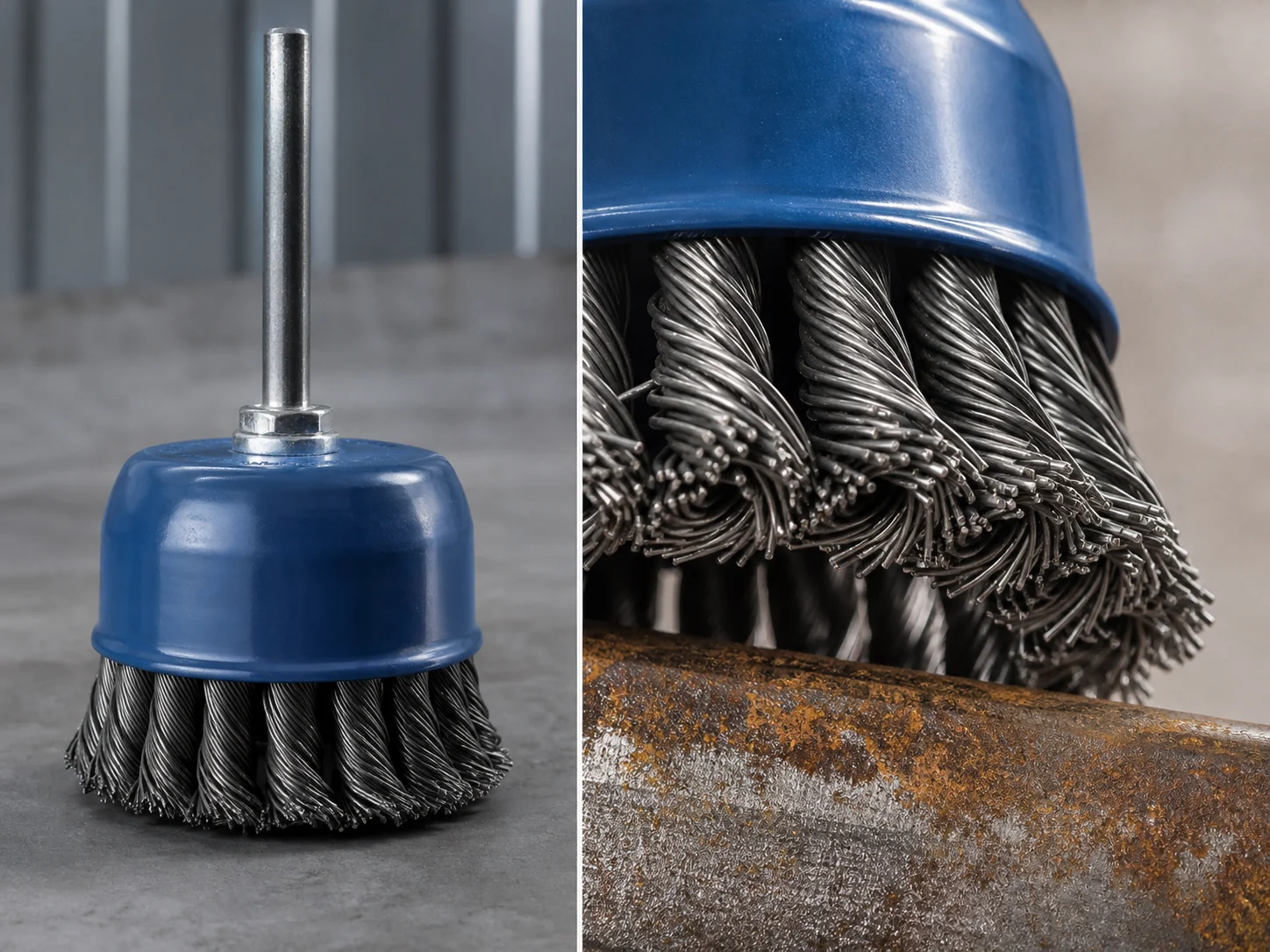
75 mm knotted HCS cup brush for angle grinders strips rust, mill scale, weld discoloration, and old coatings from steel plate, weld seams, and profiles.
Small brush
500 pcs
Minimum order
Held in one hand: tube, bottle, detail and swab brushes — including long-handled ones with a small head.
Production lead time, once the specification is confirmed
- Up to 500 pcsWithin 7 days
- 501–50,000 pcsWithin 14 days
- Over 50,000 pcsWithin 21 days
Peak season can extend these times; the shipping date is confirmed in writing with your quotation. Sampling and shipping are quoted separately.
The 75mm Knotted HCS Cup Brush is a power-driven wire cup brush for mounting on an angle grinder. Its knotted high-carbon-steel wire removes rust, mill scale, welding discoloration, old coatings, and loose slag from flat steel plate, weld seams, edges, and fabricated structural members.
What can this brush do for you?
Heavy rust and scale come off in fewer passes
The high-carbon steel wire is formed into dense twisted knots rather than loose crimped filaments. Each knot acts as a stiff cutting unit that holds its shape under grinder pressure, so the brush digs into mill scale and thick rust instead of skating over it. Fewer passes means less operator time per panel or beam.
Knotted construction extends service life and reduces wire left in the work
Twisted knots fatigue more slowly than individual crimped wires, and when they do wear, the wire tends to wear down progressively rather than shedding long loose pieces at once. This keeps replacement frequency predictable on long fabrication runs and leaves less stray wire embedded in the steel surface before coating.
The cup face cleans flat plate, while the rim follows edges and weld seams
A cup shape presents the knot ends perpendicular to the grinder face for large-area rust removal, and the outer circumference works the edges and weld toes that a flat brush cannot reach. The 30 mm head depth keeps the brush compact enough to work around gussets, stiffeners, and bracketry on fabricated parts.
The threaded arbor stays locked to the grinder spindle
The brush mounts on the angle grinder’s threaded spindle instead of a shank or adapter. This positive mechanical connection resists loosening under the lateral loads typical of wire brushing, so the cup stays concentric and balanced at speed.
High-carbon steel wire holds its edge on hard oxide scale
HCS wire is harder than low-carbon or many stainless filler wires, so the knot tips dull more slowly when working against rust and mill scale. That translates into consistent cleaning action from the first pass to the point the brush is worn out.
What is a 75mm Knotted Hcs Cup Brush?
A 75mm Knotted HCS Cup Brush is a power-driven wire brush with an internally threaded steel arbor that screws directly onto an angle grinder spindle. It uses high-carbon steel wire pulled into twisted, rope-like knots around the cup face; these knots give more aggressive cutting than crimped wire while keeping the brush diameter constant under load.
In use, the operator holds the grinder so the cup face is roughly flat to the steel surface and moves it in overlapping passes. The rotating knots strike rust, scale, welding discoloration, and old coatings off the surface. The outer edge of the cup can be presented to fillet welds, plate edges, and vertical seams when those areas need more localized contact.
This is a dry, ferrous-metal cleaning tool. It is built for carbon steel preparation, not for stainless or aluminum surfaces, and not for wet grinding or paint stripping on soft substrates. It works best when the workpiece is rigid enough to absorb the pressure of a wire brush without distortion.
Technical Specifications
Values shown are the standard configuration. Thread size, wire diameter, and cup depth can be changed to match the grinder and job.
| Parameter | Standard Specification |
|---|---|
| Head diameter | 75 mm |
| Head shape | Cup-shaped |
| Head depth | 30 mm |
| Wire material | High-carbon steel (HCS) wire |
| Wire configuration | Knotted / twisted knots |
| Standard wire diameter | 0.50 mm (heavier or lighter available) |
| Arbor / base | Steel nut and cup plate |
| Connection | Threaded, removable |
| Standard thread | M10 × 1.5 (other threads on request) |
| Compatible grinder | Angle grinder, 100–125 mm class with matching spindle |
| Maximum recommended speed | 12,500 RPM |
| Typical workpiece | Carbon steel plate, structural sections, weldments |
| Typical residue | Rust, mill scale, welding discoloration, old coatings, loose slag |
| Brush type | Custom Cup Brushes |
| How it is driven | Machine-driven, mounted in the equipment |
| Cleaning target | structural steel fabrication, weld preparation and post-weld cleanup, and plate and profile descaling cleaning |
| Surface or part | welds, edges, profiles, carbon steel, seams, weld seams, steel plate, and aluminum |
| Residue or debris | rust, scale, loose slag, paint, carbon, old coating, welding discoloration, and corrosion |
| Mounting / connection | Steel nut and cup plate; Threaded, removable; M10 × 1.5 (other threads on request) |
The thread size must match the grinder. If your grinder uses 5/8-11 UNC, M14, or another form, specify it during quoting so the brush is built with the correct arbor rather than relying on a loose adapter.
Where does this brush work best?
- Structural steel fabrication: Removing rust and mill scale from beams, columns, gussets, and base plates before welding and painting.
- Weld preparation and post-weld cleanup: Cleaning the weld zone, heat-affected area, and surrounding plate; removing weld discoloration and loose slag before inspection or coating.
- Plate and profile descaling: Stripping oxide scale and old paint from cut plate edges, rolled steel sections, and flame-cut profiles.
- Maintenance and repair: Cleaning corrosion and flaking coatings from machine bases, frames, tanks, brackets, and other large rigid steel parts.
- Pre-coating surface preparation: Producing a uniform abraded surface on carbon steel before primer, paint, or weld-through coating.
How do I choose the right one?
The standard 75mm knotted HCS cup brush fits a common angle-grinder spindle and handles most steel rust removal jobs. Use the checks below to confirm it matches your process.
Match the thread to the grinder
The standard arbor is M10 × 1.5. Measure the grinder spindle or check the manual before ordering. If the spindle is 5/8-11 UNC, M14, or another size, request that thread — do not use a loose adapter that can introduce runout and vibration.
Match the wire diameter to the deposit
A 0.50 mm knotted HCS knot is right for heavy rust, mill scale, weld spatter, and old paint. For thin coatings, light rust, or parts with detailed profiles that need more flexibility, a 0.35 mm or 0.30 mm wire may cut with less gouging. Choose the heaviest wire the surface and operator can control; heavy knots leave deeper scratches and cut slower on thin films.
Confirm the surface material before using carbon steel wire
HCS wire is for carbon steel. Do not use this brush on stainless steel or aluminum: carbon steel particles embed in the surface and can cause galvanic corrosion. For stainless or aluminum, select a dedicated stainless or brass wire cup brush instead.
Check the finish requirement
Knotted wire leaves a coarser surface profile than crimped wire. If the next step is welding or a high-build primer, that profile is usually acceptable. If you need a fine satin finish or are preparing a visible surface for a thin cosmetic coating, follow wire brushing with a crimped wire, non-woven, or coated abrasive.
Use a smaller cup or end brush if you need to get into internal corners, holes, or narrow channels. Use a larger diameter cup for uninterrupted flat areas where speed matters more than access. If rust has formed heavy laminated scale, mechanical needling or grinding may remove it faster before wire brushing.
Can I customize this brush?
The 75mm knotted HCS cup brush can be adjusted at the arbor, wire, and cup levels to fit a specific grinder, rust condition, or production process. To define a custom configuration, provide the grinder make and spindle thread, workpiece material, target residue, desired surface profile, and any plant safety or documentation requirements.
- Thread and arbor: M10 × 1.5, 5/8-11 UNC, M14, or another spindle thread; arbor plate and nut material can be matched to the grinder.
- Wire diameter and hardness: Standard 0.50 mm HCS; alternative wire gauges from 0.30 mm to 0.60 mm for softer or more aggressive cutting.
- Knot density and trim length: Denser knots for longer life, shorter trim for stiffer contact, longer trim for more conformability on profiles.
- Head depth and cup geometry: Standard 30 mm; can be changed for better access into shallow recesses or around flanges. The 75 mm diameter can also be modified if the surface width or access interval calls for a different size.
- Alternative wire materials: Stainless steel, brass-coated steel, or phosphor bronze can be built on request when cross-contamination or sparking is a concern, though these change the brush’s application window.
- Marking and packaging: Color coding, label, laser marking on the arbor, bulk pack, or individual retail/industrial packaging.
For projects that require a material certificate, third-party inspection, or test documentation for the wire or arbor, we can support those requirements during the customization process.
Which filament lasts longest on a 75mm knotted hcs cup brush?
Can the 75mm knotted HCS cup brush be used on stainless steel?
Not recommended. Carbon steel wire leaves fine carbon steel particles embedded in the stainless surface, which can initiate galvanic corrosion. Use a dedicated stainless steel wire brush and keep it separate from carbon steel tools.
What should I inspect before first use?
Check that the spindle thread and brush thread match, the cup seats flat on the spindle shoulder, and the grinder speed does not exceed 12,500 RPM. Confirm the guard and face protection are in place and that the knots are evenly distributed with no cracks in the arbor plate. Run the grinder free for about 30 seconds to check for unusual vibration.
How do I know when to replace the brush?
Replace the brush when the knots are worn to roughly half their original length, when cleaning speed drops noticeably at the same pressure, or when vibration and visible wire loss increase. Pressing harder on a worn brush usually produces more shedding than added cleaning performance.
Does this brush remove mill scale or just surface rust?
It removes surface rust and loose or lightly adherent mill scale. Tightly bonded mill scale on hot-rolled plate may require several passes, abrasive blasting, or mechanical grinding before the surface is uniformly bare. The brush works on surface oxidation, not subsurface laminations.
Is it normal for wire tips to break off during use?
Some progressive tip wear is normal, and the knotted construction is designed to control shedding. Large clumps of wire, excessive sparks, or a sudden drop in balance usually mean the brush is being run at too high a speed, held at an extreme angle, or is worn out.
What should I do after wire brushing before welding or painting?
Remove metal dust and any broken wire with a clean rag or dry air, wipe with solvent if oil or grease is present, and confirm the surface profile is uniform. On carbon steel, move to the next step quickly to prevent flash rust from forming before the primer or weld is applied.
Guides that go deeper on this
Angle Grinder Wire Wheel Brush Mistakes in Weld Cleanup
Read this guideGuideCup Brush vs Wheel Brush Speed and Pressure Trade-Offs
Read this guideGuideCup Brush vs Wheel Brush: Which One to Use
Read this guideGuideWhen to Use an Angle Grinder Wire Wheel Brush on Power Tools
Read this guideGuideNylon Cup Brushes: Polishing or Cleaning, and What Fill?
Read this guideGuideSponge Cup Brushes: Cleaning, Absorbing or Polishing?
Read this guideCustom Manufacturing RFQ
Describe Your Application
To quote this brush accurately, send the size, material, cleaning target, residue, quantity, and any available drawing or sample photo.
Drawing or photo optional — it speeds things up, it does not gate the enquiry.
Custom Brush RFQ
Send Your Brush Project
Upload a drawing, product photo, or sample photo and provide the core dimensions and cleaning conditions.
“We need a brush to remove wet residue from a stainless steel conveyor, about 800mm wide. The current brush wears quickly. We can send photos.”
“We sell drinkware and need a cleaning brush to include with the product. Quantity around 5,000 pieces.”