
What Is a Wire Wheel Brush for Angle Grinder?
A wire wheel brush for angle grinder is a disc- or cup-shaped tool that mounts to a 4-inch or larger angle grinder. Its steel, stainless steel, or brass bristles spin at high speed to abrade surface contaminants. Different wire types, diameters, and mounting styles make it versatile, but also easy to misuse if you don’t match the brush to the job.
Understanding Wire Wheel Brush Options
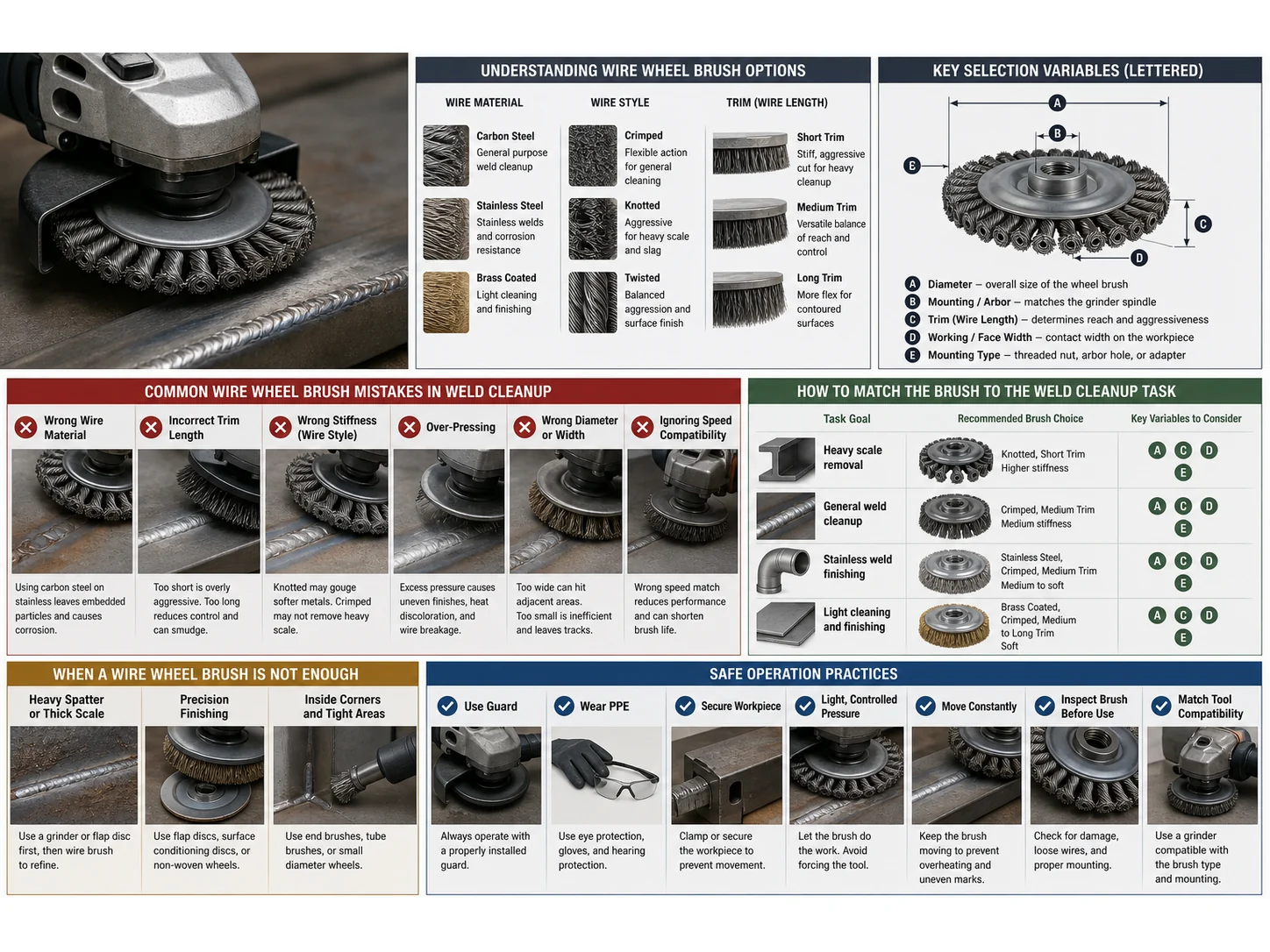
Not all wire wheel brushes are the same. Here are the key variables you’ll face when selecting a brush for weld cleanup:
| Feature | Knotted Wire Wheel | Crimped Wire Wheel |
|---|---|---|
| Bristle Type | Twisted wire rope strands | Individual crimped wires |
| Aggressiveness | High – heavy stock removal | Medium – light to medium cleaning |
| Surface Finish | Rougher, leaves deeper scratch pattern | Smoother, more uniform |
| Common Use | Heavy weld slag, thick rust, mill scale | Paint removal, light surface prep, blending |
Wire Material matters just as much:
- Carbon steel wire – common for general steel cleaning; can contaminate stainless or aluminum.
- Stainless steel wire – required for stainless or non-ferrous metals to prevent rust bloom and cross-contamination.
- Brass or bronze wire – softer, used where spark-free operation or delicate surfaces are needed.
Mounting style options include threaded arbor (most common for cup brushes), standard 7/8″ arbor with nut, and quick-change lever-lock systems. Diameter typically ranges from 3″ to 6″ for angle grinders; larger diameters require slower RPM ratings and often bench grinders.
Common Wire Wheel Brush Mistakes in Weld Cleanup
- 1. Using carbon steel wire on stainless steel or aluminum. Embedding carbon particles leads to galvanic corrosion, rust spots, and reject welds. Always use stainless wire on stainless, and brass or a dedicated stainless brush on aluminum.
- 2. Ignoring maximum RPM ratings. Exceeding the brush’s safe speed can throw wires and cause injury. Match the brush’s labeled RPM to the grinder’s no-load speed.
- 3. Choosing the wrong brush diameter. A 6-inch wire wheel on a 4.5-inch grinder may fit but will overload the motor, reduce control, and increase kickback risk. Stick to the manufacturer’s recommended size.
- 4. Pressing too hard. Excessive pressure bends bristles, generates heat, and shortens brush life. Let the wire tips do the work with moderate, steady force.
- 5. Skipping PPE. High-speed wire wheels throw broken bristles at over 200 mph. Always wear a full-face shield, safety glasses, gloves, and a leather apron.
- 6. Using a dirty or dull brush. A loaded brush with caked slag smears contaminants instead of cleaning. Clean the brush regularly and replace it when bristles lose their shape or aggression.
- 7. Overlooking surface sensitivity. On precision-machined or thin-gauge parts, knotted wheels can gouge the surface. Use crimped or fine wire brushes for delicate work.
- 8. Neglecting material cross-contamination. Using the same brush on carbon and stainless steel can transfer carbon and cause intergranular corrosion. Dedicate separate brushes per material family.
- 9. Running a wire wheel in wet or chemically active environments. Moisture and chemicals degrade carbon steel wire rapidly; choose stainless or brass for wet/damp conditions, or consider non-wire alternatives.
How to Match the Brush to the Weld Cleanup Task
Use this decision sequence to avoid the most common mistakes:
- Identify the base metal – carbon steel, stainless, aluminum, or other alloy.
- Assess the residue – heavy slag, light discoloration, paint, or rust.
- Determine surface finish requirements – rough structural weld vs. cosmetic food-grade surface.
- Check grinder speed and mount – ensure RPM compatibility and correct arbor size.
- Consider operational environment – wet, chemical exposure, or hygiene requirements may dictate wire material and alternative methods.
- Select the right combination:
- Heavy slag on carbon steel → knotted carbon steel wire wheel, 4–4.5″ diameter, coarse.
- Light cleanup on stainless → crimped stainless steel wire wheel, fine, dry use only.
- Paint/rust on mixed metals → crimped brass wire wheel to avoid contamination.
- High-hygiene or wet area → stainless or brass brush; consider non-woven nylon abrasives if wire break-off is a concern.
When a Wire Wheel Brush Is the Wrong Choice
A wire wheel brush cannot remove deep pitting corrosion, heavy mill scale on thick plate, or achieve a polished sanitary finish. It also generates sparks, making it unsafe in explosive atmospheres. In those cases:
- Flap discs or grinding wheels are better for heavy stock removal.
- Chemical strippers or citric acid baths handle complex shapes without embedding wire particles.
- Blast media (sand, garnet, CO₂) cleans irregular geometries and removes deep rust without mechanical abrasion directionality.
- Non-woven abrasive wheels (e.g., surface conditioning discs) provide a smooth, contamination-free finish for food-grade or painted surfaces.
- If part dimensions are critical, always test a sacrificial piece before committing to wire brushing.
Safe Operation Practices
- Inspect the brush for loose wires, cracks, or excessive wear before mounting.
- Let the grinder run at full speed for 30 seconds after mounting a new brush; stand clear.
- Maintain a 10–15° angle to the workpiece to prevent edge gouging and erratic brush movement.
- Never use a wire wheel without a guard. The guard should be positioned between you and the wheel.
- Disconnect power before changing brushes or adjusting the guard.
Maintenance and Storage Tips
- Clean the brush with a wire brush comb or solvent (compatible with the wire material) to remove built-up debris.
- Store in a dry environment; carbon steel brushes will rust quickly if left in damp conditions.
- Replace the brush when bristles are worn to less than half their original length or when they lose their shape.
Final Takeaway
Most weld cleanup mistakes with a wire wheel brush come from rushing the selection or skipping a material compatibility check. Always match wire material to the base metal, respect speed and diameter limits, and let the tool do the work with light, consistent pressure. When in doubt, test on scrap, and keep a dedicated brush set for stainless and carbon steel to avoid cross-contamination. For heavy removal or finish-critical welds, know when to step up to a flap disc, chemical treatment, or blast cleaning.
Frequently Asked Questions
What is the difference between knotted and crimped wire wheel brushes?
Knotted brushes use twisted wire rope segments for aggressive, heavy-duty cleaning and leave a rougher surface. Crimped brushes have individual crimped wires that are more flexible, providing a finer finish suitable for lighter cleaning and paint removal.
Can I use a wire wheel brush on aluminum?
You can, but you must use a brush with stainless steel or brass wire that is strictly dedicated to aluminum. Carbon steel brushes embed particles that cause galvanic corrosion and pitting on aluminum.
How do I attach a wire wheel brush to an angle grinder?
Most wire wheel brushes mount directly to the grinder’s threaded spindle. Remove the backing flange, screw the brush on tightly by hand, then engage the spindle lock and give a final hand-tighten. Never use a wrench to overtighten. For cup brushes with a nut, use the included wrench.
Why does my wire wheel brush leave scratches or discoloration?
Scratches can result from using a knotted wheel when a crimped wheel would be more appropriate, applying too much pressure, or using a brush contaminated with harder particles. Blueish discoloration is heat tint; it often means excessive pressure or dwelling in one spot.
Can I use the same wire wheel brush on both stainless steel and carbon steel?
No. Shared brushes transfer carbon steel particles onto stainless, causing rust and intergranular corrosion. Always designate separate brushes (and mark them clearly) for carbon steel, stainless steel, and aluminum.
How often should I replace a wire wheel brush?
Replace the brush when bristles wear down to about half their original length, when the wheel becomes unbalanced or vibrates, or when cleaning performance noticeably drops. Using a worn brush forces you to press harder, increasing the risk of injury and damaging the workpiece.
Can a wire wheel brush be used on concrete or wood?
While there are specific wire cup brushes marketed for concrete and wood, general weld-cleanup wire wheels are not designed for these materials. Concrete rapidly dulls carbon steel wire and may shatter brittle wire. For wood, wire brushes leave a rough texture and can embed metal particles; specialized nylon abrasive wheels are usually better.
Technical References
Which bristle material fits this job — AISI 304 Stainless Steel Wire, Carbon Steel Wire or Brass Wire?
| Material | Continuous temperature (°C) | Peak temperature (°C) | Water absorption | Hardness |
|---|---|---|---|---|
| AISI 304 Stainless Steel Wire | 400 | 500 | 0% | Rockwell B 70–95 depending on temper and cold work |
| Carbon Steel Wire | 200–300 | 350–450 | 0% | Rockwell C 40–60 |
| Brass Wire | 150–200 | 250–300 | 0% | Rockwell B 40–90 |
| Nylon PA | 93 | 121 | 0.3–9% by PA grade and conditioning | Medium to firm; filament diameter and trim length control bending force. |
| AISI 316 Stainless Steel Wire | 400 | 500 | 0% | Rockwell B 70–95 depending on temper and cold work |
Figures as published by Alleima; Brushtec / DuPont. Confirm the exact grade against the supplier datasheet before ordering.
What should replace Wheel Brushes for wire cup brush?
- Wheel Brushes — Wheel brushes give narrow edge contact; cup brushes cover a broader open face, while end brushes concentrate contact at the end of a small stem for recesses.
- Cup Brushes — Cup brushes cover a broader face than wheel brushes; end brushes are better for small recesses or pockets where the cup body blocks access.
- AISI 304 Stainless Steel Wire — Use AISI 316 stainless steel wire for chloride, marine, dairy, beverage, chemical washdown, or higher pitting-resistance requirements. Use carbon steel for dry aggressive cutting and brass or abrasive nylon for lower marking risk.
- Carbon Steel Wire — Compare Carbon Steel Wire with Carbon steel wire, brass wire, abrasive nylon. Change material when wet stiffness, temperature, chemical resistance, conductivity, particle shedding, or surface marking becomes the limiting factor.