
Custom Cleaning Brush
65mm SS304 Cup Brush
65mm SS304 cup brush removes rust, mill scale, weld discoloration, and coatings from steel plate and welds.
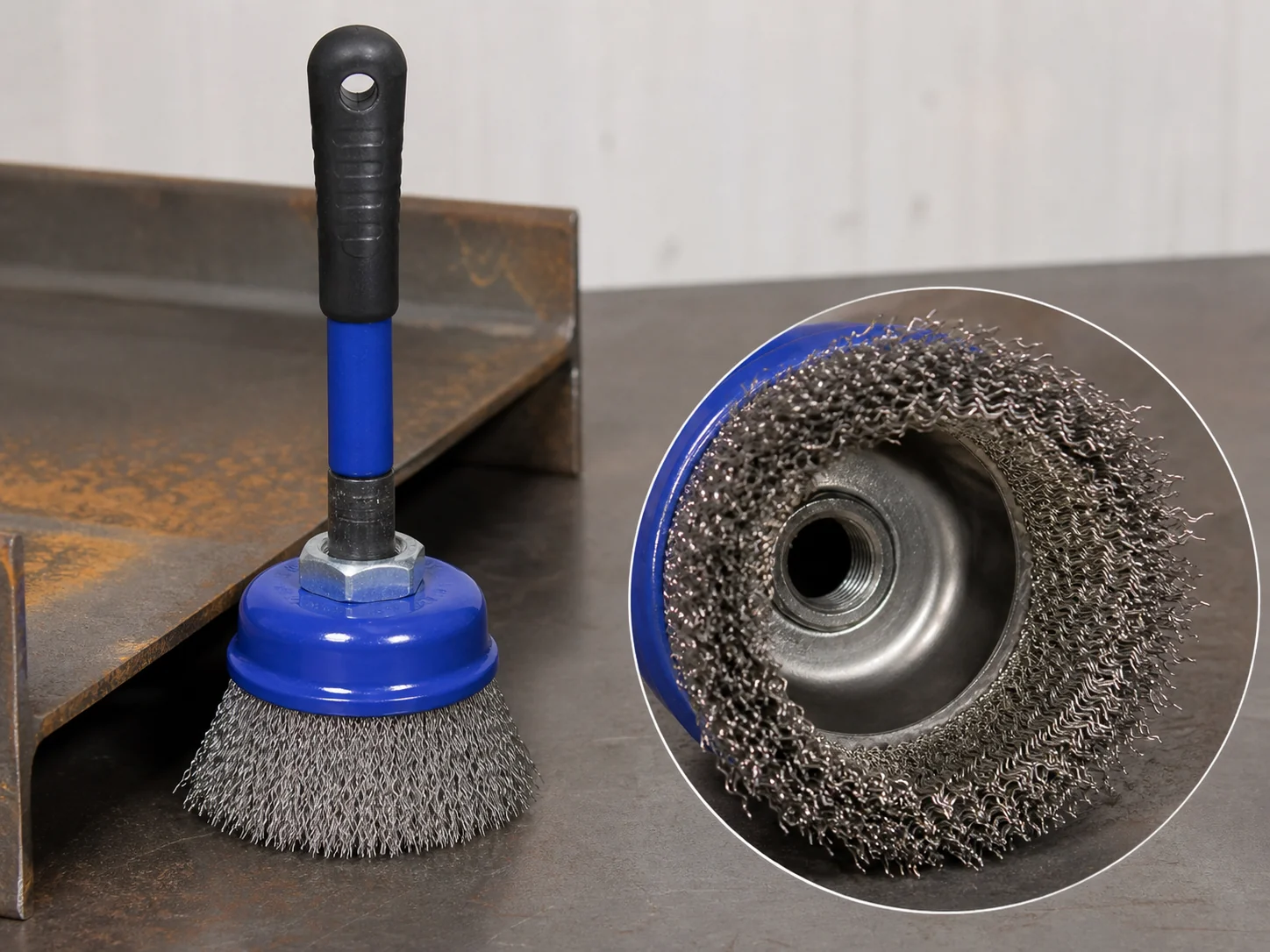
Small brush
500 pcs
Minimum order
Held in one hand: tube, bottle, detail and swab brushes — including long-handled ones with a small head.
Production lead time, once the specification is confirmed
- Up to 500 pcsWithin 7 days
- 501–50,000 pcsWithin 14 days
- Over 50,000 pcsWithin 21 days
Peak season can extend these times; the shipping date is confirmed in writing with your quotation. Sampling and shipping are quoted separately.
The 65mm SS304 Cup Brush is a stainless-steel wire cup brush for angle grinders built for stripping rust, mill scale, weld discoloration, and old coatings from steel plate, weld seams, edges, and fabricated components. It pairs a 65 mm working diameter with a removable threaded hub and SS304 crimped wire so operators get broad surface coverage, fast tool changes, and no carbon-steel wire contamination left on the prepared surface.
What can this brush do for you?
65 mm Face Clears Plate in Fewer Passes
The working diameter is sized for open steel surfaces: plate, structural sections, storage tank panels, machine beds, and welded frames. A 65 mm cup brush sweeps a wider band per pass than a small-diameter wheel brush, so large pre-paint jobs move faster without forcing the operator into long repetitive runs. The same diameter stays manageable on 100–125 mm angle grinders.
SS304 Wire Removes Rust Without Adding a Contamination Risk
The wire fill is AISI 304 stainless, not carbon steel. When operators use carbon steel brushes on stainless plate or on mild steel that will be coated, broken wire fragments can embed in the surface and create rust spots later. SS304 wire removes rust, oxide, mill scale, and weld discoloration without introducing that carbon-steel contamination source. This matters for stainless fabrication, food and beverage equipment, marine structures, and any job where the cleaned surface must stay clean after the brush leaves the shop.
Cup Shape Gives You Both a Flat Face and an Edge Tool
The 65mm SS304 cup brush is a cup brush, not a flat wheel. The wire fill is anchored around the outer rim of a metal cup, so the operator has two working attitudes with one brush. Run the face nearly flat for wide zones, then tilt the grinder 10°–30° to bring the outer wire brim into weld toes, outside corners, edges, and plate laps. That eliminates the need to stop and change over to a wheel brush at every transition.
25 mm Trim Extends Useful Life Before Replacement
The wire trim length is 25 mm from the cup mouth to the working tips. The longer usable wire allows the tips to follow mild surface waviness and reach into low spots while the cup body remains clear of the work. It also gives a longer wear path before the fill becomes too short to clean effectively, which means fewer changeouts in production settings.
Threaded Hub Mounts Directly to the Grinder Spindle
The brush has a female threaded hub. The standard configuration is M14 x 2.0 for direct mounting on common angle grinder spindles; no arbor, mandrel, or adapter is needed. The powder-coated carbon steel cup resists rust in damp shops and outdoor yard work, and the removable connection makes swapping a worn brush a one-to-two-minute job on the line.
What is a 65mm SS304 Cup Brush?
A 65mm SS304 Cup Brush is a power-driven wire brush that mounts directly on an angle grinder and uses the rotating wire tips to mechanically strip and clean metal surfaces. The 65 mm dimension is the overall working diameter of the cup; the wire fill is crimped SS304 wire held in a cup-shaped carbon steel back, with the wire ends pointing forward and slightly outward from the open mouth.
During operation, the grinder spins the cup at high speed. The wire tips strike the surface and lift rust, mill scale, old coating, welding discoloration, and loose edge slag by impact. The operator controls the contact attitude: face-on for flat areas, brim-on for weld toes, corners, and edges. The cup back gives the wire fill the support it needs to stay in shape under load while protecting the center of the brush from unnecessary wear.
This is a surface preparation and cleaning tool, not a finishing or polishing brush. It is intended for open, accessible metal faces. It will leave a characteristic brushed finish, and it should be followed by the normal cleaning, passivation, or coating steps required by the part specification. Use it inside a proper grinder guard with eye, face, and hand protection, and keep tool speed within the rated maximum for the configuration.
Technical Specifications
The table below shows the standard build. Thread, wire diameter, fill style, and trim length can be adjusted for production, OEM, or job-specific requirements.
| Parameter | Standard configuration / options |
|---|---|
| Working diameter | 65 mm |
| Wire trim length | 25 mm |
| Wire material | Stainless steel 304 / AISI 304 |
| Wire style | Crimped wire fill (standard); twisted-knot fill available for heavier deposits |
| Wire diameter | 0.30 mm standard; 0.20–0.50 mm selectable to match residue and finish |
| Cup / backplate material | Powder-coated carbon steel |
| Connection | Removable threaded hub; female M14 x 2.0 (standard); 5/8-11 UNC available |
| Mounting | Direct spindle thread; no arbor required on compatible angle grinders |
| Rated maximum speed | 12,500 rpm for the standard crimped configuration |
| Typical tool | 100–125 mm angle grinder with matching spindle thread and guard |
| Brush type | Custom Cup Brushes |
| How it is driven | Machine-driven, mounted in the equipment |
| Cleaning target | pre-paint preparation, and coating and paint removal cleaning |
| Surface or part | welds, edges, metal, steel plate, weld seams, carbon steel, hubs, and profiles |
| Residue or debris | rust, scale, weld discoloration, old coating, carbon, paint, spatter, and welding discoloration |
| Mounting / connection | Removable threaded hub; female M14 x 2.0 (standard); 5/8-11 UNC available; Direct spindle thread; no arbor required on compatible angle grinders |
Where does this brush work best?
The 65mm SS304 Cup Brush is built for metalworking and maintenance applications where the surface is open enough for a 65 mm cup and the residue is attached to the metal rather than embedded in deep cavities. Typical jobs include:
- Pre-paint preparation on steel plate, structural beams, columns, fabricated frames, and storage tank panels, removing rust, mill scale, and old coating before primer.
- Weld cleaning and post-weld surface preparation on mild steel and stainless fabrications, including heat tint, light weld discoloration, and light spatter around weld seams and toes.
- Coating and paint removal from steel doors, gates, machinery housings, pipe outer diameters, and access covers where the old layer is cracked, flaking, or loose.
- Edge deburring and scale removal on laser-cut, plasma-cut, sheared, or punched plate edges and profiles.
- Maintenance rust removal on agricultural, marine, mining, and plant equipment before touch-up painting or inspection.
How do I choose the right one?
Use the following checks to decide whether the standard 65mm SS304 cup brush fits the job, and which options need to be adjusted.
Match the spindle thread and speed first
Check the grinder’s spindle thread before ordering. The standard thread is M14 x 2.0; versions with 5/8-11 UNC are available for common US machine spindles. Also compare the tool’s maximum no-load speed with the brush rating. A 65 mm cup brush running on an overspeed grinder will throw wire and lose balance; a guard that does not cover the cup is also a mismatch.
Choose crimped or twisted wire by residue thickness
Crimped wire is flexible and works well on rust film, mill scale, old paint, and weld discoloration. Twisted-knot wire is more aggressive and holds up better on heavy rust, thick scale, and stubborn coating, but it cuts a coarser pattern. If the job is light surface prep, stay with crimped 0.30 mm wire. If the operator is fighting heavy rust on carbon steel, request twisted-knot fill.
Check whether SS304 wire is the right wire for the surface
SS304 wire is the right default when the surface is stainless steel, when the part will be coated and carbon-steel fragments are unacceptable, or when the brush will be stored in humid environments. For general carbon steel where contamination is not a concern, carbon steel wire may be more economical. For chloride or chemical exposure, SS316 wire or a fully stainless construction may be needed. For aluminum, copper, brass, and other soft metals, SS304 wire is the wrong material; use brass or nylon.
Confirm the 25 mm trim and 65 mm diameter suit the geometry
The standard 25 mm trim follows mild waviness and reaches shallow depressions. If the surface has deeper relief, a longer trim may be needed. If the part includes narrow channels, inside corners, or profiles smaller than the cup diameter, a smaller diameter cup brush, end brush, or tube brush may be the better fit. The cup brush is for open faces and outside edges, not deep blind cavities.
Know when to switch to a different tool
Use a grinding or flap disc if the part needs material removal or a specific surface profile, not just rust and coating removal. Use a non-woven or nylon cup brush if the requirement is a fine finish without a brushed pattern. Use a needle scaler or blast cleaning if the scale is too thick for wire impact. The 65mm SS304 cup brush removes attached residue, but it does not replace final degreasing, passivation, or coating.
Can I customize this brush?
The 65mm SS304 Cup Brush can be built around the job rather than forcing the job around the stock configuration. Typical variables include:
- Thread and interface: M14 x 2.0, 5/8-11 UNC, or another spindle thread; removable hub or integrated nut as the tool requires.
- Wire material and diameter: SS304 standard; SS316 for chloride or chemical exposure; carbon steel or brass wire for other target materials.
- Wire style and trim: crimped or twisted-knot fill; wire diameter from 0.20 mm to 0.50 mm; trim length from 18 mm to 30 mm; fill density adjusted for stiffness and life.
- Cup construction: powder-coated carbon steel cup standard; stainless steel cup or heavier-gauge steel cup for fully stainless or high-load applications.
- Marking and packaging: hub color or laser marking, private label, bulk carton, individual box, or retail-oriented pack.
To specify the right build, provide the tool make, spindle thread, and maximum no-load speed; the substrate material and thickness of the residue; the required surface condition after brushing; and any access constraints around weld toes, corners, or profiles. If the project needs material declarations, inspection support, or performance testing documentation, those requirements can be incorporated during configuration.
Which filament lasts longest on a 65mm SS304 cup brush?
How can I verify the brush fits my angle grinder before first use?
Check the spindle thread: the standard hub is female M14 x 2.0. If the grinder has a 5/8-11 spindle, request that thread instead. Confirm the grinder no-load speed does not exceed 12,500 rpm, mount the brush by hand, and check that the guard fully covers the brush and shields the operator. Run the brush for 30 seconds inside the guard with no contact before starting work.
Does SS304 wire leave contamination on stainless steel parts?
SS304 wire itself does not introduce carbon-steel fragments, but any brush can transfer dirt, scale, or embedded particles from a previous job. For stainless or corrosion-sensitive work, use a dedicated brush that has never touched carbon steel, and follow normal post-brush cleaning and passivation procedures. If the part will be immersed in chloride-containing service, consider an SS316 wire option.
How do I know when the cup brush is worn out?
Replace the brush when the trim length has worn to about half its original length, when wire clusters are missing or broken, or when the cup body becomes deformed, cracked, or loose on the thread. A brush that vibrates, sparks excessively, or no longer cleans at normal pressure is also due for replacement. Do not run a damaged cup brush at speed.
Can this brush be used on aluminum or galvanized steel?
SS304 wire is harder than aluminum, copper, and galvanizing. It will scratch and gall soft metal and can tear through galvanized coating. For aluminum or other soft-metal cleaning, use a brass wire cup brush or a nylon abrasive cup brush. For galvanized steel, assess whether the coating is intended to be fully removed before repainting.
What pressure and motion should operators use?
Use enough pressure to keep the wire tips in contact and working, but not enough to fold the wire. Move the brush in steady sweeping passes and tilt the cup 10°–30° when working edges and weld toes. Holding the brush in one spot with high pressure overheats the wire, breaks fill, and shortens service life without improving the result.
Can the brush be used with rust remover or in wet conditions?
Power wire brushing is normally a dry operation. If a rust remover or other chemical has been applied, remove the chemical residue and dry the surface before brushing. Do not use the brush on a live or uninsulated tool in wet conditions. The SS304 wire and powder-coated cup resist rust in humid storage, but they do not make the tool safe for wet electrical work.
Guides that go deeper on this
Angle Grinder Wire Wheel Brush Mistakes in Weld Cleanup
Read this guideGuideCar Wheel Brush vs Standard: Drill and Grinder Mounting
Read this guideGuideCar Wheel Brush: Material and Size for Weld Cleanup
Read this guideGuideCrimped Wire Cup Brush vs Standard: Drills and Grinders
Read this guideGuideCrimped Wire Cup Brush: Specs for Weld Cleanup
Read this guideGuideCup Brush vs Wheel Brush: Which One to Use
Read this guideGuideWheel Brush: Material and Size for Rust Removal
Read this guideGuideWhen to Use an Angle Grinder Wire Wheel Brush on Power Tools
Read this guideGuideCup Brush vs Wheel Brush Speed and Pressure Trade-Offs
Read this guideGuideNylon Cup Brushes: Polishing or Cleaning, and What Fill?
Read this guideGuideSponge Cup Brushes: Cleaning, Absorbing or Polishing?
Read this guideCustom Manufacturing RFQ
Describe Your Application
Please include the main sizes, application, residue, preferred material, interface, quantity, and any drawing or sample available.
Drawing or photo optional — it speeds things up, it does not gate the enquiry.
Custom Brush RFQ
Send Your Brush Project
Upload a drawing, product photo, or sample photo and provide the core dimensions and cleaning conditions.
“We need a brush to remove wet residue from a stainless steel conveyor, about 800mm wide. The current brush wears quickly. We can send photos.”
“We sell drinkware and need a cleaning brush to include with the product. Quantity around 5,000 pieces.”