
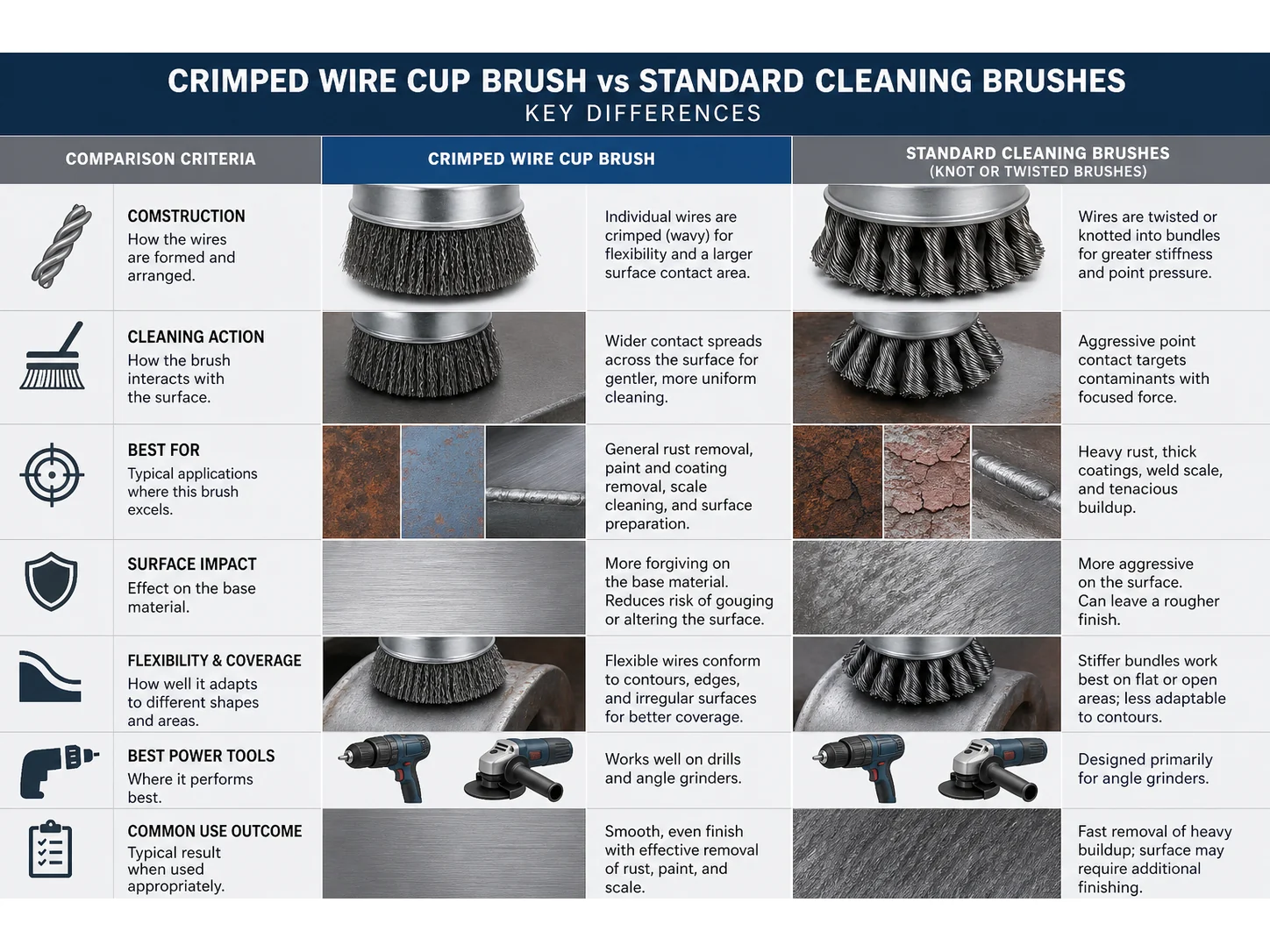
What Is a Crimped Wire Cup Brush?
A crimped wire cup brush is a rotary tool attachment shaped like a cup, with wire bristles that form a circular brushing surface. The wires are crimped—they have small bends along their length—rather than being straight and twisted. This crimping gives each bristle more flex, allowing it to hit the surface with less shock than a rigid, knotted wire. The cup shape lets the brush work perpendicular to the surface, clearing a wide area while shedding contaminants out the sides. These brushes are typically made from carbon steel, stainless steel, or brass, and mount onto a 1/4″ hex shank for drills or a 5/8″-11 threaded arbor for angle grinders.
Standard Cleaning Brushes for Drills and Grinders
By “standard cleaning brushes” we mean the other common rotary wire brush styles engineers and buyers compare when choosing an attachment:
- Knotted (twisted) wire cup brushes: The bristles are twisted into tight knots, making them extremely aggressive. They generate high impact on the surface and are best for heavy rust, thick scale, and weld spatter removal.
- Stringer bead brushes: Narrow, knotted wire wheels designed for cleaning between welds or in tight grooves. They are not as wide as cup brushes.
- End brushes: Small-diameter brushes with a side cutting action, used for cleaning holes, corners, and hard-to-reach areas. Often crimped or knotted.
- Nylon abrasive brushes: Filaments are impregnated with abrasive grit (silicon carbide, aluminum oxide). They clean without scratching base metal and can be used wet or with chemicals.
- Wheel brushes: Flat, circular brushes that clean similarly to cup brushes but with a different angle of attack, usually requiring more pressure and producing a different finish pattern.
Crimped Wire Cup Brush vs Standard Brushes: Key Differences
| Feature | Crimped Wire Cup Brush | Knotted Wire Cup Brush | Nylon Abrasive Brush |
|---|---|---|---|
| Aggressiveness | Medium | High | Low to medium |
| Surface Finish | Uniform satin to bright | Rough, textured | Smooth, scratch-free |
| Best for Removing | Light to medium rust, paint, light scale, burrs | Heavy rust, thick mill scale, weld slag | Surface coatings, light rust, without changing base material dimensions |
| Risk of Substrate Damage | Low on steel; moderate on soft metals | High—can gouge soft metals and abrade edges | Very low—often safe on non-ferrous metals, fiberglass, and gelcoat |
| Typical Wire Materials | Carbon steel, stainless, brass | Carbon steel, stainless | Nylon with SiC or AlOx grit |
| Mounting | ¼″ hex for drills, 5/8″-11 for grinders | Same as crimped | Often ¼″ hex, threaded, or special adapters |
| Operating Speed | 4,500–12,000 RPM depending on size | Similar range; knotted brushes may be rated slightly lower due to imbalance risk | Typically 2,500–8,000 RPM; high heat tolerance required |
How to Choose the Right Brush for Your Job
Use this decision logic rather than simply matching on size or cost drivers:
- Residue type: If you’re removing flaking paint, light rust, or gummy coatings, a crimped wire cup brush covers area quickly without tearing into the substrate. For concrete-like mill scale or heavy rust pits, a knotted brush will work faster.
- Surface sensitivity: On aluminum, brass, or thin sheet metal, a brass crimped wire cup brush or a nylon abrasive brush may prevent scratching. Stainless steel crimped brushes are a good middle ground for ferrous surfaces where you want a clean line without deep scratches.
- Equipment interface: Check your tool’s arbor. Most 4″ and 4-1/2″ angle grinders accept a 5/8″-11 threaded hub cup brush. For drills, you need a 1/4″ hex shank. Die grinders may require 1/4″ or 1/8″ shanks; verify the mounting before buying.
- Wet or chemical exposure: If your process uses water or solvents, a brushing tool’s material matters. Carbon steel will rust if left wet; stainless or brass resists corrosion. Nylon brushes can handle many chemicals and may be preferred in wash-down environments or food-grade areas.
- Hygiene expectations: In food, pharmaceutical, or clean-room applications, nylon abrasive brushes with sealed hubs are often easier to clean and will not shed metal particles.
- Maintenance frequency: Crimped wire cup brushes wear evenly and last longer than knotted in light-duty jobs. However, if you’re working on assemblies with heavy, irregular surfaces, knotted wires may resist breakage better under high-impact loads.
- Custom size requirements: Standard diameters range from 2″ to 6″. If your application needs a non-standard OD or a special arbor, a supplier may need to provide a drawing review. Don’t assume a standard cup brush will fit a custom tool spindle or clearance envelope.
Common Mistakes When Using Wire Cup Brushes
- Choosing by speed alone: Picking a brush just because its RPM rating matches the grinder ignores the fact that wire stiffness and diameter also affect performance. A high-speed crimped brush can still gouge soft material.
- Running too fast: Exceeding the maximum rated RPM can cause wires to eject dangerously. Always match the brush’s speed rating to your tool’s unloaded RPM.
- Over‑pressuring the tool: Let the bristle tips do the work. Excess pressure overheats wires, reduces life, and can bite into the surface. For crimped brushes, this buckles the flex in the wires and hurts finish quality.
- Ignoring wire direction: Some cup brushes are direction-specific (indicated by an arrow on the hub). Using the wrong rotation can unwind or damage the brush and create an uneven finish.
- Using the wrong wire material for the base metal: A carbon steel wire brush on stainless steel can embed iron particles, leading to rust spots (cross contamination). Use stainless wire for stainless work, and consider brass or nylon for non‑ferrous metals.
- Skipping safety gear: Wire cup brushes throw bristles at high speed. Face shield, safety glasses, gloves, and long sleeves are not optional.
When a Crimped Wire Cup Brush Is the Wrong Choice
A crimped wire cup brush excels at moderate material removal and smoothing, but it has limits. It is not a substitute for:
- Aggressive stock removal: If you need to take down weld beads more than 1/8″ high, remove deep corrosion pits, or strip thick epoxy coatings, a knotted brush or a grinding disc may be required.
- Deep crevice cleaning: The cup shape cannot reach into deep corners, inside tubing, or between closely spaced components. A stringer bead brush or a small end brush is better for those areas.
- Pre‑paint or coating operations that demand a specific profile: Some coating systems require a surface profile (anchor pattern) that a crimped brush cannot achieve. Nylon abrasive brushes or blasting may be needed to create the specified roughness.
- High‑purity environments where zero metal contamination is a must: Even stainless bristles can leave trace particles. In such cases, a sealed nylon brush or a non‑metallic abrasive tool is safer.
- Production‑line scaling: A single cup brush on a hand grinder is not a production solution for high‑volume surface finishing. Automated systems or wide‑belt sanders often replace handheld wire brushes in such settings.
Final Takeaway
The choice between a crimped wire cup brush and a standard cleaning brush comes down to three factors: how much material you need to remove, how smooth the finished surface must be, and what your tool can safely spin. Crimped wire cup brushes give you a wide, forgiving cleaning action that produces a consistent matte‑to‑satin finish on metal—ideal for prep work, light restoration, and general maintenance. When the job demands brute force for heavy scale or the finest scratch‑free finish for sensitive alloys, switch to a knotted wire or a nylon abrasive brush. Always match the wire material to the workpiece, stay within the RPM limits, and let the tool do the work without excessive force.
Frequently Asked Questions
What’s the difference between crimped and knotted wire cup brushes?
Crimped wires have small bends for flexibility and produce a finer finish. Knotted wires are twisted tightly and hit the surface harder, making them better for heavy corrosion and weld slag removal.
Can I use a crimped wire cup brush on wood?
Yes, but with caution. A crimped wire cup brush can quickly remove paint from wood or texture soft grain. On hardwoods, it may leave scratches. Test on a hidden area first; for delicate wood, a nylon abrasive brush is safer.
Does a brass crimped wire cup brush leave brass residue on the workpiece?
It can leave a faint brass transfer, especially on softer metals. This is usually cosmetic and does not affect paint adhesion. For stainless steel parts requiring zero foreign metal, use a stainless crimped brush or a nylon brush.
How do I know if my drill can handle a wire cup brush?
Check your drill’s manual for the maximum recommended wheel or brush diameter. Many 3/8″ corded drills can run a 2″ or 3″ cup brush, but heavy 4″ cups are better suited to angle grinders. The drill must also be able to reach the rated RPM without bogging down.
Can I use a wire cup brush with a cordless drill?
Yes, but the runtime will be limited. A cordless drill with a high-capacity battery and brushless motor can run a 2–3″ cup brush for light cleaning tasks. For prolonged work, a corded grinder will be more efficient.
What size wire cup brush fits my angle grinder?
Most 4″ and 4-1/2″ angle grinders use a 5/8″-11 threaded arbor and can accept cup brushes from 2″ to 4″ in diameter. Verify the arbor thread and the grinder’s guard clearance before installing.
How long does a crimped wire cup brush last?
Brush life depends on wire material, pressure, speed, and the workpiece. In moderate rust removal on steel, a high-quality crimped brush can last several hours of continuous use. Excess pressure and high heat will shorten it dramatically.
Is there an OSHA standard for using wire cup brushes?
OSHA does not have a specific wire cup brush standard, but the general duty clause and PPE standards apply. ANSI B165.1 covers power brushes, and you should follow the manufacturer’s speed ratings and safety instructions.
Technical References
Which bristle material fits this job — Nylon PA, AISI 304 Stainless Steel Wire or Carbon Steel Wire?
| Material | Continuous temperature (°C) | Peak temperature (°C) | Water absorption | Hardness |
|---|---|---|---|---|
| Nylon PA | 93 | 121 | 0.3–9% by PA grade and conditioning | Medium to firm; filament diameter and trim length control bending force. |
| AISI 304 Stainless Steel Wire | 400 | 500 | 0% | Rockwell B 70–95 depending on temper and cold work |
| Carbon Steel Wire | 200–300 | 350–450 | 0% | Rockwell C 40–60 |
Figures as published by Brushtec / DuPont; Alleima. Confirm the exact grade against the supplier datasheet before ordering.
What should replace Cup Brushes when they stop working?
- Cup Brushes — Cup brushes cover a broader face than wheel brushes; end brushes are better for small recesses or pockets where the cup body blocks access.
- Nylon PA — Compare Nylon PA with PP, PBT, PET. Change material when wet stiffness, temperature, chemical resistance, conductivity, particle shedding, or surface marking becomes the limiting factor.
- AISI 304 Stainless Steel Wire — Use AISI 316 stainless steel wire for chloride, marine, dairy, beverage, chemical washdown, or higher pitting-resistance requirements. Use carbon steel for dry aggressive cutting and brass or abrasive nylon for lower marking risk.
- Carbon Steel Wire — Compare Carbon Steel Wire with Carbon steel wire, brass wire, abrasive nylon. Change material when wet stiffness, temperature, chemical resistance, conductivity, particle shedding, or surface marking becomes the limiting factor.