
What Is a Wheel Brush Cleaner?
In industrial and detailing contexts, a wheel brush cleaner refers to a circular brush—often wire, nylon, or abrasive-impregnated—that mounts onto a power tool such as a drill, die grinder, or angle grinder. Its primary job is mechanical rust removal from steel, alloy, or mag wheels. The term can cause confusion because “wheel cleaner” is often a spray-and-rinse chemical. This guide focuses exclusively on the brush type used for rust and surface preparation.
Common Materials for Wheel Brush Brushes
The bristle material determines how aggressive the cleaning action is and whether it’s safe for sensitive alloy surfaces.
- Carbon steel wire: very aggressive, fast rust removal on steel wheels but risks scratching softer metals.
- Stainless steel wire: somewhat less aggressive, resists corrosion, good for environments where rust contamination from the brush itself is a concern.
- Brass-coated wire: slightly softer, reduces sparking, often used on non-ferrous metals.
- Nylon: non-abrasive, safe for clear-coated or painted alloy wheels when embedded with abrasive grit; without grit, it’s for light scrubbing only.
- Abrasive nylon (silicon carbide or aluminum oxide grit): bridges the gap, offering controlled abrasion for surface roughening or paint removal without deep gouging.
Sizing: Diameter, Bristle Length, and Arbor Size
Getting the right size prevents tool overload and ensures the brush reaches the rust in cracks and contours.
- Diameter: typically 2″ to 6″ for handheld wheel brushes. Larger diameters cover more area but require a more powerful drill or grinder and are harder to control in tight spaces. A 4″ or 5″ wheel is common for general wheel work.
- Bristle length (trim length): a longer trim allows the brush to flex into crevices but may wear faster. Shorter trim is more rigid and aggressive.
- Arbor hole or shank: standard arbor sizes are 1/4″, 3/8″, or 1/2″ for wheel brushes with a center hole, or a 1/4″ hex shank for quick-change drill brushes. Confirm that the brush arbor matches your tool’s collet or chuck size.
How to Match Wheel Brush Size to Your Task
- For lug nut areas and narrow spokes: a 2″ or 3″ diameter cup brush or wheel with a 1/4″ shank.
- For large flat rim faces: a 4.5″ knotted wire wheel on a 5/8″ arbor (angle grinder mount).
- For deep dish wheels: a brush with extended reach or a long trim length.
Choosing a Wheel Brush Cleaner Based on Rust Type and Surface
The table below compares materials against typical wheel surface conditions.
| Rust / Surface Condition | Recommended Brush Material | Aggressiveness | Surface Compatibility | Notes |
|---|---|---|---|---|
| Heavy, flaky rust on steel wheels (bare metal) | Carbon steel wire (knotted or crimped) | High | Steel only; will scratch alloy | Use knotted wire for fast removal, crimped for finer finish. |
| Light surface rust on alloy or aluminum wheels | Brass-coated wire or fine stainless wire | Medium | Softer metals; less risk of embedding iron particles | Avoid carbon steel—it can leave rust-promoting residue. |
| Rust on painted/clear-coated wheels | Nylon abrasive wheel (silicon carbide or aluminium oxide grit) | Low to medium | Safe for coated surfaces; removes rust without stripping paint | Test on a hidden spot; use fine grit for delicate finishes. |
| Corrosion in tight crevices (bolt holes, rim edges) | Small diameter wire brush with extended shank or detail wheel | Varies by wire type | Depends on wire type; choose brass or stainless for alloy | Prioritize access; a 2″ wheel or end brush often works best. |
Mounting Options: Shank, Arbor, and Equipment Fit
A wheel brush cleaner must mount securely to your power tool. Common interfaces:
- Threaded arbor (5/8-11): standard for angle grinders. Requires a matching nut and flange.
- Round hole with reduced shank: typical for die grinders; fits into a collet.
- Hex shank (1/4″): fits standard drill chucks and quick-change adapters. Handy for light-duty cleaning.
- Twist-knot vs. crimped wire: knot style is more aggressive and long-lasting; crimped is more flexible and produces a finer finish. Check the maximum RPM rating—exceeding it can cause bristle ejection.
Common Mistakes When Selecting a Wheel Brush Cleaner
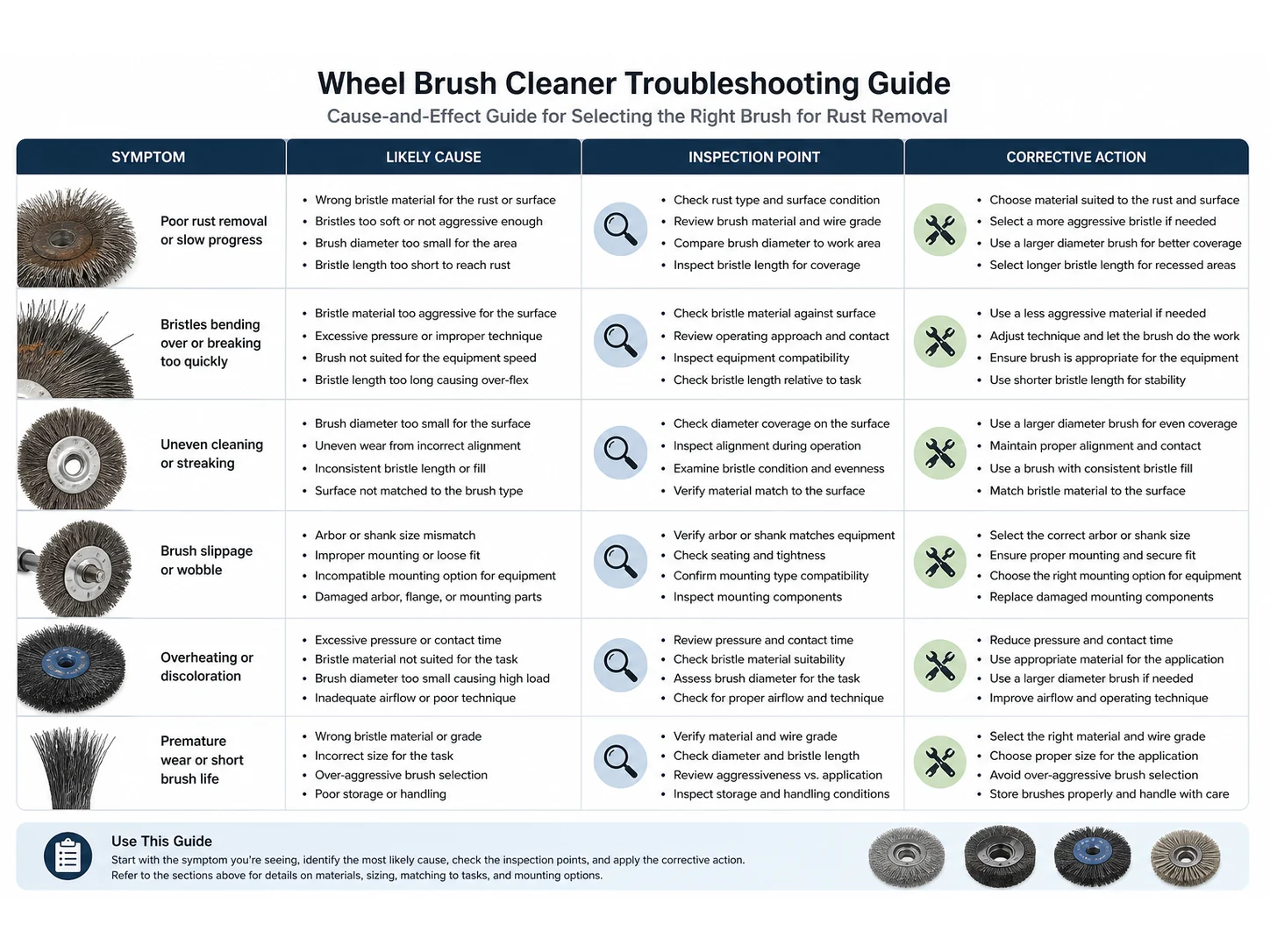
- Choosing the wrong material for the wheel metal. Carbon steel on aluminum can cause galvanic corrosion and permanent scratching.
- Ignoring maximum RPM. A brush rated for 4,500 RPM can fly apart on a 10,000 RPM die grinder. Always match or stay under the tool’s no-load speed.
- Using too large a diameter on a small tool. A 6″ wire wheel on a cordless drill will stall the motor and produce uneven results.
- Overlooking bristle trim length. Too short a trim on contoured wheels leaves rust in low spots; too long may bend and miss hard deposits.
- Assuming all “wheel brush cleaners” are the same. Some are designed for polishing, others for heavy material removal. Confirm the brush’s intended use (e.g., “high-impact” or “cleaning” grade).
- Skipping personal protective equipment (PPE). Wire bristles can shed at high speed. Always wear eye and face protection.
When a Wheel Brush Cleaner Is the Wrong Choice
A mechanical wheel brush cleaner excels at removing surface rust and loose scale, but it has limits:
- Deep pitting that has compromised structural integrity: a brush won’t restore strength. The wheel may need replacement.
- If the rust is mixed with heavy undercoating or thick paint: chemical stripping or media blasting might be faster and less damaging.
- For show-car finishes where micro-scratches are unacceptable: consider vapor honing, soda blasting, or professional refinishing.
- When rust is inside enclosed cavities (e.g., behind spokes, inside wheel barrels): a brush on a rotary tool may not reach. A soaking rust remover or ultrasonic cleaning could be more effective.
Final Takeaway
Pick a wheel brush cleaner by matching the wire or abrasive material to the wheel metal and rust severity. Double-check the arbor size, RPM rating, and brush diameter against your power tool. Start with the least aggressive option that will do the job, especially on alloy or coated wheels, and always wear PPE. If the rust is deeper than surface scale or the wheel structure is compromised, move to a restoration professional or alternative method.
Frequently Asked Questions
What’s the difference between a wheel brush cleaner and a liquid wheel cleaner?
A wheel brush cleaner is a mechanical brush that removes rust and debris by friction. A liquid wheel cleaner is a chemical spray that dissolves brake dust and light soiling. For rust removal, you often need a brush—chemical cleaners alone rarely tackle corrosion.
Can I use a wire wheel brush cleaner on alloy wheels?
You can, but you must choose the correct wire type. Stainless steel or brass-coated wire brushes are safer for alloy wheels because they are less likely to embed iron particles that cause galvanic corrosion. A nylon abrasive wheel is an even safer alternative for coated alloys.
What size wheel brush cleaner is best for car wheel rust?
A 4-inch diameter wire wheel or abrasive wheel fits most standard wheel faces. For tight areas like lug nut recesses, a 2-inch brush or an end brush works better. Always measure the clearance between spokes before ordering.
How do I know if the brush fits my drill?
Check the shank or arbor size. Most drills use a 1/4-inch hex shank. If the brush has a round arbor hole, you may need an adapter. For angle grinders, the standard mount is a 5/8-11 threaded hub. Match the brush’s maximum RPM to your tool’s speed.
Why am I seeing sparks when using a wire wheel brush?
Sparks are common with carbon steel brushes on steel wheels. They occur when tiny steel fragments oxidize rapidly. Use a brass-coated brush to reduce sparking, and always keep flammable cleaners and materials away from the work area.
How long does a wheel brush cleaner last?
It depends on the workload and material. Carbon steel wire brushes degrade faster when used aggressively on hard rust. Nylon abrasive wheels wear down gradually. Inspect bristles before each use: if they are flattened, broken, or shorter than 1/4 inch, replace the brush.
Can a wheel brush cleaner remove paint as well as rust?
Yes, a knotted wire wheel or coarse abrasive nylon wheel can strip paint along with rust. If you only want to remove rust and keep the original paint, use a fine-grit abrasive wheel or a chemical rust converter first, then lightly brush.
Technical References
- ABMA — ANSI B165.1 Power Brush Safety Slips
- OSHA — 1910.242 Hand and Portable Powered Tools
- OSHA — 1910.215 Abrasive Wheel Machinery
- OSHA — Personal Protective Equipment
- World Stainless — Corrosion Resistance of Stainless Steels
Which bristle material fits this job — Nylon PA, Carbon Steel Wire or Brass Coated Wire?
| Material | Continuous temperature (°C) | Peak temperature (°C) | Water absorption | Hardness |
|---|---|---|---|---|
| Nylon PA | 93 | 121 | 0.3–9% by PA grade and conditioning | Medium to firm; filament diameter and trim length control bending force. |
| Carbon Steel Wire | 200–300 | 350–450 | 0% | Rockwell C 40–60 |
| Brass Coated Wire | 200 industry reference range | 250 industry reference range | — | Firm non-ferrous metallic wire; softer than carbon/stainless steel wire and less aggressive on softer metal parts. |
| AISI 304 Stainless Steel Wire | 400 | 500 | 0% | Rockwell B 70–95 depending on temper and cold work |
| Abrasive Nylon | 120 | 150 | 0.1–1.0% | Abrasive filament; stiffness and cutting level is controlled by PA base, grit type, grit size, filament diameter and trim height. |
Figures as published by Brushtec / DuPont; Alleima; Perlon. Confirm the exact grade against the supplier datasheet before ordering.
What should replace Wheel Brushes for drill brush?
- Wheel Brushes — Wheel brushes give narrow edge contact; cup brushes cover a broader open face, while end brushes concentrate contact at the end of a small stem for recesses.
- Cup Brushes — Cup brushes cover a broader face than wheel brushes; end brushes are better for small recesses or pockets where the cup body blocks access.
- End Brushes — End brushes concentrate contact at the end of a small stem; wheel brushes work along a longer edge and cup brushes cover a broader open face.
- Nylon PA — Compare Nylon PA with PP, PBT, PET. Change material when wet stiffness, temperature, chemical resistance, conductivity, particle shedding, or surface marking becomes the limiting factor.