
What Is a Brass Wire Brush?
A brass wire brush uses fine to coarse brass filaments to abrade unwanted layers from a substrate. The brass alloy (typically copper‑zinc) provides a balance of cutting action and relative softness. This makes brass wire brushes a go‑to choice when you want to avoid spark hazards, reduce the risk of damage to softer metals, or achieve a non‑contaminating finish on materials like stainless steel or aluminum. They come in hand‑held versions, power‑tool attachments, and custom configurations for production machinery.
Common Configurations and Options
Not all brass wire brushes are alike. Selecting the right build means matching wire thickness, filament stiffness, handle or core design, and mounting interface to the job.
- Wire diameter – Fine wires (0.1 mm / 0.004 in and below) for light cleaning and delicate surfaces; medium wires for general rust removal; coarse wires (0.3 mm / 0.012 in and up) for heavy deposits and fast stripping.
- Stiffness grade – Soft, medium, stiff. Stiffer brushes cut faster but can leave deeper marks. Soft brushes are safer on precision surfaces but slower on thick rust.
- Handle / core design – Hand brushes with wooden, plastic, or metal handles; twisted‑in‑wire handles for manual scraping; drill shanks (1/4″ hex or round); arbor holes for bench grinders; M14 or 5/8″‑11 threaded hubs for angle grinders.
- Mounting type – Hand brush, drill attachment (cup/wheel/end brush), angle grinder cup or wheel, bench grinder wheel, rotary tool (collet-mounted) brush, or custom‑made for automated machines.
Comparison of Brass Wire Brush Types for Rust Removal
The table below compares common configurations by how they connect to your equipment, typical wire thickness, best‑use scenarios, and practical limitations. Use it to narrow down the right form factor before diving into material and wire specs.
| Brush Type | Typical Mounting | Bristle Diameter Range | Strength | Ideal Surface | Common Pitfall |
|---|---|---|---|---|---|
| Hand brass wire brush | Manual (handle, none) | 0.10–0.30 mm | Light to medium pressure only | Small parts, weld cleaning, tight spots | Operator fatigue on large areas; inconsistent pressure |
| Brass wire drill cup brush | Drill chuck (1/4″ hex or round shank) | 0.15–0.30 mm | Medium to heavy | Flat tered sections, engine parts, bolts | Overheating if RPM too high; can catch edges |
| Brass wire angle grinder wheel | Angle grinder (M14 or 5/8″‑11 hub) | 0.20–0.50 mm | Heavy | Large plates, structural steel, heavy rust | Excessive removal on thin sheet; difficult edge control |
| Brass wire end brush | Drill or die grinder (1/4″ shank) | 0.10–0.25 mm | Light to medium | Corners, recesses, threads | Limited contact area; wears quickly on sharp edges |
| Brass wire bench grinder wheel | Bench grinder arbor | 0.15–0.35 mm | Medium to heavy | Small to medium workpieces held by hand | Safety risk; requires proper kickback awareness |
How to Choose the Right Brass Wire Brush
Work through these decision factors in order. A mismatch here is more costly than the cost drivers difference between two similar brushes.
- Residue type and hardness – Light surface rust or flash corrosion? Fine‑wire, soft brush. Thick, pitted rust or mill scale? Coarse‑wire, stiff brush, or consider a steel brush instead (see boundary section).
- Surface sensitivity – Critical machined surfaces (seal faces, bearing bores) need the finest wire that still removes rust, used at low speed. Test on a scrap piece when possible.
- Equipment interface – Check the shank type, thread, and arbor size. A brush that does not fit your tool safely will waste time or cause injury. Verify RPM limits of both brush and tool.
- Wet or chemical exposure – Brass resists corrosion reasonably well, but frequent contact with acidic or alkaline cleaners can accelerate dezincification (leaching of zinc). In such cases, specify a brush with a corrosion‑resistant core or consider stainless steel bristles.
- Hygiene expectations – For food‑grade or medical environments, ensure the brush can be cleaned and that the brass does not leave residues that conflict with material safety. Some brass alloys are considered non‑sparking, which is an advantage in hazardous areas.
- Maintenance frequency – If the brush will see daily production use, opt for a replaceable‑tip design or a bulk‑brush system. Hand brushes with formed plastic handles often fail faster than those with a reinforced metal core.
- Custom size requirements – Off‑the‑shelf sizes may leave gaps. For automated lines or odd‑shaped cavities, a custom diameter, trim length, or filament pattern may be needed. Provide a drawing with the envelope restraints and arbor details when requesting quotes.
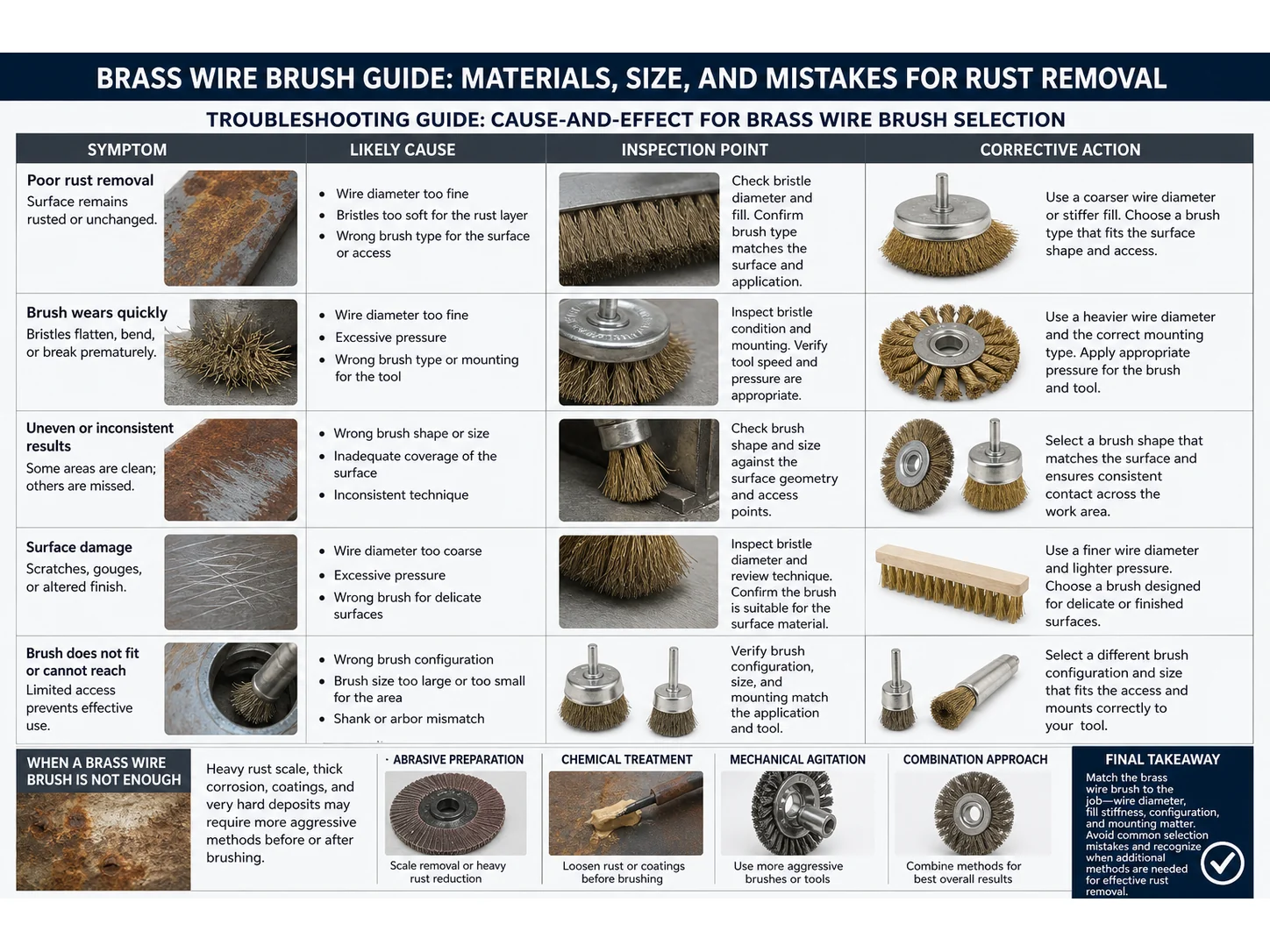
Common Mistakes When Selecting a Brass Wire Brush
Avoid these errors that lead to poor cleaning results, premature wear, or damaged workpieces.
- Choosing by size and cost drivers alone – A low-cost brush with inconsistent wire gauge or low‑density fill will shed bristles quickly and leave an uneven finish.
- Ignoring the brush RPM rating – Exceeding the maximum safe RPM can throw wires, cause imbalance, and ruin the surface. Match brush speed rating to tool RPM under load.
- Using dry brass on rust‑only without checking for embedded grit – If the rust contains hard abrasive particles, the brass may carry them across the surface, causing scratches. Pre‑clean or use a brass brush wet (with a rust remover or lubricant) to reduce this risk.
- Applying excessive pressure – Pushing harder does not always speed up rust removal; it flattens bristles, overheats the brush, and can burnish the contaminant instead of removing it. Let the wire tips do the work.
- Overlooking shank or thread compatibility – “It fits” does not mean it is safe. A loose shank in a drill chuck, a grinder wheel without the correct backing flange, or an undersized arbor on a grinder can cause dangerous wobble.
- Not accounting for brass leaving a color transfer – Brass bristles can leave a faint gold‑colored deposit, especially on stainless steel. If post‑cleaning appearance matters, specify a passivated finish or follow up with a stainless brush for final blending.
When a Brass Wire Brush Is the Wrong Choice
Brass wire brushes have clear limits. Move to a different approach if:
- Rust is deep‑pitted and structural – Mechanical abrasives (abrasive blasting, grinding) may be needed before final cleaning.
- Surface hardness exceeds 35 HRC – Brass will struggle to remove heavy scale on hardened steel. A stainless steel or carbon steel brush, or more aggressive media, may be required.
- Zero contamination is mandatory – In some aerospace or semiconductor applications, even trace brass residue is unacceptable. Consult process specifications.
- Large‑scale production – For thousands of identical parts, automated abrasive systems or chemical descaling are more consistent. A brush sample test on a few prototypes can confirm whether the process stays in control.
- You are working with titanium or magnesium – Spark potential or contamination risks may rule out brass. Always check material compatibility charts.
When uncertain, request a supplier drawing review or run a trial on scrap parts. A small sample test reveals more about finish, wear rate, and compatibility than any catalog description.
Final Takeaway
A brass wire brush is a versatile tool for rust removal, but the right choice hinges on wire diameter, stiffness, mounting style, and compatibility with the surface and workspace conditions. Define the residue type and surface tolerance first, match the brush form to your tool, and avoid the trap of assuming all brass brushes are equal. When the limits of brass are reached, escalate to harder bristle materials or different cleaning methods entirely.
Frequently Asked Questions
Will a brass wire brush scratch steel?
On mild steel, a brass wire brush typically leaves fine surface marks, not deep scratches, especially when using medium or soft bristles. On hardened steel, the effect is even less noticeable. However, excessive pressure or a stiff brush with coarse wire can impart noticeable scoring, so always test first on a hidden area.
Can a brass wire brush be used on aluminum?
Yes, brass is generally safe on aluminum because it is softer than the aluminum oxide layer and the base metal. However, cross‑contamination is a risk: if the same brush was used on steel, embedded steel particles can scratch the aluminum. Use a dedicated brass brush for aluminum only or clean it thoroughly.
What is the difference between a brass‑coated and a solid brass wire brush?
A brass‑coated brush has a steel wire core with a thin brass plating. Once the plating wears off, the steel core acts like a typical steel brush and can scratch sensitive surfaces. A solid brass brush uses brass alloy throughout the filament and remains non‑damaging even as it wears down. For sensitive rust removal, specify solid brass bristles.
How do I choose the right wire diameter for rust on a gun bore?
For a gun bore, fine‑ to medium‑wire brushes (0.15‑0.20 mm / 0.006‑0.008 in) are common. Fine wire gets into the rifling without damaging the lands, while removing light rust and carbon. Always match the brush caliber exactly and avoid a brush that feels forced—it should slide with moderate friction. A bore‑specific brush with a brass core is safer than a general‑purpose drill brush.
Can I use a brass wire brush with a cordless drill?
Yes, provided the brush has a compatible shank and the drill’s RPM does not exceed the brush’s maximum rating. Most cordless drills run between 0–2,000 RPM, which is within the safe range for many brass cup and wheel brushes rated for up to 4,500 RPM. Keep speed moderate and avoid trigger lock for hands‑free operation, which can lead to loss of control.
How should I clean and store a brass wire brush?
After use, remove loose rust and debris with a stiff nylon brush or by tapping the tool. If moisture or chemicals were used, rinse with water, dry thoroughly, and apply a light oil film to the wire and metal components to prevent corrosion. Store in a dry location away from heavy items that could bend the bristles.
Is a brass wire brush suitable for removing paint along with rust?
Brass bristles can remove soft, aged paint layers, but modern epoxy or polyurethane coatings are often too tough. The brush may polish the paint rather than strip it. For multi‑layer paint removal, a knotted steel wire brush or chemical stripper applied first will reduce brush wear. Use brass only for final surface conditioning.
What does “non‑sparking” mean for a brass wire brush?
Brass is a non‑ferrous alloy that generally does not produce sparks when struck against metal or concrete. This makes brass wire brushes safer in environments where flammable gases, vapors, or dusts may be present. However, “non‑sparking” is a risk reduction, not an absolute Help confirm. Always follow your site safety procedures and check with your brush supplier for compliance with standards like ATEX or NFPA.
Technical References
- OSHA — 1910.242 Hand and Portable Powered Tools
- ASME — Y14.5 Dimensioning and Tolerancing
- World Stainless — Corrosion Resistance of Stainless Steels
Which bristle material fits this job — Brass Wire, AISI 304 Stainless Steel Wire or Nylon PA?
| Material | Continuous temperature (°C) | Peak temperature (°C) | Water absorption | Hardness |
|---|---|---|---|---|
| Brass Wire | 150–200 | 250–300 | 0% | Rockwell B 40–90 |
| AISI 304 Stainless Steel Wire | 400 | 500 | 0% | Rockwell B 70–95 depending on temper and cold work |
| Nylon PA | 93 | 121 | 0.3–9% by PA grade and conditioning | Medium to firm; filament diameter and trim length control bending force. |
Figures as published by Alleima; Brushtec / DuPont. Confirm the exact grade against the supplier datasheet before ordering.
What should replace Brass Wire for rust removal?
- Brass Wire — Compare Brass Wire with Steel wire, stainless wire, nylon. Change material when wet stiffness, temperature, chemical resistance, conductivity, particle shedding, or surface marking becomes the limiting factor.
- AISI 304 Stainless Steel Wire — Use AISI 316 stainless steel wire for chloride, marine, dairy, beverage, chemical washdown, or higher pitting-resistance requirements. Use carbon steel for dry aggressive cutting and brass or abrasive nylon for lower marking risk.
- Nylon PA — Compare Nylon PA with PP, PBT, PET. Change material when wet stiffness, temperature, chemical resistance, conductivity, particle shedding, or surface marking becomes the limiting factor.