
Custom Cleaning Brush
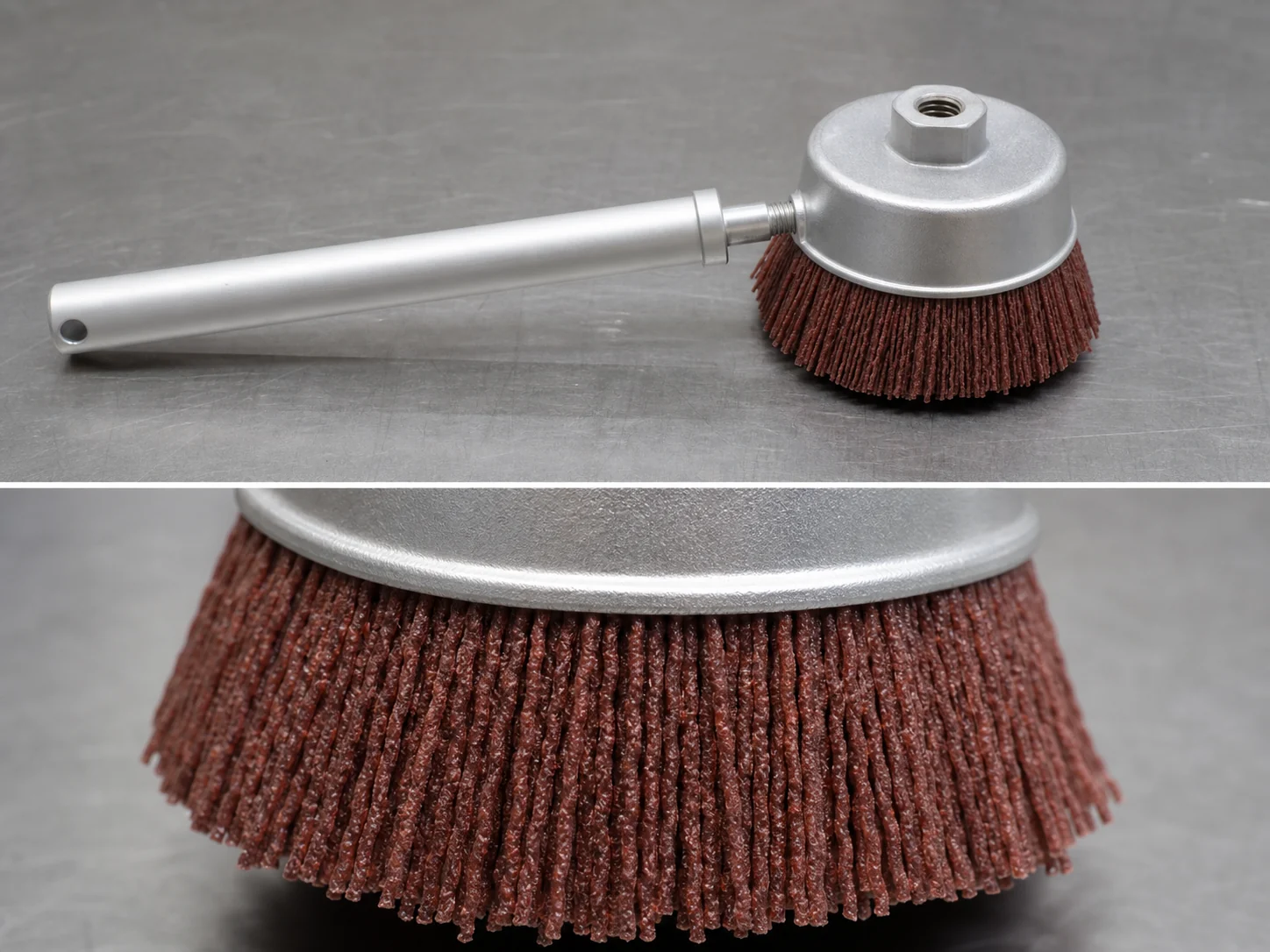
120mm P320 AO Cup Brush
120mm P320 AO cup brush with aluminum oxide abrasive nylon filaments, 6061 aluminum hub, and threaded mount for fine finishing, blending.
Small brush
500 pcs
Minimum order
Held in one hand: tube, bottle, detail and swab brushes — including long-handled ones with a small head.
Production lead time, once the specification is confirmed
- Up to 500 pcsWithin 7 days
- 501–50,000 pcsWithin 14 days
- Over 50,000 pcsWithin 21 days
Peak season can extend these times; the shipping date is confirmed in writing with your quotation. Sampling and shipping are quoted separately.
This 120mm abrasive nylon cup brush uses P320 aluminum oxide grain to produce a uniform, fine satin finish across flat faces, profiles, edges, and weld zones. The cup-shaped filament pack mounts on an angle grinder or rotary finishing tool through a threaded removable hub, giving a controlled finishing action without the aggressive scoring common with wire brushes.
What can this brush do for you?
Uniform P320 finish over broad flat areas
The 120 mm working face contacts a wide surface path on each pass, so flat sheet, plate, and panel work reaches a consistent fine satin appearance faster than with a smaller-diameter brush. P320 aluminum oxide is fine enough to blend, yet carries enough hardness to remove light residue without loading the way non-woven pads often do.
Removes surface defects without digging into the parent metal
Abrasive nylon filaments flex under pressure instead of cutting as aggressively as wire. This trade-off means the brush removes light burrs, oxide, weld discoloration, scale haze, and finishing compound while leaving less risk of undercut, scoring, or embedded wire contamination on aluminum, stainless, and coated surfaces.
Cup-shaped face reaches edges and open profiles
The cup form positions filament ends so the face contacts a flat surface evenly while the outer rim can work along edges, outside radii, and shallow contour features. It is not designed for deep bores; for flat and open-profile finishing it reduces the missed bands common between wheel passes.
Filament wear renews the cutting surface
Because AO grains are distributed through the nylon filament, a worn surface exposes fresh grain rather than leaving smooth plastic. Cut stays more predictable over the life of the brush than a loaded non-woven pad, especially when working coating residue or soft dust.
Threaded hub mounts directly and stays seated
The 6061 aluminum hub is light and dimensionally stable, and the threaded removable connection lets the brush install directly on the spindle. A correctly matched thread keeps the cup centered under rotation, reduces wobble, and makes changeover quick between finishing steps.
What is a 120mm P320 AO Cup Brush?
This product is a rotary finishing brush formed from P320 aluminum oxide abrasive nylon filaments set in a cup-shaped 6061 aluminum hub with a threaded removable mount. It is used on angle grinders and compatible rotary tools to remove light surface defects, blend weld areas, and produce a controlled fine finish on metal components.
In operation, the brush face is presented to the work at a slight angle or flat, and the tool moves across the surface while the filaments recover after each pass. The P320 grain levels fine texture without the deep scratch pattern of coarse wire or heavy grit. The result is typically a smooth satin or matte surface ready for paint, coating, inspection, or direct use.
This is not a heavy material-removal tool. Deep weld spatter, thick scale, paint stripping, or stock removal should be handled with wire wheels, flap discs, grinding wheels, or chemical methods before or instead of this brush. The 120 mm diameter also sets a practical access limit: surfaces narrower than the brush face and internal corners tighter than the cup profile will need a smaller or different brush form.
Technical Specifications
Standard configuration shown. Dimensions, grit, hub thread, and filament density can be adjusted for the project.
| Parameter | Value / Options |
|---|---|
| Brush diameter | 120 mm |
| Head shape | Cup-shaped, flat or shallow conical face |
| Working head length | 40 mm standard, adjustable |
| Abrasive filament | Aluminum oxide (AO) loaded nylon |
| Grit | P320 fine finishing |
| Filament density | Standard; high or low density available |
| Hub material | 6061 aluminum alloy |
| Connection | Threaded removable hub, matched to machine spindle |
| Typical tool interface | Angle grinder or rotary finishing tool with matching thread |
| Operating environment | Dry or with compatible finishing compound; not for continuous wet operation |
| Brush type | Custom Cup Brushes |
| How it is driven | Machine-driven, mounted in the equipment |
| Cleaning target | weld blending, aluminum extrusion, and stainless steel architectural component and handrail cleaning |
| Surface or part | aluminum, welds, hubs, edges, profiles, metal, flat faces, and bores |
| Residue or debris | oxide, burrs, spatter, scale, haze, adhesive, dressing, and powder |
| Mounting / connection | Threaded removable hub, matched to machine spindle; Angle grinder or rotary finishing tool with matching thread |
Confirm thread size and hand with the machine before ordering. Speed must stay within the rated maximum for the brush diameter and hub design; do not exceed the value marked on the brush label or hub.
Where does this brush work best?
- Weld blending on sheet metal and tube fabrications: Used after weld dressing to remove heat tint and light spatter residue while smoothing the transition into the base metal.
- Aluminum extrusions, castings, and machined plates: Removes oxidation haze, light burrs, and machining marks without contaminating parts with ferrous wire debris.
- Stainless steel architectural components and handrails: Creates a consistent fine directional finish on open faces and outside edges where uniform appearance matters.
- Pre-coating preparation: Lightly textures and cleans surfaces before painting, powder coating, or adhesive bonding, improving coating adhesion without aggressive stock removal.
- Finishing of formed or stamped parts: Blends edge burrs and profile lines on large, open surfaces accessible to the 120 mm face.
The brush is best on open working areas. Deep pockets, slots narrower than the brush diameter, internal corners, and small bores are outside its effective reach.
How do I choose the right one?
Before ordering, check four things: the machine thread, the surface area you need to cover, the severity of the surface condition, and the finish you want.
Match the threaded connection to the machine
This cup brush uses a threaded removable hub. Confirm the spindle thread size, pitch, and rotation direction on the tool it will be mounted to. A mismatched thread is both a safety problem and a performance problem, so specify the machine make and spindle drawing when placing a custom order.
Work from the smallest access dimension
A 120 mm brush face is efficient on wide flat sections, but any feature narrower than the face or recessed below the filament reach will remain partially unfinished. If the job includes ribs, channels, or machined pockets, pair this brush with a smaller cup brush, wheel brush, or detail fillet brush rather than forcing the large face into the feature.
Choose P320 only when the work matches its cut
P320 aluminum oxide is a fine finishing grit. It is right for light burrs, oxide, discoloration, coating residue, and finishing compound. For heavier scale, deep scratches, weld bead shaping, or significant stock removal, choose a coarser AO grit, a coated abrasive, or a wire cup brush first; this brush will waste time and filament if pushed into that work.
Balance speed, pressure, and material contact
Run the brush at the lowest speed that gives the required result and use light pressure. Excessive pressure folds the nylon filaments, loads the face, and generates heat that can glaze the surface or shorten filament life. On aluminum and stainless, heat is the main cause of discoloration and uneven finish.
When to use another brush
Use a wire cup brush for rust, mill scale, or heavy oxidation on steel where a brushed metal appearance is acceptable. Use a flap disc or grinding wheel when weld beads need shaping or stock removal. Use a smaller-diameter cup brush or end brush when the working area cannot accept a 120 mm face. For final optical or mirror finishes, follow this brush with non-woven surface conditioning belts, wheels, or pads.
Can I customize this brush?
Yes. The standard version is 120 mm diameter with P320 AO nylon, a 40 mm head length, a 6061 aluminum hub, and a threaded connection. For a project we can adjust:
- Diameter and face geometry: Smaller or larger cup diameters, flat face, shallow conical face, or radiused rim for edge work.
- Grit and abrasive type: Alternative grits from coarse to extra fine; AO, ceramic, or silicon carbide filament options where the process requires a different cut.
- Filament density and stiffness: Higher or lower filament counts for longer wear, softer contact, or more aggressive surface engagement.
- Hub and thread: Thread size and pitch, bore, retention features, steel or aluminum hub, and balancing requirements.
- Head length: Deeper or shallower filament projection to reach angled faces or reduce flex.
- Color, marking, and packaging: Custom hub color, label or print, individual or bulk packaging matched to your distribution channel.
To define the configuration, provide the machine spindle drawing or thread specification, target operating speed, base material, current surface condition, desired finish requirement, and production quantity. If the project calls for material documentation, inspection data, or third-party testing, we can build that support into the custom order.
When is a 120mm P320 AO cup brush worn out rather than just dirty?
What maximum RPM can this brush run at?
The maximum safe RPM depends on the final hub geometry, thread, filament density, and diameter. Each production batch should carry a rated speed marking on the hub or label. Never run the brush faster than the value marked for the specific configuration, and match the tool no-load speed to that limit before use.
Can I use this cup brush with water or coolant?
The standard configuration is intended for dry use or use with a compatible finishing compound. Continuous wet operation can stiffen filament, alter cut, and accelerate hub corrosion unless the hub and filament are specified for wet conditions at the design stage.
How do I know the brush is worn out?
Replace the brush when the working face becomes uneven, filament length has shortened enough that the outer hub is close to the work, or the finish becomes patchy and requires increasing pressure. A smooth, glazed face on nylon usually means the filament has been overheated or loaded, not necessarily that the brush is fully worn.
Will this brush leave steel contamination on aluminum?
No. The filament and abrasive media are non-ferrous, and the standard hub is aluminum, so the brush does not introduce wire residue into the workpiece. It is a common choice when aluminum or stainless components must be kept free of embedded steel particles.
What should I inspect before each use?
Check the threads for wear or cross-threading, confirm the hub seats flat on the tool flange, and look for loose, heavily bent, or missing filament clusters. If the brush vibrates at start-up or the hub runs out, stop and re-mount or replace before applying it to the part.
Does this brush clean deep pockets or bores?
No. The cup face is for open flat surfaces, profiles, edges, and weld zones. Features narrower than the cup face cannot be reached, and forcing the brush into a bore will only fold the outer filaments and damage the hub edge. Pair the cup brush with a smaller-diameter brush for those details.
Guides that go deeper on this
Cup Brush vs Wheel Brush Speed and Pressure Trade-Offs
Read this guideGuideHow to Choose Nylon Abrasive Wheel Brush
Read this guideGuideWheel Brush vs Standard Brushes: Weld Cleanup
Read this guideGuideCup Brush vs Wheel Brush: Which One to Use
Read this guideGuideNylon Cup Brushes: Polishing or Cleaning, and What Fill?
Read this guideGuideSponge Cup Brushes: Cleaning, Absorbing or Polishing?
Read this guideCustom Manufacturing RFQ
Describe Your Application
Send the key measurements, cleaning requirement, residue, material direction, mounting method, quantity, and drawing or photo.
Drawing or photo optional — it speeds things up, it does not gate the enquiry.
Custom Brush RFQ
Send Your Brush Project
Upload a drawing, product photo, or sample photo and provide the core dimensions and cleaning conditions.
“We need a brush to remove wet residue from a stainless steel conveyor, about 800mm wide. The current brush wears quickly. We can send photos.”
“We sell drinkware and need a cleaning brush to include with the product. Quantity around 5,000 pieces.”